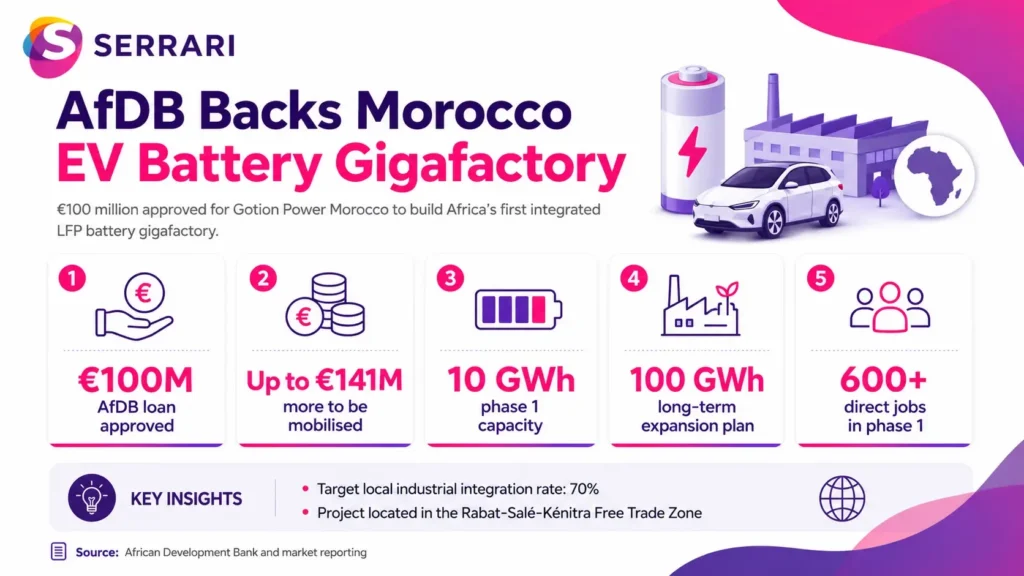
The African Development Bank Group has approved a €100 million loan to Gotion Power Morocco for an integrated lithium iron phosphate battery complex in the Rabat-Salé-Kénitra Free Trade Zone. The project will initially produce 10 gigawatt-hours of battery cells and packs annually, with a long-term plan to expand capacity to 100 GWh.
The development bank also intends to mobilise up to €141 million from other financial partners. The first phase is expected to create more than 600 direct jobs and target a 70% local industrial integration rate, strengthening Morocco’s position in electric mobility and advanced manufacturing.
Key Overview
- The approved financing is a €100 million loan to Gotion Power Morocco.
- AfDB plans to mobilise an additional €141 million from financial partners.
- Phase one targets annual production capacity of 10 GWh.
- The wider project could eventually expand to 100 GWh.
- More than 600 direct jobs are expected during the first phase.
- The project targets a 70% local industrial integration rate.
AfDB Backs a €1.3 Billion First Phase
The approved €100 million loan will help finance a cathode-to-cell lithium iron phosphate, or LFP, battery gigafactory led by China’s Gotion High-Tech. Gotion Power Morocco is the local project company, while its parent is headquartered in Hefei and listed on the Shenzhen Stock Exchange.
The initial development is expected to require approximately $1.3 billion in investment, according to project financing details reported alongside the loan approval. AfDB will act as mandated lead arranger as it seeks to bring in up to €141 million of additional funding from development partners.
That mobilisation will take place under the New African Financial Architecture for Development, an initiative intended to coordinate institutions and unlock larger pools of capital for African projects. The framework is designed to address structural financing constraints, including the continent’s estimated annual development funding gap of about $400 billion.
Context is everything. Stay ahead of shifting trends with today’s market updates, and uncover emerging opportunities using the Serrari Group Market Index and Marketplace. Then, take control of your own financial future by exploring our Money & Life Reset Transformation Blueprint ™ to build stronger habits, create better systems, and design a path toward lasting wealth.
An Integrated Battery Supply Chain
The plant is designed to cover more of the battery value chain than a conventional cell-assembly facility. It will manufacture battery materials, cells and packs, with cathode and anode production also included in the project’s industrial scope.
During phase one, the facility will have capacity to produce 10 GWh of cells and packs annually for electric vehicles. The long-term development plan targets 100 GWh, which would significantly increase Morocco’s role in the global battery manufacturing market.
The development bank describes the project as the first integrated battery manufacturing plant of its kind in Africa and the Middle East and North Africa region. It is expected to serve export markets, with Europe identified as a major destination for a substantial share of future output.
Morocco Deepens Its Electric-Vehicle Strategy
Morocco has spent years building an automotive manufacturing base around major vehicle producers, component suppliers, industrial zones and trade links with Europe. Its established industry and geographic proximity to European markets have made the country increasingly attractive to Chinese battery and materials manufacturers.
The automotive sector generated approximately $14 billion in industrial exports in 2023, while Renault and Stellantis had a combined annual production capacity of around 700,000 vehicles, according to Morocco’s industrial-sector data published during the country’s earlier battery investment drive.
Morocco has also attracted planned investments in cathode, anode and copper components from several Asian manufacturers. These projects form part of a broader effort to ensure that the country’s automotive industry can respond to rising global demand for electric vehicles and tighter emissions requirements in export markets.
Jobs, Local Integration and Execution Risks
The first phase is expected to create more than 600 direct jobs and achieve a 70% local industrial integration rate. This target could support domestic suppliers, technical training and the transfer of advanced manufacturing capabilities if the project successfully builds a competitive local network.
The facility is also expected to rely primarily on renewable energy, according to the project’s development outline, aligning battery production with Morocco’s wider clean-energy ambitions.
However, large battery projects remain capital-intensive and exposed to construction delays, technology changes, raw-material price volatility and shifting demand in global electric-vehicle markets. The project’s long-term impact will therefore depend on whether financing closes as planned, production targets are achieved and local suppliers can meet the quality and scale requirements of international customers.
Sources: African Development Bank / Reuters / Associated Press / Emirates News Agency
Your financial future isn’t something you wait for—it’s something you build.
The real question is: when do you begin?
Move beyond simply staying informed.
Navigate the markets with clarity—track trends through the Serrari Group Market Index, uncover opportunities in the Serrari Marketplace, and build practical knowledge with our Curated Wealth Builder Platform.
Stay connected to what truly matters.
Get daily insights on macro trends and financial movements across Kenya, Africa, and global markets—delivered through the Serrari Newsletter.
Growth opens doors.
Advance your career through professional programs including ACCA, HESI A2, ATI TEAS 7 , HESI EXIT , NCLEX – RN and NCLEX – PN, Financial Literacy!🌟—designed to move you forward with confidence.
See where money is flowing—clearly and in real time.
Track Money Market Funds, Treasury Bills, Treasury Bonds, Green Bonds, and Fixed Deposits, alongside global and African indexes, key economic indicators, and the evolving Crypto and stablecoin landscape—all within Serrari’s Market Index.