


















Kenya has launched a 10-year implementation strategy designed to help businesses, farmers, manufacturers and exporters capture more opportunities from its trade agreement with the European Union.
The roadmap sets out six priority areas aimed at improving competitiveness, reducing barriers to trade and helping Kenyan products meet the requirements of one of the country’s most important export markets.
The strategy is intended to turn the Kenya-EU Economic Partnership Agreement from a market-access framework into practical opportunities for businesses through better standards, trade facilitation, digital systems and sustainable development.
Key Overview
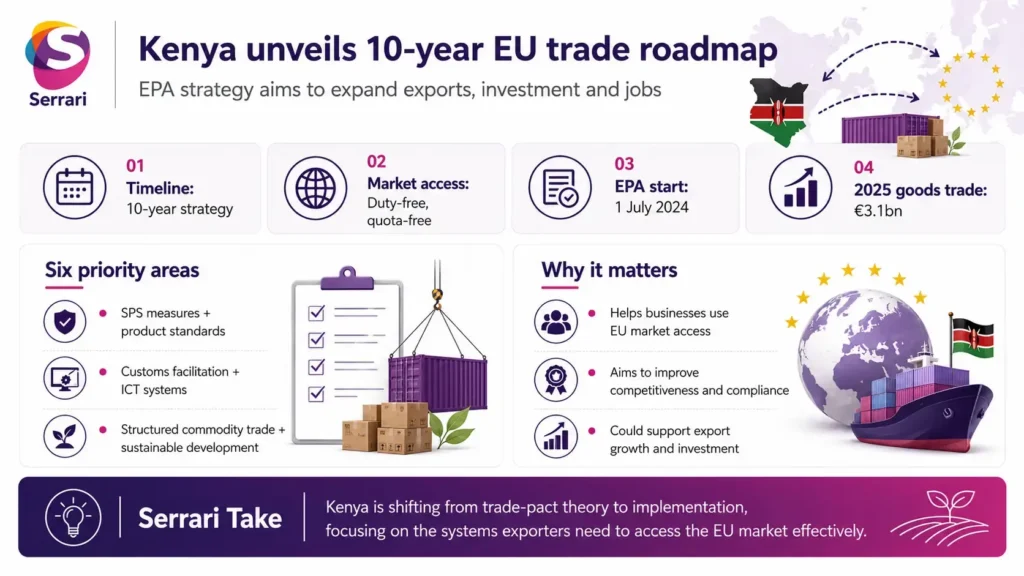
- Kenya has launched a 10-year strategy for implementing the Kenya-EU Economic Partnership Agreement.
- The roadmap focuses on six areas, including sanitary standards, customs, digital systems and sustainable trade.
- The EPA originally entered into force on July 1, 2024.
- Kenyan exports received duty-free and quota-free access to the EU market under the agreement.
- Official EU data show total goods trade between Kenya and the bloc reached about €3.1 billion in 2025.
- The strategy is being advanced against the backdrop of an ongoing legal dispute over further EPA implementation.
Kenya Moves From Trade Agreement to Practical Delivery
The new strategy is designed to help Kenya move beyond signing a trade agreement and focus on the practical reforms businesses need to take advantage of it.
According to the 10-year implementation roadmap, the government wants to improve export competitiveness, attract investment and create jobs by making it easier for businesses of different sizes to trade with the European Union.
Trade and Industry Cabinet Secretary Lee Kinyanjui said the strategy reflects Kenya’s aim of developing a resilient, competitive and sustainable trading environment.
The roadmap focuses on six areas: sanitary and phytosanitary measures; standards, technical regulations and conformity assessment; customs and trade facilitation; information and communication technology; structured commodity trade; and trade and sustainable development.
These priorities address some of the most important obstacles facing exporters. Access to a large market does not automatically guarantee export growth if businesses cannot meet health, safety, technical or documentation requirements.
The strategy therefore seeks to build the systems needed to convert tariff preferences into actual sales.
EU Market Access Creates Major Export Opportunity
The Kenya-EU Economic Partnership Agreement entered into force on July 1, 2024, after the two sides signed the deal in December 2023.
The agreement provides Kenyan goods with duty-free and quota-free access to the EU market. Kenya, in turn, agreed to gradually liberalise selected imports from the EU over an extended period while protecting a range of sensitive products.
Agricultural goods, textiles, clothing, footwear, vehicles and several other product groups were among the categories excluded from full liberalisation.
For Kenya, the immediate commercial opportunity is particularly important in sectors where the country already has established export strength.
Key exports to Europe include cut flowers, vegetables, fruit, coffee, tea and other agricultural products. Europe remains especially important to Kenya’s horticultural sector, which depends on fast access to high-value consumer markets.
The new roadmap aims to help more companies move beyond traditional exports by improving compliance, value addition and market intelligence.
Trade Reached About €3.1 Billion in 2025
Official European trade data show that goods trade between Kenya and the EU remained substantial in 2025.
The EU imported approximately €1.53 billion of goods from Kenya and exported about €1.57 billion to the country, putting total bilateral goods trade at roughly €3.1 billion.
The 2025 trade figures show that food and live animals remained the biggest category of EU imports from Kenya.
For Kenyan exporters, this creates both an opportunity and a challenge. Agricultural products already have a strong position in the European market, but future growth will increasingly depend on compliance with demanding food safety, traceability and sustainability standards.
That explains why sanitary and phytosanitary measures are one of the strategy’s six core priorities.
Helping farmers and exporters meet these standards could reduce shipment disruptions, improve market reliability and allow more businesses to participate in export supply chains.
Context is everything. Stay ahead of shifting trends with today’s market updates, and uncover emerging opportunities using the Serrari Group Market Index and Marketplace. Then, take control of your own financial future by exploring our Money & Life Reset Transformation Blueprint ™ to build stronger habits, create better systems, and design a path toward lasting wealth.
Customs and Digital Systems Could Lower Trade Friction
The strategy also targets customs and trade facilitation, where delays and complicated procedures can raise costs for exporters.
Improved coordination between border agencies, digital documentation and more efficient clearance systems could help reduce the time required to move goods through ports and into overseas markets.
The inclusion of information and communication technology reflects the growing role of digital systems in international trade.
Electronic certification, online customs processes and better access to market information can be particularly valuable for smaller companies that often lack the resources available to major exporters.
The European Union and Kenya have already highlighted digitalisation as an important part of their wider economic relationship, including efforts to use technology to improve trade flows and connect businesses.
Legal Dispute Adds an Important Complication
The launch of the strategy comes with an important legal backdrop.
In November 2025, the East African Court of Justice issued an interim injunction staying further implementation of the EPA pending determination of a case challenging the agreement.
The legal challenge argues that Kenya’s bilateral agreement with the EU raises questions under East African Community rules.
Kenya subsequently announced steps to challenge the order and said it would work to protect existing commercial arrangements and continued market access for exporters.
The government reassured businesses that Kenyan goods would continue reaching the EU market while it pursued appellate and regional engagement.
The new 10-year strategy therefore signals that Kenya is continuing to prepare businesses for deeper trade with Europe even as the wider implementation framework faces legal uncertainty.
Success Will Depend on Business-Level Execution
The roadmap gives Kenya a long-term framework, but its impact will ultimately depend on whether reforms reach businesses on the ground.
Exporters need reliable certification systems, faster customs procedures, better information on EU requirements and practical support in meeting sustainability and product standards.
Smaller businesses may require particular attention because the cost of compliance can prevent them from entering international markets even when tariffs are removed.
The agreement’s long-term value will therefore be measured not simply by headline trade figures, but by whether more Kenyan companies can export successfully, move into higher-value products and attract investment into local production.
Kenya now has a decade-long framework for pursuing those goals. The next challenge is translating the strategy into functioning systems that make European market access easier to use in practice.
Sources: Eastleigh Voice / State Department for Trade / European Commission / East African Court of Justice
Your financial future isn’t something you wait for—it’s something you build.
The real question is: when do you begin?
Move beyond simply staying informed.
Navigate the markets with clarity—track trends through the Serrari Group Market Index, uncover opportunities in the Serrari Marketplace, and build practical knowledge with our Curated Wealth Builder Platform.
Stay connected to what truly matters.
Get daily insights on macro trends and financial movements across Kenya, Africa, and global markets—delivered through the Serrari Newsletter.
Growth opens doors.
Advance your career through professional programs including ACCA, HESI A2, ATI TEAS 7 , HESI EXIT , NCLEX – RN and NCLEX – PN, Financial Literacy!🌟—designed to move you forward with confidence.
See where money is flowing—clearly and in real time.
Track Money Market Funds, Treasury Bills, Treasury Bonds, Green Bonds, and Fixed Deposits, alongside global and African indexes, key economic indicators, and the evolving Crypto and stablecoin landscape—all within Serrari’s Market Index.