
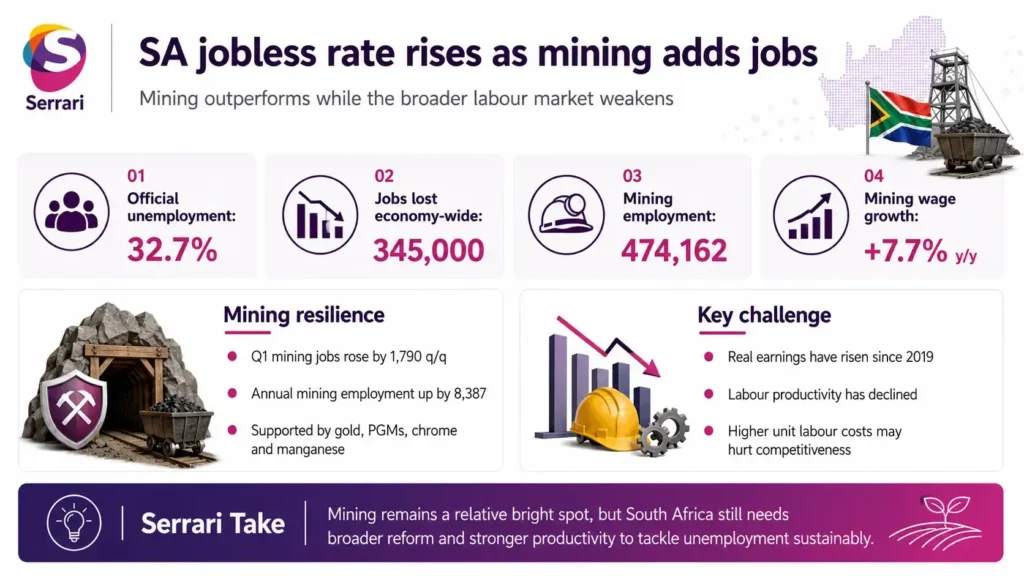
South Africa’s official unemployment rate climbed to 32.7% in the first quarter of 2026 as the economy shed hundreds of thousands of jobs, deepening one of the country’s most persistent economic challenges.
Yet mining moved in the opposite direction. Industry data show modest employment gains, supported by stronger conditions in commodities including gold, platinum group metals, chrome and manganese.
The contrast highlights mining’s resilience, but the sector faces a growing problem of its own: real worker earnings have risen sharply since 2019 while labour productivity has declined. That widening gap threatens competitiveness even as high commodity prices and South Africa’s vast mineral endowment create new opportunities.
Key Overview
- South Africa’s official unemployment rate rose from 31.4% to 32.7% in Q1 2026.
- Employment fell by 345,000 to 16.8 million, while the number of unemployed people rose to 8.1 million.
- Mining employment increased in both the household and formal payroll datasets, although the surveys measure different parts of the labour market.
- Minerals Council data put formal mining employment at 474,162, up 1,790 jobs quarter on quarter.
- Average monthly mining remuneration increased 7.7% year on year to R36,405 in February 2026.
- Mining productivity has weakened while real earnings have risen sharply since 2019.
Unemployment Rises as the Economy Sheds Jobs
South Africa’s labour market deteriorated sharply at the start of 2026.
According to the first-quarter labour force survey, the official unemployment rate increased by 1.3 percentage points from 31.4% in the final quarter of 2025 to 32.7% in the first quarter of 2026.
The number of employed people fell by 345,000 to 16.8 million, while the unemployed population increased by 301,000 to 8.1 million. The formal sector lost 189,000 jobs and informal employment declined by another 127,000.
The headline rate, however, captures only part of the pressure. The combined rate of unemployment and time-related underemployment reached 35.9%, while a broader measure including the potential labour force rose to 43.7%.
Youth outcomes were particularly severe. The unemployment rate among people aged 15 to 34 increased to 45.8% after the number of unemployed young people rose to 4.7 million.
These figures make the broader employment weakness more significant than the raw article’s suggestion that the official rate itself was approaching 35%. The official rate was 32.7%; it was the measure combining unemployment and time-related underemployment that reached 35.9%.
Mining Defies the Broader Employment Downturn
Against that difficult national backdrop, mining recorded employment growth.
The Minerals Council’s employment analysis put formal mining employment at 474,162 in the first quarter, an increase of 1,790 jobs, or 0.4%, from the previous quarter. Employment was also 8,387 higher than a year earlier.
The organisation attributed the improvement to stabilised demand for platinum group metals, gold, chrome and manganese, together with new project activity. (Minerals Council SA)
Separate Statistics South Africa household-survey data showed mining employment rising by 32,000 during the quarter. The difference does not necessarily represent a contradiction: the datasets use different methods and measure different segments of the labour market.
The broader household survey recorded gains in mining, manufacturing and agriculture, while major job losses were concentrated in community and social services, construction and transport.
The mining industry’s ability to add workers during a national employment contraction reinforces its continuing importance to South Africa’s industrial economy.
Context is everything. Stay ahead of shifting trends with today’s market updates, and uncover emerging opportunities using the Serrari Group Market Index and Marketplace. Then, take control of your own financial future by exploring our Money & Life Reset Transformation Blueprint ™ to build stronger habits, create better systems, and design a path toward lasting wealth.
Wages Rise While Productivity Falls
Mining’s employment resilience comes with a serious competitiveness challenge.
An analysis of earnings and productivity shows real gross earnings per worker rising from an index baseline of 100 in 2019 to 159 by February 2026.
Labour productivity moved in the opposite direction, falling to an index level of 90.
The widening gap suggests that remuneration has increased faster than output per worker, raising labour costs for each unit of production. The Minerals Council linked the pattern to structural inefficiencies and reduced output per employee. (Minerals Council SA)
Average monthly mining remuneration rose from R33,795 in February 2025 to R36,405 in February 2026, a nominal increase of 7.7%. That exceeded average inflation of 3.2% and the 5.9% earnings increase across the overall economy.
Higher pay can support worker retention and reflect improved profitability, particularly when commodity markets strengthen. But sustained wage growth without corresponding productivity gains can weaken the economics of labour-intensive and deep-level operations.
Gold Revival Offers a Major Growth Opportunity
Despite the productivity challenge, South Africa’s mineral base still offers considerable potential.
The gold industry is a particularly striking example. South African production has fallen dramatically from its historical peak, but the decline in output does not mean the country has exhausted its geological resources.
A recent analysis cited peer-reviewed geological estimates indicating that roughly 48,100 tonnes of gold may remain in the Witwatersrand Basin. That is close to the estimated 50,200 tonnes extracted from the basin since 1886. (Business Day)
The figure represents geological endowment rather than economically recoverable reserves, an important distinction. Whether the gold can be mined profitably depends on depth, grade, technology, electricity costs, regulation and future prices.
Still, the scale of the remaining resource suggests that declining historical production should not automatically be interpreted as the end of South African gold mining.
Energy Costs Could Determine the Next Phase
Mining companies now face a difficult balance between strong commodity opportunities and high operating costs.
Fuel, electricity, labour and logistics all affect whether new projects are viable. The Minerals Council has warned that fuel prices remain an important risk and has argued that lower electricity costs could improve competitiveness and support employment.
This is particularly important for deep-level mining, where electricity-intensive ventilation, cooling and pumping systems add heavily to costs.
South Africa’s opportunity therefore depends on more than commodity prices. Faster reforms, reliable infrastructure, greater exploration and improved productivity will all determine whether the industry can translate its mineral wealth into sustained employment.
Mining may be outperforming the wider labour market for now, but modest job growth alone will not solve South Africa’s unemployment crisis. The bigger opportunity lies in creating the conditions for investment that can turn geological potential into productive mines, exports and long-term jobs.
Sources: Statistics South Africa / Minerals Council South Africa / Business Day / Bizcommunity
Your financial future isn’t something you wait for—it’s something you build.
The real question is: when do you begin?
Move beyond simply staying informed.
Navigate the markets with clarity—track trends through the Serrari Group Market Index, uncover opportunities in the Serrari Marketplace, and build practical knowledge with our Curated Wealth Builder Platform.
Stay connected to what truly matters.
Get daily insights on macro trends and financial movements across Kenya, Africa, and global markets—delivered through the Serrari Newsletter.
Growth opens doors.
Advance your career through professional programs including ACCA, HESI A2, ATI TEAS 7 , HESI EXIT , NCLEX – RN and NCLEX – PN, Financial Literacy!🌟—designed to move you forward with confidence.
See where money is flowing—clearly and in real time.
Track Money Market Funds, Treasury Bills, Treasury Bonds, Green Bonds, and Fixed Deposits, alongside global and African indexes, key economic indicators, and the evolving Crypto and stablecoin landscape—all within Serrari’s Market Index.