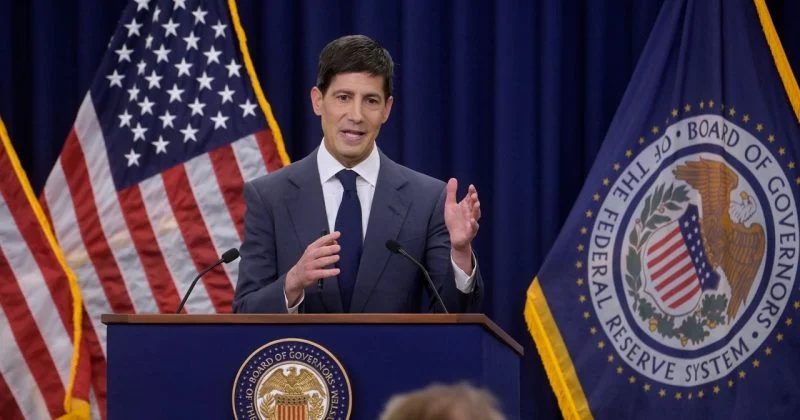
The Federal Reserve left its benchmark interest-rate range unchanged at 3.50%-3.75% on July 29, but an unusually divided vote and Chair Kevin Warsh’s limited guidance unsettled investors. Three policymakers supported an immediate quarter-point increase, while Warsh pledged to restore price stability without clearly explaining what would trigger tighter policy.
The mixed message drove a sharp shift in US Treasury markets. Shorter-term yields fell as traders reduced expectations for an imminent move, while longer-term yields rose as investors questioned whether the Fed was acting forcefully enough to contain inflation.
Key Overview
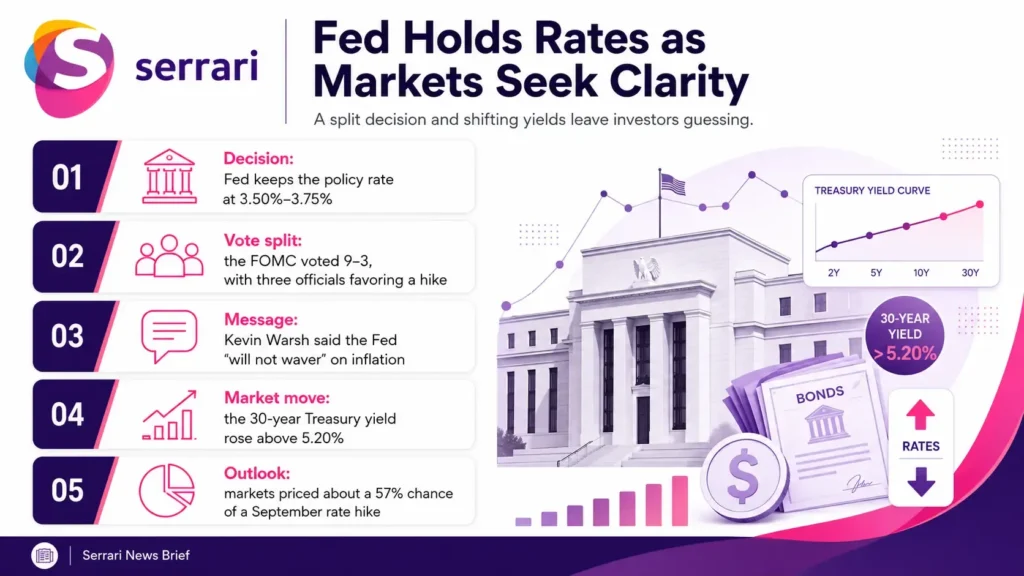
- The Federal Open Market Committee voted 9-3 to keep rates at 3.50%-3.75%.
- Three regional Fed presidents preferred a 25-basis-point increase.
- Warsh maintained the Fed’s 2% inflation target but avoided firm forward guidance.
- The 30-year Treasury yield crossed 5.20%, its highest level since 2007.
- Markets assigned roughly a 57% probability to a September rate increase.
Fed Holds Policy Steady Despite Hawkish Dissents
The FOMC kept the federal funds target range at 3.50%-3.75%, where it has remained since December. The statement described economic activity as expanding at a solid pace, supported by strong productivity growth, capital investment and a labour market in which job gains have broadly matched workforce growth.
Inflation remains above the central bank’s 2% objective. The Fed attributed some of the pressure to supply shocks, including higher energy prices linked to the Middle East conflict.
Beth Hammack of the Cleveland Fed, Neel Kashkari of the Minneapolis Fed and Lorie Logan of the Dallas Fed dissented. All three preferred a quarter-percentage-point increase, producing a 9-3 decision and exposing a clear divide over how urgently the central bank should respond.
The dissent suggests that the debate ahead of the September 15-16 meeting could become more difficult if inflation stays elevated and the labour market remains resilient.
Warsh Promises Action but Offers Few Signals
In his press-conference opening statement, Warsh said there was no unofficial inflation target above 2% and declared that the Fed “will not waver.” He also acknowledged that more than five years of above-target inflation could not be reversed within weeks.
However, his answers gave investors little certainty about what the Fed would do next. Warsh said interest rates could form part of the solution if inflation stayed elevated, but he declined to present rate increases as the only available response.
Warsh has argued that markets should respond more directly to economic data rather than relying excessively on Fed speeches, quarterly projections or hints about future meetings. That approach may reduce dependence on central-bank guidance, but it can also increase uncertainty over whether strong language reflects an approaching hike or whether higher market yields are already tightening conditions enough to delay action.
Context is everything. Stay ahead of shifting trends with today’s market updates, and uncover emerging opportunities using the Serrari Group Market Index and Marketplace. Then, take control of your own financial future by exploring our Money & Life Reset Transformation Blueprint ™ to build stronger habits, create better systems, and design a path toward lasting wealth.
Treasury Curve Steepens as Investors Question the Fed
The market reaction showed that investors were not convinced by the combination of hawkish language and unchanged policy. According to the post-meeting market report, two-year Treasury yields fell while 10-year and 30-year yields rose, causing the curve to steepen sharply.
Shorter-dated yields usually respond most directly to expectations for the Fed’s next moves, while longer-dated yields reflect broader views about inflation, growth and policy credibility.
The 30-year yield moved above 5.20% for the first time since mid-2007. Official Treasury yield-curve data recorded the 10-year yield at 4.67%, the 20-year at 5.21% and the 30-year at 5.20% on July 29.
Rising long-term yields increase borrowing costs across mortgages, corporate debt and other credit markets. They can also signal concern that inflation may remain persistent unless short-term rates rise more decisively.
September Hike Remains Possible
After the decision, traders assigned about a 57% probability to a September hike, based on futures pricing tracked through the FedWatch framework.
The Fed will receive two additional rounds of employment and inflation data before September. Strong job creation and stubborn core inflation would strengthen the case for a 25-basis-point increase, while a sharp labour-market deterioration or faster disinflation could support another pause.
The disagreement within the committee means incoming data may influence both the decision and Warsh’s ability to build consensus. Another hold alongside elevated inflation could intensify credibility concerns, while an increase would validate the warnings delivered by the three July dissenters.
Communication Becomes Part of the Policy Test
The July decision left rates unchanged, but it did not preserve market calm. Warsh’s promise to deliver price stability was clear; the route for achieving it was not.
If long-term yields remain elevated, the bond market may effectively tighten credit before the Fed acts. Warsh must now preserve flexibility while giving investors a clearer sense of how the central bank interprets inflation risks and what evidence would justify a rate move.
The September meeting will test both the Fed’s willingness to tighten and Warsh’s ability to communicate a coherent strategy.
Sources: Federal Reserve / Reuters / U.S. Department of the Treasury / CME Group
Your financial future isn’t something you wait for—it’s something you build.
The real question is: when do you begin?
Move beyond simply staying informed.
Navigate the markets with clarity—track trends through the Serrari Group Market Index, uncover opportunities in the Serrari Marketplace, and build practical knowledge with our Curated Wealth Builder Platform.
Stay connected to what truly matters.
Get daily insights on macro trends and financial movements across Kenya, Africa, and global markets—delivered through the Serrari Newsletter.
Growth opens doors.
Advance your career through professional programs including ACCA, HESI A2, ATI TEAS 7 , HESI EXIT , NCLEX – RN and NCLEX – PN, Financial Literacy!🌟—designed to move you forward with confidence.
See where money is flowing—clearly and in real time.
Track Money Market Funds, Treasury Bills, Treasury Bonds, Green Bonds, and Fixed Deposits, alongside global and African indexes, key economic indicators, and the evolving Crypto and stablecoin landscape—all within Serrari’s Market Index.