
Kenya travel health insurance is now mandatory for all foreign visitors entering the country for stays of less than 12 months. Introduced under the Social Health Insurance Act, the regulation requires visitors to maintain a minimum of $50,000 in health insurance coverage, including medical coverage, emergency medical evacuation, and repatriation benefits. The move positions Kenya among countries with the strictest travel insurance requirements while strengthening visitor protection and supporting the country’s growing tourism industry.
Key Overview
Kenya has introduced one of Africa’s most comprehensive travel insurance requirements by making travel health insurance compulsory for international travelers. The regulation, issued by the Ministry of Health Kenya, establishes minimum medical coverage standards designed to protect visitors against unexpected healthcare costs while reducing financial pressure on the country’s public health system. The new rules also align with Kenya’s broader healthcare reforms under the Social Health Insurance Act.
Kenya Makes Travel Health Insurance Mandatory for Foreign Visitors
Kenya has officially introduced mandatory Kenya travel health insurance for all foreign visitors entering the country for short-term stays, marking a major shift in its immigration and healthcare policies.
The new regulation, gazetted on July 29, 2026, by Health Cabinet Secretary Aden Duale, requires every international traveler staying in Kenya for less than 12 months to possess valid travel health insurance with minimum coverage of $50,000 before entering the country.
The policy is one of the most comprehensive travel insurance requirements currently implemented in Africa and reflects the government’s efforts to ensure visitors have adequate financial protection should they require emergency medical treatment during their stay.
The requirement applies regardless of whether visitors are travelling for tourism, business, conferences, education, or other temporary purposes.
Social Health Insurance Act Provides the Legal Framework
The mandatory insurance requirement is anchored in Kenya’s Social Health Insurance Act of 2023.
The legislation states that all non-Kenyan nationals seeking to enter and remain in the country for less than one year must hold travel medical insurance that complies with conditions prescribed by the Health Cabinet Secretary.
Although Parliament passed the law in 2023, implementation was delayed several times following procurement disputes involving the rollout of the visitor medical insurance programme.
A restricted tender issued by the State Department for Immigration in December 2024 was cancelled the following month after the Public Procurement Regulatory Authority identified legal irregularities, while insurers also raised concerns regarding the procurement process.
The publication of the final regulations in July 2026 now formally activates the requirement for international travelers.
Minimum Health Insurance Coverage Required
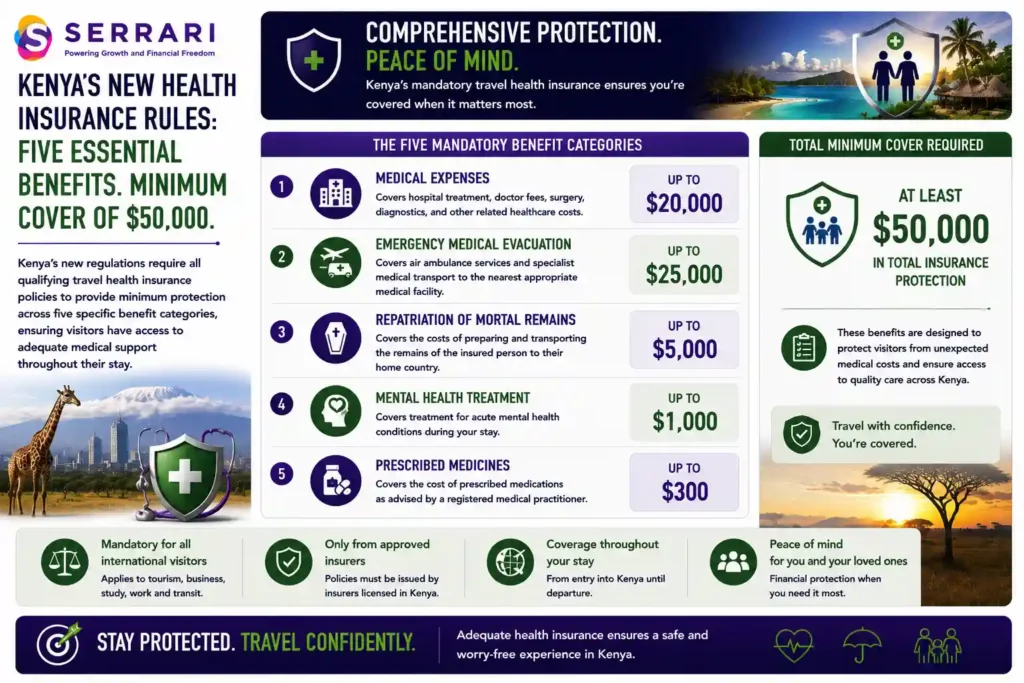
Under the new regulations, every qualifying health insurance coverage policy must provide protection across five specific benefit categories.
The largest allocation covers medical expenses, providing up to $20,000 for hospital treatment and related healthcare costs.
The regulations also require up to $25,000 for emergency medical evacuation, reflecting the high cost of air ambulance services and specialist medical transport, particularly for visitors travelling to Kenya’s remote wildlife reserves and coastal destinations.
Coverage must also include up to $5,000 for the repatriation of mortal remains, ensuring families are protected against significant international transportation costs in the unfortunate event of a death.
In addition, the policy provides up to $1,000 for mental health treatment and up to $300 for prescribed medicines.
Collectively, these benefits must provide total insurance protection of at least $50,000, ensuring visitors have access to adequate medical support throughout their stay.
Context is everything. Stay ahead of shifting trends with today’s market updates, and uncover emerging opportunities using the Serrari Group Market Index and Marketplace. Then, take control of your own financial future by exploring our Money & Life Reset Transformation Blueprint ™ to build stronger habits, create better systems, and design a path toward lasting wealth.
Why Kenya Introduced the New Insurance Requirement
The government says the regulation is intended to strengthen public health protection while ensuring visitors can access quality healthcare without placing additional financial strain on Kenya’s healthcare system.
Medical emergencies involving uninsured tourists can create substantial financial burdens for healthcare providers and public institutions, particularly when patients require intensive care or emergency evacuation.
By requiring comprehensive medical coverage before entry, Kenya hopes to reduce unpaid medical bills while ensuring visitors receive timely treatment regardless of where emergencies occur.
The regulation also supports broader healthcare reforms being implemented through the Social Health Insurance Act, which seeks to improve healthcare financing across the country.
Kenya Tourism Continues to Recover
The introduction of mandatory Kenya travel health insurance comes as the country’s tourism sector continues its strong post-pandemic recovery.
International visitor arrivals reached approximately 2.55 million during 2025, representing a 6.2% increase compared with the previous year.
August remained the busiest month for international tourism, recording more than 277,000 arrivals as travelers visited Kenya’s beaches, national parks, mountain destinations and conference facilities.
As visitor numbers continue to grow, the government believes stronger travel insurance requirements will improve confidence in Kenya as a safe destination while ensuring adequate healthcare protection for tourists.
How Kenya Compares with Other International Destinations
Kenya’s insurance requirement is among the highest mandatory medical coverage thresholds imposed by any tourism destination.
For comparison, countries within the Schengen Area require visa applicants to maintain travel medical insurance providing minimum coverage of €30,000.
Zanzibar introduced compulsory visitor insurance in September 2024 through a mandatory insurance fee applicable to incoming travelers.
Kenya’s minimum requirement of $50,000 exceeds both of these examples, reflecting the significant costs associated with emergency treatment, specialist healthcare services and emergency medical evacuation within East Africa.
Air ambulance services alone can cost tens of thousands of dollars depending on the patient’s location and medical condition, making comprehensive insurance increasingly important for international visitors.
Implications for International Travelers
Anyone planning to visit Kenya should ensure that their existing travel insurance policy satisfies the new requirements before travelling.
Visitors whose insurance does not provide the required minimum benefits may need to purchase additional cover before arrival.
Travelers should also carefully review policy wording to confirm that emergency evacuation, hospitalization, repatriation and other mandatory benefits are explicitly included within their coverage limits.
Ensuring compliance before departure can help avoid unnecessary complications during immigration processing while providing financial protection against unexpected medical emergencies.
Impact on the Travel Insurance Industry
The regulation is expected to generate increased demand for comprehensive travel insurance products among international visitors to Kenya.
Insurance providers may introduce specialised products designed specifically to meet Kenya’s entry requirements, while international insurers could adapt existing travel policies to comply with the country’s minimum benefit standards.
The move also strengthens the role of travel insurance as an essential component of international travel planning rather than an optional purchase.
For insurers, Kenya’s new regulations present opportunities to develop products covering medical treatment, evacuation, emergency assistance and related travel risks for one of Africa’s leading tourism destinations.
Outlook for Kenya’s Visitor Protection Framework
Kenya’s mandatory travel insurance requirement reflects a broader global trend toward strengthening healthcare safeguards for international travelers.
As healthcare costs continue to rise worldwide, more countries are requiring visitors to demonstrate adequate insurance protection before entry.
For Kenya, the policy supports both public health objectives and tourism sustainability by ensuring visitors can obtain medical treatment without creating financial burdens for healthcare institutions.
As the tourism sector continues expanding, the government is likely to monitor implementation closely and may refine operational procedures while maintaining the core objective of improving visitor protection and healthcare financing.
FAQs
Who is required to have Kenya travel health insurance?
All foreign visitors entering Kenya for stays of less than 12 months must have travel health insurance that complies with the minimum coverage requirements established under the Social Health Insurance Act.
What is the minimum insurance coverage required?
Visitors must have health insurance coverage providing at least $50,000 in total benefits, including medical coverage, emergency medical evacuation, repatriation of mortal remains, mental health treatment and prescribed medicines.
Why did Kenya introduce mandatory travel health insurance?
The government introduced the policy to protect international travelers, strengthen healthcare financing, reduce the burden of uninsured medical treatment and support broader reforms under the Social Health Insurance Act.
How does Kenya’s requirement compare internationally?
Kenya’s $50,000 minimum coverage exceeds the Schengen visa requirement of €30,000 and is among the highest mandatory travel insurance thresholds currently required for international travelers.
Sources: Kenyan Wallstreet, Talk Africa, Visasnews, The Standard, Kenyans
Your financial future isn’t something you wait for—it’s something you build.
The real question is: when do you begin?
Move beyond simply staying informed.
Navigate the markets with clarity—track trends through the Serrari Group Market Index, uncover opportunities in the Serrari Marketplace, and build practical knowledge with our Curated Wealth Builder Platform.
Stay connected to what truly matters.
Get daily insights on macro trends and financial movements across Kenya, Africa, and global markets—delivered through the Serrari Newsletter.
Growth opens doors.
Advance your career through professional programs including ACCA, HESI A2, ATI TEAS 7 , HESI EXIT , NCLEX – RN and NCLEX – PN, Financial Literacy!🌟—designed to move you forward with confidence.
See where money is flowing—clearly and in real time.
Track Money Market Funds, Treasury Bills, Treasury Bonds, Green Bonds, and Fixed Deposits, alongside global and African indexes, key economic indicators, and the evolving Crypto and stablecoin landscape—all within Serrari’s Market Index.