Kenya’s ambition to attract US$5 billion in investment through the Nairobi International Financial Centre is facing a familiar challenge: investors want greater certainty over future tax and regulatory policy.
NIFC Chief Executive Officer Daniel Mainda has said predictable rules will be essential if Nairobi is to establish itself as a competitive international financial centre. The authority is engaging the National Treasury and financial-sector regulators as it seeks to attract global firms, expand capital-market activity and deepen investment in fintech, sustainable finance and virtual assets.
Kenya already offers qualifying NIFC firms several incentives, including reduced corporate tax rates, full foreign ownership and freedom to repatriate profits. However, repeated changes to tax proposals and fiscal policy could limit the effectiveness of those incentives by making long-term investment returns more difficult to forecast.
Key Overview
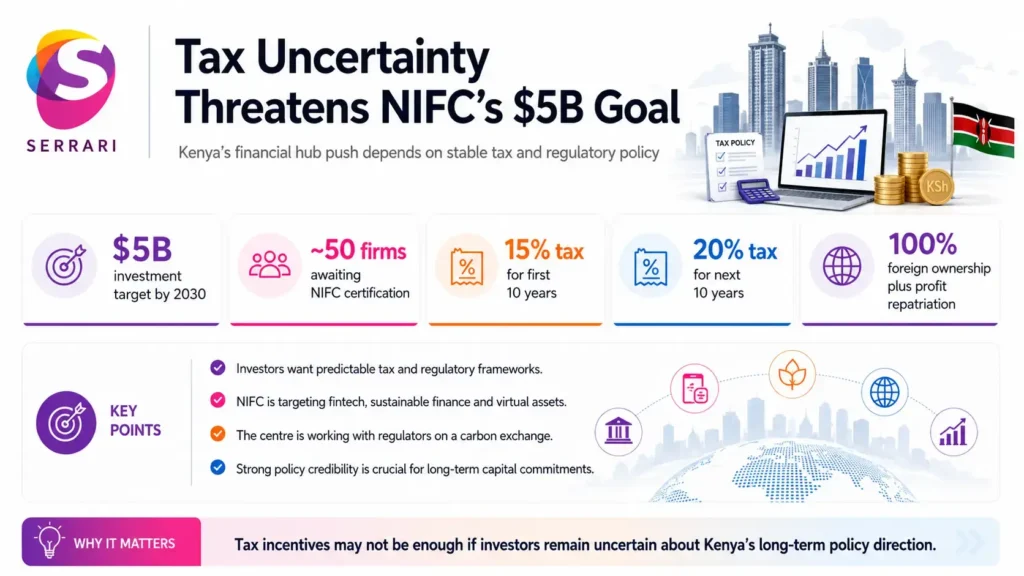
- NIFC is targeting approximately US$5 billion in investment by 2030.
- Around 50 global firms are reportedly awaiting certification under the framework.
- Qualifying firms can access a 15% corporate income tax rate for their first 10 years.
- The rate rises to 20% for the following 10 years, subject to eligibility.
- Certified companies may be fully foreign-owned and can repatriate profits and dividends.
- NIFC is working with market regulators on initiatives including a Kenyan carbon exchange.
Policy Credibility Becomes Central to NIFC Strategy
According to the original report on the investment target, Mainda said stable tax and regulatory frameworks are critical to attracting long-term capital.
The concern is not simply whether tax rates are high or low. Investors committing capital to infrastructure, financial technology platforms, fund-management operations or regional headquarters must estimate costs and returns over many years. Frequent changes in tax rules can increase legal, compliance and forecasting risks even where headline incentives appear competitive.
Kenya’s recent fiscal history has reinforced those concerns. In 2024, the government withdrew major revenue proposals following widespread protests, while subsequent budgets continued to balance debt pressures, revenue mobilisation and public resistance to additional taxation. That experience contributed to wider questions over fiscal predictability and policy continuity.
More recently, the World Bank warned that uncertainty surrounding Kenya’s economic and political environment could weaken private investment growth, particularly as the country approaches the 2027 general election.
NIFC Incentives Remain Competitive
The NIFC framework offers benefits designed to make Nairobi more attractive as a base for regional and international financial services.
According to the authority’s certification framework, eligible companies may maintain 100% foreign ownership and freely repatriate dividends and profits. These provisions reduce some of the ownership and capital-mobility restrictions that can deter international investors.
Qualifying firms may also benefit from a 15% corporate income tax rate during their first 10 years of operation, compared with Kenya’s standard resident corporate tax rate. The rate then increases to 20% for the next 10 years.
The preferential rate was introduced through changes contained in the Finance Act 2022 and applies only to businesses that meet the relevant legal and certification requirements. It is therefore not a blanket incentive for every firm operating through Nairobi.
NIFC’s proposition also extends beyond tax. The centre promotes access to Kenya’s financial-services ecosystem, regional markets, professional talent and transport and digital infrastructure. Its success will depend on whether these advantages are accompanied by consistent regulations and an efficient certification process.
Context is everything. Stay ahead of shifting trends with today’s market updates, and uncover emerging opportunities using the Serrari Group Market Index and Marketplace. Then, take control of your own financial future by exploring our Money & Life Reset Transformation Blueprint ™ to build stronger habits, create better systems, and design a path toward lasting wealth.
Certification Pipeline Could Expand Nairobi’s Reach
Mainda said about 50 global firms were awaiting certification under the NIFC framework. If approved and operationalised, the companies could broaden Nairobi’s financial-services base and mobilise new capital into Kenya.
The authority has prioritised sectors such as fintech, sustainable finance, asset management and virtual assets. These areas can generate skilled employment and help position Nairobi as a regional centre for structuring investments into East Africa.
However, certification numbers alone do not guarantee investment. Companies must still establish operations, deploy capital and build local or regional business activity. Delays, changing tax interpretations or uncertainty over future regulation could cause some firms to postpone or reduce their commitments.
The strongest measure of NIFC’s progress will therefore be the amount of capital actually invested, jobs created and financial activity conducted through Kenya rather than the number of firms expressing interest.
Carbon Exchange Forms Part of Capital-Market Plans
NIFC is also working with the Capital Markets Authority and Nairobi Securities Exchange on a carbon-credit trading platform.
Plans for a Kenyan carbon exchange have been under discussion since NIFC and the exchange signed a collaboration agreement with AirCarbon Exchange in 2022.
The proposed platform is expected to support the trading of verified carbon credits and could connect Kenyan projects with domestic and international investors. Regulators are now targeting an operational exchange in 2027, following the establishment of Kenya’s National Carbon Registry.
A well-regulated marketplace could improve price discovery and transparency for carbon projects. However, its success will also rely on clear rules governing project approval, ownership, taxation and benefit-sharing.
Predictability May Matter More Than Incentives
Kenya’s NIFC strategy is designed to compete with established financial centres by combining tax incentives, market access and regulatory coordination. Yet international investors commonly assess the durability of incentives alongside their immediate financial value.
A 15% tax rate offers limited reassurance if businesses believe the surrounding rules may change unexpectedly. Conversely, a credible long-term framework can reduce risk even where the jurisdiction is not the cheapest option.
For Kenya to reach its US$5 billion target, authorities will need to demonstrate that NIFC incentives are stable, transparent and consistently administered. Strong coordination between the Treasury, tax authority, central bank, capital-markets regulator and NIFC will be essential.
The investment goal remains achievable, but its success will depend on translating policy commitments into a predictable operating environment that gives firms confidence to deploy capital for the long term.
Sources: Capital Business / Nairobi International Financial Centre Authority / Reuters / AirCarbon Exchange / Business Daily Africa
Your financial future isn’t something you wait for—it’s something you build.
The real question is: when do you begin?
Move beyond simply staying informed.
Navigate the markets with clarity—track trends through the Serrari Group Market Index, uncover opportunities in the Serrari Marketplace, and build practical knowledge with our Curated Wealth Builder Platform.
Stay connected to what truly matters.
Get daily insights on macro trends and financial movements across Kenya, Africa, and global markets—delivered through the Serrari Newsletter.
Growth opens doors.
Advance your career through professional programs including ACCA, HESI A2, ATI TEAS 7 , HESI EXIT , NCLEX – RN and NCLEX – PN, Financial Literacy!🌟—designed to move you forward with confidence.
See where money is flowing—clearly and in real time.
Track Money Market Funds, Treasury Bills, Treasury Bonds, Green Bonds, and Fixed Deposits, alongside global and African indexes, key economic indicators, and the evolving Crypto and stablecoin landscape—all within Serrari’s Market Index.