Critical Statutory Payments & Deductions in Kenya
A complete guide to staying compliant, protected, and informed
Statutory payments in Kenya are legal requirements — not optional benefits. This guide covers every critical deduction and entitlement in detail: NSSF retirement contributions, SHIF health cover, PAYE income tax, the Employee Compensation Fund, Housing Levy, maternity and paternity leave, annual leave, and public holiday pay.
What You'll Learn
- NSSF: 6% employer + 6% employee of gross pensionable pay monthly
- SHIF: 2.75% of gross salary with no upper cap — remit by the 9th
- PAYE: progressive tax deducted at source and remitted to KRA monthly
- Employee Compensation Fund: mandatory occupational injury insurance
- Maternity leave: 3 months full pay; paternity leave: 2 weeks full pay
- Annual leave: minimum 21 working days per year on full pay
- Housing Levy: 1.5% employee + 1.5% employer of gross salary
- Non-compliance is a criminal offence — not just a civil penalty
Kenya's Statutory Payments: A Complete Compliance Guide

Statutory payments in Kenya are not optional employment benefits — they are legal obligations embedded in multiple Acts of Parliament, binding on every employer and employee in the formal sector from the first day of work. Understanding them in detail is one of the most practical financial skills a Kenyan worker can develop.
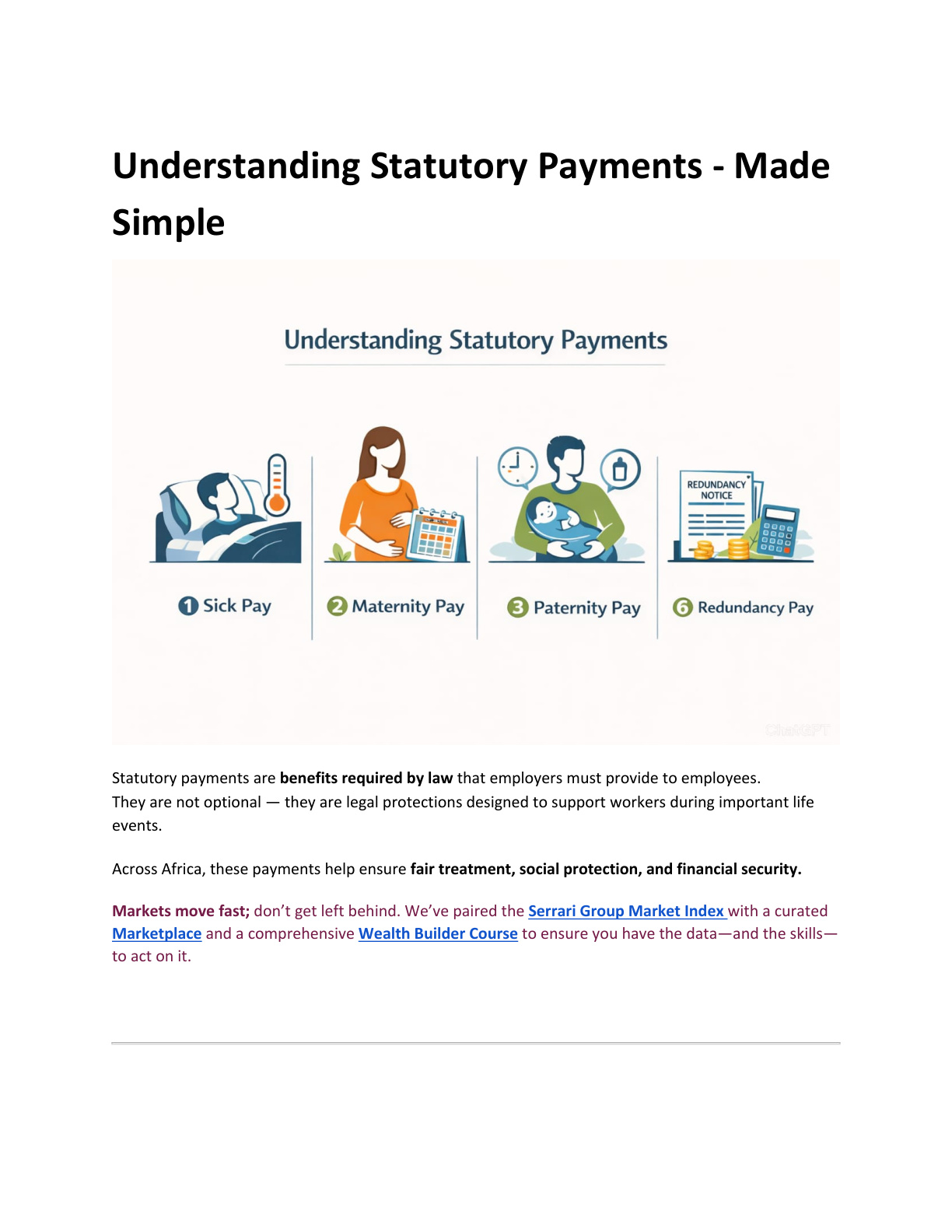
The statutory payment framework covers seven primary obligations: NSSF for retirement security, SHIF for health insurance, PAYE for income tax, the Employee Compensation Fund for workplace injury, the Housing Levy for affordable housing, the NITA levy for skills development, and enforceable leave entitlements including maternity, paternity, annual leave, and public holidays.
For employees, this knowledge is protective. It allows you to verify that every deduction on your payslip corresponds to an actual remittance to the relevant agency on your behalf. Non-remittance — where your employer deducts but does not pay — is Kenya's most common form of wage theft, and you can only detect it if you know what to look for and where to verify.
Understand the broader framework of statutory payments | See all the benefits that flow from statutory compliance
NSSF: National Social Security Fund — Rates and Rules

The National Social Security Fund provides retirement and social security benefits to formally employed Kenyans. Under the NSSF Act 2013, contributions are structured around the Lower Earnings Limit (LEL) and Upper Earnings Limit (UEL) set annually by the NSSF Board of Trustees.
The contribution structure: Employee contributes 6% of gross pensionable pay up to the UEL. Employer contributes a matching 6% of gross pensionable pay. Combined monthly contribution is 12% of pensionable pay. Both contributions are remitted by the employer to NSSF by the 15th of the following month. The UEL and LEL are reviewed periodically — check the current figures at nssf.or.ke.
NSSF funds accumulate in two accounts: Tier I (contributions up to the LEL, managed by NSSF directly as a defined benefit) and Tier II (contributions between LEL and UEL, which employers may direct to a private pension scheme if one is registered). Benefits are accessible on retirement at 60 (or early retirement at 50), permanent incapacity, emigration, or death (payable to your nominated beneficiary). Verify your monthly contributions at nssf.or.ke using your NSSF member number.
Integrate NSSF into your broader retirement planning strategy | Understand the full picture of statutory deductions and their benefits
SHIF: The Social Health Insurance Fund — Kenya's New Health Cover

The Social Health Insurance Fund (SHIF) replaced the National Hospital Insurance Fund (NHIF) following the enactment of the Social Health Insurance Act 2023. SHIF is administered by the Social Health Authority (SHA) and represents a fundamental restructuring of Kenya's national health insurance framework.
Key SHIF contribution rules: Rate is 2.75% of gross monthly salary for all formally employed Kenyans. Minimum contribution is KES 300 per month. There is no upper contribution cap — higher earners pay more in absolute terms. For non-salaried individuals, the contribution is 2.75% of declared household income, with a minimum of KES 300. Employers must remit contributions by the 9th of the following month. Late remittance attracts penalties and interest.
SHIF coverage: The fund covers inpatient services at accredited public and private facilities, outpatient services under specific schemes, maternity care, and emergency treatment. Your registered dependants — spouse and children under 18 — are covered without additional premiums. Verify your contribution status and dependant registration on the SHA member portal at sha.go.ke. Contribution gaps caused by employer non-remittance can interrupt your healthcare access at the point of claim — monitor monthly, not annually.
Understand how health insurance fits into your complete financial protection plan | See the full range of benefits flowing from SHIF and other statutory payments
PAYE: Pay As You Earn — How Your Tax is Calculated

Pay As You Earn is the mechanism by which your income tax is deducted from your salary at source each month and remitted to the Kenya Revenue Authority by your employer. PAYE must be remitted by the 9th of the following month via the KRA iTax portal. Failure to remit by this deadline attracts a penalty of 25% of the outstanding tax plus interest at 1% per month.
How PAYE is calculated: Start with your gross salary. Deduct allowable reliefs — registered pension contributions (NSSF and approved private pension schemes up to KES 20,000 per month), SHIF contributions, mortgage interest (up to KES 25,000 per month), insurance relief (15% of life insurance premiums up to KES 5,000 per month). Apply the resulting taxable income against the current KRA progressive tax bands. Subtract the personal relief of KES 28,800 per year (KES 2,400 per month). The result is your net PAYE liability.
Kenya's current PAYE tax bands (verify current rates at kra.go.ke as these are updated in national budgets): the first KES 24,000 per month is taxed at 10%; the next KES 8,333 at 25%; income above KES 32,333 at 30% up to certain thresholds, with higher rates for top earners. Every employed Kenyan should register on iTax at kra.go.ke, file an annual income tax return by 30th June, and check that their employer has remitted the PAYE shown on their P9 form.
Integrate tax planning into your personal financial strategy | See how PAYE and other deductions affect your net take-home pay
Employee Compensation Fund: Occupational Injury Protection

The Work Injury Benefits Act (WIBA, 2007) mandates that every employer in Kenya insure their workers against occupational injury, disease, and death. This insurance must be in place before any employee performs a single day of work — there is no grace period. Employers who fail to maintain WIBA cover are committing a criminal offence from the first day of uninsured employment.
Contribution rates to the Employee Compensation Fund are determined by industry risk classification. Higher-risk industries — construction, mining, manufacturing — pay higher rates than lower-risk office environments. The contribution is entirely employer-funded (employees do not contribute from their salary) and must be maintained continuously.
Benefits under WIBA: medical treatment and rehabilitation costs for workplace injuries or occupational diseases; temporary incapacity benefit — a monthly payment equivalent to a portion of salary while unable to work; permanent incapacity compensation — a lump sum based on the degree of permanent disability as assessed according to the WIBA Schedule; and death benefits payable to nominated dependants if a workplace accident or occupational disease is fatal. If you are injured at work, report it immediately to your employer, ensure a formal incident report is completed, and seek medical attention at a DOSH-approved or WIBA-registered facility. If your employer disputes your claim, contact DOSH directly at dosh.go.ke.
Understand how to complement WIBA with personal insurance coverage | See all statutory benefits available to Kenyan workers
Statutory Maternity and Paternity Leave in Kenya

Kenya's Employment Act (2007) provides some of the most generous statutory parental leave provisions in the East African region. These entitlements are mandatory — employers cannot lawfully reduce them through employment contracts or workplace policies, and any attempt to penalise employees for taking them is unlawful.
Maternity leave: Female employees are entitled to three consecutive months of paid maternity leave at full pay. This leave is fully employer-funded — there is no government reimbursement scheme. It applies from the first day of employment and can be taken before or after delivery at the employee's discretion (subject to the Employment Act provisions). Key protections: the employee cannot be dismissed during maternity leave; she must return to the same or equivalent position; she cannot be disadvantaged in pay, grade, or conditions as a result of taking maternity leave; and the leave period does not affect her annual leave accumulation (she is on paid leave during this period).
Paternity leave: Male employees are entitled to two weeks of paid paternity leave following the birth of their child. This applies to each birth event. It is taken at the employee's discretion within a reasonable period of the birth and cannot be withheld. If your employer denies or obstructs your statutory parental leave entitlement, file a complaint with the Director of Employment at the Ministry of Labour and Social Protection — this is an enforceable right, not a request.
Build parental leave into your complete family financial plan | See how maternity and paternity benefits fit into the broader statutory framework
Statutory Annual Leave: Your 21-Day Legal Entitlement

Every employee who completes 12 consecutive months of continuous service with the same employer is entitled to a minimum of 21 working days of annual leave with full pay under the Employment Act (2007). This is an unconditional legal entitlement that accrues from the first month of employment at a rate of 1.75 working days per month (21 days divided by 12 months).
Annual leave is an entitlement, not a privilege. Your employer cannot: deny your leave without legal justification; force you to forfeit accrued leave; compel you to take leave as unpaid; reduce your leave entitlement through a contract that provides less than the statutory minimum. On termination of employment — whether voluntary resignation, dismissal, or redundancy — your employer must pay out all accrued but untaken annual leave at your current daily rate of pay.
Practical considerations: while the statutory minimum is 21 working days, many employment contracts in Kenya's formal sector offer more generous terms — 25 or 30 days is common. Check your contract. Annual leave must be taken within 12 months of accrual unless your employer and you agree in writing to carry it over. Some employers restrict when leave can be taken (busy periods, blackout dates) — this is permissible as long as the leave is not denied entirely. Keep a record of your annual leave accrual, take, and balance — do not rely solely on your employer's records.
Understand how employment benefits connect to your overall financial plan | See the full framework of statutory entitlements in Kenya
Public Holiday Pay in Kenya

Kenya observes 13 national public holidays per year, including New Year's Day (1 January), Good Friday, Easter Monday, Labour Day (1 May), Madaraka Day (1 June), Huduma Day (10 October), Mashujaa Day (20 October), Jamhuri Day (12 December), and Christmas Day (25 December), among others. When a public holiday falls on a Sunday, the following Monday is observed as the gazetted holiday.
Employee entitlements on public holidays: If the holiday falls on a normal working day, you are entitled to the day off at full regular pay. If your employer requires you to work on a public holiday, you are entitled to additional pay at double your regular daily rate for hours worked, or an equivalent day off in lieu — at your employer's discretion. You cannot be required to work a public holiday without additional compensation.
Payslip verification: public holiday pay entitlements should be reflected in the pay period in which the holiday falls. If you worked a public holiday, verify that the additional pay appears on your payslip. If the holiday fell on a working day and you took the day off, verify that no deduction was made. Deducting salary for statutory public holidays taken is unlawful. If your employer systematically underpays public holiday entitlements, this is a wage theft matter reportable to the Director of Employment at the Ministry of Labour.
Understand all your statutory entitlements as a Kenyan employee | See the broader benefits of statutory compliance for workers
Housing Levy: The Affordable Housing Fund Contribution
The Affordable Housing Levy was introduced under the Affordable Housing Act (2023) and requires monthly contributions from both employers and employees to the National Housing Corporation's Affordable Housing Fund. The levy applies to all formally employed Kenyans regardless of income level, employment type, or housing status.
Contribution rates: Employee contributes 1.5% of gross monthly salary. Employer contributes a matching 1.5% of gross monthly salary. Combined contribution is 3% of gross salary per month. The Housing Levy is remitted alongside PAYE to KRA by the 9th of the following month. It appears as a separate line item on your payslip and on your KRA iTax payment record.
The levy funds the development of affordable housing units for Kenyan citizens, with registered contributors having priority access to the Affordable Housing Programme. While the levy has been the subject of legal challenges since its introduction, it remains in force and must be remitted by employers until any court order directs otherwise. Employers who fail to deduct or remit the Housing Levy face the same penalties applicable to PAYE non-compliance — fines, interest, and potential prosecution. Verify that your Housing Levy deductions appear in your iTax payment history.
Integrate housing planning into your wealth management strategy | Understand all statutory deductions on your payslip
NITA Levy: Skills Development Funding
The National Industrial Training Authority levy is a mandatory employer contribution toward Kenya's skills development, vocational training, and industrial education infrastructure. It is calculated as a percentage of gross payroll and remitted monthly by the employer to NITA. This is an employer cost — employees do not see it as a deduction on their payslip.
The NITA levy rate is set by the NITA Board and varies by industry category. Employers registered with NITA can recover levy expenditure by sponsoring employees on NITA-accredited training programmes and claiming reimbursement against their levy account. This creates a direct incentive for employers to invest in workforce development rather than simply paying the levy as a non-recoverable tax.
For employees, the NITA levy is relevant because it funds the training ecosystem from which you can benefit. NITA-accredited programmes span accounting, engineering, ICT, hospitality, construction, and commercial skills — many are available at subsidised rates. If your employer fails to invest in NITA-funded training, you can pursue NITA-accredited courses independently. Career skills development directly increases your earning power and financial security — integrating skills investment with your personal financial plan is a high-return strategy for Kenyan professionals at every level.
Build career development into your complete financial plan | Understand how all statutory contributions connect to your financial future
Your Payslip Decoded: Every Deduction Explained
A standard Kenyan formal-sector payslip should be transparent, itemised, and reconcilable with your employment contract and the current statutory rates. If any item is unclear or missing, you are entitled to ask your employer for a detailed explanation — and to receive one.
Reading your payslip line by line: Gross Salary — your total pre-deduction earnings including basic salary and any fixed allowances. NSSF Deduction — your 6% share of pensionable pay (confirm the figure matches 6% of your declared pensionable salary). SHIF Deduction — 2.75% of gross salary (confirm the calculation). PAYE — your income tax after personal relief and allowable deductions (this should match a calculation using current KRA bands). Housing Levy — 1.5% of gross salary. Net Salary — your actual take-home pay after all statutory and any voluntary deductions.
Each deduction line should correspond to a remittance to the relevant agency on your behalf. The presence of a deduction on your payslip does not prove that the money was remitted — verify independently on each agency's portal. Maintain a file of your payslips. They are legal documents and evidence of earnings, deductions, and employment history. In any dispute with your employer or any agency, your payslips are your primary evidence. Many Kenyan employees discover employer non-compliance only when they try to access benefits and find their accounts empty — monthly verification prevents this.
Understand all statutory deductions in the full framework | See how your statutory contributions translate into real benefits
Penalties for Non-Compliance in Kenya
Employer non-compliance with statutory payment obligations is a criminal matter in Kenya — not merely a civil dispute settled by fines. This distinction is important because it means directors and officers of non-compliant companies can face personal criminal liability, including prosecution and imprisonment, not just corporate fines.
NSSF non-compliance: Under the NSSF Act 2013, employers who fail to register employees, fail to deduct contributions, or fail to remit deductions face fines of up to KES 100,000 and imprisonment for up to two years for company officers. SHIF non-compliance: Under the Social Health Insurance Act 2023, non-remittance attracts a penalty of twice the outstanding amount plus interest. Criminal liability applies to responsible persons within the employer organisation. PAYE non-compliance: Under the Income Tax Act, employers who fail to deduct or remit PAYE face a penalty of 25% of the unpaid tax plus 1% monthly interest on the outstanding amount, plus potential prosecution.
Housing Levy non-compliance: Treated as PAYE non-compliance for penalty purposes — remit through the same KRA channel. WIBA non-compliance: Operating without valid occupational injury insurance is a criminal offence under the Work Injury Benefits Act. DOSH can issue stop-orders against non-compliant employers, preventing operations until insurance is obtained. The Kenyan regulatory landscape has strengthened enforcement significantly in recent years — the risk of detection and prosecution is real and growing.
Understand your rights as an employee when employers are non-compliant | Know all the benefits you are entitled to under a compliant employer
How to Report Non-Compliance as an Employee
If you discover that your employer is non-compliant with statutory payment obligations, you have clear and effective reporting channels — and legal protection from retaliation for making a legitimate report.
NSSF non-remittance: Log into nssf.or.ke, check your contribution history against your payslips, and if gaps are found, report in writing to your nearest NSSF regional office or use the online complaint mechanism. Bring copies of your payslips as evidence. SHIF non-remittance: Report to the Social Health Authority at sha.go.ke or call the SHA Contact Centre. Provide your SHA member number, payslips, and a written statement of the discrepancy.
PAYE and Housing Levy non-remittance: Report via the KRA contact centre or in writing to the nearest KRA office. WIBA non-compliance: Contact DOSH at dosh.go.ke or the Ministry of Labour. Leave entitlement violations — maternity, paternity, annual leave, public holidays: file a complaint with the Director of Employment at the Ministry of Labour and Social Protection, Labour Department. The Director has powers to investigate, mediate, and direct employers to comply. Unresolved disputes can be filed with the Employment and Labour Relations Court (ELRC). Protection from retaliation: dismissing, demoting, or otherwise disadvantaging an employee for reporting employer non-compliance is an additional criminal offence. Document everything — your complaint, any response, and any subsequent change in your treatment.
Understand your full rights and entitlements as a Kenyan employee | Build financial security on top of your statutory protections
Key Takeaways
Kenya's statutory payment framework is comprehensive, enforceable, and financially significant. Every formally employed Kenyan is entitled to its protections — but only those who understand it can verify compliance and act when something is wrong.
The core obligations in summary: NSSF — 6% employee + 6% employer of pensionable pay, remit by 15th, verify at nssf.or.ke. SHIF — 2.75% of gross salary, no cap, minimum KES 300, remit by 9th, verify at sha.go.ke. PAYE — progressive tax per KRA bands, personal relief KES 2,400/month, remit by 9th, verify on iTax. Housing Levy — 1.5% employee + 1.5% employer, remit by 9th via KRA. Employee Compensation Fund — employer-funded WIBA insurance, rates by industry. Maternity leave — 3 months full pay. Paternity leave — 2 weeks full pay. Annual leave — 21 working days minimum. Public holidays — 13 per year on full pay, double rate if worked.
Non-compliance is a criminal offence carrying fines, interest, and imprisonment. Report non-compliance to the relevant agency with payslip evidence. Your contributions build your retirement, protect your health, and provide a safety net — they are worth more than you may realise until you need them.
Understand the foundational framework of statutory payments | Discover all the benefits your statutory contributions entitle you to
Frequently Asked Questions
What is the difference between SHIF and NHIF? NHIF (National Hospital Insurance Fund) was replaced by the Social Health Authority (SHA) and its fund SHIF (Social Health Insurance Fund) under the Social Health Insurance Act 2023. Key changes: SHIF uses a 2.75% percentage-based contribution rather than banded flat rates; there is no upper contribution cap; coverage and benefit structures have been revised. Existing NHIF members were migrated to SHA. Visit sha.go.ke for current details.
When must statutory deductions be remitted in Kenya? NSSF: by the 15th of the following month. SHIF: by the 9th of the following month. PAYE and Housing Levy: by the 9th of the following month via KRA iTax. NITA: per NITA schedule. Late remittance attracts automatic penalties and interest on all obligations.
Can I verify my NSSF and SHIF contributions online? Yes. NSSF: log into nssf.or.ke with your NSSF member number. SHA/SHIF: log into sha.go.ke with your SHA number. Both portals show your contribution history by month. Compare each monthly entry against your payslip deduction for that period. Any gap indicates non-remittance by your employer.
What is the Housing Levy and do I have to pay it? The Affordable Housing Levy was introduced in 2023 at 1.5% of gross salary each for employer and employee (3% combined), remitted monthly via KRA. It is mandatory for all formally employed Kenyans. It has been subject to legal challenges, but remains in force and must be remitted until any court order directs otherwise.
What should I do if my employer refuses my maternity leave? Your right to three months of paid maternity leave at full pay is guaranteed by the Employment Act (2007). No employer can lawfully deny or reduce it. If denied, file a formal complaint immediately with the Director of Employment at the Ministry of Labour. Keep all written communication from your employer as evidence. If you face dismissal or adverse action for asserting this right, you have grounds for an unfair dismissal claim at the Employment and Labour Relations Court.
Get the foundational overview of statutory payments in Kenya | Understand the full benefits your statutory contributions provide