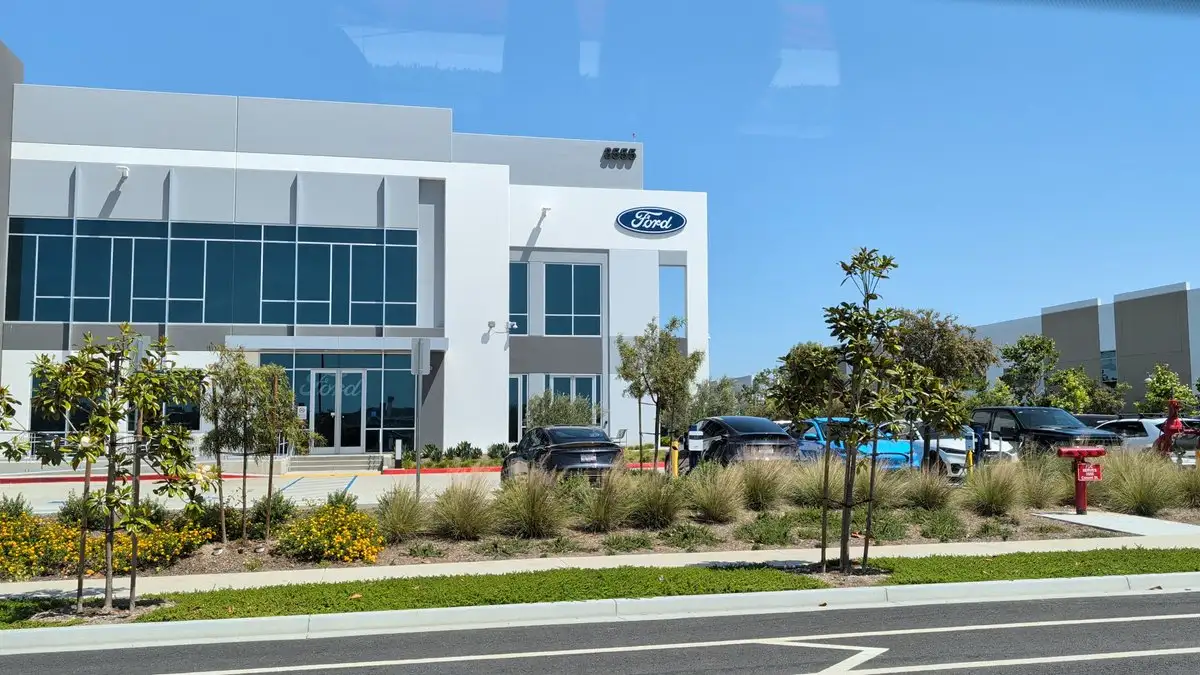
Ford Motor Company is pressing forward with a radically redesigned electric vehicle strategy centered around its new Universal Electric Vehicle (UEV) platform, despite slowing EV demand, billions in restructuring losses, and weakening U.S. incentives. The automaker plans to launch a roughly $30,000 midsize electric pickup by 2027, targeting profitability through lower-cost manufacturing, smaller batteries, and simplified vehicle architecture.
Developed by a secretive “skunkworks” team led by former Tesla engineers, the platform is designed to compete with Chinese EV makers and bring EV costs closer to traditional gasoline vehicles. Ford expects the UEV program to transform its loss-making Model e division and achieve breakeven by 2029, while reducing parts, wiring, assembly time, and production complexity.
The initiative represents one of Ford’s most ambitious manufacturing overhauls since the Model T, signaling a broader industry shift toward affordable, scalable EVs amid intensifying global competition.
Key Overview
- Ford Motor Company targeting ~$30,000 EV pickup by 2027
- EV restructuring charges reached $19.5B
- Model e projected to lose $4B–$4.5B in 2026
- New UEV platform aims for profitability within one year of launch
- Vehicles designed with 20% fewer parts and 25% fewer fasteners
- Assembly time expected to improve by 15%
- EV Development Center spans 270,000 square feet in California
- Ford targeting Model e breakeven by 2029
Ford Pushes Forward Despite EV Market Slowdown
While much of the global automotive industry is scaling back electric vehicle ambitions after reporting billions of dollars in losses, Ford Motor Company is continuing to move aggressively toward its next generation of EVs. The company’s strategy comes despite mounting industry headwinds, including slowing consumer adoption, the removal of U.S. EV purchase incentives, and rising competitive pressure from Chinese automakers.
Ford’s EV transition has been costly. The company has recorded approximately $19.5 billion in EV restructuring charges, while its Model e electric vehicle division is projected to lose between $4 billion and $4.5 billion in 2026, following losses of roughly $4.8 billion the previous year.
Yet despite these financial pressures, Ford executives remain committed to electrification—albeit with a significantly revised strategy focused on affordability, efficiency, and manufacturing discipline.
According to company leadership, “agility” has become central to Ford’s EV roadmap, allowing the automaker to adapt to changing market conditions while maintaining long-term ambitions.
Markets move fast; don’t get left behind. We’ve paired the Serrari Group Market Index with a curated Marketplace and a comprehensive Wealth Builder Course to ensure you have the data—and the skills—to act on it.
The Universal EV Platform: Ford’s “Moon Shot”
At the center of Ford’s strategy is its new Universal Electric Vehicle (UEV) platform, a clean-sheet architecture designed to dramatically reduce production costs while improving scalability and profitability.
The platform is expected to underpin a new family of electric vehicles, beginning with a roughly $30,000 midsize electric pickup truck targeted for launch in 2027. Ford believes the vehicle will occupy a largely untapped segment, combining:
- Mainstream affordability
- Strong utility and performance
- Advanced software and in-car technology
- Approximately 300 miles of driving range
Executives describe the UEV program internally as a “moon shot,” reflecting its strategic importance to the company’s future.
Ford expects the platform to help transform its EV business from a loss-generating operation into a profitable one, with the company targeting breakeven for Model e by 2029 and profitability for future EVs within one year of launch.
CEO Jim Farley has compared the significance of the UEV to the historic Ford Model T, describing it as one of the most radical manufacturing changes at Ford in over a century.
Reinventing EV Manufacturing for Lower Costs
To achieve profitability at lower price points, Ford is fundamentally redesigning how it engineers and manufactures electric vehicles.
The company has adopted a “best part is no part” philosophy, aiming to reduce unnecessary complexity throughout the vehicle. Compared to the Ford Mustang Mach-E, future UEV-based vehicles are expected to feature:
- 20% fewer parts
- 25% fewer fasteners
- 40% fewer workstations in assembly plants
- 15% faster assembly times
Engineers have also eliminated thousands of feet of wiring and improved aerodynamics by approximately 15%, helping reduce weight and increase efficiency.
A major innovation is Ford’s adoption of a modular assembly system using three large castings merged late in production, a manufacturing approach commonly associated with Tesla and leading Chinese EV makers.
Battery technology is another key focus area. Ford plans to use:
- Smaller battery packs
- U.S.-produced lithium iron phosphate (LFP) cells
- A new 48-volt electrical architecture
These changes are intended to lower costs, improve efficiency, and reduce dependence on expensive battery materials that have historically undermined EV profitability.
A “Skunkworks” Team Inspired by Silicon Valley
The UEV platform was developed through a highly unconventional internal initiative often described as a “skunkworks” project—a small, isolated team operating largely outside Ford’s traditional corporate structure.
The effort began in 2022 under the leadership of former Tesla and Apple engineers, including Alan Clarke, a Tesla veteran who became one of the first employees involved in the project. The team prioritized:
- Speed and rapid iteration
- Cost reduction
- Simplified design and manufacturing
Initially, the project faced friction between Silicon Valley-style developers and traditional Detroit engineering culture. However, collaboration improved as the program evolved and strategic priorities became clearer.
Ford later abandoned an earlier SUV concept and redirected the initiative toward a midsize pickup truck, which executives viewed as a stronger opportunity for mass-market EV adoption in North America.
Today, the company’s new 270,000-square-foot Electric Vehicle Development Center in Long Beach, California, houses roughly 350 employees working on the platform and future vehicle programs.
Context is everything. While you follow today’s updates, use the Serrari Group Market Index and Marketplace to spot emerging shifts. Need to sharpen your edge? Our Wealth Builder Course turns these insights into a professional-grade strategy.
Competing Against China’s EV Surge
A major driver behind Ford’s strategic overhaul is the rapid rise of Chinese EV manufacturers, which have dramatically expanded their global market share in recent years and intensified pressure on traditional automakers worldwide. Chinese brands have become increasingly competitive due to their ability to produce lower-cost electric vehicles at scale while rapidly advancing battery and software technologies.
According to industry data, Chinese automotive brands have increased global market share by nearly 70% over the past five years, gaining ground across Europe, Latin America, Southeast Asia, and other international markets. Their rapid expansion is reshaping the competitive landscape and forcing legacy automakers to rethink pricing, manufacturing efficiency, and product development strategies.
Although Chinese EV companies have not yet fully entered the U.S. market, Ford executives view them as one of the biggest long-term competitive threats to the global auto industry due to:
- Lower manufacturing and battery production costs
- Faster product development cycles
- Aggressive pricing strategies
- Advanced battery, software, and digital integration
Ford leadership has repeatedly emphasized the importance of maintaining strong domestic manufacturing capabilities while remaining globally competitive in an increasingly price-sensitive market.
As a result, the new Universal EV (UEV) platform is not just an electrification strategy—it is also part of a broader industrial strategy aimed at restoring competitiveness, improving efficiency, and helping Ford compete in a rapidly evolving global automotive market increasingly shaped by Chinese EV innovation.
Lessons From Earlier EV Setbacks
Ford’s current EV strategy reflects lessons learned from earlier electric vehicle challenges, particularly as the company works to balance electrification goals with profitability. The automaker has increasingly shifted toward a more disciplined and cost-focused approach after several high-profile EV programs failed to meet expectations.
The Ford F-150 Lightning was initially promoted as a transformational product and even described as a “Model T moment” for the company. However, demand slowed amid high prices, rising interest rates, and concerns around charging infrastructure and towing range. Ford is now reportedly redesigning the vehicle with hybrid capabilities as part of a more flexible strategy.
Similarly, Ford canceled its planned three-row electric SUV in 2024 after determining that the project would not be profitable under current market conditions and battery costs.
These experiences pushed the company to rethink its EV priorities, moving away from:
- Large battery-intensive vehicles
- Premium pricing strategies
- Low-margin EV programs
Instead, Ford is now focusing on smaller, more affordable vehicles designed for higher production efficiency and broader consumer appeal. The company believes its new Universal EV platform can help lower manufacturing costs while improving profitability and scalability for future electric models.
Outlook: Can Ford Build a Profitable Mass-Market EV?
Ford’s next-generation EV strategy represents one of the most important tests facing the broader automotive industry: whether electric vehicles can become both mass-market affordable and consistently profitable.
In the near term, the company’s focus will remain on:
- Finalizing prototype testing
- Preparing production lines in Kentucky
- Driving down battery and manufacturing costs
- Launching the midsize pickup on schedule in 2027
Over the longer term, the success of the UEV platform could determine Ford’s competitive position in a global market increasingly shaped by:
- Chinese EV expansion
- Cost pressures
- Software-defined vehicles
- Consumer demand for affordability rather than premium performance alone
Ultimately, Ford is betting that the future of electric mobility will not be won through luxury pricing or oversized battery packs, but through efficient manufacturing, simplified engineering, and accessible price points.
If successful, the company’s UEV initiative could redefine how mainstream EVs are designed and built—potentially becoming Ford’s most important industrial transformation since the original Model T.
Your financial future isn’t something you wait for—it’s something you build.
The real question is: when do you begin?
Move beyond simply staying informed.
Navigate the markets with clarity—track trends through the Serrari Group Market Index, uncover opportunities in the Serrari Marketplace, and build practical knowledge with our Curated Wealth Builder Course.
Stay connected to what truly matters.
Get daily insights on macro trends and financial movements across Kenya, Africa, and global markets—delivered through the Serrari Newsletter.
Growth opens doors.
Advance your career through professional programs including ACCA, HESI A2, ATI TEAS 7 , HESI EXIT , NCLEX – RN and NCLEX – PN, Financial Literacy!🌟—designed to move you forward with confidence.
See where money is flowing—clearly and in real time.
Track Money Market Funds, Treasury Bills, Treasury Bonds, Green Bonds, and Fixed Deposits, alongside global and African indexes, key economic indicators, and the evolving Crypto and stablecoin landscape—all within Serrari’s Market Index.