The Kenya residential real estate market continues to show mixed signals in 2026, with wealthy investors remaining cautious about purchasing additional homes despite rising property values in select locations. While home-buying activity has softened, rental demand and real estate investment in quality residential assets continue to support the broader market.
Key Overview
- Wealthy buyers remain cautious.
- Most clients own three homes.
- Home purchases stay limited.
- Rental demand remains strong.
- Standalone homes outperform apartments.
- Luxury property allocations stay low.
- Nairobi suburbs record price gains.
- Investors favour income stability.
Kenya Residential Real Estate Buyers Stay Cautious in 2026
Kenya’s residential real estate market is expected to remain subdued among high-net-worth individuals this year, with wealthy investors showing limited appetite for additional home purchases despite continued growth in selected property markets.
According to the latest Knight Frank Wealth and Investments Trends survey, affluent households continue to prioritise portfolio preservation over aggressive property acquisitions, even as multiple-home ownership becomes increasingly common among Kenya’s wealthy families.
Wealthy Investors Slow Home Purchases
The survey found that 39% of wealth managers expect fewer than one in ten of their affluent clients to purchase a home during 2026.
Although this represents a slight improvement from 2025, when 43% of wealth managers reported similarly low buying activity, the findings suggest that caution continues to dominate investment decisions in Kenya’s residential property market.
Rather than expanding their portfolios through new acquisitions, many wealthy investors appear focused on managing existing property holdings while waiting for more favourable market conditions.
Multiple-Home Ownership Continues to Rise
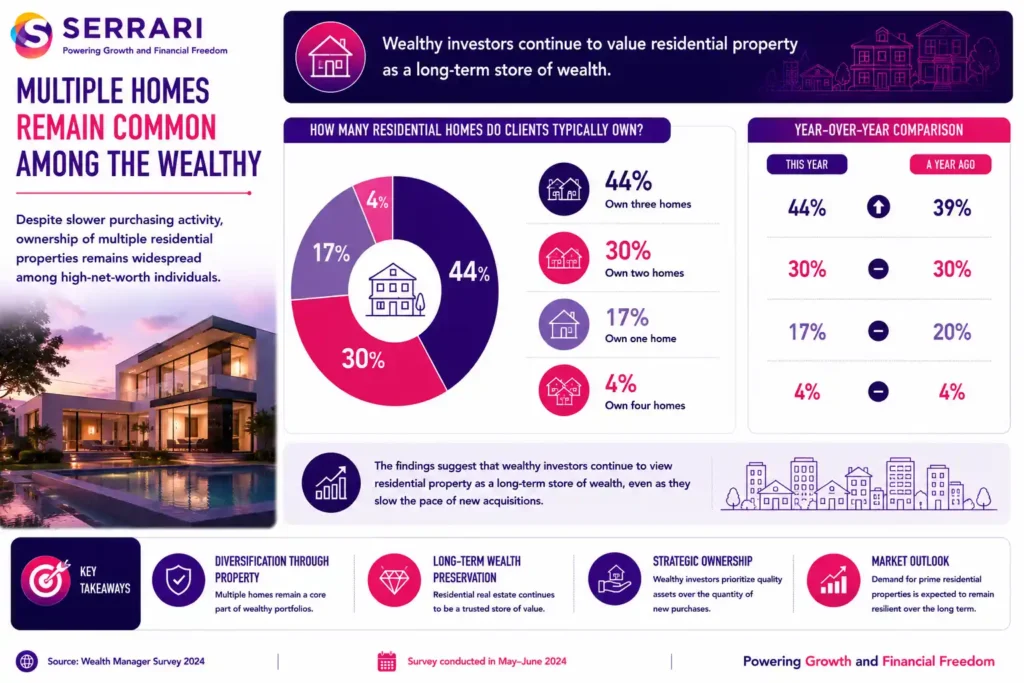
Despite slower purchasing activity, ownership of multiple residential properties remains widespread among high-net-worth individuals.
According to the survey, 44% of wealth managers said their clients typically own three homes, an increase from 39% a year earlier.
Another 30% reported that their clients generally own two homes, while 17% said affluent households own a single residential property. Only 4% indicated that clients typically own four homes.
The findings suggest that wealthy investors continue to view residential property as a long-term store of wealth, even as they slow the pace of new acquisitions.
Standalone Homes Continue to Outperform
Recent market data shows that demand remains strongest for standalone houses.
According to the HassConsult Property Price Index for the first quarter of 2026, residential property prices in Nairobi’s suburbs increased by 1.1%, accelerating from 0.8% in the previous quarter.
Lavington recorded the strongest quarterly house price growth at 4.2%, followed by Spring Valley at 4.0%, Kilimani at 3.9%, and Karen, Loresho and Westlands, each posting growth of 3.8%.
The performance reflects continued demand for larger detached homes despite the cautious investment environment.
Apartment Market Shows Mixed Performance
The apartment segment delivered varied results across Nairobi.
Muthangari and Riverside recorded price gains of 3.8% and 1.8% respectively, while Westlands and Upper Hill experienced declines of 2.8% and 2.5% as increased supply placed downward pressure on prices.
Outside the capital, satellite towns also experienced weaker performance, with residential prices declining by 0.9% after recording only modest growth during the previous quarter.
The contrasting performance highlights growing differences between individual property segments and locations across the Kenyan housing market.
Context is everything. Stay ahead of shifting trends with today’s market updates, and uncover emerging opportunities using the Serrari Group Market Index and Marketplace. Then, take control of your own financial future by exploring our Money & Life Reset Transformation Blueprint ™ to build stronger habits, create better systems, and design a path toward lasting wealth.
Rental Market Remains Resilient
While residential sales have moderated, Kenya’s rental market continues to demonstrate resilience.
Rental prices increased by 1.3% across Nairobi’s suburbs during the first quarter, while satellite towns recorded growth of 1.4%, reflecting sustained demand from households choosing to rent rather than purchase homes.
Juja and Ngong posted the strongest rental growth among satellite towns, with asking rents rising 4.0% and 3.9% respectively.
The strength in rental demand helped maintain attractive investment returns, with gross yields remaining steady at 7.4% in Nairobi suburbs and improving slightly to 5.3% in satellite towns.
Luxury Assets Remain a Small Allocation
The survey also indicates that luxury investments continue to occupy only a small portion of wealthy investors’ portfolios.
Nearly 63% of wealth advisers said their clients allocate less than 10% of their investment portfolios to luxury assets, while only 6% reported allocations between 31% and 40%.
No respondents indicated that clients allocate more than 40% of their wealth to luxury investments, suggesting that most affluent households continue prioritising diversified investment strategies over passion assets.
Outlook for Kenya Residential Real Estate
The Kenya property market continues to display resilience despite cautious buying activity among wealthy investors.
Demand for standalone homes, stable rental income and improving performance in selected residential locations continue supporting the sector, even as affordability challenges and economic uncertainty limit new purchases.
With Nairobi’s homeownership rate remaining relatively low and rental demand strengthening, investors are increasingly focusing on income-generating residential assets while waiting for clearer market signals before expanding their property portfolios.
FAQs
Why are wealthy investors buying fewer homes in Kenya?
High-net-worth investors are adopting a more cautious approach amid economic uncertainty and changing market conditions. Many already own multiple properties and are prioritising portfolio optimisation rather than expanding their residential holdings.
Which residential properties are performing best in Kenya?
Standalone houses continue to outperform apartments, particularly in Nairobi suburbs such as Lavington, Spring Valley, Karen, Kilimani and Westlands, where prices recorded some of the strongest quarterly gains.
Is Kenya’s rental market still attractive?
Yes. Rental demand remains strong across Nairobi and surrounding satellite towns as many households continue renting instead of buying homes. This has helped maintain healthy rental yields for residential property investors.
What does the outlook mean for Kenya’s residential real estate market?
The market is expected to remain stable rather than experience rapid growth. Investors are likely to continue favouring quality residential assets that generate consistent rental income while remaining selective about new property acquisitions.
Sources: Kenyan Wallstreet, Kenyans.co, Kenya News Agency
Your financial future isn’t something you wait for—it’s something you build.
The real question is: when do you begin?
Move beyond simply staying informed.
Navigate the markets with clarity—track trends through the Serrari Group Market Index, uncover opportunities in the Serrari Marketplace, and build practical knowledge with our Curated Wealth Builder Platform.
Stay connected to what truly matters.
Get daily insights on macro trends and financial movements across Kenya, Africa, and global markets—delivered through the Serrari Newsletter.
Growth opens doors.
Advance your career through professional programs including ACCA, HESI A2, ATI TEAS 7 , HESI EXIT , NCLEX – RN and NCLEX – PN, Financial Literacy!🌟—designed to move you forward with confidence.
See where money is flowing—clearly and in real time.
Track Money Market Funds, Treasury Bills, Treasury Bonds, Green Bonds, and Fixed Deposits, alongside global and African indexes, key economic indicators, and the evolving Crypto and stablecoin landscape—all within Serrari’s Market Index.