The Kenya green bond will mobilise KSh 6.47 billion (USD 50 million) to finance off-grid solar energy across East Africa, with Kenya expected to be one of the primary beneficiaries. Led by Standard Chartered Kenya and African Frontier Capital, the transaction aims to improve household energy access, accelerate renewable energy financing, and support climate finance Kenya by bringing affordable clean energy to approximately 4.3 million people.
Key Overview
- Standard Chartered and African Frontier Capital announced a KSh 6.47 billion green bond.
- The transaction will finance off-grid solar energy through d.light.
- Around 4.3 million people are expected to benefit from improved energy access.
- Kenya remains one of East Africa’s largest solar home system markets.
- Nearly 62.7% of rural Kenyan households remain off the national electricity grid.
- The financing builds on African Frontier Capital’s previous successful securitisation for d.light.
- The initiative supports Kenya’s universal electricity access target by 2030.
- The structure demonstrates how private capital can accelerate renewable energy investment across Africa.
Kenya Green Bond Supports Clean Energy Expansion
The Kenya green bond marks another important milestone in the country’s transition toward renewable energy and sustainable finance. Standard Chartered and African Frontier Capital have announced a USD 50 million (KSh 6.47 billion) green bond designed to expand access to affordable solar power for millions of households that remain outside the national electricity grid.
The financing is expected to benefit approximately 4.3 million people across East Africa, with Kenya positioned at the centre of the initiative due to its well-established off-grid solar market and ambitious electrification goals. By mobilising international private capital, the transaction strengthens renewable energy financing while advancing broader climate finance Kenya objectives.
Standard Chartered Kenya Leads Major Green Financing Initiative
The transaction brings together Standard Chartered Kenya, African Frontier Capital and renewable energy provider d.light to support wider deployment of solar home systems using innovative capital markets financing.
Rather than relying solely on traditional bank lending, the green bond channels institutional investment into portfolios of pay-as-you-go solar assets. This approach enables renewable energy companies to expand operations while allowing investors to participate in sustainable infrastructure financing.
According to the project partners, the transaction creates a scalable funding model capable of supporting future renewable energy investments across Africa.
Kenya Remains a Regional Leader in Solar Energy
Kenya has become one of Africa’s most successful markets for off-grid solar technology.
d.light has operated in Kenya since 2011 and has established itself as one of East Africa’s leading providers of solar home systems and PayGo energy financing.
The country currently accounts for nearly three-quarters of all solar home system sales in East Africa, reflecting strong consumer demand for affordable alternatives where grid electricity remains unavailable or unreliable.
This mature market provides a strong foundation for expanding household energy access through additional investment.
Context is everything. Stay ahead of shifting trends with today’s market updates, and uncover emerging opportunities using the Serrari Group Market Index and Marketplace. Then, take control of your own financial future by exploring our Money & Life Reset Transformation Blueprint ™ to build stronger habits, create better systems, and design a path toward lasting wealth.
Millions Still Lack Reliable Electricity
Despite Kenya’s progress in expanding electricity access, significant gaps remain, particularly in rural communities.
According to the Kenya National Bureau of Statistics, approximately 62.7% of rural households remain off the national electricity grid.
For many families, extending the traditional grid remains costly due to geographic and infrastructure challenges.
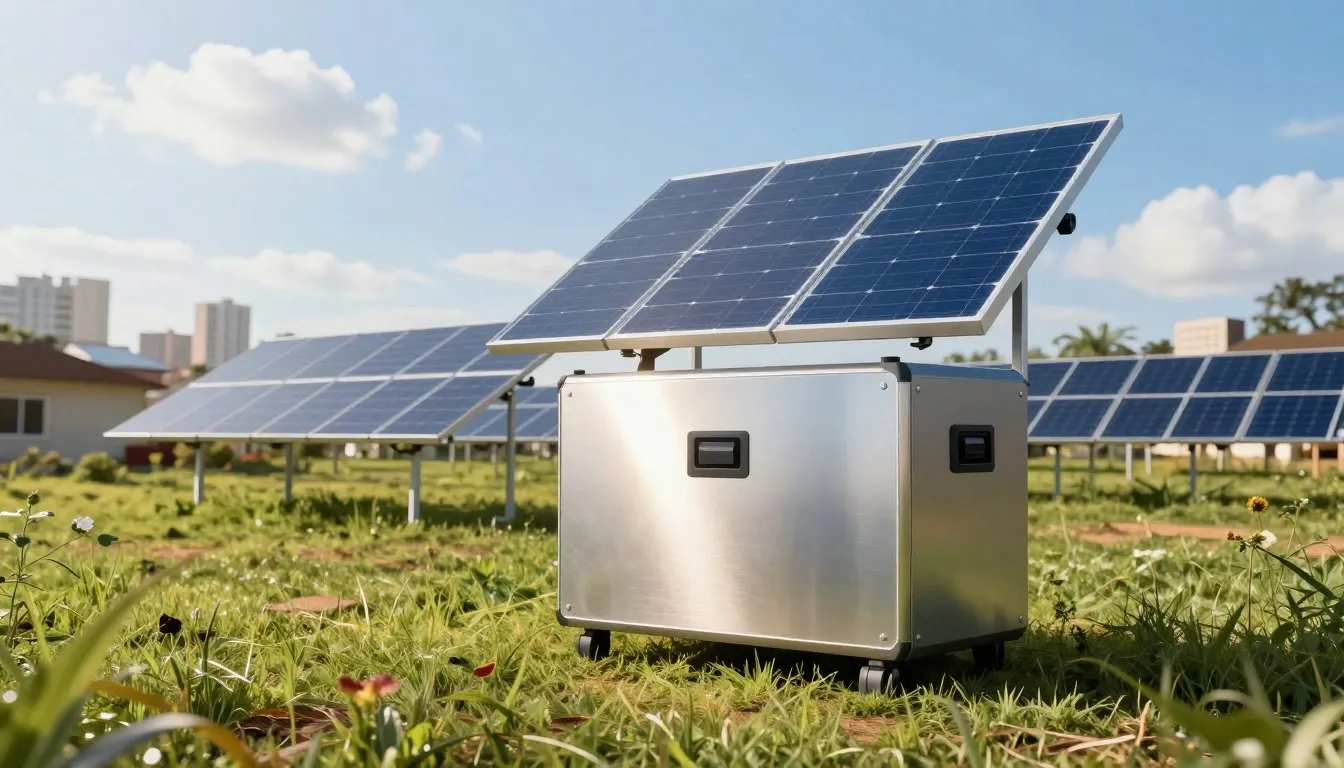
Off-grid solar systems provide an alternative solution by delivering electricity directly to households without requiring expensive transmission infrastructure. These systems support lighting, mobile phone charging, televisions, radios and small productive businesses, improving both living standards and economic opportunities.
The government continues working toward its goal of achieving universal electricity access by 2030, making renewable energy investment increasingly important.
Building on a Proven Financing Model
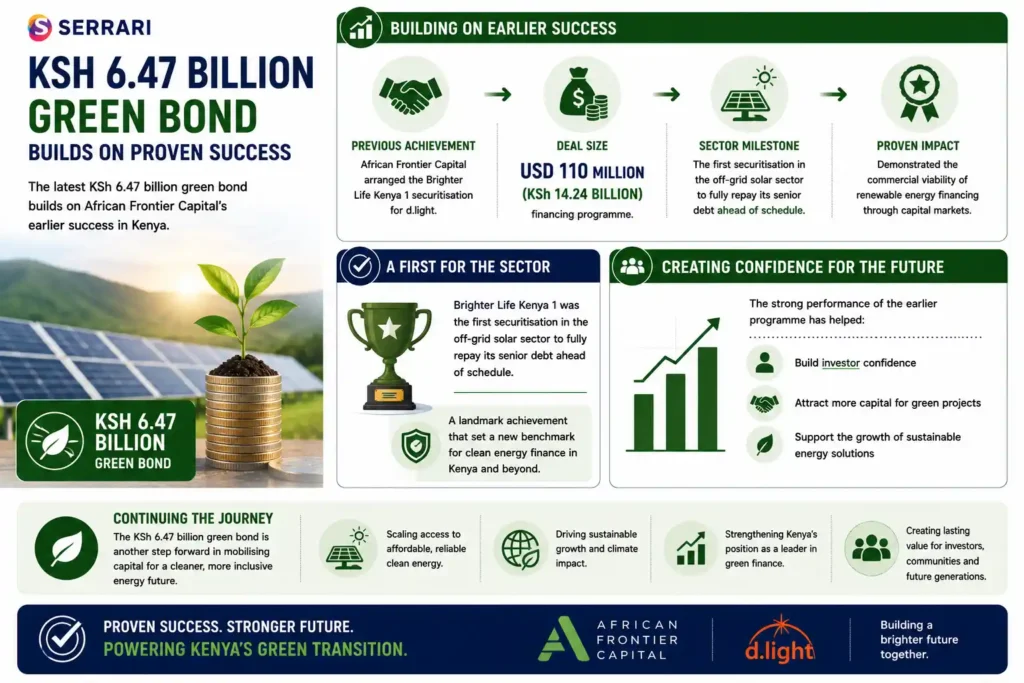
The latest KSh 6.47 billion green bond builds on African Frontier Capital’s earlier success in Kenya.
The firm previously arranged the Brighter Life Kenya 1 securitisation, a USD 110 million (KSh 14.24 billion) financing programme for d.light.
That transaction became the first securitisation in the off-grid solar sector to fully repay its senior debt ahead of schedule, demonstrating the commercial viability of renewable energy financing through capital markets.
The strong performance of the earlier programme has helped create investor confidence for subsequent green financing initiatives.
Private Capital Supports Climate Finance Kenya
The transaction highlights the growing role of private investors in supporting climate finance Kenya.
While governments and development institutions remain important sources of climate funding, private capital is increasingly viewed as essential for meeting the enormous investment required to achieve clean energy targets.
By combining institutional investment with guarantees and capital markets expertise, the financing structure connects global investors with renewable energy projects capable of generating both financial returns and measurable environmental benefits.
This approach reduces dependence on public funding while encouraging broader participation in sustainable infrastructure investment.
Renewable Energy Financing Drives Inclusive Growth
Beyond reducing carbon emissions, renewable energy projects deliver significant social and economic benefits.
Greater access to electricity enables households to improve education, healthcare, communication and small business productivity.
Solar home systems also reduce dependence on kerosene, candles and diesel generators, lowering household energy costs while improving indoor air quality and reducing greenhouse gas emissions.
As more households gain access to reliable electricity, renewable energy contributes directly to financial inclusion and rural economic development.
For investors, these projects also demonstrate how sustainable finance can generate measurable environmental and social outcomes alongside long-term investment returns.
Green Bonds Continue Expanding Across Africa
The latest Kenya green bond reflects a broader trend across African capital markets as governments, banks and development finance institutions increasingly use thematic bonds to finance climate-related projects.
Green bonds have become an important mechanism for raising capital dedicated to renewable energy, sustainable infrastructure, clean transportation and environmental conservation.
As investor demand for environmental, social and governance (ESG) investments continues to grow globally, African issuers are increasingly accessing international capital markets to finance climate resilience and sustainable development initiatives.
Successful transactions such as this one may encourage additional green bond issuances across the continent.
Conclusion
The Kenya green bond demonstrates how innovative financing structures can accelerate renewable energy investment while expanding household energy access across the country. Supported by Standard Chartered Kenya and African Frontier Capital, the KSh 6.47 billion green bond provides new capital for off-grid solar systems that could benefit approximately 4.3 million people. As Kenya works toward universal electricity access by 2030, partnerships between private investors and renewable energy providers are expected to play an increasingly important role in advancing climate finance Kenya and sustainable economic development.
FAQs
1. What is the Kenya green bond?
The Kenya green bond is a USD 50 million (KSh 6.47 billion) sustainable financing transaction arranged by Standard Chartered and African Frontier Capital to support renewable energy projects through d.light. The proceeds will help finance off-grid solar home systems that expand access to affordable electricity across East Africa, with Kenya expected to be one of the main beneficiaries. The bond also demonstrates how private capital can be mobilised to support climate-friendly infrastructure while delivering measurable social and environmental benefits.
2. How will the green bond improve household energy access?
The financing will support the expansion of solar home systems that provide electricity to households not connected to the national power grid. These systems enable families to access lighting, phone charging, televisions and other basic electrical services without waiting for traditional grid infrastructure to reach their communities. Since around 62.7% of rural Kenyan households remain off-grid, expanding renewable energy solutions can significantly improve quality of life while supporting education, healthcare and small business activities.
3. Why is Kenya important for renewable energy financing?
Kenya is one of Africa’s leading markets for off-grid solar energy and accounts for nearly three-quarters of all solar home system sales in East Africa. The country has developed a strong ecosystem for pay-as-you-go solar financing, supported by companies such as d.light that have operated locally for many years. Combined with Kenya’s national target of achieving universal electricity access by 2030, these factors make the country an attractive destination for renewable energy financing and climate-focused investment.
4. How do green bonds support climate finance in Kenya?
Green bonds raise capital specifically for environmentally sustainable projects such as renewable energy, clean transportation and climate resilience initiatives. In Kenya, these instruments help attract international institutional investors while providing long-term funding for projects that reduce greenhouse gas emissions and expand clean energy access. As demand for sustainable investments continues to grow globally, green bonds are becoming an increasingly important tool for advancing climate finance in Kenya and supporting the country’s long-term environmental and economic development goals.
Your financial future isn’t something you wait for—it’s something you build.
The real question is: when do you begin?
Move beyond simply staying informed.
Navigate the markets with clarity—track trends through the Serrari Group Market Index, uncover opportunities in the Serrari Marketplace, and build practical knowledge with our Curated Wealth Builder Platform.
Stay connected to what truly matters.
Get daily insights on macro trends and financial movements across Kenya, Africa, and global markets—delivered through the Serrari Newsletter.
Growth opens doors.
Advance your career through professional programs including ACCA, HESI A2, ATI TEAS 7 , HESI EXIT , NCLEX – RN and NCLEX – PN, Financial Literacy!🌟—designed to move you forward with confidence.
See where money is flowing—clearly and in real time.
Track Money Market Funds, Treasury Bills, Treasury Bonds, Green Bonds, and Fixed Deposits, alongside global and African indexes, key economic indicators, and the evolving Crypto and stablecoin landscape—all within Serrari’s Market Index.