
Kenya has introduced a new framework governing international carbon trading under Article 6 of the Paris Agreement, becoming one of the first African countries to place a national cap on the volume of carbon credits it can sell internationally. The framework limits international carbon credit authorisations to 10 million metric tons of carbon dioxide equivalent through 2030, with annual allocations capped at 1.67 million metric tons. The reforms are designed to protect Kenya’s own climate commitments while improving transparency, streamlining project approvals and strengthening investor confidence in the country’s growing carbon market.
Key Overview
- Kenya has introduced a new Article 6 of the Paris Agreement carbon trading framework.
- International carbon credit authorisations are capped at 10 million metric tons of carbon dioxide equivalent through 2030.
- Annual allocations are limited to 1.67 million metric tons.
- The framework prioritises renewable energy, transportation and waste projects.
- Forestry and other land-use projects are excluded from the initial priority list.
- The reforms simplify project approvals and strengthen transparency for investors.
Kenya has introduced a comprehensive framework governing international carbon trading, becoming one of the first African countries to establish a national cap on the volume of carbon credits that can be authorised for international trading.
The new framework aligns with Article 6 of the Paris Agreement and limits international carbon credit authorisations to 10 million metric tons of carbon dioxide equivalent through 2030, with annual allocations capped at 1.67 million metric tons.
The policy is intended to ensure Kenya does not transfer emissions reductions needed to meet its own climate commitments while providing greater certainty for project developers and international buyers.
New Carbon Budget Strengthens Climate Integrity
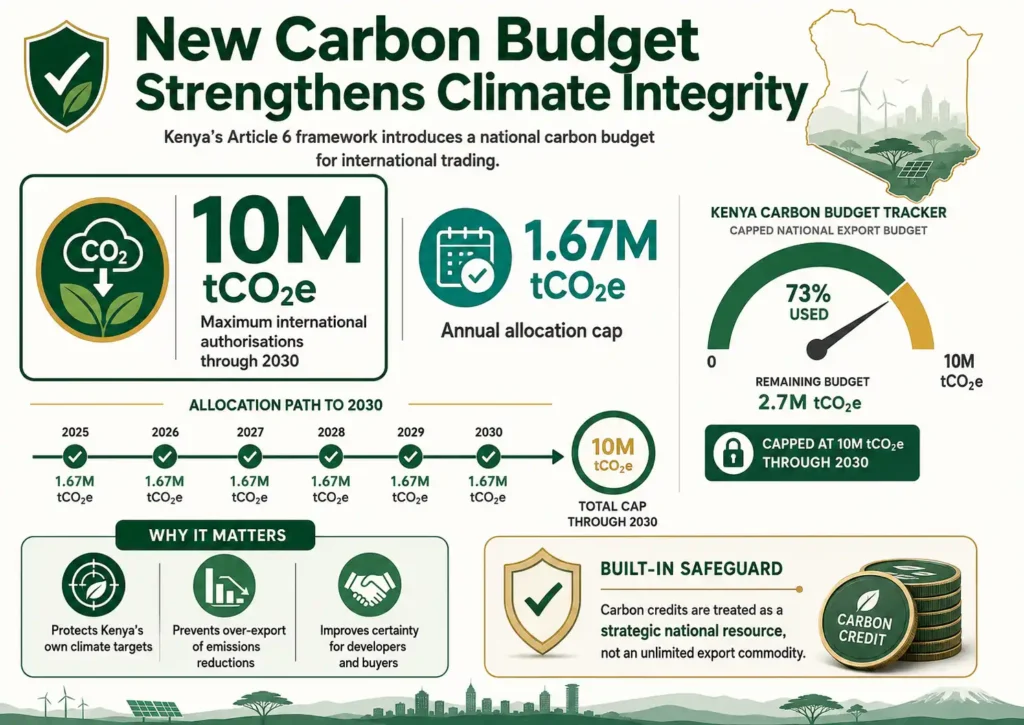
The framework introduces what officials describe as a national carbon budget for international trading.
According to Environment and Climate Change Principal Secretary Festus Ng’eno, the guide establishes “a national carbon budget for trading as a binding safeguard” while providing government agencies with practical decision-making tools throughout the lifecycle of carbon market projects.
The export ceiling is designed to prevent large volumes of emissions reductions from being transferred overseas before Kenya secures the reductions required to achieve its domestic climate targets.
Officials say transparent tracking of the remaining carbon budget will provide both project developers and buyers with greater certainty regarding the volume of carbon credits that can still be authorised for international trading.
Project Approval Process Simplified
The framework replaces the previous approval system, which relied on a three-stage process comprising No-Objection, Approval and Authorization.
Under the new guide, project approvals will be based on clearer and more transparent decision-making criteria intended to improve efficiency while maintaining environmental integrity.
Festus Ng’eno said government decisions will be guided by “clear, published criteria designed to deliver national benefits without compromising Kenya’s climate integrity.”
Officials believe the simplified approval framework will improve predictability for investors while strengthening institutional coordination across government agencies.
Priority Sectors Identified
The guide introduces a conditional list of priority activities covering renewable energy, transportation and waste projects.
However, forestry and other land-use projects have been excluded from the initial priority list while Kenya develops stronger emissions baselines and improved data systems to address reversal risks and strengthen project monitoring.
Officials emphasised that inclusion on the priority list does not guarantee project approval but is intended to accelerate the review of projects that align with Kenya’s national development priorities.
Context is everything. Stay ahead of shifting trends with today’s market updates, and uncover emerging opportunities using the Serrari Group Market Index and Marketplace. Then, take control of your own financial future by exploring our Money & Life Reset Transformation Blueprint ™ to build stronger habits, create better systems, and design a path toward lasting wealth.
Supporting Kenya’s Growing Carbon Market
Kenya has emerged as one of Africa’s leading carbon market destinations, attracting investments in clean cooking, renewable energy, mangrove restoration and forest conservation.
The government expects the new framework to improve investor confidence by making regulatory decisions more predictable while ensuring local communities continue benefiting from carbon market projects.
“Predictability, transparency, and institutional coherence are essential to attracting quality investment,” Festus Ng’eno said.
The framework also reflects a broader shift toward treating carbon credits as a strategic national resource rather than an unlimited export commodity.
Building a Stronger Carbon Market Framework
The new guide builds on recent reforms aimed at strengthening Kenya’s carbon market architecture.
It comes six months after the launch of the National Carbon Registry, which provides a centralised system for authorising, tracking and reporting carbon credits generated across the economy while verifying ownership of emissions reductions.
The framework also arrives weeks after plans were confirmed for a domestic carbon exchange to begin operations by the end of March 2027 through a partnership involving the Nairobi International Financial Centre (NIFC), the Capital Markets Authority (CMA) and the Nairobi Securities Exchange (NSE).
The planned exchange is expected to provide a regulated marketplace where carbon credits can be traded locally before reaching international markets.
Outlook
Kenya’s new carbon trading framework represents a significant step in strengthening governance of the country’s growing carbon market while safeguarding its domestic climate commitments. By introducing a national carbon budget, simplifying project approvals and establishing priority investment sectors, the government aims to improve transparency and investor confidence without compromising climate integrity. As the National Carbon Registry and the planned domestic carbon exchange continue to develop, the new framework is expected to provide a stronger regulatory foundation for Kenya’s participation in international carbon markets while ensuring carbon credits remain aligned with national climate and development objectives.
FAQs
1. What is the purpose of Kenya’s new carbon trading framework?
The framework regulates international carbon trading under Article 6 of the Paris Agreement, strengthens transparency and ensures Kenya retains sufficient emissions reductions to meet its own climate commitments.
2. How many carbon credits can Kenya authorise for international trading?
The framework authorises no more than 10 million metric tons of carbon dioxide equivalent through 2030, with annual allocations limited to 1.67 million metric tons.
3. Which projects are prioritised under the new framework?
The framework gives priority to renewable energy, transportation and waste projects, while forestry and other land-use projects are currently excluded.
4. How does the framework support Kenya’s carbon market?
It introduces a national carbon budget, simplifies project approvals, strengthens transparency through the National Carbon Registry and supports the planned domestic carbon exchange.
Your financial future isn’t something you wait for—it’s something you build.
The real question is: when do you begin?
Move beyond simply staying informed.
Navigate the markets with clarity—track trends through the Serrari Group Market Index, uncover opportunities in the Serrari Marketplace, and build practical knowledge with our Curated Wealth Builder Platform.
Stay connected to what truly matters.
Get daily insights on macro trends and financial movements across Kenya, Africa, and global markets—delivered through the Serrari Newsletter.
Growth opens doors.
Advance your career through professional programs including ACCA, HESI A2, ATI TEAS 7 , HESI EXIT , NCLEX – RN and NCLEX – PN, Financial Literacy!🌟—designed to move you forward with confidence.
See where money is flowing—clearly and in real time.
Track Money Market Funds, Treasury Bills, Treasury Bonds, Green Bonds, and Fixed Deposits, alongside global and African indexes, key economic indicators, and the evolving Crypto and stablecoin landscape—all within Serrari’s Market Index.