The International Monetary Fund (IMF) has warned that government bond markets face a risk of sudden, disorderly increases in yields as elevated public debt, renewed inflation pressures and large-scale artificial intelligence (AI) financing strain investor demand. Its October 2026 financial stability assessment highlights vulnerabilities that could spread well beyond government borrowing.
The warning was issued during the IMF–World Bank annual meetings in Bangkok on October 13. Although major bond markets have generally continued to function in an orderly manner, the Fund cautioned that fiscal shocks and leveraged trading could make future selloffs more disruptive.
Key Overview
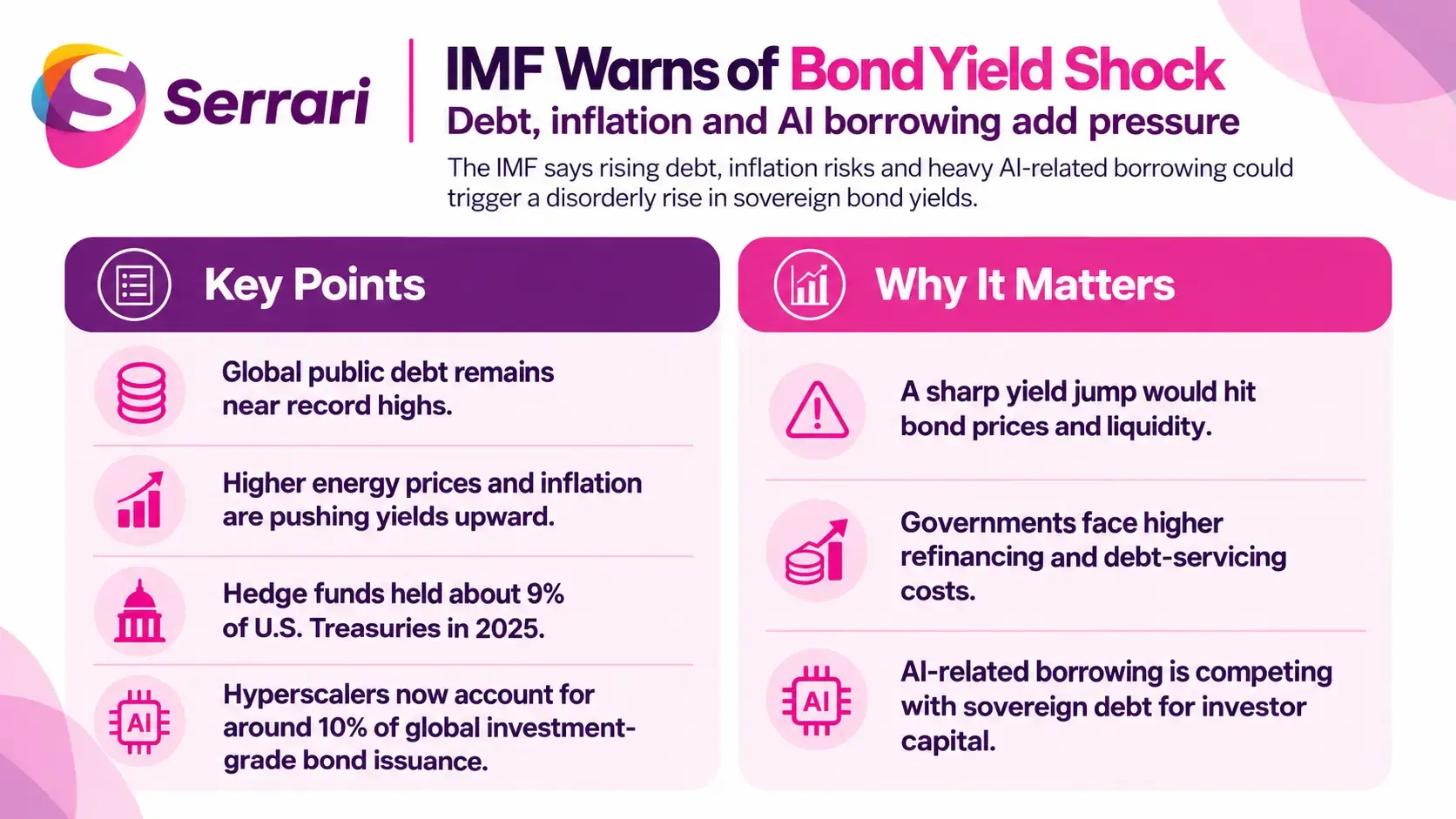
- Sovereign debt: Global public debt was nearly 94% of GDP in 2025 and is projected to reach 100% by 2029.
- Bond market risks: Inflation, heavy issuance and refinancing needs could trigger abrupt yield increases and bond price declines.
- Hedge fund exposure: Hedge funds held approximately 9% of outstanding US Treasuries in 2025, increasing concerns about leveraged trading.
- AI borrowing: Hyperscalers now account for around 10% of global investment-grade bond issuance, up from less than 1% in 2024.
- Circular financing: Large equity and debt commitments between AI companies may amplify losses if expected revenues disappoint.
Rising Debt and Inflation Threaten Bond Stability
Government finances are becoming more sensitive to changes in borrowing costs. The IMF’s public debt projections put global debt at just under 94% of GDP in 2025, rising toward 100% by 2029, a level previously reached only around the aftermath of World War II.
Higher energy prices linked to the Middle East conflict have added to inflation concerns, increasing the possibility that central banks will maintain tighter monetary policy. Higher yields make new government borrowing more expensive and reduce the market value of existing bonds.
Countries relying heavily on short-term debt face added refinancing pressure because maturing obligations must be replaced at prevailing interest rates. The IMF has consequently urged governments to strengthen fiscal credibility and debt managers to avoid excessive dependence on short-term issuance.
Hedge Funds Could Magnify Treasury Market Selloffs
The growing presence of leveraged investors is another source of concern. In its analysis of hedge fund exposures, the IMF estimated that the sector held about 9% of US Treasury securities in 2025, alongside roughly $13 trillion in gross assets globally.
Hedge funds often use repurchase agreements and derivatives to finance relative-value strategies, including trades involving Treasury bonds and futures. Such activity can improve liquidity in normal conditions but create pressure when market prices move abruptly.
If volatility rises, lenders may demand additional collateral or investors may withdraw money, forcing funds to unwind similar positions simultaneously. That could drive bond prices down, lift yields and weaken liquidity across interconnected funding markets. The IMF nevertheless reported that some leveraged Treasury trades had already been unwound without major disruption to repurchase markets.
Context is everything. Stay ahead of shifting trends with today’s market updates, and uncover emerging opportunities using the Serrari Group Market Index and Marketplace. Then, take control of your own financial future by exploring our Money & Life Reset Transformation Blueprint ™ to build stronger habits, create better systems, and design a path toward lasting wealth.
AI Borrowing Competes for Long-Term Capital
The global AI infrastructure boom is introducing another large source of bond supply. The IMF estimates that hyperscale technology companies account for approximately 10% of global investment-grade bond issuance, compared with less than 1% in 2024.
Financing for data centres, chips and computing infrastructure competes for institutional capital, potentially adding pressure to long-term borrowing costs. However, AI issuance is not established as the main reason sovereign yields have risen. A recent central-bank assessment also warns that growing debt-funded AI investment broadens financial-market exposure if projected earnings fail to materialise.
Circular AI Deals Create Additional Vulnerabilities
The IMF has also flagged transactions in which large technology firms invest in AI businesses that subsequently commit to buying the investors’ computing services or chips. These arrangements create interconnected funding and revenue expectations rather than fully independent demand.
According to reported financing commitments, approximately $300 billion in equity and $650 billion in debt are associated with some $1.4 trillion in future revenue commitments. The revenue figure represents promised business, not money already earned, and should not be added to the financing totals as if all were completed cash flows.
The concern is that disappointing AI returns could simultaneously weaken equity valuations, debt-servicing capacity and anticipated future revenue. This would increase the chance of losses spreading through lenders, investors and related companies, a vulnerability also identified in research on circular AI financing.
What Policymakers and Investors Should Watch
The IMF’s warnings concern risks rather than an imminent forecast of market collapse. Priority indicators include inflation expectations, long-term sovereign yields, debt refinancing schedules, hedge fund leverage and the profitability of AI infrastructure investments.
For policymakers, stronger fiscal plans, closer monitoring of nonbank leverage and improved market resilience could reduce the chance that an ordinary repricing becomes a broader financial shock. For investors, the key distinction is between higher yields that markets can absorb and an abrupt selloff that overwhelms available liquidity.
Sources: International Monetary Fund / Reuters / Bank of England / Bank for International Settlements / The Times
Your financial future isn’t something you wait for—it’s something you build.
The real question is: when do you begin?
Move beyond simply staying informed.
Navigate the markets with clarity—track trends through the Serrari Group Market Index, uncover opportunities in the Serrari Marketplace, and build practical knowledge with our Curated Wealth Builder Platform.
Stay connected to what truly matters.
Get daily insights on macro trends and financial movements across Kenya, Africa, and global markets—delivered through the Serrari Newsletter.
Growth opens doors.
Advance your career through professional programs including ACCA, HESI A2, ATI TEAS 7 , HESI EXIT , NCLEX – RN and NCLEX – PN, Financial Literacy!🌟—designed to move you forward with confidence.
See where money is flowing—clearly and in real time.
Track Money Market Funds, Treasury Bills, Treasury Bonds, Green Bonds, and Fixed Deposits, alongside global and African indexes, key economic indicators, and the evolving Crypto and stablecoin landscape—all within Serrari’s Market Index.