Jeonbuk Bank, a subsidiary of JB Financial Group, has introduced Bitcoin-backed loans for corporate customers in South Korea. Businesses can borrow Korean won for operating expenses using Bitcoin as collateral, while registered third-party custodians hold the cryptocurrency. The launch follows changes to civil enforcement rules that provide a court-supervised route for selling digital assets when borrowers default.
Key Overview
- Lender: Jeonbuk Bank, part of JB Financial Group.
- Eligible borrowers: Corporate customers.
- Accepted collateral: Bitcoin only at launch.
- Loan currency: South Korean won.
- Permitted use: Business operating expenses.
- Custody arrangement: Registered third-party digital asset custodians.
- Default recovery: Court-supervised sale of pledged Bitcoin.
Jeonbuk Bank Introduces Bitcoin-Backed Business Loans
Jeonbuk Bank has launched a lending service that allows corporate customers to borrow Korean won using Bitcoin as collateral, marking a first for South Korea’s traditional banking sector. The regional lender is initially restricting the product to businesses seeking working capital, rather than offering cryptocurrency-backed loans to individual consumers.
The initiative introduces a new way for companies holding Bitcoin to access financing without immediately selling their digital assets. Under the arrangement, borrowers pledge Bitcoin to secure a loan, while the bank provides funding in Korean won.
The service is part of Jeonbuk Bank’s wider effort to develop digital asset financial services. The bank’s first bank-issued won loans backed by Bitcoin also establish a framework for handling cryptocurrency collateral within conventional banking procedures.
The initial rollout is deliberately narrow: Bitcoin is the only accepted digital asset, and loan proceeds must be used for business operations. The bank may consider expanding the service as it gains experience and as regulations and customer demand evolve.
How the Bitcoin-Backed Loans Work
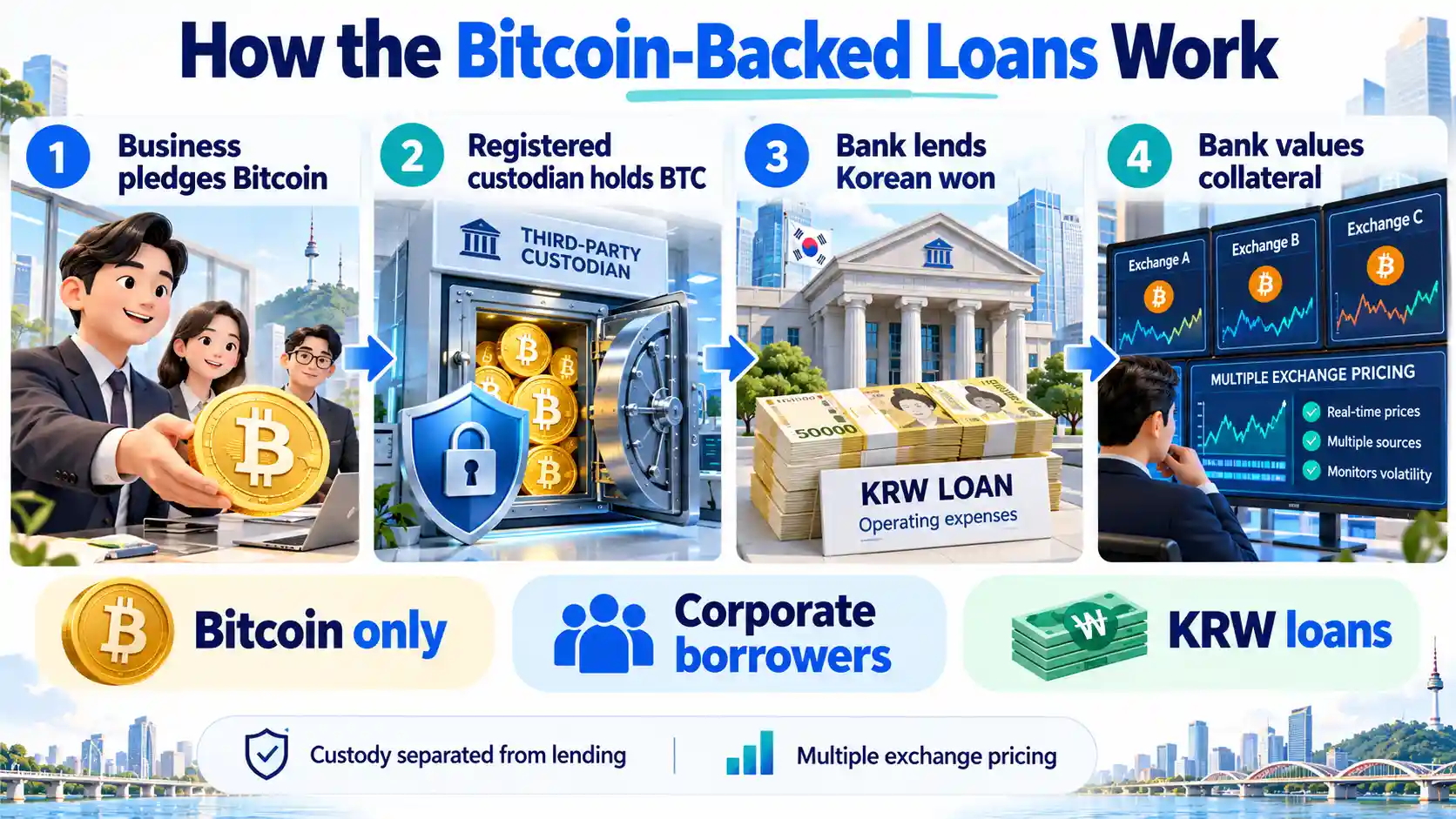
The arrangement separates lending from cryptocurrency custody. Businesses pledge Bitcoin as collateral, but Jeonbuk Bank does not directly own or manage the pledged coins. Instead, a registered custodian holds the assets while the bank manages the lending relationship and assesses the collateral.
This structure allows the lender to provide financing without operating its own Bitcoin custody system. The registered crypto custody provider holds the collateral, while the bank retains a claim secured by the pledged assets.
Bitcoin was selected because of its market size, trading activity and liquidity, which provide a broader basis for valuing the collateral and assessing whether it can be sold if a borrower fails to repay.
The bank has developed its own valuation system using prices from multiple cryptocurrency exchanges alongside market volatility indicators. This approach is designed to reduce dependence on a single exchange’s price and help the lender assess collateral during volatile market conditions.
However, the bank has not publicly disclosed key commercial terms, including interest rates, borrowing limits, loan-to-value ratios or the identity of the custodian.
Court Procedures Provide a Route to Recover Unpaid Loans
A central feature of the service is how the bank can recover its money if a borrower defaults. South Korea’s revised Civil Execution Rules, which took effect on 1 October 2026, provide procedures for enforcing claims involving virtual assets.
If a company fails to repay its loan, Jeonbuk Bank can pursue a court-ordered sale of the bitcoin pledged as collateral. The proceeds can then be used to settle the outstanding debt without the bank needing to take direct possession of the cryptocurrency.
This legal process distinguishes the service from some cryptocurrency lending arrangements that automatically liquidate collateral when preset price thresholds are reached. Jeonbuk Bank’s model instead relies on custody arrangements, loan agreements and court-supervised enforcement.
The framework provides a route for recovering funds, but it does not eliminate lending risks. Bitcoin prices can fall sharply, and the amount recovered from a forced sale may be insufficient to cover the outstanding loan. The timing and outcome of enforcement also matter.
Context is everything. Stay ahead of shifting trends with today’s market updates, and uncover emerging opportunities using the Serrari Group Market Index and Marketplace. Then, take control of your own financial future by exploring our Money & Life Reset Transformation Blueprint ™ to build stronger habits, create better systems, and design a path toward lasting wealth.
Risk Management and Collateral Valuation
Bitcoin’s volatility presents a central challenge for any lender accepting it as security. If the asset’s market value declines substantially, the collateral may no longer adequately cover the borrower’s obligations.
Jeonbuk Bank has conducted stress tests to examine how Bitcoin collateral could perform during sharp price declines. It also reviewed loan-to-value ratios and margin-call thresholds while designing the product.
These measures are intended to help the bank assess potential losses and determine how collateral should be valued. The use of prices from multiple exchanges can also help reduce the influence of unusual price movements on any one trading platform.
Custody is another important part of the risk framework. The bank’s arrangements rely on eligible providers that must meet South Korea’s relevant security and regulatory requirements, including applicable safeguards for customer assets.
Still, important details remain undisclosed. Without public information on collateral requirements, interest rates, margin procedures and borrowing limits, businesses cannot fully assess the financing costs and risks associated with the product.
A Potential Expansion of Digital Asset Banking
Jeonbuk Bank’s launch could provide a model for other financial institutions exploring ways to incorporate digital assets into conventional lending. The bank is beginning with corporate borrowers and a single cryptocurrency, giving it an opportunity to assess how collateral valuation, custody and enforcement work in practice.
The lender has indicated that it will review whether to broaden eligible borrowers, accepted assets and services based on market demand and regulatory developments. For now, individual customers cannot access the loans.
The development also reflects wider interest in using digital assets as collateral for institutional financing. However, Jeonbuk Bank’s initial offering remains distinct from consumer crypto lending and does not establish that other South Korean banks will immediately introduce similar products.
Outlook
Jeonbuk Bank’s Bitcoin-backed corporate loans introduce a new financing option for South Korean businesses that hold digital assets. By allowing companies to borrow Korean won against Bitcoin, the lender provides a way to access working capital without requiring an immediate sale of the cryptocurrency.
The model’s success will depend on the effectiveness of its collateral valuation, custody arrangements and recovery procedures. Bitcoin’s price volatility remains a significant risk, while the undisclosed loan terms make it difficult to assess the product’s full cost and suitability for businesses.
The court-supervised recovery framework provides a legal route for handling defaults, but it does not guarantee that collateral sales will cover every outstanding loan. The bank will also need to demonstrate that its risk controls remain effective during periods of market stress.
For now, the launch represents an initial step in bringing digital assets into conventional corporate lending. Any broader adoption will depend on operational results, regulatory developments and whether the bank can manage cryptocurrency-related risks within its existing lending framework.
FAQs
1. What is Jeonbuk Bank launching?
It has introduced loans in South Korean won for corporate customers who pledge Bitcoin as collateral.
2. Can individuals apply for these loans?
No. The initial service is limited to corporate customers seeking funding for business operations.
3. Does Jeonbuk Bank hold the Bitcoin directly?
No. Registered third-party digital asset custodians hold the pledged Bitcoin while the bank provides the loan.
4. What happens if a borrower defaults?
The bank can pursue a court-supervised sale of the pledged Bitcoin and use the proceeds to recover the outstanding debt.
Sources: BigGo Finance | PrimeXBT | CryptoRank
Your financial future isn’t something you wait for—it’s something you build.
The real question is: when do you begin?
Move beyond simply staying informed.
Navigate the markets with clarity—track trends through the Serrari Group Market Index, uncover opportunities in the Serrari Marketplace, and build practical knowledge with our Curated Wealth Builder Platform.
Stay connected to what truly matters.
Get daily insights on macro trends and financial movements across Kenya, Africa, and global markets—delivered through the Serrari Newsletter.
Growth opens doors.
Advance your career through professional programs including ACCA, HESI A2, ATI TEAS 7 , HESI EXIT , NCLEX – RN and NCLEX – PN, Financial Literacy!🌟—designed to move you forward with confidence.
See where money is flowing—clearly and in real time.
Track Money Market Funds, Treasury Bills, Treasury Bonds, Green Bonds, and Fixed Deposits, alongside global and African indexes, key economic indicators, and the evolving Crypto and stablecoin landscape—all within Serrari’s Market Index.