The International Monetary Fund (IMF) has warned that a sharp fall in artificial intelligence (AI) stocks could spread through global financial markets as stretched valuations, mounting borrowing and interconnected investments expose investors to common risks. Its October 2026 financial stability warning identifies an AI-driven correction, surging government bond yields and a major cyberattack as three possible triggers of market turmoil.
Released during the IMF–World Bank annual meetings in Bangkok on October 13, the assessment does not predict an imminent crash. Instead, it cautions that a setback in AI profitability could become systemic if debt, concentrated holdings and forced selling magnify an initial decline.
Key Overview
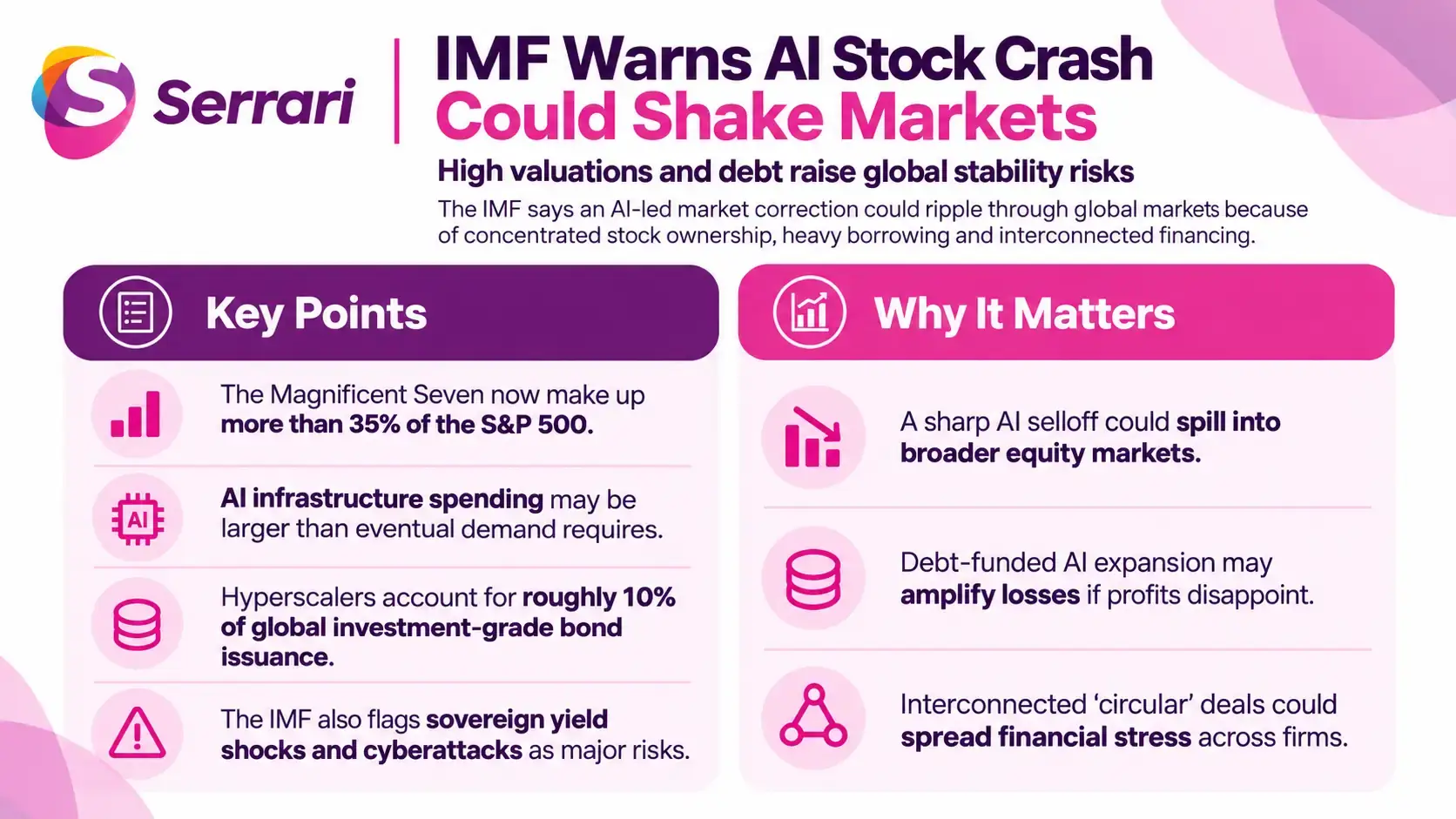
- Market concentration: The seven largest US technology stocks associated with the “Magnificent Seven” represent more than 35% of the S&P 500, compared with around 12% a decade earlier.
- Investment concerns: AI capabilities could become cheaper to deliver, leaving some planned infrastructure spending harder to justify.
- Debt exposure: Hyperscalers account for about 10% of global investment-grade bond issuance, up from less than 1% in 2024.
- Circular financing: Interconnected equity, debt and future purchasing commitments could transmit losses across AI businesses.
- Global spillovers: US and Asian markets appear particularly exposed, while sovereign bond volatility and cyber risks add pressure.
Technology Stock Concentration Amplifies Market Risk
An AI selloff would matter beyond specialist technology investors because major US stock indices are increasingly dominated by a small group of companies. The IMF’s market-concentration findings put the Magnificent Seven—Alphabet, Amazon, Apple, Meta, Microsoft, Nvidia and Tesla—at more than 35% of the S&P 500’s market value, up from about 12% ten years earlier. Their combined capitalization has risen by more than 50% over the past two years.
This concentration means a simultaneous reassessment of leading technology stocks could weigh heavily on index-tracking funds, retirement portfolios and other investors holding broad US equities. The IMF sees substantial potential spillovers into Asian markets through technology supply chains and investor exposure. UK and euro-area markets may be less directly exposed, although their holdings of US assets would remain vulnerable.
AI Investment Returns May Fall Short of Expectations
The scale of spending on data centres, chips, energy infrastructure and computing capacity assumes that AI adoption will generate sustained demand and earnings. However, the IMF says there is growing evidence that useful AI capabilities may be delivered with less investment than companies currently anticipate, or that the economic payoff may be smaller than projected.
A more modest revenue outlook could force companies to revisit expansion plans and weaken valuations built on rapid future growth. At the same time, the surge in hyperscaler bond issuance shows how financing needs have extended the AI boom from equity markets into corporate debt markets. Borrowing is not inherently problematic, but large fixed obligations increase pressure when expected returns are delayed.
Context is everything. Stay ahead of shifting trends with today’s market updates, and uncover emerging opportunities using the Serrari Group Market Index and Marketplace. Then, take control of your own financial future by exploring our Money & Life Reset Transformation Blueprint ™ to build stronger habits, create better systems, and design a path toward lasting wealth.
Circular AI Financing Could Spread Losses
The IMF has also highlighted financing arrangements in which large technology companies invest in smaller AI firms that commit to buying computing services or equipment from those same investors. The relationships can support expansion, but their interconnected nature makes each company’s projections more dependent on counterparties remaining financially healthy.
Its assessment of these financing links identifies around $300 billion in transactions involving major technology companies and financially weaker AI firms, alongside approximately $650 billion in debt and $1.4 trillion in future revenue commitments. Those future commitments are prospective purchases, not revenue already earned, and should not be counted as realized cash flow.
If commercial demand disappoints, equity values could fall, debt repayment could become harder and expected purchases might not materialize. Hedge funds and individual investors using leverage could face margin calls, forcing asset sales and adding to price volatility.
Bond Yields and Cyberattacks Add to the Threat
AI valuation risk is only one of the IMF’s concerns. A sudden increase in sovereign bond yields, potentially driven by inflation and heavy government borrowing, could raise financing costs and reduce the present value of future corporate earnings. This would place additional pressure on highly valued growth stocks.
The Fund also warns that AI-enabled cyber threats can disrupt financial institutions and shared technology providers. An attack on critical infrastructure could erode confidence even without a simultaneous stock-market correction. These are distinct risks, but interconnected markets could amplify their effects if several pressures emerged together.
What Investors and Policymakers Should Watch
The principal indicators include AI earnings relative to capital spending, debt-servicing capacity, leveraged trading, technology-stock concentration and the resilience of financial infrastructure. In the IMF’s latest financial stability assessment, supervisors are urged to contain excessive leverage, strengthen debt sustainability and improve oversight of critical technology providers.
For now, the warning describes vulnerabilities rather than an unfolding crash. Its central message is that an AI-sector disappointment could have consequences well beyond technology shares if financial markets are insufficiently prepared.
Sources: International Monetary Fund / Reuters / The Guardian
Your financial future isn’t something you wait for—it’s something you build.
The real question is: when do you begin?
Move beyond simply staying informed.
Navigate the markets with clarity—track trends through the Serrari Group Market Index, uncover opportunities in the Serrari Marketplace, and build practical knowledge with our Curated Wealth Builder Platform.
Stay connected to what truly matters.
Get daily insights on macro trends and financial movements across Kenya, Africa, and global markets—delivered through the Serrari Newsletter.
Growth opens doors.
Advance your career through professional programs including ACCA, HESI A2, ATI TEAS 7 , HESI EXIT , NCLEX – RN and NCLEX – PN, Financial Literacy!🌟—designed to move you forward with confidence.
See where money is flowing—clearly and in real time.
Track Money Market Funds, Treasury Bills, Treasury Bonds, Green Bonds, and Fixed Deposits, alongside global and African indexes, key economic indicators, and the evolving Crypto and stablecoin landscape—all within Serrari’s Market Index.