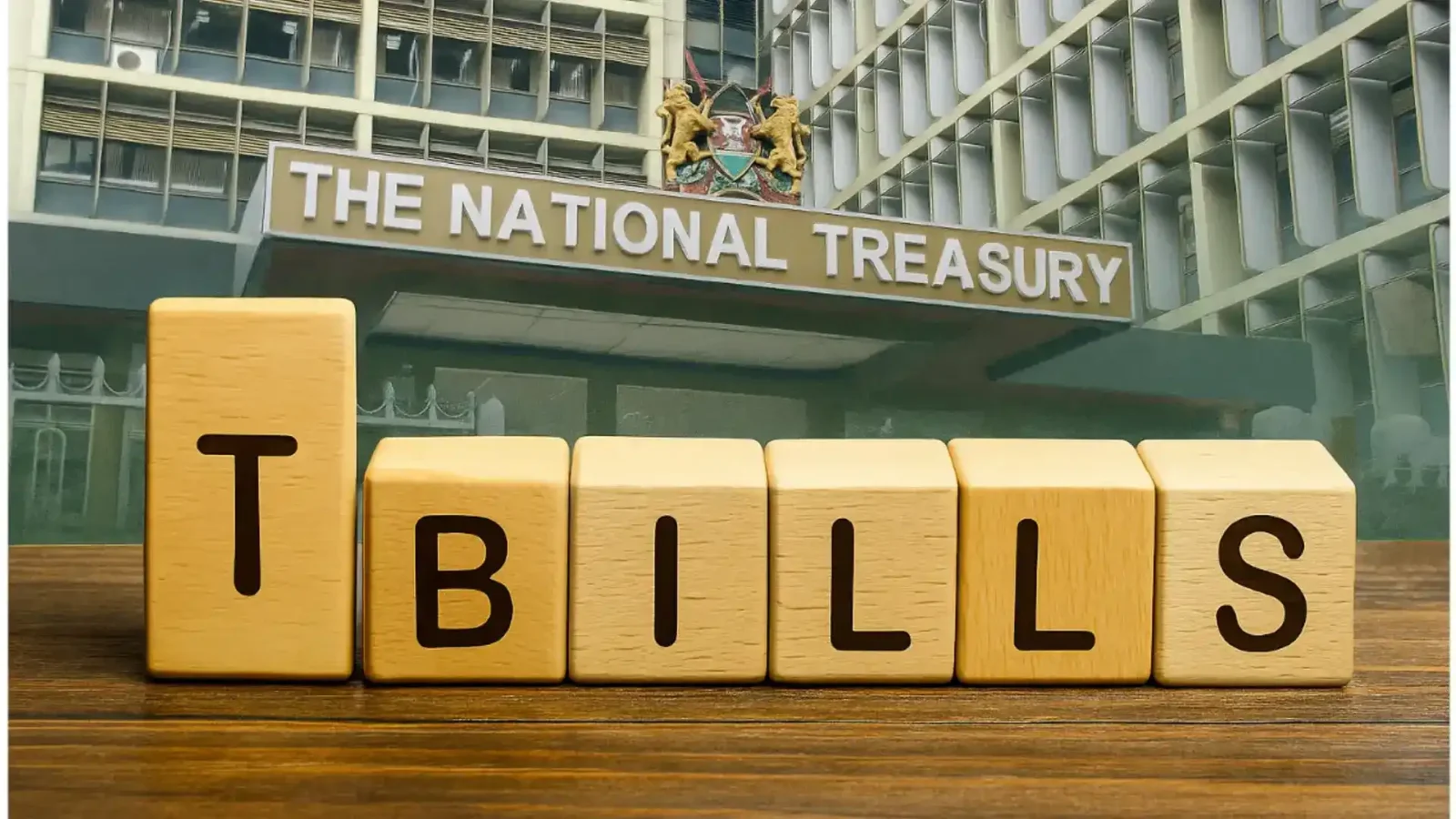
Kenya’s National Treasury raised KES 24.35 billion from its latest weekly Treasury bills auction, closing the sale at a 102.3% subscription rate and once again underscoring the depth of local investor appetite for short-dated government paper. The Central Bank of Kenya (CBK) offered KES 24 billion and received KES 24.55 billion in bids, ultimately accepting KES 24.53 billion across the 91-day and 182-day tenors. Demand was sharply concentrated on the three-month bill, which attracted bids worth 199.4% of the amount on offer, while the six-month paper was oversubscribed at 108.5%. The auction was buoyed by a KES 35.02 billion coupon maturing on 13 April 2026, with a further KES 32.87 billion set to mature on 20 April — liquidity that analysts at Pergamon Investment Bank expect to fuel even stronger bids at the next sale. The backdrop is a policy environment of cautious easing: the CBK’s Monetary Policy Committee (MPC) held the Central Bank Rate at 8.75% at its 8 April meeting after ten consecutive cuts since August 2024.
LIVET-bill rates: 91-day 8.76% · 182-day 8.87% · 364-day 9.04% · auction of 8 OctSee rates →Key Overview
- Total raised: KES 24.35 billion at a subscription rate of 102.3%.
- Offer vs bids: KES 24.00 billion offered; KES 24.55 billion in bids; KES 24.53 billion accepted.
- 91-day paper: Oversubscribed at 199.4% — KES 7.98 billion in bids, KES 7.96 billion accepted.
- 182-day paper: Oversubscribed at 108.5% — KES 10.85 billion in bids, fully accepted.
- Previous weighted-average rates: 7.40% on the 91-day and 7.83% on the 182-day, per CBK.
- Liquidity tailwind: A KES 35.02 billion coupon matured on 13 April 2026, with KES 32.87 billion more due 20 April.
- Policy backdrop: CBK held the CBR at 8.75% on 8 April 2026, pausing a 425-basis-point easing cycle.
Markets move fast; don’t get left behind. We’ve paired the Serrari Group Market Index with a curated Marketplace and a comprehensive Wealth Builder Platform to ensure you have the data—and the skills—to act on it.
A Fully Covered Auction in a Softening Rate Environment
Kenya’s weekly Treasury bills sale once again cleared with room to spare. The National Treasury, acting through the CBK, sought KES 24 billion from the market and walked away with KES 24.35 billion after accepting nearly all of the KES 24.55 billion offered by investors. The headline subscription rate of 102.3% masks a more uneven story underneath — the shorter end of the curve was swamped with demand, while the six-month tenor carried most of the accepted volume.
The auction was held at a moment when Kenyan short-term yields are sitting at their lowest levels in years. According to the CBK, the previous weighted-average rate on the 91-day bill stood at 7.40% while the 182-day paper closed its prior auction at 7.83%. Those prints continue a sustained downward drift from the 15%-plus yields that characterised mid-2024, a shift engineered almost entirely by the central bank’s aggressive easing cycle.
For investors, the T-bill market remains attractive for reasons that go beyond the headline yield. Interest on Kenyan Treasury bills is exempt from withholding tax for individual investors, meaning that a 7.56% bill yield translates into something closer to 8.9% on a pre-tax basis for comparable bank deposits or money market funds, where the 15% withholding tax still applies.
The 91-Day Paper Steals the Show
The standout feature of the auction was demand for the 91-day bill. Investors tendered KES 7.98 billion against a modest offer size, producing a subscription rate of 199.4% — nearly double the amount on sale. The CBK accepted KES 7.96 billion of that, effectively taking almost every bid that came in.
This pattern — extreme concentration at the short end — has become familiar in Kenya’s post-easing T-bill market. Analysts explain it in two ways. First, cautious investors are reluctant to lock in sub-9% yields for longer periods when the CBK has just paused its cutting cycle and global conditions are volatile. A 91-day bill at 7.40% offers quick reinvestment optionality if rates turn again. Second, large institutional holders — banks, pension funds, SACCOs — use the three-month paper as a liquidity management tool, rolling maturing positions into fresh auctions each week.
The 182-day tenor also performed well. It drew KES 10.85 billion in bids against the offer on that side of the auction — an oversubscription of 108.5% — and the CBK accepted the full amount. Taken together, the 91-day and 182-day tenors absorbed all of the paper the Treasury wanted to sell, with the composition skewed toward the six-month bill in shilling terms because that is where the larger allocation was on offer.
Maturities Fuel Reinvestment
The auction did not happen in a vacuum. Pergamon Investment Bank flagged that the sale was supported by a KES 35.02 billion coupon payment that matured on 13 April 2026 — cash that flowed back to bondholders and was immediately available to be recycled into new government paper.
A further KES 32.87 billion is scheduled to mature on 20 April 2026, just ahead of the next auction. Pergamon expects that wave of redemptions to drive even stronger subscription levels, with investors choosing rollover over hunting for alternative short-term yield. That is consistent with what the market has looked like for months. At the auction for bills dated 5 February 2026, the CBK raised KES 47.2 billion — nearly double its KES 24 billion target — in a heavily oversubscribed sale, while the year-end auction on 31 December 2025 brought in KES 25.9 billion against the same KES 24 billion advertised amount.
Even larger one-off prints have not been unusual. A Treasury bill auction earlier in March 2026 saw the government ultimately accept KSh 41.42 billion after bids dramatically exceeded the initial offer — a now-familiar pattern in which the CBK lets the auction grow when liquidity is ample and pricing is favourable.
Context is everything. While you follow today’s updates, use the Serrari Group Market Index and Marketplace to spot emerging shifts. Need to sharpen your edge? Our Wealth Builder Platform turns these insights into a professional-grade strategy.
Policy Context: A Pause After Ten Straight Cuts
The T-bill market’s behaviour in April sits on top of a landmark monetary-policy moment. On 8 April 2026, the CBK’s Monetary Policy Committee kept the Central Bank Rate at 8.75%, the first pause after ten consecutive cuts that have taken 425 basis points off the policy rate since August 2024, when it peaked at a 12-year high of 13%.
Governor Kamau Thugge said the current stance remains appropriate to keep inflation expectations anchored and the exchange rate stable, though he flagged risks from recent oil-price increases tied to the escalation of conflict in the Middle East. Headline inflation ticked up modestly to 4.4% in March from 4.3% in February, remaining below the 5% midpoint of the CBK’s target band. The central bank simultaneously trimmed its 2026 growth outlook to 5.3% from 5.5%, reflecting emerging external risks.
For fixed-income investors, the pause matters because it tightens the link between the CBR and near-term T-bill yields. With the policy rate no longer in steady decline, the yield floor of roughly 7.4–7.8% on the shortest bills is unlikely to collapse further without another dovish pivot. That, in turn, strengthens the case for parking cash in the weekly auctions rather than chasing scarcer and riskier yields elsewhere.
LIVET-bill rates: 91-day 8.76% · 182-day 8.87% · 364-day 9.04% · auction of 8 OctSee rates →A Broader Trend: From 15% to Mid-7s in Twelve Months
The longer arc is striking. In July 2024, the 91-day T-bill was auctioning at roughly 16%, with the 182-day at 16.8% and the 364-day near 16.9%. By February 2025, the 91-day yield had already dropped below 9% for the first time since late 2022. By March 2026, the three-month tenor had settled at 7.5636% (rounded to 7.56%), with the 182-day at 7.85% and the 364-day at 8.48%.
That eight-percentage-point compression inside twelve months reflects both the CBK’s own cuts and a deliberate strategy of rejecting expensive bids at auction to push the government’s borrowing cost lower. The Business Daily reported that during the fourth quarter of 2025 the CBK enforced yield discipline by rejecting expensive offers, while investors increasingly limited themselves to rolling over maturing paper rather than pushing for higher returns.
The National Treasury has also been actively reshaping the short end of the sovereign curve. In early 2025 it announced it would stop issuing new 364-day T-Bills, pushing investors looking for one-year exposure toward consecutive six-month bills or short-dated bonds instead. The move is designed to lengthen the average maturity of domestic debt and reduce the refinancing risk associated with a constant stream of one-year paper rolling off.
How Kenyan Investors Actually Participate
The weekly auction process itself has changed materially. Both 91-day and 182-day bills are auctioned every Wednesday, with 364-day bills auctioned monthly when they are on offer. Results are published the same day by the CBK and payments from successful bidders are due by 2:00 p.m. on the following Monday by RTGS transfer, based on instructions made available through the DhowCSD investor portal.
Accessibility has improved sharply since the CBK launched the Dhow Central Securities Depository in 2023. The DhowCSD portal and mobile app allow investors to open a CDS account remotely and bid directly from a smartphone, sidestepping the branch-by-branch paperwork that once defined retail participation. The minimum investment stands at KES 100,000, with subsequent increments in multiples of KES 50,000, and non-competitive bids (recommended for retail investors) guarantee allocation at the weighted-average rate.
For the weekly bills, non-competitive bids are capped at KES 50 million per investor account per tenor, except for state corporations, public universities and semi-autonomous government agencies (SAGAs), which are not subject to that cap.
What to Watch in the Next Auction
The next auction — issue numbers 2678/091 and 2652/182 — is scheduled for 16 April 2026, value-dated 20 April. Three variables will drive how it clears.
First is the scale of incoming liquidity. With KES 32.87 billion maturing on 20 April, the CBK will effectively have fresh cash arriving at the same time it is pricing the new issue — a reinvestment dynamic that has consistently produced oversubscription in recent weeks. Second is the CBK’s willingness to accept bids above the advertised offer. The central bank has repeatedly shown that when liquidity is strong and rates are stable, it is happy to take significantly more than it seeks — as happened at the February 2026 auction when it scooped up KES 47.2 billion against a KES 24 billion target.
Third, and most consequential, is whether anything dislodges the current yield band. With the CBR paused and inflation hovering below the 5% midpoint, the mechanical case for further compression in 91-day and 182-day yields has weakened. But if the Middle East conflict escalates and pushes oil prices higher, imported inflation could force the MPC back into a defensive stance at its next meeting — which would ripple quickly into T-bill pricing.
The Bottom Line
Kenya’s KES 24.35 billion auction is not, on its own, a dramatic event. It is a routine weekly sale that cleared comfortably, with the 91-day paper doing what it has done for months: attracting far more bids than there is paper to absorb. What the numbers do confirm is the durability of domestic demand for Kenyan sovereign paper at a moment when the easing cycle has paused, tax-adjusted yields still look competitive, and two large coupon payments are flooding the market with reinvestable cash. For the Treasury, that translates into consistent access to local financing at some of the lowest short-term borrowing costs in years — a useful cushion as the government navigates a more uncertain external backdrop through the rest of 2026.
Your financial future isn’t something you wait for—it’s something you build.
The real question is: when do you begin?
Move beyond simply staying informed.
Navigate the markets with clarity—track trends through the Serrari Group Market Index, uncover opportunities in the Serrari Marketplace, and build practical knowledge with our Curated Wealth Builder Platform.
Stay connected to what truly matters.
Get daily insights on macro trends and financial movements across Kenya, Africa, and global markets—delivered through the Serrari Newsletter.
Growth opens doors.
Advance your career through professional programs including ACCA, HESI A2, ATI TEAS 7 , HESI EXIT , NCLEX – RN and NCLEX – PN, Financial Literacy!🌟—designed to move you forward with confidence.
See where money is flowing—clearly and in real time.
Track Money Market Funds, Treasury Bills, Treasury Bonds, Green Bonds, and Fixed Deposits, alongside global and African indexes, key economic indicators, and the evolving Crypto and stablecoin landscape—all within Serrari’s Market Index.