














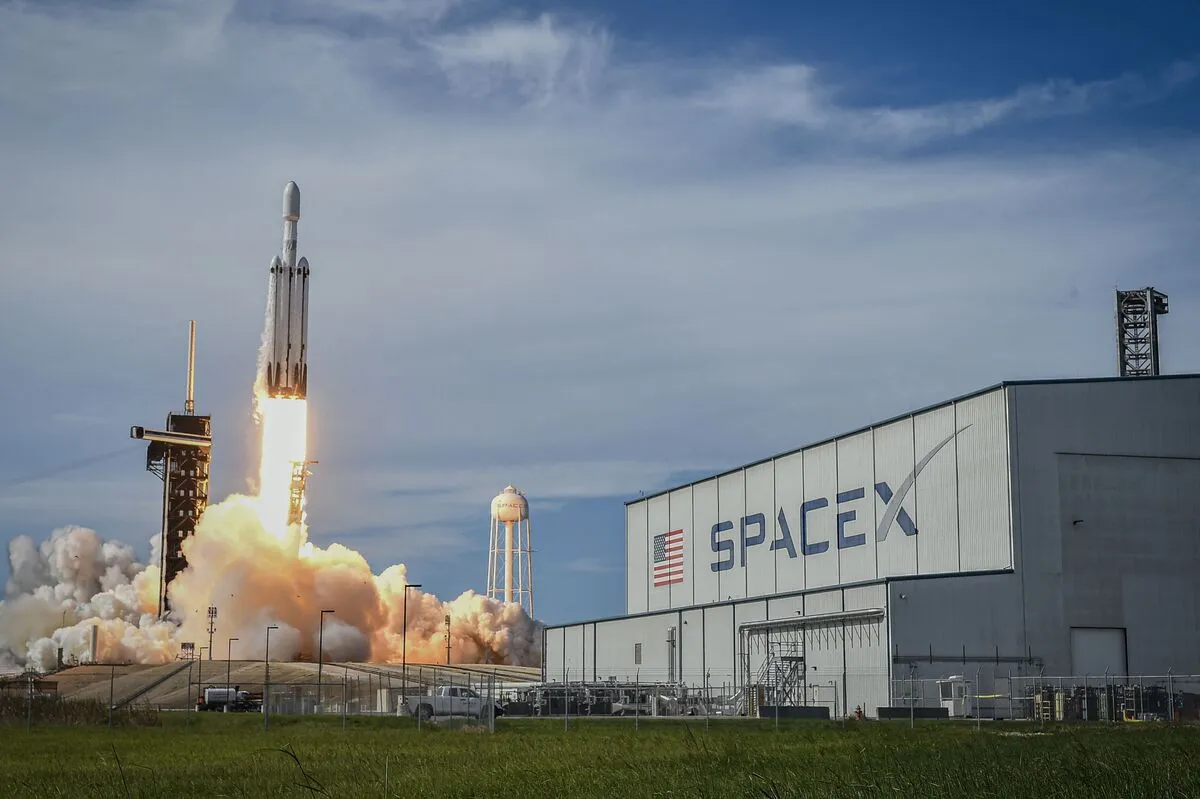
SpaceX has officially filed its S-1 prospectus with the SEC, confirming plans for what could become the largest initial public offering in Wall Street history. The company plans to list on the Nasdaq under the ticker SPCX, with pricing expected on June 11 and public trading beginning as early as June 12, 2026. The offering aims to raise up to $75 billion at a valuation of approximately $1.75 trillion. The IPO combines SpaceX’s rocket launch business, its Starlink satellite internet division, and xAI — the artificial intelligence company Musk merged with SpaceX in February 2026.
Key Overview
- Ticker: SPCX on the Nasdaq
- Expected listing date: June 12, 2026
- Target valuation: $1.75 trillion to $2 trillion
- Capital raise: Up to $75 billion
- 2025 revenue: $18.7 billion (consolidated)
- Starlink subscribers: Over 10 million globally
- Lead underwriters: Goldman Sachs, Morgan Stanley, Bank of America, Citigroup, JPMorgan Chase
- Musk voting control: 85.1% through dual-class share structure
- Retail investor allocation: Up to 30% of shares
Elon Musk’s SpaceX formally released its S-1 prospectus with the Securities and Exchange Commission on May 20, setting the stage for a historic public debut. If the deal prices at the upper end of its reported range, SpaceX would instantly rank among the ten most valuable publicly traded companies on the planet, surpassing the market capitalisation of Musk’s own Tesla.
The company plans to trade on the Nasdaq under the ticker symbol SPCX, with a roadshow expected to begin the week of June 8, pricing on June 11, and shares available to the public as early as June 12, according to Reuters. A faster-than-expected SEC review helped accelerate the timeline from an originally planned late-June debut.
A Record-Breaking Offering
SpaceX is targeting a raise of approximately $75 billion at a $1.75 trillion valuation, which would shatter the previous IPO record set by Saudi Aramco’s $29 billion listing in 2019. The implied valuation works out to roughly 110 times trailing revenue, a multiple higher than Tesla at its own 2010 IPO and greater than nearly every other publicly traded company today.
The filing names Goldman Sachs as the lead left underwriter, followed by Morgan Stanley, Bank of America, Citigroup, and JPMorgan Chase as joint book-running managers. Roughly 16 additional investment banks form the broader underwriting syndicate, creating one of the most powerful Wall Street lineups ever assembled for a single deal. Total underwriting fees could approach $1 billion.
In an unusual move, SpaceX is reportedly exploring allocating up to 30% of IPO shares to retail investors, roughly three times the typical Wall Street norm. On a $75 billion raise, that would translate to approximately $22.5 billion worth of shares available to individual investors at the IPO price — granting everyday buyers access alongside major institutions through brokerages including Schwab, Fidelity, and Robinhood.
What the S-1 Reveals
The prospectus provided the first public look at SpaceX’s finances. The company generated $18.7 billion in consolidated revenue in 2025, though it posted a net loss of nearly $4.9 billion during the same period. The loss is largely attributable to its AI segment; the legacy SpaceX divisions covering space operations and Starlink connectivity are profitable on both an operating and EBITDA basis.
Starlink is the financial engine driving the valuation. The satellite internet service now has more than 10 million subscribers globally and brought in $11.4 billion in revenue for 2025, followed by $3.3 billion in the first quarter of 2026 alone. Starlink accounted for more than half of overall revenue last year and nearly two-thirds of sales in Q1 2026. Airlines including United, Southwest, and Hawaiian now use the service to provide in-flight wireless internet, and the brand entered the Brand Finance top 500 rankings for the first time in 2026 with an estimated brand value of $5.19 billion.
Capital expenditures, however, are enormous. SpaceX spent $20.7 billion in 2025, with $12.7 billion directed toward AI infrastructure, $4.2 billion toward Starlink, and $3.8 billion toward rockets and other space ventures. In Q1 2026 alone, total capex hit $10.1 billion, of which $7.7 billion went to AI — covering GPU clusters, data centres, and engineering talent to compete with OpenAI and Anthropic.
The filing also revealed that SpaceX holds 18,712 bitcoin with a fair value of $1.29 billion as of March 31, 2026.
Context is everything. While you follow today’s updates, use the Serrari Group Market Index and Marketplace to spot emerging shifts. Need to sharpen your edge? Our Wealth Builder Platform turns these insights into a professional-grade strategy.
The xAI Merger and Governance Concerns
SpaceX completed an all-stock merger with xAI in February 2026, valuing the combined entity at $1.25 trillion at the time. The deal folded Musk’s artificial intelligence startup — creator of the Grok chatbot — into SpaceX as a wholly owned subsidiary, making it the largest private corporate merger in history. The xAI platform now claims 117 million monthly active users across its integrated services.
However, xAI also introduces significant financial drag. The AI division was burning roughly $1 billion per month at the time of the merger, and multiple co-founders have since departed. The combined structure means investors buying SPCX are effectively purchasing exposure to aerospace, satellite broadband, defence contracting, social media, and AI infrastructure all under one ticker — making SpaceX unusually difficult to value using traditional financial models.
Governance is another focal point. Musk controls 85.1% of the company’s voting power through a dual-class share structure combining his 12.3% common stake with a 93.6% holding in Class B super-voting shares, each carrying ten votes. This arrangement essentially guarantees he maintains unilateral control over all major corporate decisions regardless of outside shareholder sentiment.
Risks Investors Should Weigh
Despite the excitement, the SpaceX IPO carries substantial risks. The $1.75 trillion valuation prices in decades of future growth across multiple speculative businesses. First-day price surges on high-profile tech IPOs frequently retrace 20 to 40% within the first 90 days, and some analysts recommend waiting until SpaceX’s first public earnings report, expected in early November 2026, before committing capital.
Competition is also intensifying. Amazon’s Project Kuiper, Eutelsat’s OneWeb constellation with over 600 satellites, and emerging launch providers like Rocket Lab all present growing challenges across SpaceX’s core business lines.
Other notable risks include heavy dependence on government contracts with NASA and the U.S. military, regulatory uncertainty, the high cost profile of Starship development, and concentration of control in a single individual who simultaneously runs multiple companies.
How to Access Shares
Once SPCX begins trading, any standard U.S. brokerage account can purchase shares. Platforms named in the prospectus as selling group members include Schwab, Fidelity, Robinhood, SoFi, and E*TRADE.
For investors who want pre-IPO exposure, secondary marketplaces such as Forge Global and EquityZen have historically offered limited access to private SpaceX shares, though these platforms typically require accredited investor status, higher minimum investments, and carry complex fee structures.
For those considering buying on day one, financial commentators suggest treating SPCX as a high-volatility growth position and sizing it accordingly within a diversified portfolio.
Sources: CNBC / Yahoo Finance / CNN Business / Inc. / CoinDesk / Reuters / GovConWire / Euronews / The Street / Investing.com / TradingKey / Gear Musk / TechRepublic / The Motley Fool / Seeking Alpha / HeyGoTrade / The VC Corner / AOL Finance
Your financial future isn’t something you wait for—it’s something you build.
The real question is: when do you begin?
Move beyond simply staying informed.
Navigate the markets with clarity—track trends through the Serrari Group Market Index, uncover opportunities in the Serrari Marketplace, and build practical knowledge with our Curated Wealth Builder Platform.
Stay connected to what truly matters.
Get daily insights on macro trends and financial movements across Kenya, Africa, and global markets—delivered through the Serrari Newsletter.
Growth opens doors.
Advance your career through professional programs including ACCA, HESI A2, ATI TEAS 7 , HESI EXIT , NCLEX – RN and NCLEX – PN, Financial Literacy!🌟—designed to move you forward with confidence.
See where money is flowing—clearly and in real time.
Track Money Market Funds, Treasury Bills, Treasury Bonds, Green Bonds, and Fixed Deposits, alongside global and African indexes, key economic indicators, and the evolving Crypto and stablecoin landscape—all within Serrari’s Market Index.













Comments are closed.