
















The Green Climate Fund (GCF) has approved a balance sheet reform that increases its capacity to finance new climate projects by more than $4 billion, raising available funding from $1.37 billion to approximately $5.65 billion over the next two years. Without requiring new donor contributions, the reform is expected to unlock at least $16 billion in total climate investment through co-financing while maintaining the fund’s focus on adaptation and vulnerable developing countries.
Key Overview
- GCF increased available climate finance from $1.37 billion to $5.65 billion.
- The reform unlocks more than $4 billion without new donor funding.
- The additional financing could mobilize at least $16 billion in total climate investment.
- More than half of GCF financing will continue supporting climate adaptation.
- The changes take effect from the Fund’s October 2026 Board meeting.
Green Climate Fund Unlocks $4 Billion Through Balance Sheet Reform
The Green Climate Fund (GCF) has significantly expanded its ability to finance climate projects by adopting a new balance sheet management approach that unlocks more than $4 billion in additional funding without requiring fresh contributions from donor governments.
The reform, approved by the Fund’s Board earlier this month, increases GCF’s projected financing capacity from $1.37 billion to approximately $5.65 billion over the next two years.
According to GCF Executive Director Mafalda Duarte, the new approach will take effect following the Fund’s next Board meeting in October 2026, enabling the organization to accelerate investments supporting climate resilience and low-carbon development across developing countries.
Expanding Climate Finance Without New Contributions
Unlike traditional funding increases that rely on donor replenishment rounds, the additional financing capacity comes entirely from improving how the Fund manages resources already on its balance sheet.
Rather than raising new capital, the reform refines the methodology used to calculate and deploy existing financial resources across GCF’s portfolio of grants, loans, equity investments and guarantees.
By managing its capital more efficiently, the Fund can make significantly more financing available while maintaining prudent financial safeguards.
This approach is particularly significant at a time when international development assistance and climate finance budgets are under increasing pressure, making it more difficult for multilateral climate funds to secure new government contributions.
The reform therefore provides a faster and more efficient way to increase climate investment without waiting for lengthy donor negotiations or future replenishment cycles.
Potential to Mobilize $16 Billion in Climate Investment
The impact of the reform extends well beyond the additional $4 billion made available by the Fund itself.
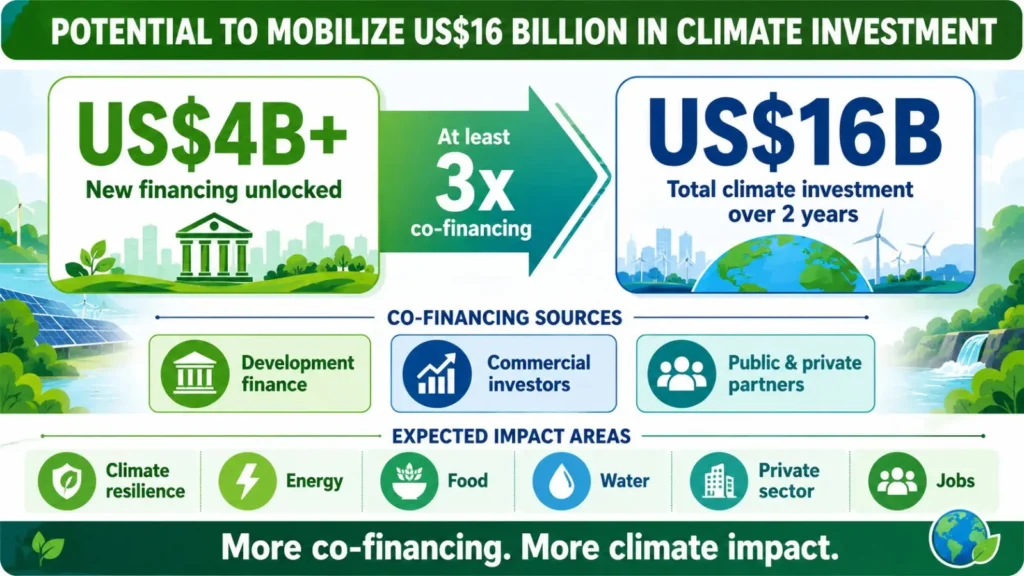
According to Duarte, the GCF expects the newly unlocked financing to attract at least three times that amount in co-financing from development finance institutions, commercial investors and other public and private sector partners.
If achieved, the additional funding could mobilize approximately USD 16 billion in total climate investment over the next two years.
These investments are expected to strengthen climate resilience, improve energy, food and water security, stimulate private sector participation and support job creation in developing economies.
The Fund’s extensive network of accredited public and private sector partners is expected to play a key role in leveraging this additional capital.
Maintaining Support for Vulnerable Countries
Despite expanding its financing capacity, the Green Climate Fund emphasized that the reform will not alter its development priorities or risk appetite.
More than half of the Fund’s financing will continue to be directed toward climate adaptation, with the majority of those investments supporting Least Developed Countries, Small Island Developing States and African countries.
These nations remain among the most vulnerable to climate change while having the least financial capacity to invest in climate adaptation and resilience.
The Fund also confirmed that it will preserve its highly concessional financing model, allowing it to provide below-market-rate funding for projects that would otherwise struggle to attract commercial investment.
Improving Capital Efficiency
The balance sheet reform also increases the value of every contribution made to the Green Climate Fund.
According to GCF, every US$1 contributed by donor countries will now support approximately $1.30 in new climate financing for developing countries, increasing the overall impact of existing contributions.
For donor governments, this improves the efficiency of taxpayer-funded climate finance by generating greater investment from the same level of financial support.
For beneficiary countries, it translates into increased access to urgently needed financing for projects focused on climate adaptation, renewable energy, sustainable infrastructure and resilience-building.
A Response to Challenging Funding Conditions
The reform comes amid a more challenging international funding environment for climate finance institutions.
Government budgets for international development and climate initiatives have come under increasing pressure in several countries, while changes in political priorities have affected support for multilateral climate organizations.
Earlier this year, the United States announced its withdrawal from several climate, energy and sustainable development initiatives, including the Green Climate Fund, adding further uncertainty around future public funding for international climate finance.
Against this backdrop, improving the efficiency of existing financial resources has become an increasingly important strategy for maintaining support for climate action in developing countries.
The World’s Largest Dedicated Climate Fund
Established in 2010 under the United Nations Framework Convention on Climate Change (UNFCCC), the Green Climate Fund is the world’s largest dedicated climate finance institution supporting developing countries.
The Fund finances projects that promote both climate mitigation and climate adaptation, with the goal of supporting low-emission and climate-resilient development pathways.
To date, the GCF has committed over $20 billion to projects across 134 developing countries, supporting initiatives ranging from renewable energy and sustainable agriculture to coastal protection, resilient infrastructure and climate-smart water management.
Outlook
The Green Climate Fund’s balance sheet reform demonstrates how multilateral financial institutions can significantly expand climate finance without relying solely on new donor contributions. By increasing capital efficiency while preserving its concessional financing model and focus on vulnerable countries, the Fund is positioning itself to deliver greater climate impact despite tightening global aid budgets. If the projected US$16 billion in total investment is realized, the reform could accelerate climate adaptation and mitigation projects across developing countries while encouraging other international financial institutions to adopt similar balance sheet optimization strategies. As demand for climate finance continues to grow, innovative financial management approaches such as this may become increasingly important in bridging the global climate investment gap.
FAQs
1. How much additional financing has the Green Climate Fund unlocked?
The reform unlocks more than US$4 billion, increasing available financing from US$1.37 billion to approximately US$5.65 billion.
2. Does the additional funding come from new donor contributions?
No. The increased financing capacity comes from a more efficient balance sheet management approach rather than new government pledges.
3. How much total investment could the reform generate?
The GCF expects the additional financing to mobilize at least US$16 billion in total climate investment through co-financing.
4. Who will benefit from the additional funding?
The financing will continue supporting developing countries, particularly Least Developed Countries, Small Island Developing States, and African nations, with a strong focus on climate adaptation and resilience projects.
Sources: ESG Today, OneStop ESG, Green Climate Fund
Your financial future isn’t something you wait for—it’s something you build.
The real question is: when do you begin?
Move beyond simply staying informed.
Navigate the markets with clarity—track trends through the Serrari Group Market Index, uncover opportunities in the Serrari Marketplace, and build practical knowledge with our Curated Wealth Builder Platform.
Stay connected to what truly matters.
Get daily insights on macro trends and financial movements across Kenya, Africa, and global markets—delivered through the Serrari Newsletter.
Growth opens doors.
Advance your career through professional programs including ACCA, HESI A2, ATI TEAS 7 , HESI EXIT , NCLEX – RN and NCLEX – PN, Financial Literacy!🌟—designed to move you forward with confidence.
See where money is flowing—clearly and in real time.
Track Money Market Funds, Treasury Bills, Treasury Bonds, Green Bonds, and Fixed Deposits, alongside global and African indexes, key economic indicators, and the evolving Crypto and stablecoin landscape—all within Serrari’s Market Index.