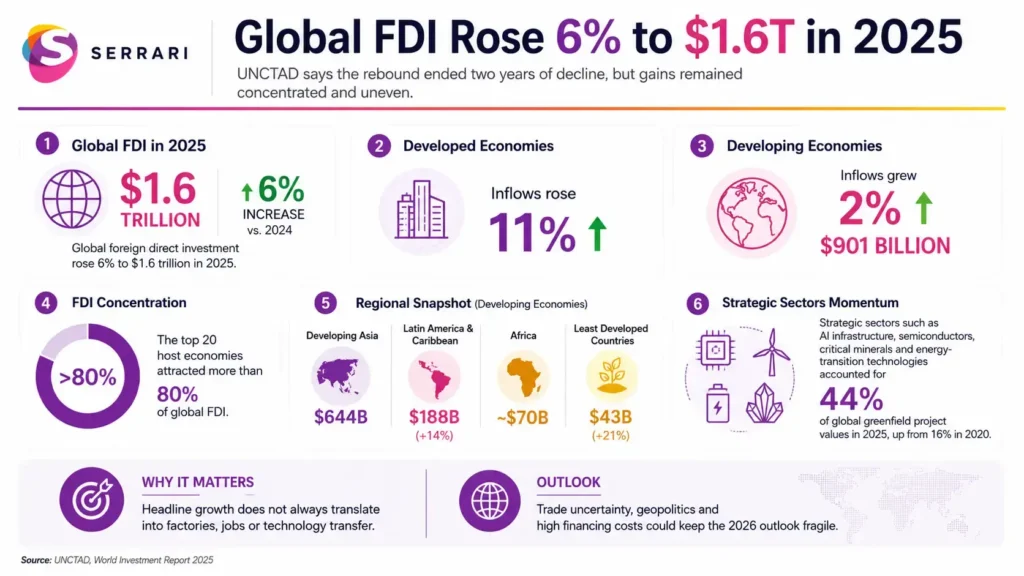
Global foreign direct investment returned to growth in 2025, rising 6% to $1.6 trillion after two consecutive years of decline. However, the rebound was heavily concentrated in developed economies, a small group of leading destinations and capital-intensive strategic industries.
According to the World Investment Report 2026, inflows to developed economies increased 11%, while investment in developing economies grew just 2% to $901 billion. The divergence raises questions over whether the recovery will generate broad-based gains in jobs, productive capacity and technology transfer.
Key Overview
- Global FDI increased 6% to $1.6 trillion in 2025.
- Developed economies recorded 11% growth, compared with 2% in developing economies.
- The world’s top 20 host economies attracted more than 80% of total global FDI.
- Strategic sectors accounted for 44% of global greenfield project values, up from 16% in 2020.
- Developing Asia received $644 billion, while Latin America and the Caribbean attracted $188 billion.
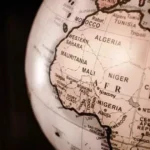
- Africa received about $70 billion in FDI.
- Governments introduced a record 229 investment policy measures during 2025.
A Recovery Concentrated in Few Economies
The global rebound marks an important change after two years of falling cross-border investment, but the headline figure masks deep geographical disparities.
The top 20 host economies captured more than 80% of global FDI in 2025. Developing countries still received more than half of worldwide inflows, but their overall growth rate remained modest.
The concentration also means higher global FDI does not automatically translate into a comparable rise in new factories, infrastructure or employment. Large financial transactions, corporate restructurings and a small number of megaprojects can substantially influence headline investment figures.
The development impact therefore depends increasingly on what investment actually builds and whether foreign projects create connections with local suppliers, workers and domestic industries.
AI and Strategic Industries Drive the Expansion
Technology and industrial policy are reshaping the global investment map.
Strategic sectors, including artificial intelligence infrastructure, semiconductors, critical minerals and energy-transition technologies and services, generated 44% of global greenfield project values in 2025. Their share stood at just 16% five years earlier.
The rise was led primarily by data centres, followed by oil and gas projects and semiconductor investment. Meanwhile, several broader areas of the economy, including manufacturing, infrastructure and renewable energy, recorded weaker project activity.
This creates a more selective investment landscape. Capital is increasingly favouring economies with technological capacity, reliable infrastructure, skilled workforces, large markets or strategically important resources. A widening development divide could emerge as poorer economies struggle to compete for these projects.
Low-income and lower-middle-income countries attracted only around 10% of strategic-sector investment between 2020 and 2025, compared with more than 20% of investment in other industries.
Context is everything. Stay ahead of shifting trends with today’s market updates, and uncover emerging opportunities using the Serrari Group Market Index and Marketplace. Then, take control of your own financial future by exploring our Money & Life Reset Transformation Blueprint ™ to build stronger habits, create better systems, and design a path toward lasting wealth.
Regional Performance Remains Uneven
Developing Asia retained its position as the largest developing-region destination, receiving $644 billion in 2025. The region accounted for roughly 40% of global FDI and more than 70% of flows into developing economies.
The investment shift across Asia reflects the region’s established manufacturing networks, major consumer markets and integration into global production chains. However, these advantages remain unevenly distributed between countries.
Latin America and the Caribbean performed strongly, with inflows rising 14% to $188 billion.
Africa received about $70 billion. Although this was below 2024’s exceptional level, the total remained roughly one-third above the continent’s 2010–2024 average. The African investment picture increasingly reflects projects in energy, digital infrastructure and other strategic industries.
Least developed countries recorded a 21% rise in FDI to $43 billion, but they still accounted for only 2.7% of global flows. Much of the investment was concentrated in a small number of resource-rich economies.
Governments Intensify the Global Investment Race
Governments are taking a more direct role in deciding which industries attract capital.
A record 229 investment policy measures were introduced in 2025. Most remained favourable to investors, but an increasing number targeted strategic industries, domestic economic priorities and economic security concerns.
This marks a shift from an era in which investment decisions were driven mainly by cost and efficiency. Subsidies, industrial policy, supply-chain security and technological competition now play a larger role.
For developing countries, competing effectively may require more than traditional tax incentives. Strong infrastructure, trained workers, efficient investment processes, domestic supplier networks and access to regional markets are becoming increasingly important.
The 2026 Outlook Remains Fragile
The outlook for international investment remains difficult. Trade policy uncertainty, geopolitical tensions, conflicts, high financing costs and economic fragmentation continue to influence corporate decisions.
Competition for AI infrastructure, semiconductors, critical minerals and other strategic projects is also expected to intensify as governments seek greater technological and economic security.
These challenges will shape discussions at the World Investment Forum 2026, scheduled for 25 to 27 October in Doha, Qatar. Policymakers, investors and development partners are expected to focus on how a more selective global investment system can produce broader and more inclusive economic gains.
The central challenge is no longer simply attracting more foreign capital. The bigger question is whether investment reaches a wider range of countries, strengthens productive economies and ensures that the benefits of the global investment recovery extend beyond a small group of markets and industries.
Sources: UN Trade and Development / World Economic Forum / Emirates News Agency
Your financial future isn’t something you wait for—it’s something you build.
The real question is: when do you begin?
Move beyond simply staying informed.
Navigate the markets with clarity—track trends through the Serrari Group Market Index, uncover opportunities in the Serrari Marketplace, and build practical knowledge with our Curated Wealth Builder Platform.
Stay connected to what truly matters.
Get daily insights on macro trends and financial movements across Kenya, Africa, and global markets—delivered through the Serrari Newsletter.
Growth opens doors.
Advance your career through professional programs including ACCA, HESI A2, ATI TEAS 7 , HESI EXIT , NCLEX – RN and NCLEX – PN, Financial Literacy!🌟—designed to move you forward with confidence.
See where money is flowing—clearly and in real time.
Track Money Market Funds, Treasury Bills, Treasury Bonds, Green Bonds, and Fixed Deposits, alongside global and African indexes, key economic indicators, and the evolving Crypto and stablecoin landscape—all within Serrari’s Market Index.