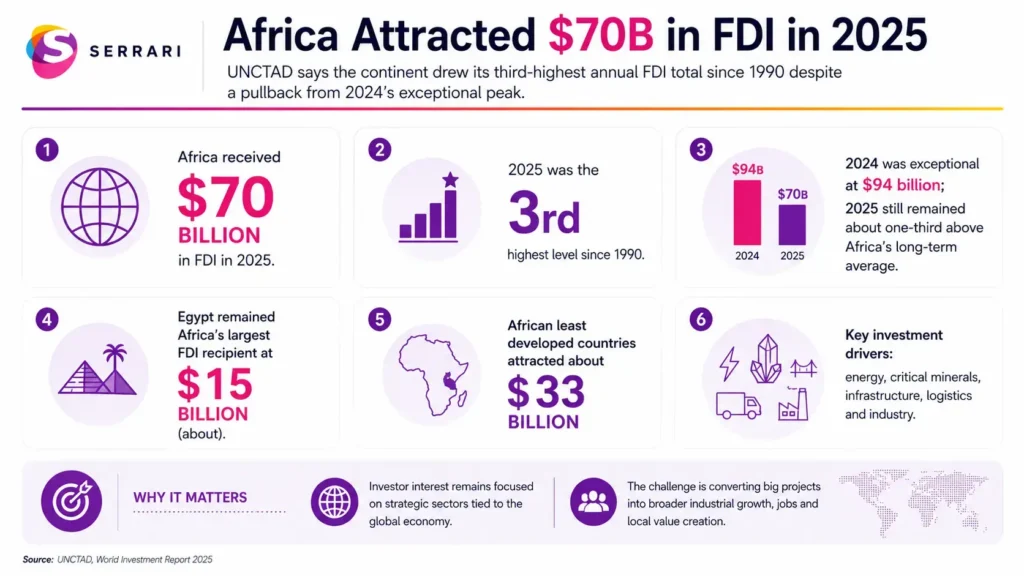
Africa attracted about $70 billion in foreign direct investment in 2025, down from the exceptional level recorded a year earlier but still its third-highest annual total since 1990.
The latest investment analysis shows that the continent remained roughly one-third above its long-term average despite the decline. Egypt retained its position as Africa’s largest FDI recipient, while energy infrastructure, critical minerals, logistics and industrial projects continued to shape investor interest.
The central challenge is now whether these capital flows can support broader industrialisation, employment, skills development and stronger local supply chains.
Key Overview
- Africa received about $70 billion in FDI during 2025.
- The total was the continent’s third-highest annual level since 1990.
- Egypt remained Africa’s largest recipient with about $15 billion.
- African least developed countries attracted roughly $33 billion.
- Investment remained concentrated in a relatively small number of economies and projects.
- Energy, critical minerals, infrastructure and industrial supply chains are becoming major investment drivers.
Africa Remains Above Its Long-Term Investment Average
The decline from 2024 does not necessarily signal a collapse in investor interest.
The previous year was heavily influenced by a small number of unusually large transactions, particularly in Egypt. Once that exceptional base is considered, the 2025 total still represents a historically strong outcome.
Africa’s roughly $70 billion in inflows remained about one-third above the continent’s 2010–2024 average. This suggests that international investors continue to view parts of the continent as important to the changing global economy.
However, the headline total also highlights the importance of examining where capital is going. A small number of major transactions can lift regional figures without necessarily generating broad investment across multiple economies.
The continent’s opportunity therefore depends not only on attracting more FDI, but also on ensuring that projects create lasting productive capacity.
Egypt Retains Africa’s Top Position
Egypt remained Africa’s largest recipient of foreign direct investment in 2025, attracting about $15 billion.
The country’s performance helped keep North Africa as the continent’s leading recipient subregion, even after inflows fell sharply from the exceptional levels recorded in 2024.
Egypt’s position reflects its large domestic market, extensive infrastructure needs and strategic location linking Africa, the Middle East and Europe. According to recent investment reporting, the country retained the top position on the continent despite the broader decline in African inflows.
Its experience also demonstrates how large projects can significantly influence regional investment totals. The record African result in 2024 was boosted by a major project finance transaction in Egypt, making year-on-year comparisons particularly sensitive to individual deals.
Energy and Critical Minerals Attract Global Capital
Much of the investment attention directed toward Africa is increasingly connected to sectors that are strategically important to the global economy.
One major driver is energy. Growing electricity demand, industrial expansion and the need for new generation and transmission infrastructure are creating opportunities across conventional and renewable energy systems.
Critical minerals form another important part of the investment story. Africa holds significant deposits of minerals used in batteries, electric vehicles, electronics and advanced manufacturing.
As governments and companies seek to diversify global supply chains, investment in mining, processing and related infrastructure is becoming increasingly strategic.
Yet simply extracting more raw materials may not generate the strongest development gains. The larger opportunity lies in building local processing, manufacturing, logistics and supplier networks around these resources.
Context is everything. Stay ahead of shifting trends with today’s market updates, and uncover emerging opportunities using the Serrari Group Market Index and Marketplace. Then, take control of your own financial future by exploring our Money & Life Reset Transformation Blueprint ™ to build stronger habits, create better systems, and design a path toward lasting wealth.
Supply Chain Changes Create New Industrial Openings
Changes in global trade and manufacturing are also creating potential opportunities for African economies.
Companies are reconsidering where they manufacture products, source inputs and locate logistics operations as geopolitical tensions and supply-chain disruptions reshape international business decisions.
Africa can benefit from this shift through manufacturing, processing, transport and logistics investment. The continent offers expanding consumer markets, a growing workforce and access to major natural resources.
The African investment outlook nevertheless shows that investor interest remains concentrated.
Countries with stronger infrastructure, more predictable regulation, skilled labour and efficient investment processes are likely to capture a larger share of new projects.
Least Developed Countries Receive $33 Billion
African least developed countries attracted about $33 billion in FDI during 2025.
This represented a substantial share of the continent’s total, but investment was concentrated in a limited number of economies and often linked to natural resources, energy, infrastructure and selected manufacturing developments.
That concentration creates both opportunity and risk.
Large projects can bring capital, jobs and infrastructure, but economies may remain vulnerable when investment depends heavily on individual commodities or a small number of foreign-financed developments.
The broader policy challenge is to connect major projects with domestic companies and workers. Local procurement, workforce training, technology transfer and downstream processing can help ensure that FDI produces benefits beyond the initial capital inflow.
Turning Strategic Interest Into Broader Growth
Africa is attracting capital at a time when the global investment landscape is becoming more selective.
Energy security, critical minerals, industrial policy and supply-chain resilience are increasingly influencing where international investors deploy capital.
For African economies, this creates an opening to move beyond being suppliers of raw resources. Greater investment in processing, manufacturing and supporting infrastructure could allow countries to retain more economic value domestically.
Achieving this will require competitive infrastructure, reliable energy, efficient regulation and policies that help local businesses participate in foreign-backed projects.
Africa’s $70 billion FDI result therefore tells two stories. The continent remains an important investment destination despite the decline from 2024, but the gains remain concentrated.
The next stage will be determined by whether strategic investment can be converted into stronger industries, more skilled jobs and broader economic development across the continent.
Sources: UN Trade and Development / Egyptian Gazette / Emirates News Agency
Your financial future isn’t something you wait for—it’s something you build.
The real question is: when do you begin?
Move beyond simply staying informed.
Navigate the markets with clarity—track trends through the Serrari Group Market Index, uncover opportunities in the Serrari Marketplace, and build practical knowledge with our Curated Wealth Builder Platform.
Stay connected to what truly matters.
Get daily insights on macro trends and financial movements across Kenya, Africa, and global markets—delivered through the Serrari Newsletter.
Growth opens doors.
Advance your career through professional programs including ACCA, HESI A2, ATI TEAS 7 , HESI EXIT , NCLEX – RN and NCLEX – PN, Financial Literacy!🌟—designed to move you forward with confidence.
See where money is flowing—clearly and in real time.
Track Money Market Funds, Treasury Bills, Treasury Bonds, Green Bonds, and Fixed Deposits, alongside global and African indexes, key economic indicators, and the evolving Crypto and stablecoin landscape—all within Serrari’s Market Index.