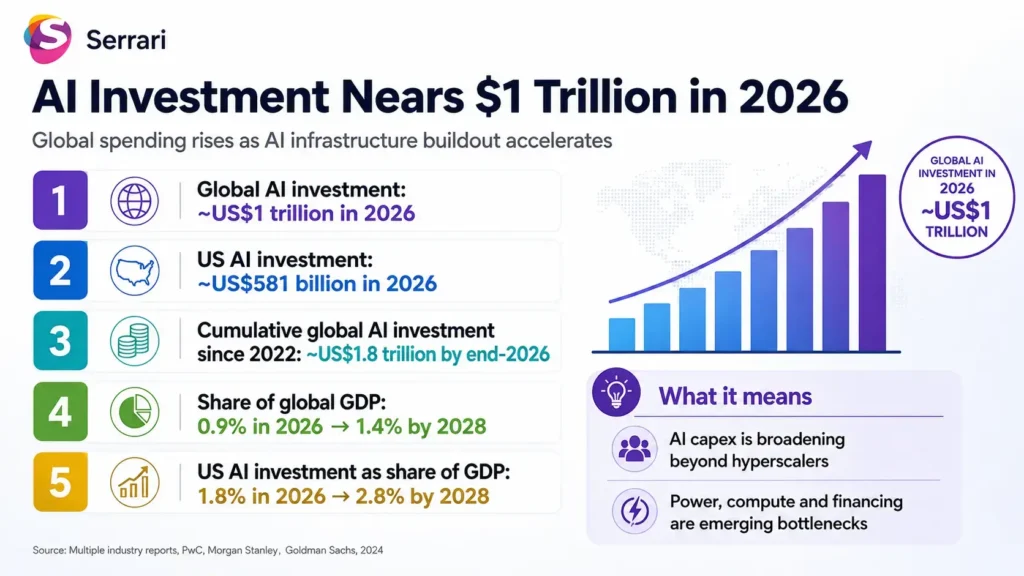
Global artificial intelligence investment is entering a new phase of scale, with spending expected to exceed $1 trillion in 2026. The latest global estimate (Goldman Sachs) puts US AI investment at about $581 billion this year, while total global AI investment is projected to rise from 0.9% of world GDP in 2026 to 1.4% by 2028.
The forecast suggests the AI buildout is broadening beyond the largest US cloud companies into private firms, non-hyperscaler businesses and companies outside the US. The underlying research also places the expected scale of US investment within the historical range seen during previous general-purpose technology buildouts, while power capacity and financing are emerging as increasingly important constraints.
Key Overview
- Global AI-related investment is projected at roughly $1 trillion in 2026.
- The US is expected to account for around $581 billion of that total.
- Cumulative AI investment since 2022 could reach about $1.8 trillion by the end of 2026.
- Global AI investment is projected to increase from 0.9% of GDP in 2026 to 1.4% by 2028.
- US AI investment could rise from 1.8% of GDP in 2026 to 2.8% in 2028.
- Strong near-term indicators suggest the AI capital-spending cycle has not yet entered a clear slowdown.
AI Spending Is Bigger Than Hyperscaler Capex Suggests
The headline numbers commonly used to describe the AI boom are often based on capital expenditure by major US hyperscalers. However, that measure does not capture the entire AI ecosystem. The broader investment methodology (Goldman Sachs) includes spending by private AI companies, other publicly listed AI-exposed firms and businesses outside the US, while adjusting for expenditure that may not actually be AI-related.
This produces a substantially different picture. The commonly cited hyperscaler capex estimate of about $794 billion may understate global AI investment by roughly $200 billion, while simultaneously overstating the amount of AI investment physically occurring in the US by a similar amount. (Goldman Sachs) Much of the wider buildout extends through semiconductor supply chains, data centres, computing equipment and supporting infrastructure.
Cross-checks using corporate earnings revisions, government investment data and global trade flows produced broadly similar results. The alternative estimation approaches (Goldman Sachs) also pointed to approximately $1 trillion in worldwide AI investment during 2026 and just under $600 billion in the US. On average, the methodologies suggest cumulative AI investment since 2022 will total around $1.8 trillion by the end of this year.
Context is everything. Stay ahead of shifting trends with today’s market updates, and uncover emerging opportunities using the Serrari Group Market Index and Marketplace. Then, take control of your own financial future by exploring our Money & Life Reset Transformation Blueprint ™ to build stronger habits, create better systems, and design a path toward lasting wealth.
AI Capex Could Keep Rising Through 2028
The investment cycle is expected to remain strong over the next two years. The GDP-based projections (Goldman Sachs) show US AI investment rising from 1.8% of GDP in 2026 to 2.5% in 2027 and 2.8% in 2028. Globally, the equivalent share is expected to move from 0.9% to 1.3% and then 1.4%.
Those US levels would fall within the roughly 2% to 5% of GDP investment peaks associated with previous general-purpose technology buildouts. The comparison does not guarantee equivalent economic returns, but it suggests the current level of spending is not yet outside historical ranges for transformative infrastructure cycles.
Near-term signals also remain supportive. Semiconductor manufacturing equipment imports in Taiwan and South Korea, purchasing managers’ indicators, import prices, memory prices and GPU rental rates are among the leading indicators being tracked (Goldman Sachs) and currently point toward continued strength rather than an imminent collapse in AI capital expenditure.
Power and Financing Are Becoming Critical Constraints
As more capital moves into AI infrastructure, physical bottlenecks are becoming increasingly important. Global electricity demand from data centres increased 17% in 2025, while electricity consumption from AI-focused facilities surged 50%, according to the latest energy assessment (IEA) as computing requirements expanded substantially faster than overall electricity demand.
That makes access to electricity generation, transmission infrastructure and grid connections a central factor in determining how quickly new computing capacity can actually be deployed. The challenge increasingly links the AI investment boom to utilities, energy infrastructure and construction rather than limiting its economic impact to semiconductor and software companies.
Financing is also moving into focus. A July analysis of major US hyperscalers (Reuters) found that rapidly increasing AI investment could outpace growth in their free cash flow by 2027, potentially increasing reliance on debt, private capital and alternative financing structures.
The result is an AI boom that is becoming a global capital-investment cycle spanning data centres, semiconductor manufacturing, electricity systems, cloud infrastructure and financial markets. The next major test will be whether AI-generated revenue and productivity improvements scale quickly enough to justify the extraordinary amount of capital now being committed.
Sources: Goldman Sachs / NDTV Profit / Reuters / International Energy Agency
Your financial future isn’t something you wait for—it’s something you build.
The real question is: when do you begin?
Move beyond simply staying informed.
Navigate the markets with clarity—track trends through the Serrari Group Market Index, uncover opportunities in the Serrari Marketplace, and build practical knowledge with our Curated Wealth Builder Platform.
Stay connected to what truly matters.
Get daily insights on macro trends and financial movements across Kenya, Africa, and global markets—delivered through the Serrari Newsletter.
Growth opens doors.
Advance your career through professional programs including ACCA, HESI A2, ATI TEAS 7 , HESI EXIT , NCLEX – RN and NCLEX – PN, Financial Literacy!🌟—designed to move you forward with confidence.
See where money is flowing—clearly and in real time.
Track Money Market Funds, Treasury Bills, Treasury Bonds, Green Bonds, and Fixed Deposits, alongside global and African indexes, key economic indicators, and the evolving Crypto and stablecoin landscape—all within Serrari’s Market Index.