The European Commission has proposed major reforms to the EU Emissions Trading System (ETS), slowing the pace of emissions reductions while extending free carbon allowances for heavy industries. The changes aim to strengthen industrial competitiveness and encourage investment in clean technologies, but critics argue they weaken Europe’s flagship climate policy and could delay industrial decarbonization well into the 2040s.
Key Overview
- The EU plans to slow annual emissions reductions under the ETS.
- Free carbon allowances for heavy industry would be extended until 2038.
- Companies could use international carbon credits from 2036.
- The reforms aim to balance industrial competitiveness with climate goals.
- Climate advocates warn the proposals could delay Europe’s transition to net zero.
European Commission Proposes Major ETS Overhaul
The European Commission has unveiled a comprehensive review of the European Union Emissions Trading System (ETS), proposing changes that would slow the pace of emissions reductions while providing additional support for energy-intensive industries.
The ETS is the EU’s primary carbon pricing mechanism, requiring companies in sectors such as power generation, manufacturing and aviation to purchase allowances for every tonne of carbon dioxide they emit. By reducing the number of allowances available each year, the system gradually increases the cost of pollution and encourages businesses to invest in cleaner technologies.
Under the Commission’s proposal, industries would receive greater flexibility and a longer transition period as Europe seeks to balance climate ambition with economic competitiveness.
Slower Decline in Carbon Allowances
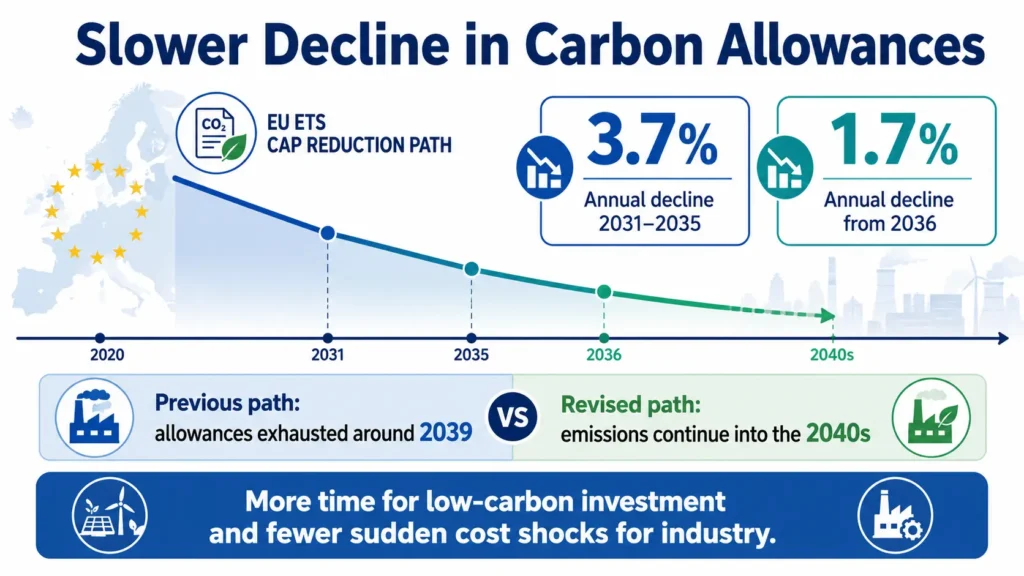
At the heart of the proposal is a revision of the Linear Reduction Factor (LRF), which determines how quickly the overall cap on emissions falls each year.
The Commission proposes reducing the annual decline in allowances to:
- 3.7 percent between 2031 and 2035
- 1.7 percent annually from 2036 onwards
The previous framework would have exhausted allowances around 2039, but the revised schedule would allow emissions to continue well into the 2040s.
The Commission argues that the slower reduction gives industries more time to invest in low-carbon technologies while avoiding sudden increases in production costs that could weaken Europe’s manufacturing competitiveness.
Free Carbon Permits Extended Until 2038
The proposal also extends free carbon allowances for heavy industries until 2038, four years longer than originally planned.
The extension affects sectors including steel, cement, chemicals and other carbon-intensive industries that face strong international competition.
Rather than distributing the permits without conditions, the Commission intends to tie them to decarbonization efforts. Companies would receive 80 percent of their free allowances after submitting credible investment plans for emissions reductions, while the remaining 20 percent would only be released once those investments have been implemented.
The cleanest 10% of industrial facilities would automatically qualify for the allocations without having to meet the additional requirements.
The extension also delays the full phase-in of the Carbon Border Adjustment Mechanism (CBAM), the EU’s carbon border levy designed to protect European manufacturers from imports produced under weaker climate standards.
International Carbon Credits Added
For the first time, companies covered by the ETS would be allowed to use international carbon credits beginning in 2036.
The Commission proposes that these offsets could account for up to 2% of the emissions reductions required under the ETS.
In addition, 250 million tonnes of domestic carbon removal credits would be introduced between 2031 and 2040, creating new opportunities for projects that remove carbon dioxide from the atmosphere.
Supporters argue these measures provide businesses with greater flexibility and lower compliance costs, while critics warn they could weaken incentives for companies to reduce emissions within Europe and reduce demand for EU carbon allowances.
Context is everything. Stay ahead of shifting trends with today’s market updates, and uncover emerging opportunities using the Serrari Group Market Index and Marketplace. Then, take control of your own financial future by exploring our Money & Life Reset Transformation Blueprint ™ to build stronger habits, create better systems, and design a path toward lasting wealth.
More Funding for Industrial Decarbonization
Alongside the regulatory changes, the Commission proposes increasing financial support for companies investing in cleaner production technologies.
Since 2013, the ETS has generated approximately €260 billion in auction revenues, most of which has flowed into national government budgets.
Under the new proposal, EU member states would be required to allocate “at least” 50 percent of future ETS revenues to support industrial decarbonization projects.
The Commission also plans to establish an Investment Booster Fund, setting aside 400 million carbon allowances, worth an estimated €30 billion, to finance investments in clean technologies before 2030.
The funding is expected to support projects involving renewable energy, hydrogen, electrification, carbon capture and storage, and other technologies needed to reduce industrial emissions.
Green Industries Express Concern
While many industrial groups have welcomed the additional flexibility, the proposals have drawn criticism from governments and companies that have already invested heavily in low-carbon technologies.
One example is northern Sweden’s emerging green steel industry, where companies such as Stegra and SSAB are investing billions of euros in hydrogen-based steel production.
These investments were made on the assumption that carbon prices would continue rising steadily as allowances became scarcer. Extending free permits and slowing emissions reductions could delay the point at which cleaner technologies become more cost-competitive than traditional coal-based production.
Sweden’s Climate and Environment Minister Romina Pourmokhtari criticized the proposal, saying it weakens Europe’s most effective climate policy and undermines businesses that have invested early in decarbonization.
Commission Defends the Reforms
Despite criticism, the European Commission insists the reforms remain fully aligned with the EU’s legally binding target of reducing net greenhouse gas emissions by 90% by 2040.
EU Climate Commissioner Wopke Hoekstra described the review as creating a more business-friendly carbon market that continues to drive innovation while supporting Europe’s industrial base.
According to the Commission, the reforms are intended to accelerate clean investment by making the transition more economically manageable for companies operating in increasingly competitive global markets.
The ETS currently covers approximately 40% of all greenhouse gas emissions within the European Union, making it the bloc’s single most important climate policy instrument.
Outlook
The proposed reforms are expected to trigger extensive negotiations among the European Parliament and EU member states before they can become law. Supporters believe the changes provide industries with the flexibility needed to remain globally competitive while continuing to invest in decarbonization technologies. Critics, however, argue that slowing emissions reductions, extending free allowances and introducing international carbon credits risk weakening the long-term carbon price signal that has driven clean investment across Europe for nearly two decades. The final outcome will have significant implications for the future of European manufacturing, carbon markets and the pace at which the EU progresses toward its climate neutrality goals.
FAQs
1. What is the EU Emissions Trading System (ETS)?
The ETS is the European Union’s carbon market, where companies purchase emissions allowances for the greenhouse gases they emit.
2. What are the main proposed changes?
The Commission proposes slowing the annual reduction in emissions allowances, extending free permits until 2038 and allowing limited use of international carbon credits from 2036.
3. Why is the Commission proposing these reforms?
The changes aim to improve industrial competitiveness, encourage investment in clean technologies and provide businesses with a more gradual transition toward lower emissions.
4. Why have the proposals been criticized?
Critics argue they weaken Europe’s strongest climate policy by delaying emissions reductions and reducing incentives for industries to invest rapidly in low-carbon technologies.
Sources: Ecobiz Asia, Politico, illuminem, RTE, Reuters
Your financial future isn’t something you wait for—it’s something you build.
The real question is: when do you begin?
Move beyond simply staying informed.
Navigate the markets with clarity—track trends through the Serrari Group Market Index, uncover opportunities in the Serrari Marketplace, and build practical knowledge with our Curated Wealth Builder Platform.
Stay connected to what truly matters.
Get daily insights on macro trends and financial movements across Kenya, Africa, and global markets—delivered through the Serrari Newsletter.
Growth opens doors.
Advance your career through professional programs including ACCA, HESI A2, ATI TEAS 7 , HESI EXIT , NCLEX – RN and NCLEX – PN, Financial Literacy!🌟—designed to move you forward with confidence.
See where money is flowing—clearly and in real time.
Track Money Market Funds, Treasury Bills, Treasury Bonds, Green Bonds, and Fixed Deposits, alongside global and African indexes, key economic indicators, and the evolving Crypto and stablecoin landscape—all within Serrari’s Market Index.