The Central Bank of Nigeria has proposed stricter rules for Financial Holding Companies, setting out tougher requirements on ownership, governance, capital strength, shared services and group structures. The proposed framework comes through an exposure draft of the revised guidelines for licensing and regulating Financial Holding Companies in Nigeria.
The draft, which is open for public consultation until July 9, 2026, marks a significant regulatory step for Nigerian banking groups. It seeks to strengthen oversight of holding company structures and reduce risks that can spread from non-bank subsidiaries into banking operations.
Key Overview
- CBN has proposed revised guidelines for licensing and regulating Financial Holding Companies in Nigeria.
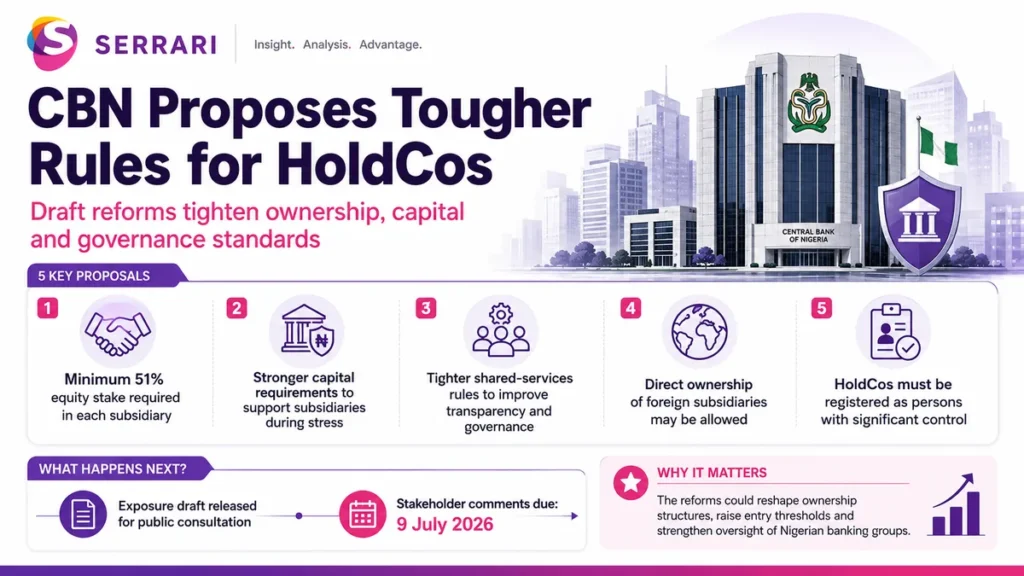
- Financial Holding Companies would be required to maintain a minimum 51% equity stake in each subsidiary.
- The draft strengthens capital requirements so holding companies can support subsidiaries during stress.
- The proposal tightens rules around shared services to reduce abuse, conflicts and operational risk.
- Financial Holding Companies may be allowed to directly own foreign subsidiaries instead of routing ownership through Nigerian banking subsidiaries.
- Stakeholders have until July 9, 2026, to submit comments before final guidelines are issued.
CBN Moves to Strengthen Group Supervision
The Central Bank of Nigeria is seeking to overhaul the regulatory framework for Financial Holding Companies more than a decade after the original 2014 guidelines were introduced. Those earlier rules were designed to ring-fence banking operations from risks created by non-core financial activities within larger banking groups.
The new draft is aimed at improving regulatory oversight and making holding company structures more transparent and accountable. According to reporting on the circular, the CBN said the review was necessary after identifying areas in the existing framework that required enhancement to improve the operational effectiveness of Financial Holding Companies.
A key proposal is the requirement for Financial Holding Companies to hold at least 51% equity in every subsidiary. This would ensure that holding companies retain meaningful control and responsibility across their group structures. It also raises the governance bar for financial groups that operate across banking, insurance, pensions, asset management or other regulated financial services.
Context is everything. Stay ahead of shifting trends with today’s market updates, and uncover emerging opportunities using the Serrari Group Market Index and Marketplace. Then, take control of your own financial future by exploring our Money & Life Reset Transformation Blueprint ™ to build stronger habits, create better systems, and design a path toward lasting wealth.
Tougher Capital, Ownership and Transparency Rules
The draft guidelines also strengthen minimum capital requirements. The aim is to ensure that Financial Holding Companies have enough financial capacity to act as a reliable source of support for their subsidiaries during periods of pressure. This is important in a market where large banking groups can face risks across multiple regulated entities at the same time.
The CBN is also proposing clearer eligibility requirements for promoters seeking to establish Financial Holding Companies. This would raise the entry threshold for new players and require stronger demonstration of financial capacity, governance readiness and ownership transparency.
Another major proposal is the requirement that Financial Holding Companies be registered as persons with significant control with the relevant corporate registration authority. This aligns with broader efforts to improve beneficial ownership disclosure and prevent opaque ownership structures in the financial system.
Foreign Subsidiaries and Shared Services Under Review
The proposed framework would also allow Financial Holding Companies to directly hold equity interests in foreign subsidiaries rather than doing so through Nigerian banking subsidiaries. This change is designed to streamline group structures and improve regulatory clarity for institutions with cross-border operations.
Shared services are another major focus. The draft seeks to regulate shared service arrangements among subsidiaries more tightly, helping to prevent unfair cost allocation, operational conflicts or arrangements that could give one group entity undue advantage over another.
For banks and financial groups, the proposed rules could require internal restructuring, governance reviews and changes to how group-level services are managed. Existing holding companies may need to review ownership stakes, reporting lines, capital buffers and foreign subsidiary structures to prepare for the final guidelines.
What It Means for Nigeria’s Financial Sector
The proposed rules suggest that CBN is moving beyond basic licensing requirements and toward deeper consolidated supervision of financial groups. The focus is no longer only on whether individual subsidiaries are compliant, but whether the entire group is properly capitalised, transparent and governed.
If adopted, the revised guidelines could strengthen confidence in Nigeria’s financial system by reducing contagion risks across banking groups. They could also improve accountability at holding company level, especially where subsidiaries operate across several markets and regulatory categories.
However, the rules may increase compliance costs for existing Financial Holding Companies and raise the bar for future promoters. The consultation period gives banks, investors, professional advisers and other stakeholders an opportunity to influence the final framework before it reshapes the regulatory landscape for Nigerian financial groups.
Sources used: Central Bank of Nigeria / Premium Times / TheCable / Proshare / Nigerian Tribune
Your financial future isn’t something you wait for—it’s something you build.
The real question is: when do you begin?
Move beyond simply staying informed.
Navigate the markets with clarity—track trends through the Serrari Group Market Index, uncover opportunities in the Serrari Marketplace, and build practical knowledge with our Curated Wealth Builder Platform.
Stay connected to what truly matters.
Get daily insights on macro trends and financial movements across Kenya, Africa, and global markets—delivered through the Serrari Newsletter.
Growth opens doors.
Advance your career through professional programs including ACCA, HESI A2, ATI TEAS 7 , HESI EXIT , NCLEX – RN and NCLEX – PN, Financial Literacy!🌟—designed to move you forward with confidence.
See where money is flowing—clearly and in real time.
Track Money Market Funds, Treasury Bills, Treasury Bonds, Green Bonds, and Fixed Deposits, alongside global and African indexes, key economic indicators, and the evolving Crypto and stablecoin landscape—all within Serrari’s Market Index.