

















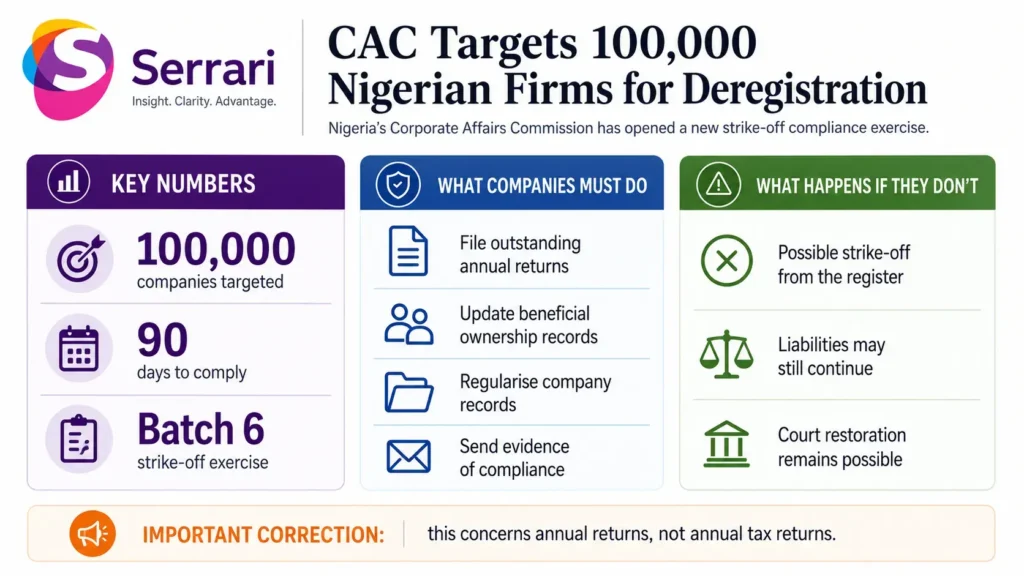
Nigeria’s Corporate Affairs Commission has opened a compliance exercise that could remove 100,000 companies from the national register. The affected businesses have 90 days to file outstanding annual returns, update Persons with Significant Control or beneficial ownership information and regularise their corporate records.
The exercise, identified as Batch 6, is a notice of intended strike-off rather than an immediate cancellation of every listed company. It also concerns corporate annual returns, not annual tax returns, which are administered separately by Nigeria’s tax authorities.
Key Overview
- The exercise covers 100,000 registered companies.
- Affected businesses have 90 days to regularise their records.
- Required filings include annual returns and beneficial ownership information.
- Companies must submit evidence of compliance.
- Businesses that fail to respond may be struck off without another notice.
- Existing liabilities may continue after removal from the register.
- A company, member or creditor may seek court-ordered restoration.
CAC Begins Sixth Strike-Off Compliance Round
The regulator said it had commenced another round of removing inactive or non-compliant companies under Sections 692(3) and 692(4) of the Companies and Allied Matters Act, 2020.
According to the official Batch 6 notice, affected companies must file all outstanding annual returns and, by extension, update their Persons with Significant Control or beneficial ownership information. They must also correct any other outstanding information on the corporate register.
Companies that fail to comply within the 90-day period will be struck off without further notice. Businesses should check the published list, complete the required filings and send evidence of compliance through the channel specified by the regulator.
Annual Returns Are Not Tax Returns
The raw report described the issue as involving annual tax returns, but the required filings are corporate annual returns. These update the company registry and are different from company income-tax returns filed with tax authorities.
Under Section 417 of the governing law, every company must generally submit an annual return at least once each year, subject to limited exemptions. The return records information such as the registered office, directors, secretary, members, share structure and other statutory particulars.
For most companies, the return must be delivered within 42 days after the annual general meeting. Companies with only one member are exempt from that particular 42-day timing rule, although they remain subject to applicable reporting obligations.
Annual returns help the regulator determine whether an entity remains active and whether its public records are current. Persistent failure to file can therefore signal that a company is dormant, neglected or operating without maintaining mandatory corporate information.
Ownership Disclosures Are Part of the Exercise
The regulator has linked annual-return compliance to information on Persons with Significant Control. These are individuals who ultimately own, control or exercise significant influence over a company.
The beneficial ownership rules require a person with significant control to notify the company. The company must then inform the regulator and include the relevant information in its annual return.
Separate disclosure regulations generally identify significant control through factors such as directly or indirectly holding at least 5% of shares or voting rights, having power over director appointments or exercising substantial influence.
Affected companies may therefore need to update ownership information in addition to filing overdue annual returns. Incorrect or outdated beneficial ownership records can leave the company non-compliant even where its basic registration details appear current.
Context is everything. Stay ahead of shifting trends with today’s market updates, and uncover emerging opportunities using the Serrari Group Market Index and Marketplace. Then, take control of your own financial future by exploring our Money & Life Reset Transformation Blueprint ™ to build stronger habits, create better systems, and design a path toward lasting wealth.
What Section 692 Permits
Section 692 allows the commission to begin a strike-off process where it reasonably believes that a company is not carrying on business, has not operated for 10 years or has failed to comply with the Act for a consecutive 10-year period.
The law allows the regulator to remove a company where it receives no response within 90 days of the last publication confirming that the business is operating. This makes the present notice an opportunity for affected companies to demonstrate activity and correct their records before removal.
Strike-off does not necessarily erase existing obligations. The statutory provisions state that liabilities of directors, managing officers and members may continue and remain enforceable as though the company had not been struck off. A court also retains power to wind up a removed company.
Restoration Is Possible but More Costly
A company, member or creditor affected by an administrative strike-off may apply to court for restoration within 10 years of publication of the removal notice.
The court may restore the company if it was operating when struck off or if restoration would otherwise be just. It can also issue directions intended to return the company and affected parties, as closely as possible, to their previous positions.
Restoration may involve legal costs, delays and additional compliance work. Companies included in Batch 6 can avoid those complications by responding during the current 90-day window.
Steps Affected Businesses Should Take
Directors should confirm whether their company appears on the published list and review all overdue annual returns, registered office information, director details, shareholding records and ownership disclosures.
After completing the filings and paying applicable fees or penalties, the company should submit evidence of compliance as directed in the notice. Filing receipts, payment confirmations and correspondence should be retained in case the registry status is not updated immediately.
The exercise is intended to improve the reliability of Nigeria’s corporate register. For active companies, regularising records can protect legal status and strengthen credibility with banks, investors, customers and government agencies. For dormant entities, the notice provides a final period to either restore compliance or face removal.
Sources
Corporate Affairs Commission / Punch
Your financial future isn’t something you wait for—it’s something you build.
The real question is: when do you begin?
Move beyond simply staying informed.
Navigate the markets with clarity—track trends through the Serrari Group Market Index, uncover opportunities in the Serrari Marketplace, and build practical knowledge with our Curated Wealth Builder Platform.
Stay connected to what truly matters.
Get daily insights on macro trends and financial movements across Kenya, Africa, and global markets—delivered through the Serrari Newsletter.
Growth opens doors.
Advance your career through professional programs including ACCA, HESI A2, ATI TEAS 7 , HESI EXIT , NCLEX – RN and NCLEX – PN, Financial Literacy!🌟—designed to move you forward with confidence.
See where money is flowing—clearly and in real time.
Track Money Market Funds, Treasury Bills, Treasury Bonds, Green Bonds, and Fixed Deposits, alongside global and African indexes, key economic indicators, and the evolving Crypto and stablecoin landscape—all within Serrari’s Market Index.