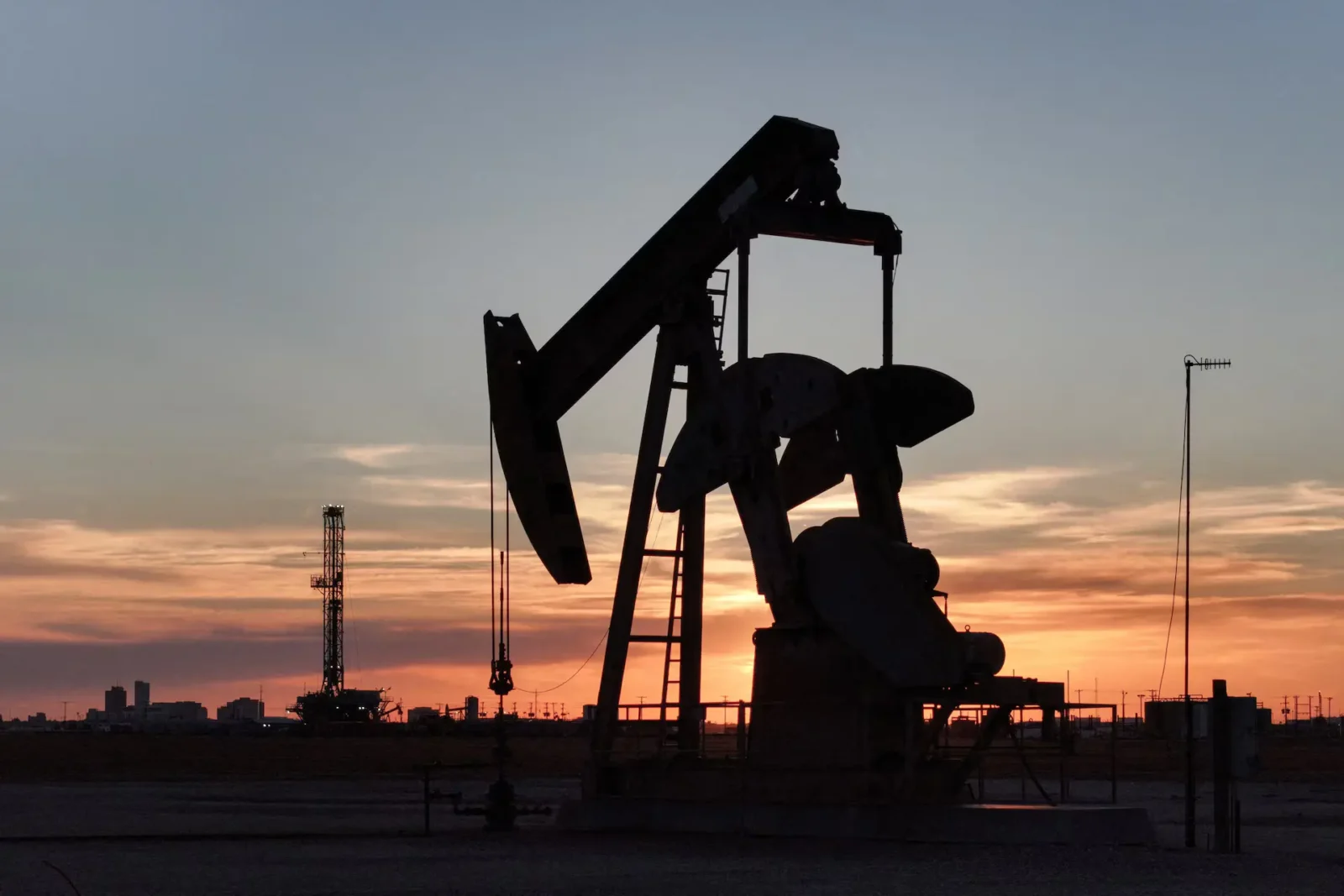
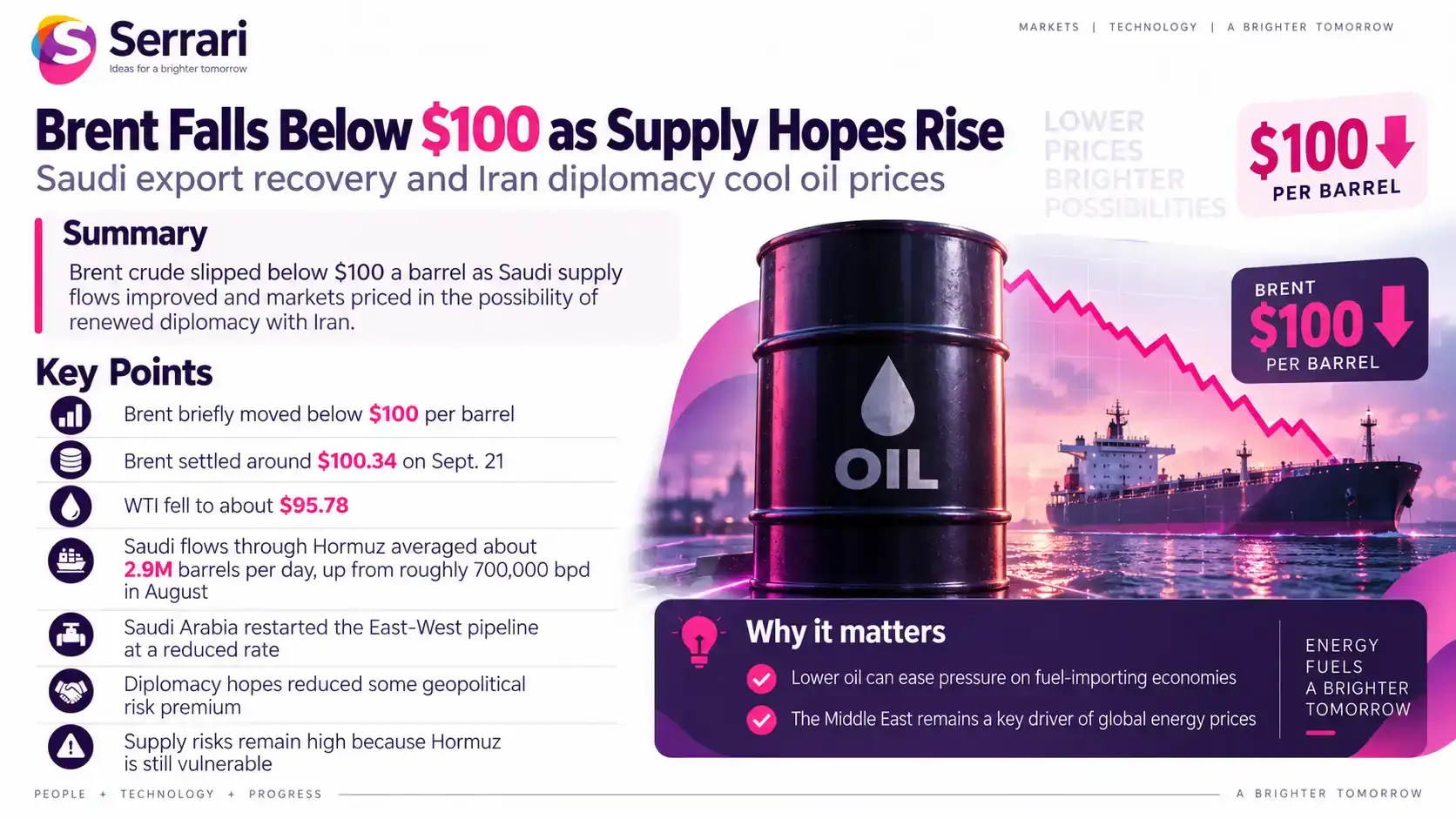
Brent crude has fallen below $100 a barrel as oil traders respond to improving Saudi supply prospects and tentative diplomatic signals surrounding the U.S.-Iran conflict.
The pullback marks a sharp reversal from the previous week’s surge toward $110, when attacks on energy infrastructure and continued disruption around the Strait of Hormuz intensified fears of tightening global supply.
Brent settled at $100.34 on September 21 after briefly trading below $100, while West Texas Intermediate fell to $95.78. Prices weakened further on September 22 as Saudi Arabia began restoring its East-West pipeline and markets assessed the possibility of increased Middle Eastern exports.
Key Overview
- Brent briefly moved below $100 per barrel on September 21, its lowest level since September 9.
- Brent settled that session at $100.34, down about 3.4%.
- WTI fell 4.51% to $95.78 for the October contract.
- Saudi oil flows through the Strait of Hormuz recently averaged about 2.9 million barrels per day, compared with roughly 700,000 bpd in August.
- Saudi Arabia has started restoring its East-West oil pipeline after infrastructure damage disrupted Red Sea exports.
- Markets are monitoring possible U.S.-Iran diplomatic engagement around the UN General Assembly.
- The Strait of Hormuz remains a major risk because disruption there can quickly affect global energy supply.
- Lower crude prices could eventually ease some pressure on oil-importing economies, although refined fuel prices remain elevated in several markets.
Saudi Supply Recovery Pulls Oil Lower
One of the biggest reasons behind the retreat in oil prices is the apparent recovery in Saudi export capacity.
Following attacks that disrupted Saudi Arabia’s East-West pipeline and affected shipments through the Red Sea port of Yanbu, Saudi Aramco increased the amount of oil moving through the Persian Gulf.
Satellite tracking cited by analysts showed Saudi flows through the Strait of Hormuz averaging approximately 2.9 million barrels per day over six days, compared with roughly 700,000 barrels per day during August.
The additional flows eased some concerns that damage to Saudi infrastructure would significantly reduce the amount of crude reaching international markets.
Supply expectations improved further on September 22 when Saudi Arabia restarted its East-West pipeline at a reduced rate.
The pipeline can eventually transport up to approximately 7 million barrels per day and allows Saudi crude to reach the Red Sea without passing through Hormuz. Full restoration is expected to take longer because several pumping stations sustained damage.
Context is everything. Stay ahead of shifting trends with today’s market updates, and uncover emerging opportunities using the Serrari Group Market Index and Marketplace. Then, take control of your own financial future by exploring our Money & Life Reset Transformation Blueprint ™ to build stronger habits, create better systems, and design a path toward lasting wealth.
Iran Diplomacy Reduces Some of the Risk Premium
Oil prices are also reacting to tentative diplomatic signals between Washington and Tehran.
Ahead of the United Nations General Assembly in New York, the possibility of renewed negotiations raised hopes that the conflict could eventually de-escalate.
U.S. President Donald Trump said he was open to meeting Iranian President Masoud Pezeshkian, while Iran communicated conditions through mediators for potentially returning to negotiations.
Those signals do not constitute a peace agreement, but crude markets can respond quickly to changes in the perceived probability of future supply disruptions. Expectations of diplomatic progress can reduce the geopolitical premium incorporated into oil prices even before any formal agreement is reached.
By September 22, Brent had fallen as low as around $97.43, as markets also responded to reports that Saudi pipeline flows were returning and that Iran could consider measures affecting passage through Hormuz.
Hormuz Still Keeps Oil Markets Vulnerable
Despite the price decline, the underlying supply risk has not disappeared.
The Strait of Hormuz remains one of the world’s most important oil chokepoints. Before the major 2026 disruptions, approximately 20.9 million barrels per day passed through the route during the first half of 2025, equivalent to roughly one-fifth of global petroleum-liquids consumption.
Flows collapsed substantially during the 2026 conflict. Official energy data show average oil flows through Hormuz declining from 14.9 million barrels per day in the first quarter of 2026 to just 4.9 million in the second quarter.
The latest energy outlook expects Middle Eastern production to increase as shipping flows gradually recover, although some export constraints are expected to persist through the end of 2026.
That means oil prices could remain highly sensitive to attacks, diplomatic developments and changes in tanker traffic.
Lower Oil Offers Some Relief, But Nigeria Remains Exposed
The fall in Brent could eventually ease pressure on countries dealing with elevated fuel costs, but the benefit is unlikely to be immediate.
Nigeria has experienced particularly high fuel prices despite being one of Africa’s largest oil producers. Petrol prices have recently reached around ₦1,400 per litre in Lagos and Abuja, while diesel has traded above ₦2,000 per litre in some areas.
Higher international crude costs raise feedstock expenses for refiners, meaning global oil-price increases have continued feeding into domestic fuel prices even as Nigeria expands domestic refining capacity.
A sustained reduction in crude prices could therefore provide some relief, but exchange rates, refinery economics, logistics and domestic pricing structures will continue to influence what consumers ultimately pay.
For global markets, Brent’s return below $100 shows how quickly geopolitical premiums can unwind when supply expectations improve. But with conflict continuing and major Middle Eastern export routes still vulnerable, the current decline does not yet signal a return to normal oil-market conditions.
Sources: Reuters / U.S. Energy Information Administration / Daily Trust
Your financial future isn’t something you wait for—it’s something you build.
The real question is: when do you begin?
Move beyond simply staying informed.
Navigate the markets with clarity—track trends through the Serrari Group Market Index, uncover opportunities in the Serrari Marketplace, and build practical knowledge with our Curated Wealth Builder Platform.
Stay connected to what truly matters.
Get daily insights on macro trends and financial movements across Kenya, Africa, and global markets—delivered through the Serrari Newsletter.
Growth opens doors.
Advance your career through professional programs including ACCA, HESI A2, ATI TEAS 7 , HESI EXIT , NCLEX – RN and NCLEX – PN, Financial Literacy!🌟—designed to move you forward with confidence.
See where money is flowing—clearly and in real time.
Track Money Market Funds, Treasury Bills, Treasury Bonds, Green Bonds, and Fixed Deposits, alongside global and African indexes, key economic indicators, and the evolving Crypto and stablecoin landscape—all within Serrari’s Market Index.