
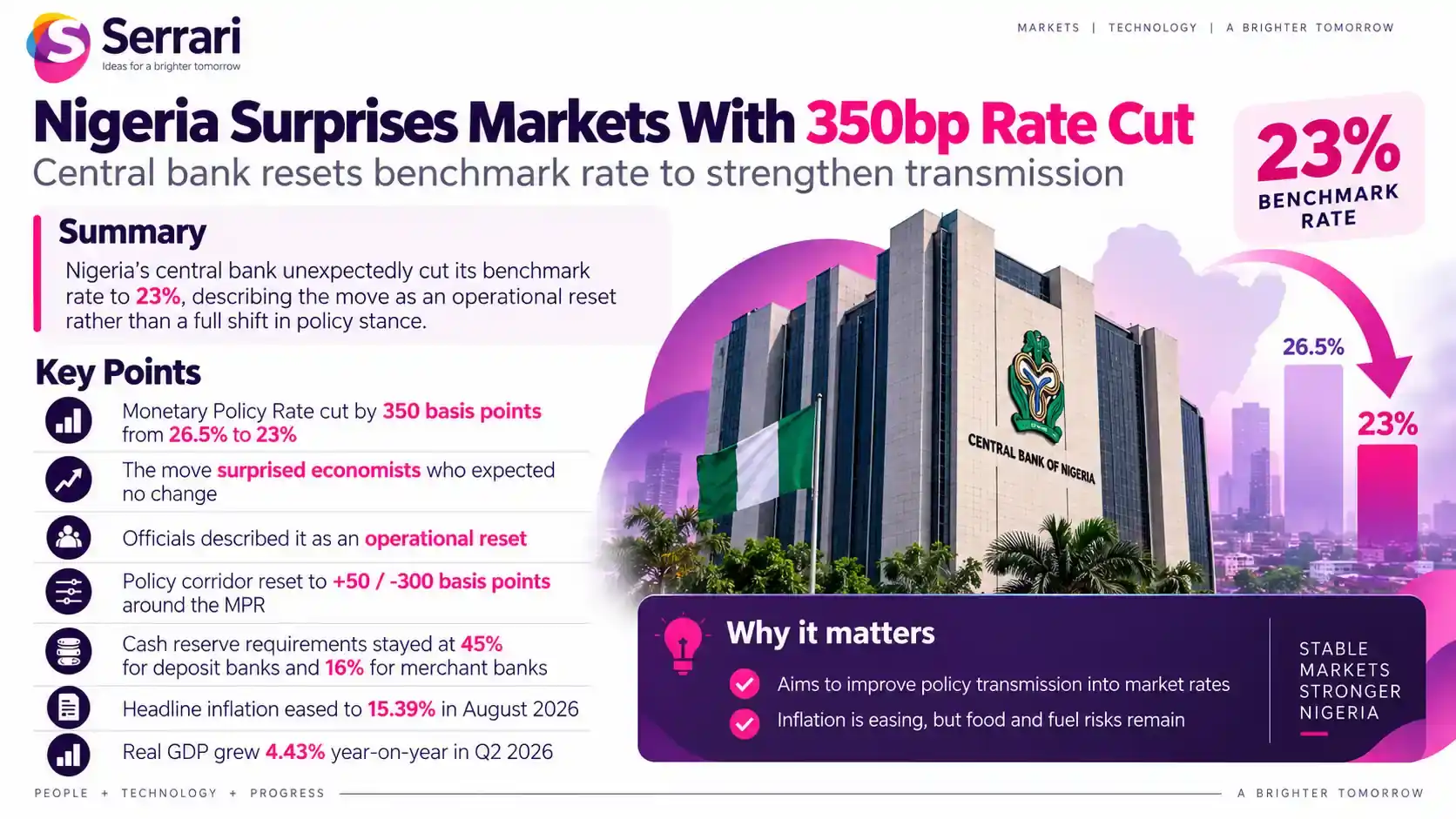
Nigeria’s central bank has delivered a surprise 350-basis-point reduction in its benchmark Monetary Policy Rate, taking it from 26.5% to 23% after two consecutive meetings in which policymakers left rates unchanged.
The decision was unusual not only because of its size, but also because policymakers described it as an “operational reset” rather than a conventional shift toward looser monetary policy. The bank said prevailing market rates had moved too far away from the official benchmark, weakening the MPR’s ability to guide financial conditions.
The reset comes as headline inflation has moderated to 15.39% in August, economic growth strengthened in the second quarter and the foreign-exchange environment showed greater stability. However, high food and fuel costs mean inflation risks remain significant.
Key Overview
- The Monetary Policy Rate was reduced by 350 basis points from 26.5% to 23%.
- The move surprised economists, who had expected the rate to remain unchanged.
- Policymakers described the decision as an operational reset, not a change in the underlying policy stance.
- The standing facilities corridor was recalibrated to +50/-300 basis points around the MPR.
- Cash reserve requirements were retained at 45% for deposit money banks and 16% for merchant banks.
- Headline inflation eased to 15.39% in August 2026, from 15.43% in July.
- Nigeria’s real GDP expanded 4.43% year-on-year in Q2 2026.
- Lower benchmark rates do not automatically mean commercial lending rates will fall by the same amount.
A 350-Basis-Point Reset Surprises Markets
The Monetary Policy Committee ended its September meeting with an unexpected reduction in the benchmark rate, lowering the MPR to 23% from 26.5%.
All seven economists surveyed before the meeting had expected policymakers to leave the rate unchanged at 26.5%, after the central bank maintained that level at its May and July meetings.
The size of the move makes it especially significant. But Governor Olayemi Cardoso stressed that the adjustment should be understood as a technical recalibration of the monetary-policy framework rather than simply the beginning of an aggressive easing cycle.
Context is everything. Stay ahead of shifting trends with today’s market updates, and uncover emerging opportunities using the Serrari Group Market Index and Marketplace. Then, take control of your own financial future by exploring our Money & Life Reset Transformation Blueprint ™ to build stronger habits, create better systems, and design a path toward lasting wealth.
Why the Central Bank Calls It an Operational Reset
The central issue was the widening gap between the official MPR and interest rates actually prevailing in financial markets.
Policymakers said that this disconnect with market rates had weakened the benchmark’s usefulness as the main signal of monetary policy. Bringing the MPR closer to actual funding and money-market conditions is intended to strengthen policy transmission.
The committee therefore reset the MPR to 23% and recalibrated the standing facilities corridor to 50 basis points above and 300 basis points below the benchmark.
It retained the Cash Reserve Requirement at 45% for deposit money banks, 16% for merchant banks and 75% for non-Treasury Single Account public-sector deposits.
Keeping those reserve requirements unchanged reinforces the central bank’s argument that the decision was not simply a broad relaxation of monetary conditions. Banks still face substantial liquidity constraints even with the lower headline policy rate.
Inflation Gives Policymakers More Room
The rate adjustment also comes against a more favourable inflation backdrop.
Nigeria’s headline inflation eased to 15.39% in August from 15.43% in July. Month-on-month inflation slowed more sharply to 0.71% from 1.57%, while food inflation declined to 19.57% year-on-year.
Policymakers attributed the moderation partly to the impact of earlier monetary tightening, greater exchange-rate stability and improving inflation expectations.
Economic activity has also remained resilient. Nigeria’s real GDP expanded 4.43% year-on-year in the second quarter of 2026, accelerating from 3.89% in the first quarter as both oil and non-oil activity strengthened.
That combination of slower inflation and stronger growth gave the central bank greater room to recalibrate its framework without abandoning its focus on price stability.
What the Cut Could Mean for Borrowers and Banks
A lower MPR can eventually reduce funding costs across the financial system, but the impact on businesses and households is unlikely to be immediate or uniform.
Commercial lending rates depend on more than the benchmark rate. Banks also consider deposit costs, liquidity, credit risk, reserve requirements and the broader economic outlook when pricing loans.
The continued 45% reserve requirement for deposit money banks means a large share of qualifying deposits remains tied up as reserves, which can continue to constrain the amount of liquidity available for lending.
For financial markets, the more immediate significance is that the official policy signal has been brought closer to prevailing market rates. If the reset improves transmission as intended, future changes in the MPR could have a clearer relationship with money-market rates, bond yields and eventually credit conditions.
The next test will be whether inflation continues to moderate despite pressures from food and energy costs. If those pressures intensify, policymakers may face a more difficult balance between maintaining price stability and allowing borrowing conditions to normalise.
Sources: Central Bank of Nigeria / Reuters / National Bureau of Statistics / Proshare / Nairametrics
Your financial future isn’t something you wait for—it’s something you build.
The real question is: when do you begin?
Move beyond simply staying informed.
Navigate the markets with clarity—track trends through the Serrari Group Market Index, uncover opportunities in the Serrari Marketplace, and build practical knowledge with our Curated Wealth Builder Platform.
Stay connected to what truly matters.
Get daily insights on macro trends and financial movements across Kenya, Africa, and global markets—delivered through the Serrari Newsletter.
Growth opens doors.
Advance your career through professional programs including ACCA, HESI A2, ATI TEAS 7 , HESI EXIT , NCLEX – RN and NCLEX – PN, Financial Literacy!🌟—designed to move you forward with confidence.
See where money is flowing—clearly and in real time.
Track Money Market Funds, Treasury Bills, Treasury Bonds, Green Bonds, and Fixed Deposits, alongside global and African indexes, key economic indicators, and the evolving Crypto and stablecoin landscape—all within Serrari’s Market Index.