Kenya has signed a five-year partnership with the Emerging Markets Working Group at Stanford University’s Hoover Institution to expand the use of artificial intelligence, data analytics and digital tools in government decision-making.
The agreement, signed in New York on the sidelines of the 81st United Nations General Assembly, moves Kenya’s digital-government agenda beyond simply putting services online toward using connected datasets to monitor risks, assess policies and support economic decisions.
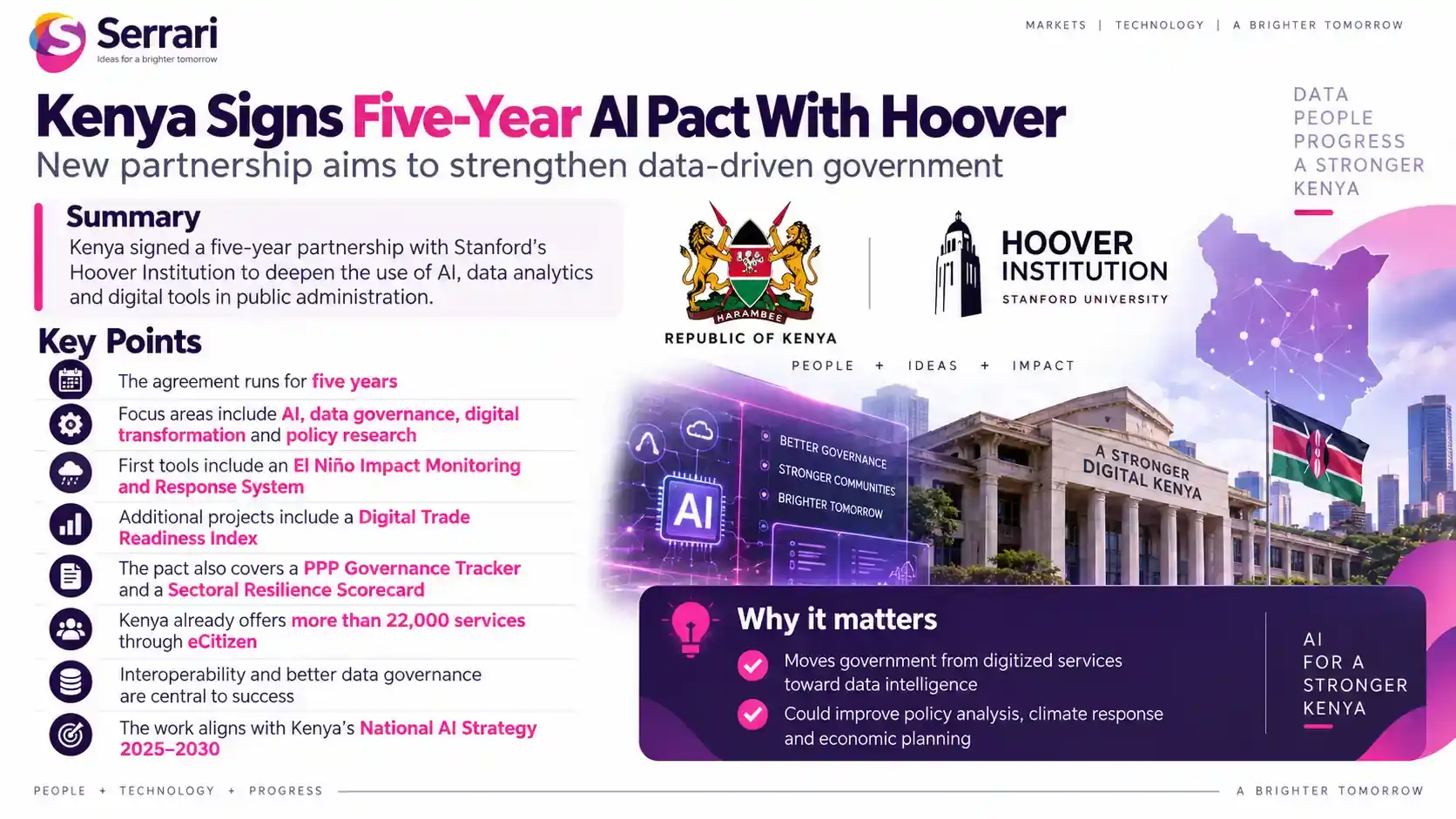
Among the first planned applications are an El Niño monitoring system, a Digital Trade Readiness Index, a Public-Private Partnership Governance Tracker and a Sectoral Resilience Scorecard.
Key Overview
- Kenya and the Hoover Institution have signed a five-year AI and data collaboration agreement.
- The partnership covers AI, data governance, digital transformation, policy research and institutional capacity.
- An El Niño Impact Monitoring and Response System is among the first planned projects.
- Other tools include a Digital Trade Readiness Index, PPP Governance Tracker and Sectoral Resilience Scorecard.
- Kenya already provides more than 22,000 government services through eCitizen.
- The country is implementing new government architecture and interoperability standards to improve data exchange.
- Kenya’s National AI Strategy 2025–2030 provides the broader framework for responsible AI adoption.
Kenya Moves From Digital Services to Data Intelligence
The five-year cooperation agreement was signed by Prime Cabinet Secretary and Foreign Affairs Cabinet Secretary Musalia Mudavadi and Jendayi Frazer, Co-Director of the Emerging Markets Working Group.
Its central objective is to strengthen Kenya’s ability to move from collecting data to generating insights that government institutions can use in policy, planning, monitoring and investment decisions.
That represents a natural next stage in Kenya’s digital transformation. Government digitisation has already expanded significantly, with more than 22,000 public services available through eCitizen.
Putting services online, however, does not automatically mean government agencies can combine their information effectively. The new partnership therefore places greater emphasis on analytics, interoperability and the institutional ability to turn information into actionable intelligence.
El Niño System Will Test the Model
One of the first planned applications is an El Niño Impact Monitoring and Response System.
The system will combine climate, geospatial, water, agricultural and infrastructure data to produce county-level intelligence.
Such a platform could allow authorities to identify where flooding, drought, agricultural disruption or infrastructure damage is emerging and coordinate responses across agencies using a more consistent information base.
The value for Kenya could extend beyond disaster management. Climate shocks can affect food production, transport networks, electricity infrastructure, water supply and government expenditure at the same time. Connecting information across those areas could provide policymakers with a broader picture of economic risks as they develop.
Its effectiveness will ultimately depend on the quality and timeliness of the underlying data and whether institutions have clear responsibility for responding to the signals generated.
Context is everything. Stay ahead of shifting trends with today’s market updates, and uncover emerging opportunities using the Serrari Group Market Index and Marketplace. Then, take control of your own financial future by exploring our Money & Life Reset Transformation Blueprint ™ to build stronger habits, create better systems, and design a path toward lasting wealth.
New Tools Target Trade, Investment and Resilience
The partnership will also develop three additional analytical tools.
A Digital Trade Readiness Index is intended to assess Kenya’s preparedness for an increasingly digital trading environment. This could encompass factors such as connectivity, digital payments, electronic documentation, regulatory systems and the ability of businesses to interact digitally across borders.
A PPP Governance Tracker will focus on public-private partnership processes, creating a more structured way of assessing project preparation, governance and implementation.
The proposed Sectoral Resilience Scorecard will initially focus on areas including agriculture and the digital economy, helping policymakers evaluate vulnerabilities and investment conditions across important parts of the economy.
Kenya’s Foreign Affairs Ministry says the planned analytical platform is expected to establish an initial working capability in roughly six months, followed by further development over a 12-month period. Individual programmes will still require consideration and approval by the institutions involved.
Data Governance Is the Critical Foundation
Kenya’s ability to make sophisticated use of AI will depend heavily on the quality of its government data.
In February 2026, the government acknowledged that its data ecosystem remains fragmented, citing siloed systems, inconsistent standards, fragmented legal frameworks and limited capacity in data management and analytics.
A National Data Governance Policy is being developed to address those weaknesses and establish clearer standards around how public-sector information is collected, shared and managed.
The government is also advancing the Government Enterprise Architecture and Government Interoperability Framework, which provide common principles for connecting systems, exchanging information through APIs and reducing duplication across public institutions.
These foundations matter because artificial intelligence cannot compensate for unreliable or poorly structured data. Predictive systems are only useful when the information feeding them is sufficiently accurate, current and consistently governed.
AI Strategy Provides the Wider Framework
The Hoover partnership also sits within Kenya’s National Artificial Intelligence Strategy 2025–2030.
The strategy is built around three central pillars: AI digital infrastructure, data ecosystems and governance, and AI research, innovation and commercialisation. It also emphasises skills, responsible AI, ethics and institutional governance.
The new partnership therefore represents more than another government technology project. It is an attempt to connect Kenya’s growing digital infrastructure with a deeper capability to analyse information and use it in public decision-making.
The measure of success will not simply be how many dashboards or AI tools are created. It will be whether government institutions can reliably combine data, identify risks earlier, evaluate policies more effectively and translate digital information into better operational decisions.
Sources: Ministry of Information, Communications and the Digital Economy / Ministry of Foreign and Diaspora Affairs / Hoover Institution / Africa Sustainability Matters
Your financial future isn’t something you wait for—it’s something you build.
The real question is: when do you begin?
Move beyond simply staying informed.
Navigate the markets with clarity—track trends through the Serrari Group Market Index, uncover opportunities in the Serrari Marketplace, and build practical knowledge with our Curated Wealth Builder Platform.
Stay connected to what truly matters.
Get daily insights on macro trends and financial movements across Kenya, Africa, and global markets—delivered through the Serrari Newsletter.
Growth opens doors.
Advance your career through professional programs including ACCA, HESI A2, ATI TEAS 7 , HESI EXIT , NCLEX – RN and NCLEX – PN, Financial Literacy!🌟—designed to move you forward with confidence.
See where money is flowing—clearly and in real time.
Track Money Market Funds, Treasury Bills, Treasury Bonds, Green Bonds, and Fixed Deposits, alongside global and African indexes, key economic indicators, and the evolving Crypto and stablecoin landscape—all within Serrari’s Market Index.