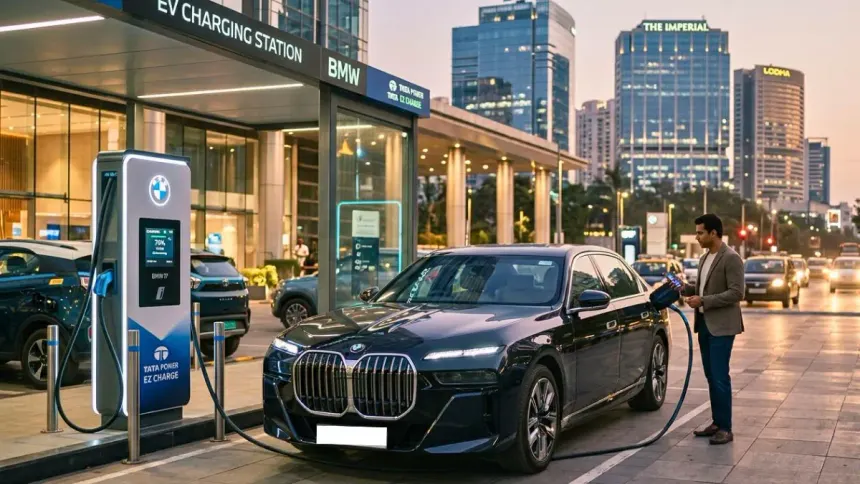
BMW Group India is witnessing a strong surge in electric vehicle (EV) adoption, with EVs accounting for 26% of total sales in Q1 2026. This growth reflects a broader shift in India’s luxury car market, where high-income consumers are increasingly prioritizing electric mobility due to rising fuel costs, global uncertainty, and evolving preferences.
The company’s dominance in the luxury EV segment—holding over 70% market share—signals that premium EV adoption is moving beyond early adopters into mainstream luxury demand.
This trend highlights a key transition point: EVs are no longer just a sustainability choice in India’s luxury segment—they are becoming a strategic and economic decision.
Key Overview
- BMW India recorded its highest-ever Q1 sales at 4,567 units
- EVs accounted for 26% of total sales (1 in 4 cars)
- EV sales grew 83% year-on-year
- BMW holds over 70% share in India’s luxury EV market
- Growth driven by fuel price volatility and changing preferences
- Strong demand for BMW iX1 long wheelbase model
- Luxury EV adoption expanding beyond early adopters
- Company plans major EV product expansion in 2026
- Signals structural shift in premium mobility trends in India
- EVs increasingly viewed as practical, not just sustainable choice
BMW Group India has started the year on a notably strong note, reporting its highest-ever first-quarter sales, with 4,567 cars delivered between January and March.
This represents a 17% year-on-year increase, a solid and encouraging performance given the broader challenges currently facing the global automotive industry. Factors such as geopolitical uncertainty, fluctuating fuel prices, and persistent supply chain pressures have created a complex operating environment for automakers worldwide.
However, what makes this performance particularly compelling is not just the growth itself—but the underlying drivers behind it.
Electric vehicles have emerged as a key engine of momentum, signaling not only strong demand but also a deeper and more structural transformation taking place within India’s luxury car market. This shift suggests that BMW’s growth is increasingly tied to changing consumer preferences rather than short-term market conditions.
Markets move fast; don’t get left behind. We’ve paired the Serrari Group Market Index with a curated Marketplace and a comprehensive Wealth Builder Course to ensure you have the data—and the skills—to act on it.
Electric Vehicles Move to the Center of Growth
Electric vehicles are no longer a niche or experimental segment within BMW India’s portfolio—they are rapidly becoming a central pillar of its growth strategy and long-term positioning.
During the quarter, BMW and MINI together sold 1,185 electric vehicles, marking a remarkable 83% increase compared to the previous year.
As a result, EVs now account for 26% of total sales, meaning roughly one in every four vehicles sold by the group in India is electric.
This level of penetration is particularly significant in a market where EV adoption has historically been gradual and concentrated within early adopters or specific urban pockets. It reflects a growing shift in consumer confidence toward electric mobility.
More importantly, it indicates that EVs are beginning to move into the mainstream of the luxury segment—often acting as a leading indicator of broader trends that may eventually influence the wider automotive market.
Luxury Buyers Are Leading the EV Transition
One of the most important insights from BMW India’s performance is the pivotal role of luxury consumers in driving the transition toward electric mobility.
Unlike the mass market, where affordability and infrastructure limitations can slow down EV adoption, premium buyers are generally more open to innovation and better positioned to absorb higher upfront costs associated with electric vehicles.
For these consumers, EVs represent more than just an environmentally conscious choice—they offer a compelling combination of advanced technology, refined performance, and long-term value. These attributes align closely with the expectations of luxury buyers who prioritize quality, innovation, and driving experience.
BMW’s strong EV sales indicate that this segment is moving beyond initial curiosity into sustained and confident adoption, suggesting a deeper shift in purchasing behavior.
The success of models such as the BMW iX1 further demonstrates how effective product positioning—blending electric efficiency with luxury comfort and practicality—can significantly accelerate adoption when aligned with consumer preferences.
The iX1 Effect: A Key Growth Driver
A significant portion of BMW India’s EV success can be attributed to a single model: the BMW iX1 long wheelbase.
The vehicle has emerged as the entry point into BMW’s electric portfolio, accounting for a large share of EV sales.
Its popularity reflects a broader trend in the Indian market, where buyers are increasingly prioritizing comfort, space, and practicality, alongside sustainability.
The long wheelbase design caters to chauffeur-driven customers—a key segment in India’s luxury market—making it particularly appealing.
This highlights an important lesson: EV adoption is not just about technology—it is about aligning products with local consumer preferences.
Fuel Prices and Global Uncertainty Shape Demand
Beyond product strategy and brand positioning, external macroeconomic factors are also playing a critical and increasingly influential role in driving EV adoption.
Rising global crude oil prices, combined with ongoing supply chain disruptions and geopolitical tensions, have introduced a heightened level of uncertainty around fuel availability and long-term costs.
For many consumers—particularly in the premium segment—this uncertainty has shifted the perception of electric vehicles from being a future-oriented or environmentally driven choice to a more immediate and practical solution for managing long-term expenses.
The volatility in fuel markets is reinforcing the core value proposition of EVs, especially for high-mileage users who are more exposed to fluctuations in fuel prices. Over time, the predictability of electricity costs compared to petrol or diesel is becoming a significant advantage.
In this context, EVs are increasingly being viewed not just as environmentally responsible, but as economically sensible and strategically advantageous—offering both cost stability and reduced exposure to global energy market volatility.
Context is everything. While you follow today’s updates, use the Serrari Group Market Index and Marketplace to spot emerging shifts. Need to sharpen your edge? Our Wealth Builder Course turns these insights into a professional-grade strategy.
BMW Strengthens Its Leadership in Luxury EVs
BMW India’s strong performance has further reinforced its position as the leading luxury EV brand in the country, with a market share exceeding 70%.
This dominance is underpinned by a broad and well-curated product portfolio that includes models such as the BMW i7, i5, iX, and iX1, alongside electric offerings from MINI. Each of these models caters to different segments within the luxury market, ensuring that the brand can meet a wide range of customer preferences and use cases.
Having such a diverse lineup allows BMW to engage both first-time EV buyers and experienced luxury consumers looking to upgrade to electric mobility. It also enables the company to capture demand across multiple price points and vehicle categories.
In a market where EV adoption is still evolving and consumer preferences are shifting rapidly, this level of product diversity provides a significant competitive advantage. It positions BMW not just as a participant in the EV transition, but as a leader shaping its direction within the luxury segment.
Expanding the EV Portfolio for Future Growth
Looking ahead, BMW India is positioning itself to build on its current momentum through a strategic expansion of its electric vehicle portfolio.
The company has outlined plans for an ambitious product rollout, with multiple new EV launches expected across both sedan and SUV categories in 2026. This expansion reflects a proactive approach to capturing growing demand and staying ahead in an increasingly competitive market.
By broadening its lineup, BMW aims to offer greater choice to consumers, addressing a wider range of preferences in terms of design, performance, and functionality. This is particularly important as the EV market matures and buyers become more discerning.
At the same time, the company is investing in charging infrastructure and the broader EV ecosystem, recognizing that convenience, accessibility, and user experience are critical factors in sustaining long-term adoption.
This dual focus on product expansion and ecosystem development highlights a comprehensive strategy—one that goes beyond selling vehicles to building a complete electric mobility experience.
A Luxury Market Defying Broader Trends
BMW’s strong performance is particularly noteworthy when viewed against the backdrop of the broader luxury car market, which has remained relatively subdued despite overall automotive growth.
While the wider market has shown moderate expansion, the luxury segment has been more sensitive to global economic conditions, including inflation, currency fluctuations, and shifts in consumer confidence.
Despite these challenges, BMW has managed to outperform the market, driven largely by its focus on electric mobility and its ability to align with emerging consumer trends.
This outperformance suggests that EVs are not merely contributing to incremental growth—they are fundamentally reshaping competitive dynamics within the luxury segment.
Brands that are able to adapt quickly to this shift are gaining a clear advantage, while those slower to respond risk losing relevance in an increasingly electrified market landscape.
A Structural Shift in Consumer Preferences
The growing share of electric vehicles within BMW Group India’s portfolio points to a deeper and more structural shift in consumer preferences—one that goes beyond short-term trends and reflects a fundamental change in how buyers evaluate mobility.
Customers are increasingly prioritizing technology, sustainability, and long-term cost efficiency over traditional factors such as engine size, fuel type, and even brand legacy. Features such as connected driving experiences, lower running costs, and environmental impact are becoming central to purchasing decisions, particularly in the premium segment.
This shift is especially pronounced among younger, urban consumers who are more exposed to global trends and are generally more open to adopting new technologies. For this group, EVs are not just vehicles—they represent a lifestyle choice aligned with innovation, sustainability, and future readiness.
At the same time, increasing awareness about climate change, rising fuel costs, and improvements in EV performance are reinforcing this transition. As charging infrastructure continues to expand and range anxiety gradually diminishes, more consumers are likely to view EVs as a practical and reliable alternative to conventional vehicles.
Taken together, these factors suggest that the shift toward electric mobility is not temporary but structural—one that is set to influence not just the luxury segment, but the broader automotive industry in India over the coming years.
Outlook: The Future of Luxury EVs in India
Looking ahead, BMW India’s performance offers a clear and compelling glimpse into the future trajectory of the country’s automotive market.
In the short term, EV adoption within the luxury segment is expected to continue its upward momentum, supported by rising fuel costs, a growing portfolio of electric models, and increasing consumer awareness about the benefits of electric mobility. Premium buyers are likely to remain at the forefront of this transition, setting the tone for broader market adoption.
Over the medium term, the pace of growth will depend heavily on the expansion of charging infrastructure, regulatory support, and the introduction of incentives that make EV ownership more accessible. Improvements in charging accessibility, faster charging technologies, and supportive government policies could significantly accelerate adoption across a wider range of consumers.
In the long term, the shift toward electric mobility appears increasingly inevitable. As battery technology advances, costs decline, and infrastructure becomes more robust, EVs are expected to transition from being an alternative option to becoming the default choice for many buyers.
For BMW, its early leadership and strong positioning in the luxury EV segment place it in a favorable position to capture this transition and maintain its competitive edge.
More broadly, the company’s performance highlights a critical insight for the industry:
The transition to electric mobility in India is no longer a question of “if”—but increasingly a matter of “how fast” it will unfold.
Your financial future isn’t something you wait for—it’s something you build.
The real question is: when do you begin?
Move beyond simply staying informed.
Navigate the markets with clarity—track trends through the Serrari Group Market Index, uncover opportunities in the Serrari Marketplace, and build practical knowledge with our Curated Wealth Builder Course.
Stay connected to what truly matters.
Get daily insights on macro trends and financial movements across Kenya, Africa, and global markets—delivered through the Serrari Newsletter.
Growth opens doors.
Advance your career through professional programs including ACCA, HESI A2, ATI TEAS 7 , HESI EXIT , NCLEX – RN and NCLEX – PN, Financial Literacy!🌟—designed to move you forward with confidence.
See where money is flowing—clearly and in real time.
Track Money Market Funds, Treasury Bills, Treasury Bonds, Green Bonds, and Fixed Deposits, alongside global and African indexes, key economic indicators, and the evolving Crypto and stablecoin landscape—all within Serrari’s Market Index.