
The latest crypto market selloff has pushed Bitcoin and Ethereum to their weakest weekly performance since July 2024. A combination of ETF outflows, weak spot trading volumes, leveraged liquidations, and declining investor risk appetite has triggered sharp losses across the digital asset sector, with Bitcoin testing key support levels and Ethereum approaching a critical technical zone.
Key Overview
- Bitcoin fell nearly 15% during the week, while Ether lost more than 17%.
- The decline marks crypto’s worst weekly performance since July 2024.
- More than $1.2 billion in leveraged crypto positions were liquidated during the selloff.
- Bitcoin briefly traded in the mid-$59,000 range before recovering toward $62,500.
- Ethereum fell toward the important $1,420 support level that previously triggered a major rally in 2025.
- Spot crypto trading volume dropped to $679 billion in April, the lowest monthly level since October 2023.
- Bitcoin ETFs experienced more than $4 billion in cumulative outflows before a modest reversal.
- Zcash plunged over 30% after an exploit capable of minting unlimited tokens was discovered.
- Altcoins suffered widespread losses, with Cardano falling more than 10%.
- Analysts remain divided on whether the market is nearing a recovery bounce or deeper downside.
Bitcoin and Ether Price Decline Deepens Market Losses
The recent Bitcoin and Ether price decline has placed the cryptocurrency market under significant pressure, resulting in its worst weekly performance since July 2024.
Bitcoin lost approximately 14.5% during the week, while Ethereum dropped more than 17%, reflecting broad weakness across digital assets. The selloff erased a substantial portion of the gains accumulated earlier in 2026 and pushed investor sentiment toward caution.
The market downturn comes amid falling trading activity, large-scale liquidations, ETF outflows, and concerns surrounding broader macroeconomic conditions.
As a result, traders are closely monitoring key support levels that could determine the next direction for the cryptocurrency market.
Bitcoin Price Drop Tests Critical Support Levels
The latest Bitcoin price drop has brought the world’s largest cryptocurrency dangerously close to a major technical support zone.
Bitcoin traded as low as the mid-$59,000 range during intraday trading before recovering toward approximately $62,500. Despite the rebound, the asset remains significantly below recent highs and has lost nearly 15% since the beginning of the week.
Analysts point to several factors contributing to the decline.
One major concern has been persistent outflows from Bitcoin exchange-traded funds. Recent data indicates that Bitcoin ETFs experienced cumulative outflows exceeding $4 billion over several weeks before a modest recovery emerged.
At the same time, stronger-than-expected U.S. economic data reduced expectations for interest rate cuts, creating additional pressure on risk assets such as cryptocurrencies.
Some market observers view the $60,000 level as a critical support zone that could trigger a relief rally if buyers return. Others warn that a sustained break below this threshold could expose Bitcoin to further declines toward $55,000 or lower.
Ether Price Decline Raises Bear Market Concerns
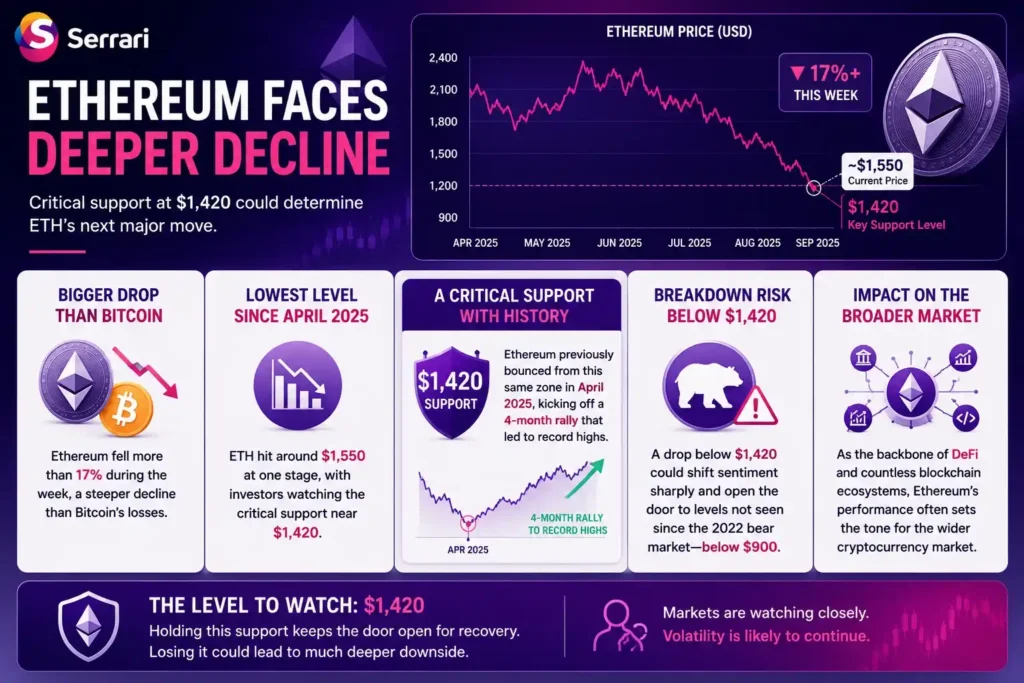
The ongoing Ether price decline has been even more severe than Bitcoin’s recent losses.
Ethereum fell more than 17% during the week and reached its lowest level since April 2025. At one stage, the cryptocurrency traded around $1,550, while investors focused on the important support level near $1,420.
This price zone is particularly significant because Ethereum previously rebounded from the same area in April 2025 before embarking on a four-month rally that eventually led to record highs.
A breakdown below $1,420 could significantly alter market sentiment and potentially open the door to price levels not seen since the 2022 bear market, when Ethereum briefly traded below $900.
Given Ethereum’s role as the foundation for many decentralized finance applications and blockchain ecosystems, its performance often influences the broader cryptocurrency market.
Context is everything. Stay ahead of shifting trends with today’s market updates, and uncover emerging opportunities using the Serrari Group Market Index and Marketplace. Then, take control of your own financial future by exploring our Money & Life Reset Transformation Blueprint ™ to build stronger habits, create better systems, and design a path toward lasting wealth.
Cryptocurrency Market Volatility Intensifies
The recent downturn has highlighted the ongoing cryptocurrency market volatility that continues to characterize digital asset investing.
According to CoinGlass data, liquidation activity surged dramatically during the selloff. More than $1.2 billion in leveraged positions were liquidated, with some reporting periods showing liquidations ranging between $1.1 billion and $1.8 billion.
The vast majority of these liquidations originated from long positions, indicating that many traders had been betting on further price increases before the market reversed sharply.
As leveraged positions were forced to close, the resulting selling pressure amplified losses and accelerated the decline.
This cascading liquidation effect is a common feature of crypto markets, where leverage levels often exceed those seen in traditional financial markets.
Crypto Market Correction Driven by Multiple Factors
Several interconnected developments contributed to the current crypto market correction.
One notable event involved privacy-focused cryptocurrency Zcash. The asset fell more than 30% after a security researcher identified an exploit capable of creating unlimited tokens within its shielded pool.
The incident negatively affected sentiment toward privacy coins, causing related cryptocurrencies such as Monero and Dash to decline as well.
Additional pressure emerged after Arthur Hayes disclosed that his firm had completely exited its Zcash position.
Another factor was the unwinding of the artificial intelligence investment theme that had previously boosted certain high-growth crypto assets. As investors rotated capital away from speculative sectors, many AI-linked and high-beta cryptocurrencies experienced significant declines.
The combination of technical breakdowns, reduced demand, and investor uncertainty created a challenging environment for digital assets.
Digital Asset Prices Reflect Weakening Demand
Recent trends in digital asset prices suggest that demand across the cryptocurrency market has weakened considerably.
CryptoQuant data shows that spot trading volume fell to approximately $679 billion during April, representing the lowest monthly trading activity since October 2023.
Lower trading volumes often indicate reduced investor participation and weaker buying pressure, making it more difficult for markets to sustain upward momentum.
Altcoins suffered particularly severe losses during the downturn.
Cardano dropped more than 10% after founder Charles Hoskinson announced he was taking a break following public concerns regarding ecosystem challenges. The token fell below $0.16, illustrating how sentiment-driven events can significantly impact cryptocurrency valuations.
The broad weakness across both large-cap and smaller cryptocurrencies demonstrates the risk-off environment currently dominating the market.
What Comes Next for Crypto Markets?
Investors are now focused on whether the current selloff represents a temporary correction or the beginning of a deeper bearish phase.
Technical analysts continue to monitor Bitcoin’s performance around the $60,000 level and Ethereum’s ability to hold support near $1,420.
If these levels remain intact, markets could experience a relief rally fueled by oversold conditions and bargain hunting.
However, further deterioration in institutional flows, economic conditions, or investor sentiment could increase downside risks.
The coming weeks may prove crucial in determining whether cryptocurrencies can stabilize or face additional pressure.
Conclusion
The Bitcoin and Ether price decline has resulted in crypto’s worst weekly performance since July 2024, driven by ETF outflows, heavy liquidations, declining trading volumes, and broader market uncertainty. Bitcoin has tested critical support near $60,000, while Ethereum approaches a key technical level at $1,420.
With over $1.2 billion in leveraged positions liquidated and investor demand showing signs of weakness, the cryptocurrency market remains under pressure. Whether the current correction evolves into a recovery or a deeper downturn will likely depend on market liquidity, institutional flows, and the ability of major cryptocurrencies to hold crucial support levels.
FAQs
1. Why did Bitcoin and Ethereum prices fall this week?
Bitcoin and Ethereum experienced sharp declines due to a combination of factors, including significant ETF outflows, weak spot trading volumes, and large-scale liquidations of leveraged positions. Strong U.S. economic data also reduced expectations for interest rate cuts, leading investors to move away from riskier assets such as cryptocurrencies.
2. How much did Bitcoin and Ethereum lose during the selloff?
Bitcoin fell by nearly 15% over the week, while Ethereum declined by more than 17%, making it the worst weekly performance for the cryptocurrency market since July 2024. The losses pushed Bitcoin toward the $60,000 support level and brought Ethereum close to key technical support near $1,420.
3. Why is Ethereum’s $1,420 support level important?
The $1,420 level is closely watched because Ethereum rebounded from this area in April 2025 before rallying to record highs over the following months. If the cryptocurrency falls below this support level, analysts warn that it could trigger additional selling pressure and potentially move toward price levels seen during the 2022 bear market.
4. How did liquidations contribute to the crypto market decline?
Liquidations occur when leveraged traders are forced to close positions after prices move against them. During the recent selloff, more than $1.2 billion in leveraged positions were liquidated, creating a cascade of forced selling that accelerated losses across Bitcoin, Ethereum, and the broader cryptocurrency market. This amplified market volatility and increased downward pressure on prices.
Sources: Mexc, Bidget, Coin Desk, Binance Square
Your financial future isn’t something you wait for—it’s something you build.
The real question is: when do you begin?
Move beyond simply staying informed.
Navigate the markets with clarity—track trends through the Serrari Group Market Index, uncover opportunities in the Serrari Marketplace, and build practical knowledge with our Curated Wealth Builder Platform.
Stay connected to what truly matters.
Get daily insights on macro trends and financial movements across Kenya, Africa, and global markets—delivered through the Serrari Newsletter.
Growth opens doors.
Advance your career through professional programs including ACCA, HESI A2, ATI TEAS 7 , HESI EXIT , NCLEX – RN and NCLEX – PN, Financial Literacy!🌟—designed to move you forward with confidence.
See where money is flowing—clearly and in real time.
Track Money Market Funds, Treasury Bills, Treasury Bonds, Green Bonds, and Fixed Deposits, alongside global and African indexes, key economic indicators, and the evolving Crypto and stablecoin landscape—all within Serrari’s Market Index.