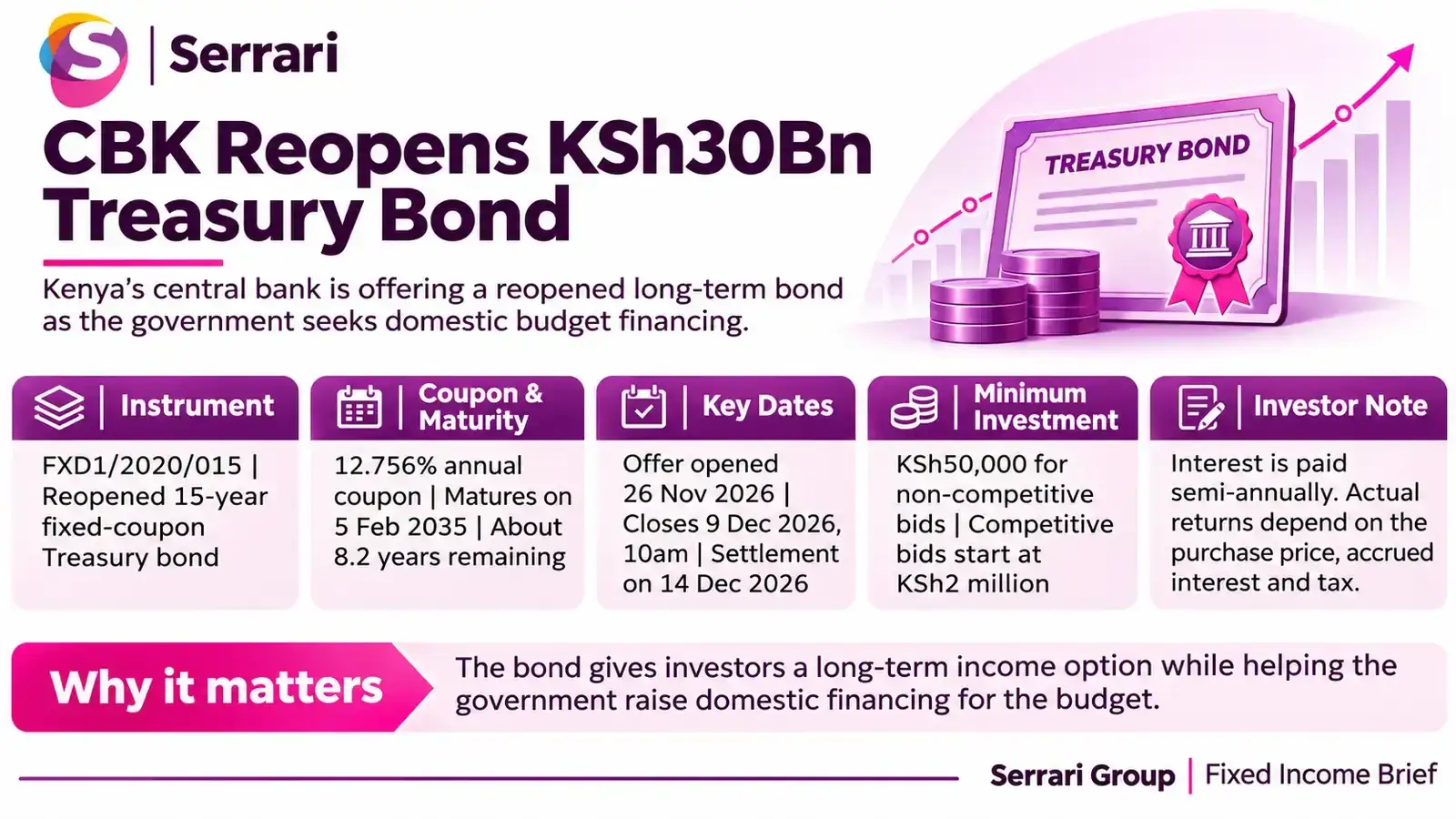
The Central Bank of Kenya (CBK) has opened a KSh30 billion Treasury bond sale to finance government budgetary requirements, giving investors access to a fixed annual coupon of 12.756% on a security maturing in February 2035. The reopening of FXD1/2020/015, which has approximately 8.2 years remaining, runs from November 26 to December 9, 2026. Beyond providing households and institutions with an opportunity to earn regular interest, the auction illustrates Kenya’s reliance on domestic capital markets to finance public expenditure and manage borrowing risks. Investors’ actual returns will depend on the purchase price, applicable taxes and whether they hold the security until maturity.
LIVEKenya bond yields: Average yield 11.89% across 58 bonds · 26 NovSee yields →Key Overview
- The government is targeting KSh30 billion through the reopened 15-year Treasury bond, FXD1/2020/015.
- The bond has a fixed annual coupon of 12.756%, a maturity date of February 5, 2035, and approximately 8.2 years remaining.
- Applications close at 10am on December 9, 2026, with settlement scheduled for December 14.
- Non-competitive applications start at KSh50,000 in face value, while competitive bids start at KSh2 million.
- Interest is paid twice annually, with a 10% withholding tax specified in the prospectus.
- The auction’s outcome will help reveal investors’ required returns on medium-to-long-term government debt.
Why Kenya Is Reopening an Existing Treasury Bond
The Central Bank of Kenya’s December 2026 bond prospectus identifies budgetary support as the purpose of the KSh30 billion fundraising exercise. This means that the government is seeking financing for its broader fiscal requirements rather than raising money for a specifically identified infrastructure project.
The auction comes against the backdrop of a public financing system that depends on regular access to domestic and international credit. Whenever government revenue falls short of expenditure, borrowing can help bridge the gap. Governments also raise funds to refinance obligations approaching maturity, making access to capital markets important even when the budget deficit narrows.
Kenya’s public borrowing framework explicitly recognises both deficit financing and debt repayment as reasons for government borrowing. The December auction is therefore part of an established financing mechanism rather than evidence, by itself, of an unexpected fiscal emergency.
Reopening an existing security also serves a different purpose from launching an entirely new bond. Instead of creating another maturity date and coupon schedule, the government increases the outstanding amount of a security already circulating in the market.
This can help consolidate trading activity around established bond issues and potentially improve secondary-market liquidity. It also allows investors to evaluate a security using its existing payment schedule and market history. However, reopening increases the amount of principal due on the existing maturity date, creating a future repayment obligation that must be incorporated into debt management plans.
What the 12.756% Coupon Actually Means for Investors
The advertised annual coupon determines the interest payable on the bond’s face value. It does not necessarily represent the annual investment return calculated on the amount an investor spends to acquire it.
For example, a KSh100,000 nominal holding generates KSh12,756 in gross annual coupon income, generally equivalent to KSh6,378 every six months. After an illustrative 10% deduction from coupon income, the annual amount would be KSh11,480.40, before any other applicable adjustments.
The following amounts illustrate the relationship between nominal holdings and coupon income.
Bond face value
Gross annual coupon
Illustrative annual coupon after 10% tax
KSh50,000
KSh6,378
KSh5,740.20
KSh100,000
KSh12,756
KSh11,480.40
KSh500,000
KSh63,780
KSh57,402
KSh1,000,000
KSh127,560
KSh114,804
The applicable withholding tax framework includes a 10% rate for bearer bonds with original maturities of at least ten years, consistent with the rate stated for this issue. These examples illustrate coupon cash flows, not the investor’s net yield to maturity or final settlement invoice.
The distinction is especially important for households comparing Treasury bonds with money market funds, fixed deposits and Treasury bills. A product’s advertised percentage cannot be compared meaningfully with another without accounting for taxation, purchase cost, payment timing, liquidity and investment duration.
Context is everything. Stay ahead of shifting trends with today’s market updates, and uncover emerging opportunities using the Serrari Group Market Index and Marketplace. Then, take control of your own financial future by exploring our Money & Life Reset Transformation Blueprint ™ to build stronger habits, create better systems, and design a path toward lasting wealth.
LIVEKenya bond yields: Average yield 11.89% across 58 bonds · 26 NovSee yields →Why the Purchase Price Can Exceed the Minimum Investment
Because FXD1/2020/015 is a reopened bond, investors enter an existing interest payment cycle. They may therefore pay accrued interest covering the period between the previous coupon date and the new settlement date.
At an illustrative quoted yield of 12.756%, the official pricing schedule gives a clean price of KSh99.9553 for every KSh100 of face value. Adding accrued interest of KSh4.1702 produces a dirty price of KSh104.1255.
At that illustrative yield, a KSh50,000 face-value allocation would have a clean price of approximately KSh49,977.65 and accrued interest of KSh2,085.10, giving a dirty price of KSh52,062.75 before any applicable settlement adjustments.
The minimum nominal subscription is therefore not necessarily the exact amount of cash required. Accrued interest is not an additional annual fee: it compensates for interest accumulated before the investor joins the payment cycle, after which the holder receives the scheduled coupon subject to applicable taxation.
The official bond pricing calculator provides a way to examine how purchase prices change with yields. If investors demand a higher yield, the price of a fixed-coupon security generally declines; if they accept a lower yield, the price generally rises.
This inverse relationship explains why investors buying the same bond at different times can receive identical coupons but earn different overall returns. A buyer paying above face value must account for the fact that the government repays face value at maturity, not the premium paid to acquire the security.
What the Auction Reveals About Government Borrowing Costs
The sale uses a multi-price auction, allowing competitive bidders to specify the returns they require. Non-competitive applicants generally accept the auction-determined rate rather than setting their own yield. Allocation remains subject to CBK’s acceptance and proration rules.
For smaller investors, the non-competitive route reduces the need to estimate the appropriate market yield. Larger investors can use competitive bids to express their assessment of inflation, prevailing interest rates, alternative investments and sovereign credit risk.
The final auction outcome matters because a bond’s historical coupon does not necessarily reflect the government’s current cost of obtaining funds. If the market requires a higher yield than the coupon, the government may receive less than face value for each unit issued. If demand is strong enough to produce lower yields, it may receive a premium instead.
Kenya’s medium-term debt management strategies provide the broader context for these choices, which involve balancing financing costs against refinancing and other debt portfolio risks.
If the government secures KSh30 billion in additional nominal principal, the associated annual gross coupon obligation would be KSh3.8268 billion. Actual proceeds and future obligations will depend on accepted allocations and issue prices. That distinction matters when evaluating the fiscal implications of the fundraising target.
Strong demand for government bonds can support public financing, but sustained heavy domestic borrowing may also compete with private-sector borrowers for available capital. The extent of this effect depends on banking liquidity, credit demand and monetary conditions. It is not an automatic consequence of any single auction.
Liquidity, Inflation and the Risks of Holding Until 2035
A fixed coupon can offer predictable nominal income over several years, which can be valuable for institutions and households managing future obligations. However, predictable income does not mean that the investment is free of risk.
Inflation can erode the purchasing power of future coupons. If prevailing interest rates rise substantially after an investor purchases the bond, the market value of that holding may decline. Investors who sell before maturity could consequently receive less than their original purchase cost.
The official guide to Treasury bonds explains the structure of fixed-coupon government securities and their periodic payments. The relevant distinction is between holding a bond for its contractual cash flows and relying on its market value to meet an unexpected short-term expense.
Secondary-market trading for the reopened allocation begins on December 14, with transactions in KSh50,000 multiples. The bond is listed on the Nairobi Securities Exchange and can also be pledged as collateral to regulated lenders, subject to their lending conditions.
Nevertheless, exchange listing does not guarantee immediate access to cash at a favourable price. CBK’s last-resort rediscounting facility applies a yield three percentage points above the higher of the prevailing market yield or coupon, potentially producing an unfavourable sale price. This reinforces the importance of matching investment duration with expected cash requirements.
What Happens Next for Investors and the Government
The sale closes on December 9, 2026, with applications due by 10am. Successful applicants can retrieve their payment instructions through DhowCSD on December 11, ahead of settlement on December 14. The next scheduled coupon is February 15, 2027, followed by another on August 16, 2027.
The government’s domestic debt statistics provide a broader picture of the securities through which households, banks and institutional investors finance the state. As this market develops, the ability to attract a diverse investor base becomes increasingly important to the government’s financing flexibility.
For the Treasury, the December auction offers an opportunity to secure financing beyond the current financial year. For investors, it creates access to a defined stream of shilling-denominated interest payments extending into 2035. The two objectives are connected: the income earned by investors represents a financing cost that the government must meet through future revenue or other resources.
The most consequential figures will emerge after the auction closes: the amount investors bid, the amount accepted and the weighted average yield. Together, these will indicate how much capital the government can attract and at what cost. Until then, the 12.756% coupon remains a contractual feature of the bond, not a guarantee that every successful bidder will earn an equivalent annual investment return.
Sources: Central Bank of Kenya / Kenya Revenue Authority / Public Debt Management Office
Your financial future isn’t something you wait for—it’s something you build.
The real question is: when do you begin?
Move beyond simply staying informed.
Navigate the markets with clarity—track trends through the Serrari Group Market Index, uncover opportunities in the Serrari Marketplace, and build practical knowledge with our Curated Wealth Builder Platform.
Stay connected to what truly matters.
Get daily insights on macro trends and financial movements across Kenya, Africa, and global markets—delivered through the Serrari Newsletter.
Growth opens doors.
Advance your career through professional programs including ACCA, HESI A2, ATI TEAS 7 , HESI EXIT , NCLEX – RN and NCLEX – PN, Financial Literacy!🌟—designed to move you forward with confidence.
See where money is flowing—clearly and in real time.
Track Money Market Funds, Treasury Bills, Treasury Bonds, Green Bonds, and Fixed Deposits, alongside global and African indexes, key economic indicators, and the evolving Crypto and stablecoin landscape—all within Serrari’s Market Index.