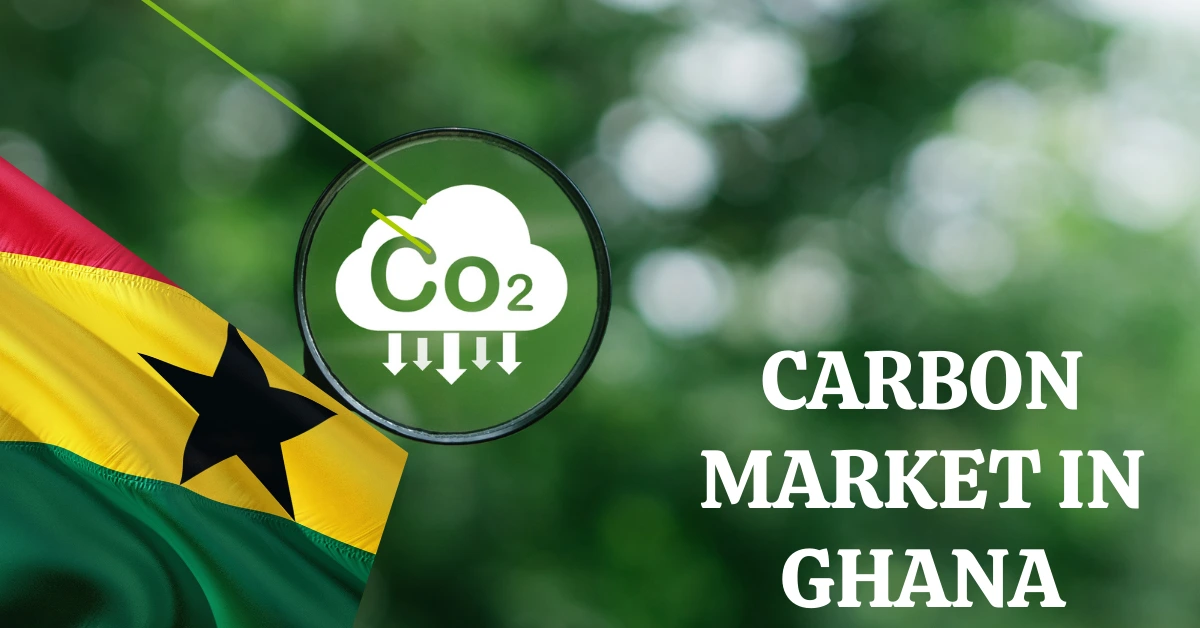
Ghana is targeting approximately US$68 million in potential climate finance following the issuance of around 6.5 million jurisdictional forest carbon credits under the Architecture for REDD+ Transactions (ART) and its REDD+ Environmental Excellence Standard (TREES). The achievement makes Ghana the first African country and the third globally, after Guyana and Costa Rica, to secure credits under the standard. Buyers, including members of the LEAF Coalition, have committed approximately US$43 million for four million credits, while the remaining 2.5 million could generate another US$25 million. The credits represent verified emission reductions achieved between 2017 and 2021. However, Ghana has not yet received the corresponding payments. The expected proceeds are intended to support forest conservation, biodiversity protection, community livelihoods and sustainable land management.
Key Takeaways
- Ghana has secured approximately 6.5 million jurisdictional forest carbon credits under the ART TREES standard.
- It is the first African country and the third globally, after Guyana and Costa Rica, to achieve the milestone.
- Four million credits have attracted purchase commitments worth approximately US$43 million, at prices ranging from US13 per credit.
- The remaining 2.5 million credits could generate an additional US$25 million, bringing the potential total to approximately US$68 million.
- Ghana has not yet received the proceeds from the committed purchases; payments remain subject to sales agreements and transaction procedures.
- Under the approved benefit-sharing arrangement, forest-dependent communities, farmers and traditional authorities are allocated 46% of the benefits.
- Illegal mining, illegal logging, wildfires and unsustainable agricultural expansion remain threats to future forest carbon earnings.
Ghana Secures 6.5 Million Internationally Verified Forest Carbon Credits
Ghana is targeting approximately US$68 million in potential climate finance following the issuance of millions of internationally verified forest carbon credits, marking a major development in the country’s efforts to protect its forests and attract climate-related investment.
The achievement was announced on 10 November 2026 during the 31st United Nations Climate Change Conference (COP31) in Antalya, Türkiye.
Under the internationally recognised Architecture for REDD+ Transactions (ART) and its REDD+ Environmental Excellence Standard (TREES), Ghana secured approximately 6.5 million jurisdictional forest carbon credits. Another source puts the issuance at approximately 6.57 million.
The milestone makes Ghana the first African country and the third globally, after Guyana and Costa Rica, to achieve the issuance under the standard.
Minister of Lands and Natural Resources Emmanuel Armah-Kofi Buah disclosed the projected revenue during a press conference in Accra, explaining that buyers had already committed approximately US$43 million to purchase four million tonnes of the credits.
The remaining 2.5 million credits could generate a further US$25 million when sold, potentially bringing the total revenue opportunity to approximately US$68 million.
For Ghana, the achievement creates an opportunity to turn measurable forest conservation results into a source of international climate finance.
However, the credits’ issuance should not be confused with revenue already received. The Forestry Commission has confirmed that the corresponding payments are still outstanding.
How Ghana Could Generate US$68 Million from Forest Carbon Credits
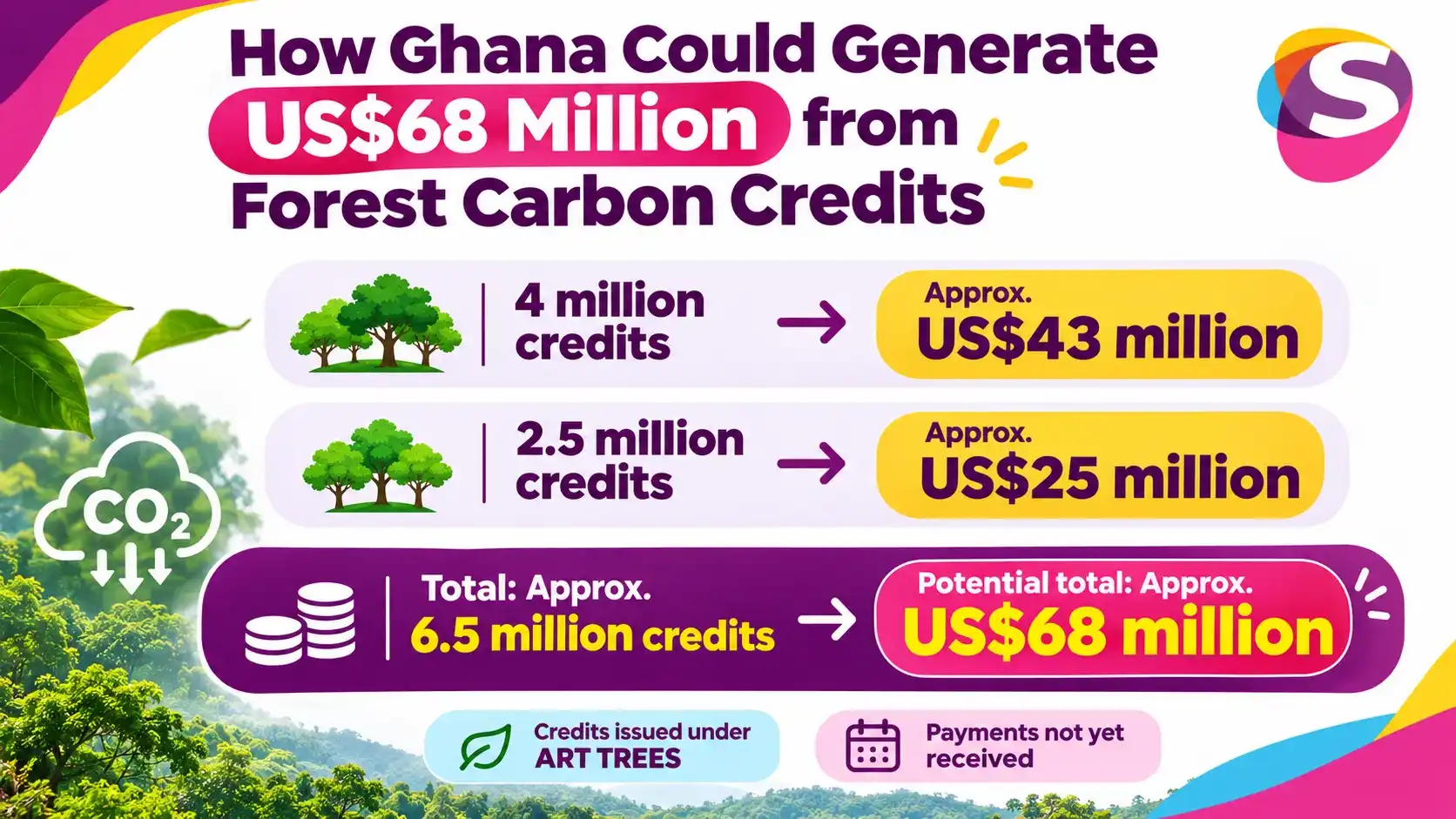
The potential US$68 million is based on two parts of the credit sale.
The first involves four million credits that have attracted purchase commitments from members of the LEAF Coalition and other prospective buyers.
According to Forestry Commission Chief Executive Dr Hugh Clement Adokwei Brown, these commitments are valued at approximately US$43 million, with indicated prices ranging between US$10 and US$13 per credit.
The remaining 2.5 million credits are available for further commercial transactions and could generate an additional US$25 million.
Carbon credit position
Volume
Potential value
Credits with purchase commitments
4 million
Approximately US$43 million
Credits available for further sale
2.5 million
Approximately US$25 million
Total
Approximately 6.5 million
Approximately US$68 million
The remaining credits represent another opportunity for Ghana to engage international buyers and secure additional climate finance.
However, the Forestry Commission has emphasised that the issuance of carbon credits does not mean the country has already received the funds.
Dr Brown explained:
“It is important to distinguish credit issuance from receipt of funds. Ghana has secured the verified credits, but yet to receive the corresponding revenues.”
Payments will follow the completion of sales agreements, verification requirements and other transaction procedures.
This distinction matters because the US$68 million is a potential revenue opportunity, not money already available to the government or communities. The immediate financial impact will depend on whether the committed purchases are completed, payments are made and the remaining credits are successfully sold.
What Makes Ghana’s Forest Carbon Credits Different?
Ghana’s achievement is based on a jurisdictional approach to forest carbon accounting under ART TREES.
Under this framework, each credit represents one tonne of carbon dioxide equivalent (CO₂e) in verified emission reductions achieved through measures to prevent deforestation and forest degradation, alongside forest landscape restoration.
The credits cover emission reductions recorded between 2017 and 2021 under Ghana’s REDD+ programme.
Unlike conventional carbon credit projects that operate within defined project boundaries, the ART TREES jurisdictional approach requires countries to account for forest-related emissions across a broader landscape, including communities, farms and forests both within and outside reserves.
This means Ghana’s credits were earned through demonstrated conservation results across its accounting area rather than simply being allocated to the country.
Dr Brown said:
“These credits were not simply allocated to Ghana. They were earned through results that had to be achieved, measured, reported, independently validated, and verified.”
The process involved technical assessments of forest data, carbon accounting, reported emission reductions and compliance with environmental and social safeguards.
The ART Board approved the issuance on 10 November 2026 following independent verification of Ghana’s submission.
This is significant because international buyers need confidence that carbon credits represent measurable and credible emission reductions. Independent assessment and verification help establish the environmental integrity of the credits and their suitability for results-based climate finance.
Nearly Two Decades of Forest Conservation Work Behind the Achievement
Ghana’s carbon credit issuance follows nearly two decades of institutional investment, technical development and international collaboration.
The country’s REDD+ journey began in 2008, with successive governments investing in forest monitoring, restoration, social and environmental safeguards, benefit-sharing arrangements and institutional capacity.
The process towards ART TREES issuance involved several important stages:
- 2008: Ghana began its REDD+ journey, building the systems needed to demonstrate reductions in emissions from deforestation and forest degradation.
- 2021: The Architecture for REDD+ Transactions approved Ghana’s TREES Concept.
- January 2024: Ghana’s TREES Registration Document and Monitoring Report covering the 2017–2021 period were accepted.
- May 2024: Independent third-party verification firm AENOR CONFIA S.A. was appointed to assess the country’s submission.
- September 2026: Following technical consultations, clarifications and corrections, AENOR cleared the reviewed documents and forwarded them to the ART Secretariat.
- 10 November 2026: The ART Board approved the issuance of approximately 6.5 million TREES credits to Ghana.
The verification process examined forest data, carbon accounting methodologies, reported emission reductions and environmental and social safeguards.
The Food and Agriculture Organization of the United Nations (FAO), through its AIM4Forests programme, also supported improvements in Ghana’s forest monitoring data, carbon accounting and measurement, reporting and verification systems.
FAO’s technical support helped strengthen the quality of forest activity data and the procedures underpinning Ghana’s submission.
The process demonstrates that accessing international forest carbon markets requires sustained investment in environmental monitoring, institutional capacity and credible reporting systems.
Context is everything. Stay ahead of shifting trends with today’s market updates, and uncover emerging opportunities using the Serrari Group Market Index and Marketplace. Then, take control of your own financial future by exploring our Money & Life Reset Transformation Blueprint ™ to build stronger habits, create better systems, and design a path toward lasting wealth.
Forest Communities and Farmers to Receive 46% of the Benefits
One of the most important elements of Ghana’s carbon credit programme is its benefit-sharing arrangement, which allocates the largest proportion of expected proceeds to forest-dependent communities, farmers and traditional authorities.
Under the approved arrangement, 46 per cent of the revenue is expected to go to communities, recognising the role played by people living in and around forest areas in protecting the country’s natural resources.
The remaining allocations are structured as follows:
Beneficiary
Share of benefits
Forest-dependent communities, farmers and traditional authorities
46%
Government institutions
39%
Environmental non-governmental organisations
2%
Private sector
3%
Project Management Unit
10%
Total
100%
The government allocation includes the Forestry Commission, Metropolitan, Municipal and District Assemblies (MMDAs), COCOBOD and the Ghana National Fire Service.
The Project Management Unit’s 10% allocation is intended to cover programme management, including verification and validation costs.
The framework was developed through a multi-stakeholder consultative process and is intended to ensure that those whose activities and cooperation contribute to forest conservation participate in the financial benefits.
The 46% community allocation is particularly important because farmers, traditional authorities and forest-fringe communities are directly involved in activities that affect forest protection.
The financial arrangement is also intended to strengthen incentives for conservation by linking forest protection to improved livelihoods.
Dr Brown said:
“Farmers, forest range communities, and traditional authorities contributed directly to this achievement, and have a legitimate interest in how the benefits are shared.”
He added that the government remained committed to transparent and equitable distribution of the proceeds.
However, the effectiveness of the arrangement will depend on actual credit sales, receipt of payments and transparent distribution of the money to the intended beneficiaries.
Ghana’s Previous Cocoa Forest Programme Shows How Climate Finance Can Support Communities
Ghana has already received forest-related climate finance through its Cocoa Forest REDD+ Programme, providing an example of how proceeds can support conservation and community development.
Between 2023 and 2024, the country received approximately US$21.8 million under the programme, supported by the Forest Carbon Partnership Facility.
The funding supported forest protection and landscape restoration, alongside the provision of farming inputs, boreholes, Community-Based Health Planning and Services (CHPS) compounds, school blocks and school furniture.
These investments illustrate how climate finance can extend beyond environmental protection to support services and infrastructure in rural communities.
The experience provides a practical reference point for the potential impact of the new ART TREES transactions.
If the expected revenues materialise and the approved benefit-sharing arrangements are effectively implemented, the additional financing could support rural infrastructure, sustainable agriculture, forest restoration and community development.
It could also strengthen the economic case for farmers and communities to adopt production practices that reduce pressure on forest landscapes.
However, the US$21.8 million received under the earlier programme is separate from the approximately US$68 million potential revenue associated with the newly issued credits. The two should not be treated as one funding allocation.
Illegal Mining and Deforestation Threaten Future Carbon Earnings
Despite the financial opportunity, the Forestry Commission has warned that Ghana’s forests continue to face serious threats.
Illegal mining, commonly known as galamsey, illegal logging, wildfires and unsustainable agricultural expansion remain major challenges that could undermine forest conservation and future carbon credit earnings.
This is particularly important because the current issuance rewards verified emission reductions achieved between 2017 and 2021. Ghana’s next monitoring period will cover 2022 to 2026.
Any further issuance will depend on the country demonstrating additional emission reductions through avoided deforestation, reduced forest degradation and forest landscape restoration.
The results must also undergo independent verification and continue meeting ART TREES requirements.
This means the current achievement does not guarantee future carbon credit issuance. Ghana will need to sustain the environmental performance that supported the first batch of credits.
Dr Brown has called for continued collaboration among government agencies, traditional authorities, farmers and local communities to safeguard forest resources.
As the harmattan season approaches, the Forestry Commission has also called for stronger efforts to prevent and respond to bushfires.
The commission is expected to work with the Ministry of Lands and Natural Resources, district assemblies, traditional authorities and local communities on forest protection, law enforcement, public education and sustainable livelihood alternatives.
The Bigger Picture: Forest Conservation Is Becoming a Source of Climate Finance
Ghana’s achievement highlights the growing role of forest conservation in international carbon markets and results-based climate finance.
Traditionally, forests have been valued for their biodiversity, ecological functions, water resources and role in supporting livelihoods. Jurisdictional forest carbon programmes add another dimension by creating a mechanism through which verified emission reductions can attract payments from international buyers.
The ART TREES framework requires countries to demonstrate measurable results across a wider forest landscape, supported by monitoring systems, independent verification and environmental and social safeguards.
For Ghana, this creates an opportunity to connect forest protection with international financing while supporting local communities and sustainable land management.
The achievement also highlights Africa’s growing participation in global carbon markets. As the first African country to secure jurisdictional forest carbon credits under ART TREES, Ghana provides an example of how national forest conservation programmes can access international results-based financing.
However, participation in these markets requires more than possessing extensive forest resources. Countries need credible carbon accounting, reliable monitoring systems, transparent benefit-sharing arrangements and the ability to sustain emission reductions.
The commercial value of credits will also depend on buyer demand, the integrity of the underlying reductions and the successful completion of transactions.
For Ghana, the next challenge is to demonstrate that the environmental results can be maintained while ensuring that the financial benefits reach the communities and institutions responsible for protecting the forests.
Why Does This Matter Now?
The timing matters because Ghana has moved beyond the technical verification stage and now has an opportunity to commercialise its first batch of internationally recognised jurisdictional forest carbon credits.
The four million credits with purchase commitments represent approximately US$43 million in potential payments, while the remaining 2.5 million could bring in another US$25 million.
For the government, this could provide an additional source of climate-related financing for forest conservation and sustainable land management.
For communities and farmers, the approved 46% benefit allocation creates a financial link between protecting forests and improving local livelihoods.
For international carbon market participants, Ghana’s achievement demonstrates that forest conservation results can be independently verified and brought into a recognised market framework.
But the immediate priority is converting purchase commitments into actual payments. Ghana must also secure buyers for the remaining credits and ensure that proceeds are distributed transparently.
At the same time, the next monitoring period is already important. Illegal mining, logging, wildfires and unsustainable agricultural expansion could weaken the environmental results needed to support future credit issuance.
The milestone therefore presents both a financial opportunity and a responsibility to protect the natural resources that made it possible.
Outlook
Ghana’s issuance of approximately 6.5 million ART TREES credits creates a potential US$68 million climate finance opportunity, but the financial benefits will depend on the successful completion of transactions and payment arrangements.
The immediate developments to watch include the finalisation of sales agreements for the four million committed credits, the commercialisation of the remaining 2.5 million and the distribution of proceeds under the approved benefit-sharing framework.
The next monitoring period, covering 2022 to 2026, will also be important in determining whether Ghana can demonstrate additional emission reductions and qualify for further issuance.
The Forestry Commission will need to maintain investments in forest monitoring, enforcement, restoration and community engagement to protect the environmental integrity of the programme.
For Ghana, the achievement is more than international recognition. It creates a potential financing channel through which forest conservation can contribute to economic development.
The real measure of success will be how much of the expected revenue the country receives, how transparently the proceeds are managed and whether the financing delivers lasting improvements in forest protection and rural livelihoods.
Frequently Asked Questions
1. How much could Ghana earn from its newly issued forest carbon credits?
Ghana is targeting approximately US$68 million. Four million credits have attracted purchase commitments worth about US$43 million, while the remaining 2.5 million could generate another US$25 million.
2. Why is Ghana’s carbon credit achievement significant?
Ghana is the first African country and the third globally, after Guyana and Costa Rica, to secure jurisdictional forest carbon credits under the ART TREES standard.
3. How will communities benefit from the carbon credit revenue?
Under the approved benefit-sharing arrangement, forest-dependent communities, farmers and traditional authorities are allocated 46% of the benefits. The funding is expected to support forest conservation and community livelihoods, although actual payments remain subject to completed transactions.
4. Has Ghana already received the US$68 million?
No. The US$68 million represents potential revenue. Buyers have committed to purchasing four million credits for approximately US$43 million, but the Forestry Commission says the corresponding payments have not yet been received. The remaining credits are also yet to be sold.
Your financial future isn’t something you wait for—it’s something you build.
The real question is: when do you begin?
Move beyond simply staying informed.
Navigate the markets with clarity—track trends through the Serrari Group Market Index, uncover opportunities in the Serrari Marketplace, and build practical knowledge with our Curated Wealth Builder Platform.
Stay connected to what truly matters.
Get daily insights on macro trends and financial movements across Kenya, Africa, and global markets—delivered through the Serrari Newsletter.
Growth opens doors.
Advance your career through professional programs including ACCA, HESI A2, ATI TEAS 7 , HESI EXIT , NCLEX – RN and NCLEX – PN, Financial Literacy!🌟—designed to move you forward with confidence.
See where money is flowing—clearly and in real time.
Track Money Market Funds, Treasury Bills, Treasury Bonds, Green Bonds, and Fixed Deposits, alongside global and African indexes, key economic indicators, and the evolving Crypto and stablecoin landscape—all within Serrari’s Market Index.