



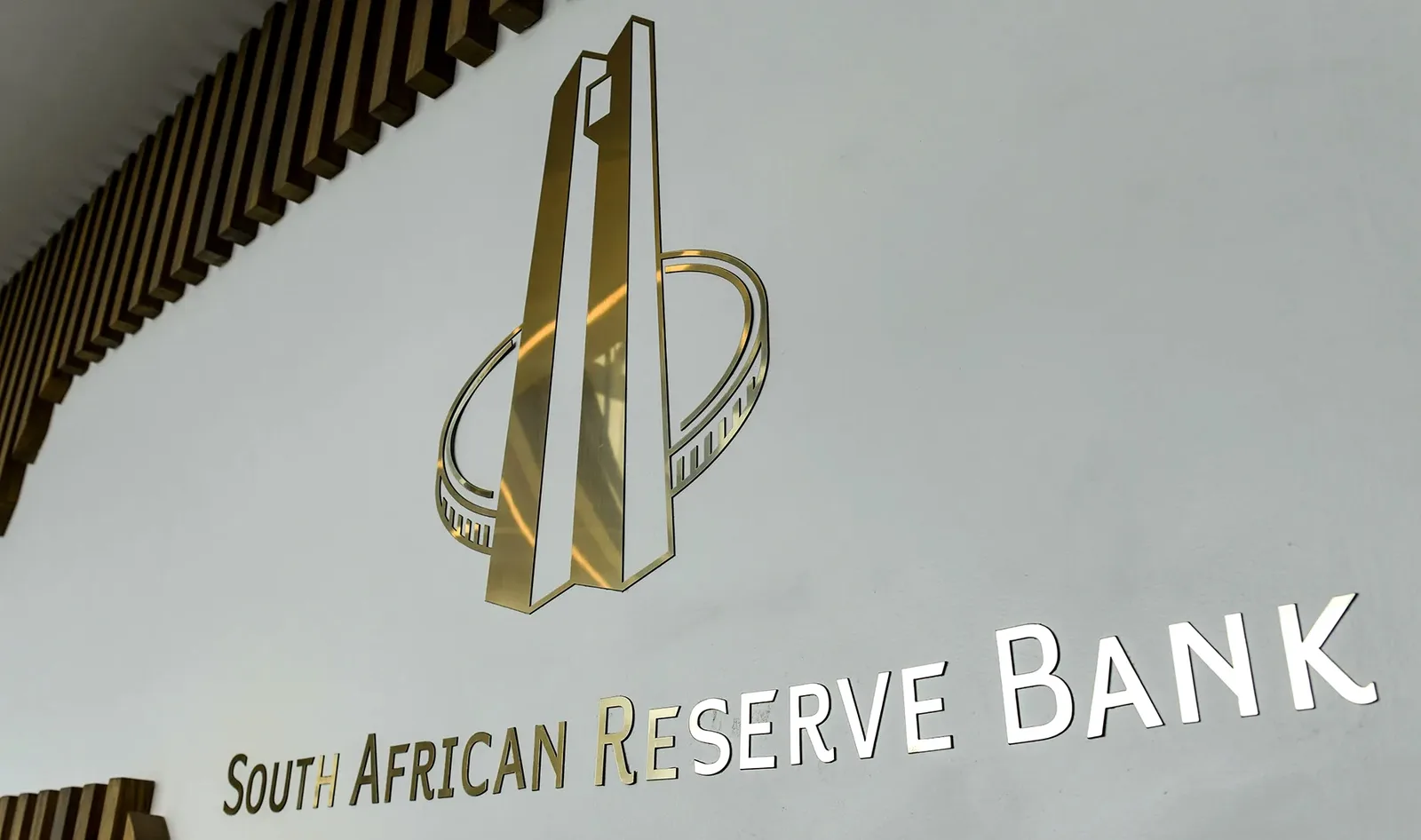
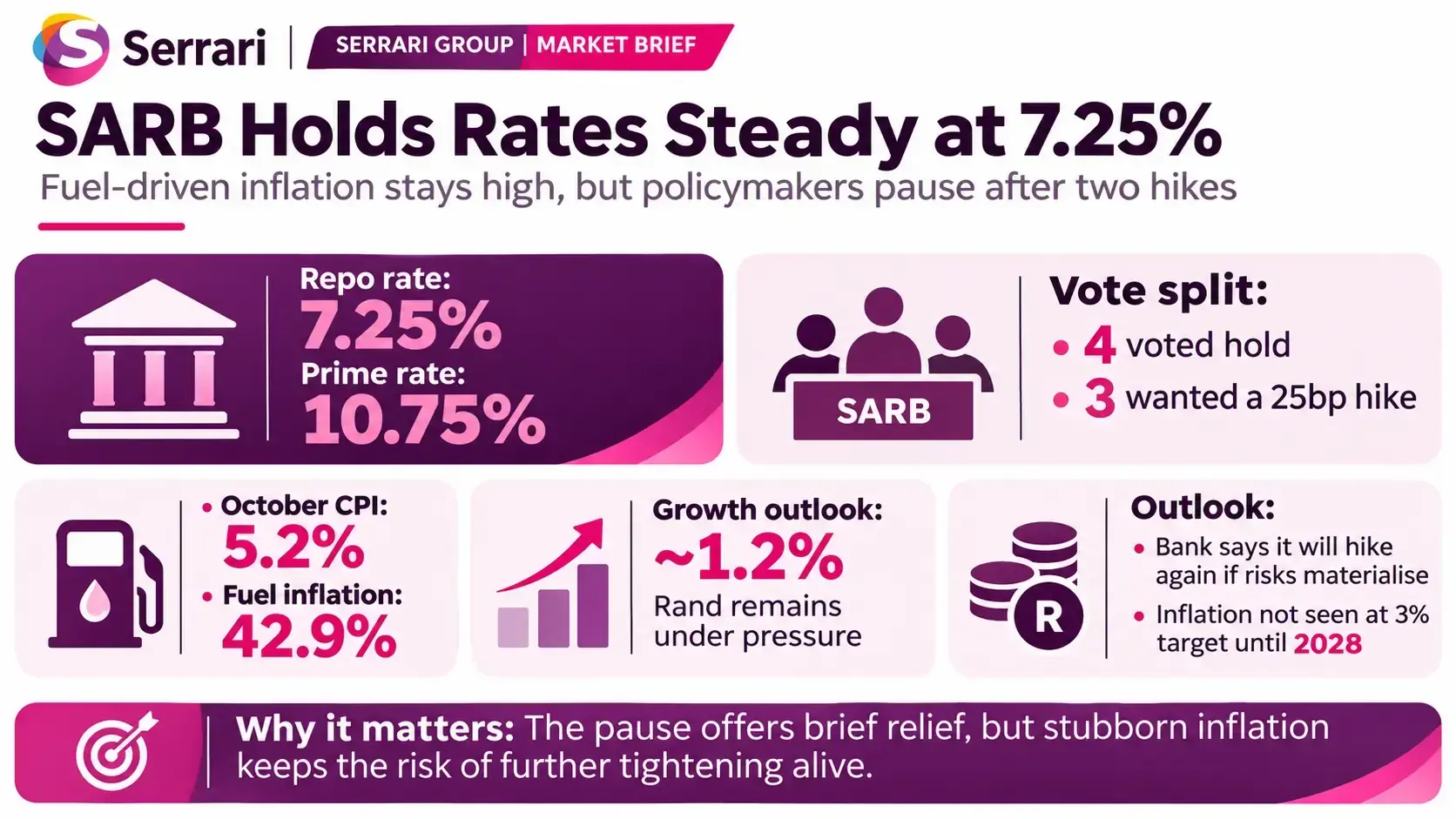
South Africa’s central bank kept its benchmark repurchase rate at 7.25% on November 19, 2026, but the decision was far from comfortable: four Monetary Policy Committee members favoured holding steady and three wanted another quarter-point increase. Annual inflation had just reached 5.2%, its highest level in almost two and a half years, driven largely by fuel costs linked to the war involving Iran and disruption to global energy markets. The pause gives indebted households and businesses temporary relief after two increases earlier in the year, but it does not indicate that policymakers have defeated inflation. With the rand under pressure, food-price risks emerging and growth weak, the central bank faces the difficult task of preventing temporary supply shocks from becoming persistent increases across the economy.
Key Overview
- Rate held at 7.25%: The central bank paused after two 25-basis-point increases in 2026; the prime lending rate remains 10.75%.
- Narrow decision: Four committee members supported no change, while three preferred a 25-basis-point increase.
- Inflation accelerates: October consumer inflation rose to 5.2%, from 4.5% in September, while annual fuel inflation reached 42.9%.
- Households gain breathing space: Borrowers avoid another immediate increase in variable-rate repayments, though existing borrowing costs remain high.
- More risks ahead: Rand weakness, higher global interest rates, possible El Niño-related food pressures and rising underlying inflation could force another hike.
- Slow recovery: Policymakers expect growth of around 1.2% in 2026 and a gradual improvement, underscoring why tighter monetary policy carries economic costs.
Why the Central Bank Paused Despite Higher Inflation
The November decision captures a central problem for monetary policymakers: interest rates can restrain domestic spending, but they cannot directly produce more oil or reverse a geopolitical supply disruption. South Africa imports most of its fuel, so higher international energy prices and a weaker rand feed into petrol, diesel and transport costs. The result is a rise in consumer prices even if local demand remains modest.
In its November monetary policy statement, the South African Reserve Bank described its policy position as moderately restrictive after two increases during 2026. That means interest rates were already intended to discourage excessive borrowing and spending. With monetary policy affecting demand gradually, the majority of the committee concluded there was value in observing how the earlier increases worked through the economy before adding more pressure.
The closeness of the vote is equally important. Three of seven members wanted an immediate increase of 25 basis points, showing that the pause was not a declaration of victory. Governor Lesetja Kganyago warned that rates could rise again if inflation risks materialised. For investors, that is a deliberately cautious message: the current rate is unchanged, but the path ahead is not committed to cuts.
The decision was also consistent with the majority of surveyed economists, although the sharp inflation print made the outcome less straightforward. A report on the split decision described the bank as weighing the effects of previous hikes against the possibility that rising prices could become more entrenched.
Why Fuel Prices Are Driving the Inflation Shock
October’s official inflation release showed the scale of the energy problem. Headline inflation increased from 4.5% in September to 5.2% in October, while transport prices were 15.2% higher than a year earlier. Transport alone contributed 2.1 percentage points to the headline inflation rate. Annual fuel inflation reached 42.9%, and fuel prices rose 11.8% in a single month, according to the October consumer-price breakdown.
That concentration matters. When inflation is mainly driven by petrol and diesel, higher interest rates cannot remedy the underlying shortage or trade disruption. However, the central bank still has reason to respond if rising energy costs begin to influence wages, transport charges, shop prices and expectations about future inflation. A temporary shock can become persistent when businesses and households start setting prices and pay demands on the assumption that rapid inflation will continue.
There are early signs that the risk is broadening. Food and non-alcoholic beverage inflation remained comparatively subdued at 1.4% in October, but it had increased for a third consecutive month. Some categories, including vegetables and fish, were already posting much stronger price increases. The distinction between low overall food inflation and rising prices in particular products is important for households whose spending is concentrated on essential items.
The bank also warned about potential El Niño-related dry conditions, particularly if harvests weaken in early 2027. When food-price pressure overlaps with high fuel costs, businesses face simultaneous increases in distribution and input expenses. That is precisely the kind of second-round inflation the central bank is trying to prevent.
Context is everything. Stay ahead of shifting trends with today’s market updates, and uncover emerging opportunities using the Serrari Group Market Index and Marketplace. Then, take control of your own financial future by exploring our Money & Life Reset Transformation Blueprint ™ to build stronger habits, create better systems, and design a path toward lasting wealth.
What the Rate Hold Means for Borrowers and Businesses
For households with variable-rate loans, holding the repo rate steady avoids an additional immediate increase in borrowing costs. South Africa’s prime lending rate remains at 10.75%, according to the official report of the decision. The practical relief is a pause in further tightening, not a reduction in current instalments.
Consider a household with a R1 million mortgage on a 20-year repayment schedule. At an illustrative annual interest rate of 10.75%, the monthly repayment would be about R10,152. If that rate rose to 11.00%, the payment would increase to roughly R10,322, or about R170 more each month. The example assumes a fully amortising loan with the same remaining term, and actual bank pricing and loan balances will differ.
For employers, the rate decision also helps preserve some near-term cash-flow certainty. Higher financing costs affect working capital, equipment investment and expansion decisions. But firms that depend on deliveries, electricity-intensive production or imported inputs still face rising operating costs. A stable interest rate can prevent an additional financial squeeze; it cannot neutralise the price of fuel.
Savers face a different calculation. A continued restrictive policy rate can support returns on some cash and floating-rate products, depending on their pricing arrangements. Yet higher nominal interest does not always mean higher purchasing power if inflation is rising at the same time. The relevant comparison is the return after fees, taxes and the erosion of value caused by inflation.
Why the Rand Complicates the Next Decision
The rand remained close to its weakest level against the dollar for the year after the decision, amid a broad strengthening of the US currency and international financial volatility. The currency-market reaction illustrates another dilemma: keeping rates stable protects domestic borrowers, but a weaker currency can make imported fuel and other dollar-priced goods more expensive.
Exchange rates are influenced by more than South African interest rates. US yields, global risk appetite, domestic political developments and commodity prices all matter. Nevertheless, if investors expect higher returns elsewhere, the rand can come under pressure as capital shifts towards other currencies. That depreciation can intensify imported inflation, potentially renewing the case for higher domestic rates.
The central bank must therefore balance two channels that sometimes conflict. Increasing rates may support currency confidence and limit demand-driven inflation, but it can also weaken spending and investment. Holding rates protects the domestic economy from additional tightening, while leaving policymakers exposed if exchange-rate depreciation feeds more strongly into prices.
Why Growth and Unemployment Make This Decision Harder
South Africa’s economy is not entering this inflation episode from a position of rapid expansion. The central bank expects growth of approximately 1.2% in 2026, gradually improving towards around 2% over its forecast horizon. Meanwhile, unemployment reached 33.7% in the third quarter, and fixed investment was estimated at only about 13% of output. These figures show why an additional interest-rate increase would have wider consequences than a small change in loan repayments.
Expensive credit can discourage businesses from buying equipment, building facilities and hiring workers. Households burdened by debt may reduce purchases, affecting retailers and service providers. Yet allowing inflation to remain elevated also harms economic confidence, particularly among lower-income families that devote a large share of their budgets to transport and food.
The difficult trade-off is between short-term activity and longer-term price stability. Persistent inflation erodes purchasing power, complicates contracts and may eventually require even more severe tightening. But excessive restraint in an already weak economy can suppress investment that is needed to improve productivity, energy capacity and employment prospects.
As the post-decision economic assessment noted, the bank now expects inflation to return to its 3% target only in the third quarter of 2028, later than previously anticipated. That delay is a reminder that the pause does not signal a quick return to cheaper credit.
The Bigger Picture: An Emerging-Market Inflation Dilemma
South Africa’s challenge reflects a wider problem for emerging-market central banks confronting a global energy shock. Higher oil prices arrive through imports and shipping costs, while elevated interest rates in major economies can pressure local currencies. Unlike a domestic consumption boom, these external forces are difficult for any one central bank to reverse.
That does not make monetary policy irrelevant. Central banks can still influence inflation expectations, the exchange-rate channel and the willingness of businesses to pass through higher costs. But their success depends partly on external developments, including oil supply, geopolitical conditions and global interest rates. This is why a policy pause can be appropriate even when inflation is above target, provided the central bank remains willing to act if price pressures spread.
The coming months will test that judgment. Policymakers will watch whether fuel inflation moderates as annual comparisons become less extreme, whether food prices accelerate, whether core inflation stabilises and whether rand weakness adds fresh pressure to imports. The next scheduled monetary policy announcement is January 28, 2027, leaving incoming data to determine whether November’s pause extends or becomes a brief interruption before another increase.
For South African households, the immediate benefit is that borrowing costs have not risen again. For the economy, the longer-term stakes are greater: keeping inflation expectations anchored without choking off an already fragile recovery. The November decision bought time, but it did not remove the underlying tension between expensive energy, weak growth and the central bank’s commitment to 3% inflation.
Sources: South African Reserve Bank / Statistics South Africa / Reuters / SAnews / Business Day
Your financial future isn’t something you wait for—it’s something you build.
The real question is: when do you begin?
Move beyond simply staying informed.
Navigate the markets with clarity—track trends through the Serrari Group Market Index, uncover opportunities in the Serrari Marketplace, and build practical knowledge with our Curated Wealth Builder Platform.
Stay connected to what truly matters.
Get daily insights on macro trends and financial movements across Kenya, Africa, and global markets—delivered through the Serrari Newsletter.
Growth opens doors.
Advance your career through professional programs including ACCA, HESI A2, ATI TEAS 7 , HESI EXIT , NCLEX – RN and NCLEX – PN, Financial Literacy!🌟—designed to move you forward with confidence.
See where money is flowing—clearly and in real time.
Track Money Market Funds, Treasury Bills, Treasury Bonds, Green Bonds, and Fixed Deposits, alongside global and African indexes, key economic indicators, and the evolving Crypto and stablecoin landscape—all within Serrari’s Market Index.