





Bitcoin has recovered above $60,000 after falling to approximately $55,130 on November 20, 2026, its weakest level in more than two years according to reports covering the sell-off. The decline triggered a wave of forced liquidations across cryptocurrency futures markets, with estimates ranging from $1.8 billion to $2.7 billion in a 24-hour period. More than 340,000 traders were affected, with leveraged long positions accounting for most of the initial losses. The recovery followed the clearing of a major concentration of bullish futures positions between $59,000 and $62,000, easing forced selling and contributing to a short squeeze. However, significant US spot Bitcoin ETF outflows and weakness in technology stocks continue to raise questions about whether the rebound can be sustained.
Key Takeaways
- Bitcoin fell to approximately $55,130 on November 20 before recovering above $60,000.
- Crypto futures liquidations reached an estimated $1.8 billion to $2.7 billion within 24 hours, depending on the data reported.
- More than 340,000 traders had their positions forcibly closed.
- Bitcoin’s largest concentration of leveraged long positions was between $59,000 and $62,000, according to Glassnode.
- US spot Bitcoin ETFs recorded approximately $1.1 billion to $1.5 billion in net outflows over the reported period.
- Ethereum and Solana also recovered as the wider cryptocurrency market moved higher.
- Analysts warn that sustained recovery may depend on improving technology stocks, interest-rate stability and renewed institutional investment.
Bitcoin Rebounds Above $60,000 After Sharp Sell-Off
Bitcoin has climbed back above $60,000 after a sharp sell-off pushed the world’s largest cryptocurrency to approximately $55,130 on November 20, triggering billions of dollars in forced liquidations across cryptocurrency derivatives markets.
The decline was followed by a rapid recovery, with Bitcoin trading around $60,279 on Saturday night, according to CoinMarketCap data. Other reports placed the price near $60,300 during the recovery, representing an intraday gain of roughly 9% from the low.
The rebound came after a significant number of leveraged positions were wiped out, reducing the immediate pressure from forced selling.
The recovery came as reaction buying accelerated once a wave of leveraged positions was cleared out, easing selling pressure across the market.
However, the recovery has not erased the losses accumulated during the week. Bitcoin’s weekly decline narrowed to approximately 8.2%, while market participants continued monitoring developments in traditional financial markets and institutional investment flows.
The sharp price movement also exposed the risks associated with leveraged cryptocurrency trading, where relatively small market declines can trigger large-scale forced closures of positions.
Billions of Dollars in Leveraged Positions Wiped Out
The sell-off triggered a liquidation cascade across cryptocurrency futures markets, with estimates of total liquidations varying between approximately $1.8 billion to $2.7 billion over 24 hours.
CoinGlass data cited in one report put the total at approximately $2.4 billion, including more than $1 billion in Bitcoin futures positions and about $545 million in Ethereum positions.
Another report cited approximately $1.8 billion in liquidations, including $1.3 billion in bullish bets. The different figures reflect variations in the reported estimates and measurement periods.
More than 340,000 traders were affected by the forced closures, with one report putting the number above 343,000.
To understand the scale of the event, it is important to understand how leveraged trading works.
Leverage allows traders to control larger positions than their available capital would normally permit by borrowing funds or using margin. It can amplify potential profits when prices move in the expected direction, but it also increases losses when the market moves against a position.
When prices fall far enough, exchanges automatically close positions to cover the borrowed funds and limit further losses. These forced closures are known as liquidations.
In this case, traders who had borrowed money or used margin to bet on rising Bitcoin prices were particularly exposed.
Longs bore the brunt of the initial drop, as the market moved sharply against traders expecting prices to increase.
The resulting forced selling added further downward pressure to Bitcoin’s price. As positions were closed, additional sell orders entered the market, potentially triggering more liquidations.
This created a chain reaction in which falling prices caused forced sales, which in turn contributed to further declines.
Why the 59,000 – 62,000 Range Was Important
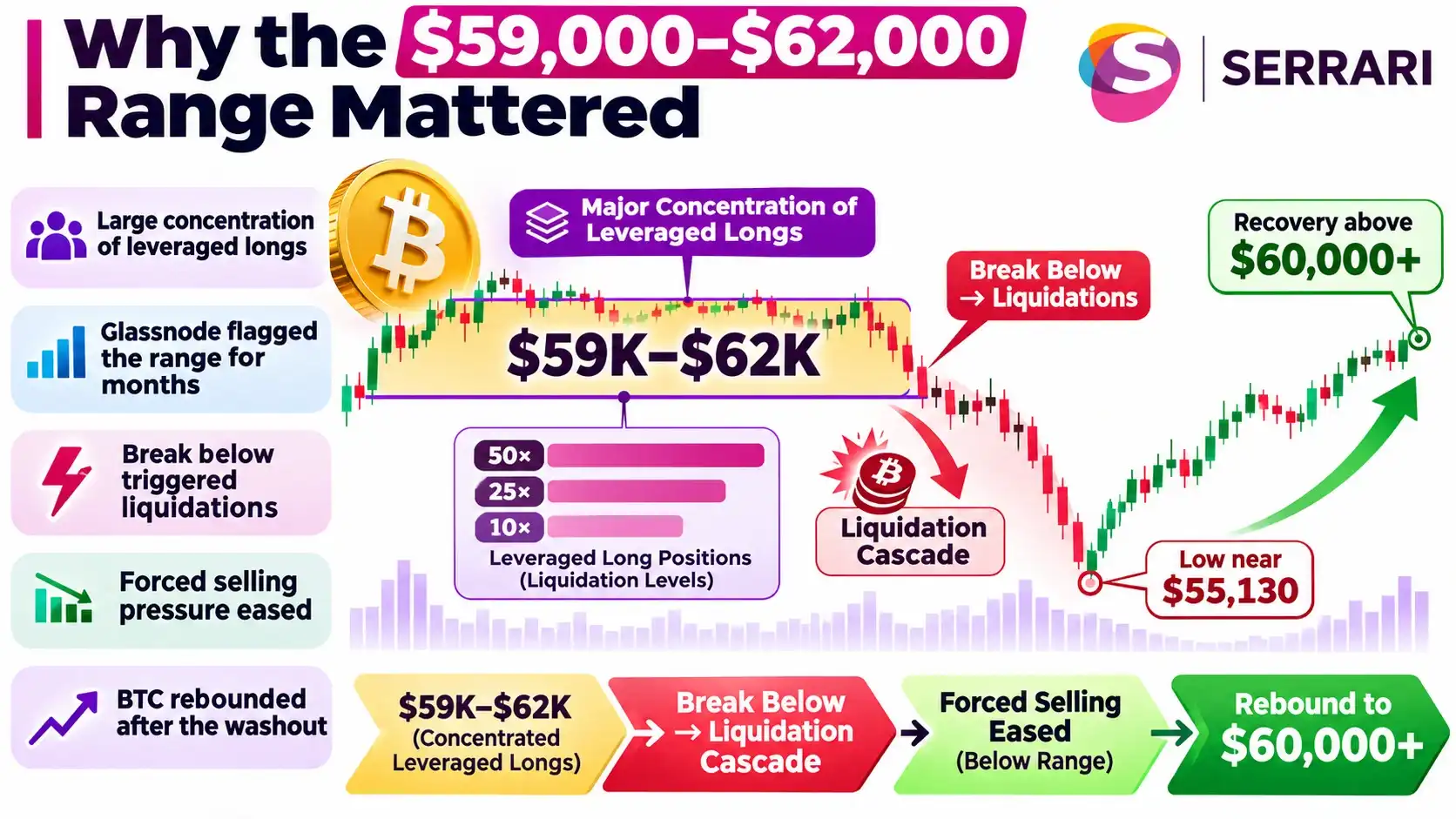
A major factor behind the scale of the sell-off was the concentration of leveraged long positions between $59,000 and $62,000.
On-chain analytics firm Glassnode had identified this range as a significant concentration of estimated Bitcoin futures liquidations.
Glassnode said it had tracked that concentration of leveraged long positions between $59,000 and $62,000 for months, making the price band an important area to watch as Bitcoin declined.
When the cryptocurrency moved through this range, many of those positions were forcibly closed.
The liquidation of these trades removed a significant number of potential forced sellers from the market.
Glassnode described the result as removing “a large source of forced selling” below the market.
This helps explain why Bitcoin was able to recover after reaching approximately $55,130. Once many of the vulnerable leveraged positions had been cleared, the immediate selling pressure eased.
However, the recovery was also influenced by another market mechanism: a short squeeze.
Short Sellers Also Faced Liquidations During the Rebound
The initial decline heavily affected traders betting on higher prices, but the subsequent recovery caught some traders who had positioned themselves for further losses.
These traders held short positions, which are designed to generate profits when an asset’s price falls.
As Bitcoin moved back above $60,000, short sellers faced increasing pressure to close their positions. Closing a short position generally involves buying back the asset, creating additional buying demand.
This contributed to the upward movement.
CoinGlass data showed that approximately $230 million in short positions were liquidated within four hours as Bitcoin moved above $60,000, compared with about $23 million in long liquidations during the same period.
This illustrates how the market experienced pressure in both directions.
Initially, falling prices forced bullish traders out of their positions. During the rebound, rising prices caught bearish traders who had expected the decline to continue.
The result was a two-way liquidation event, with forced selling contributing to the initial decline and short covering adding momentum to the recovery.
Context is everything. Stay ahead of shifting trends with today’s market updates, and uncover emerging opportunities using the Serrari Group Market Index and Marketplace. Then, take control of your own financial future by exploring our Money & Life Reset Transformation Blueprint ™ to build stronger habits, create better systems, and design a path toward lasting wealth.
Ethereum and Solana Recover Alongside Bitcoin
The rebound extended beyond Bitcoin, with other major cryptocurrencies also recording gains.
Ethereum rose during the recovery, with reports placing its gains between approximately 3% and 5%. CoinMarketCap data cited in one report put Ethereum at around $1,684, representing a gain of 5.07%.
Solana also moved higher, gaining approximately 2% to 2.3% during the recovery period and trading around $71.
The wider cryptocurrency market’s total capitalisation increased by 2.84% over 24 hours to approximately $2.06 trillion, according to figures in the supplied reports.
The broader recovery suggests that the movement was not limited to Bitcoin alone. However, the gains do not necessarily indicate that the market has returned to a sustained upward trend.
The performance of other digital assets remains closely connected to Bitcoin’s direction, overall investor sentiment and liquidity conditions across cryptocurrency markets.
ETF Outflows and Technology Stock Weakness Add Pressure
The liquidation cascade did not happen in isolation. Bitcoin was already facing pressure from institutional investment withdrawals and a broader shift towards risk reduction in financial markets.
US spot Bitcoin exchange-traded funds (ETFs) recorded approximately $1.1 billion to $1.5 billion in net outflows over the reported period, depending on the reporting window.
These withdrawals indicate that some investors were reducing their exposure to Bitcoin through traditional brokerage and investment products.
Institutional demand is particularly important because spot Bitcoin ETFs provide investors with exposure to the cryptocurrency through regulated investment vehicles without requiring them to directly hold or manage digital tokens.
When these funds experience sustained withdrawals, it can signal weakening demand through an important channel of traditional financial market participation.
One report also noted that updated figures for Friday’s trading in BlackRock’s iShares Bitcoin Trust (IBIT), the largest Bitcoin ETF by net assets, were still pending.
The broader stock market also contributed to the uncertain environment.
The Nasdaq fell more than 4% on Friday, moving close to bear-market territory, while concerns about technology stocks and wider macroeconomic conditions weighed on investor sentiment.
This matters because Bitcoin and other cryptocurrencies are often treated as risk-sensitive assets. When investors become more cautious about equities and other higher-risk investments, digital assets can also face selling pressure.
CryptoQuant analyst Darkfost described the recent movement as “extreme capitulation“, reporting that Bitcoin holders had realised more than $11.3 billion in losses over seven days, approximately eight times the gains booked over the same period.
The combination of ETF withdrawals, technology stock weakness and large leveraged positions helps explain why the decline became so severe.
Rather than being driven by a single development within the cryptocurrency industry, the sell-off reflected pressure from both digital-asset market positioning and broader financial conditions.
Why the Rebound May Not Signal a Sustained Recovery
Bitcoin’s return above $60,000 offers some relief following the sharp decline, but analysts remain cautious about what happens next.
The removal of heavily leveraged positions may reduce the immediate risk of another liquidation cascade around the same price range. However, it does not automatically restore investor confidence or bring institutional capital back into the market.
Singapore-based trading firm QCP Capital said a more meaningful recovery would likely depend on several developments:
- Stabilisation in technology stocks.
- Lower volatility in interest rates.
- Evidence that institutional investment flows are returning.
These conditions matter because they could help improve the wider environment for risk-sensitive assets, including cryptocurrencies.
Until then, QCP Capital warned that short-covering rallies may struggle to develop into sustained upward movements.
Market participants are also watching how Bitcoin performs when US markets reopen on Monday. The response of equity investors and the latest ETF flow figures could provide further indications of whether the recovery is supported by renewed demand or mainly by the unwinding of bearish positions.
The Bigger Picture: Leverage, Institutional Flows and Crypto Market Volatility
The November sell-off highlights three important forces shaping cryptocurrency markets: leverage, institutional investment flows and the relationship between digital assets and traditional financial markets.
First, leveraged trading can amplify market movements. When large numbers of traders position themselves in the same direction, a relatively sharp price decline can trigger forced liquidations and accelerate losses.
Second, institutional flows have become an increasingly important part of Bitcoin’s market structure. Spot ETFs provide a route for traditional investors to gain exposure to Bitcoin, meaning withdrawals from these funds can contribute to wider market pressure.
Third, cryptocurrency markets are increasingly influenced by developments outside the digital-asset sector. Technology stock performance, interest-rate volatility and investor appetite for risk can all affect demand for Bitcoin.
The latest episode demonstrates how these factors can interact. ETF outflows and wider market uncertainty created an unfavourable environment, while concentrated leveraged positions magnified the decline. Once those positions were cleared, short covering and reaction buying helped support the rebound.
For investors, this means Bitcoin’s price cannot be assessed solely by looking at cryptocurrency-specific developments. Institutional flows, derivatives positioning and wider financial market conditions also matter.
Why Does This Matter Now?
The speed of Bitcoin’s fall and recovery makes the episode particularly important for traders and investors assessing market conditions heading into the new week.
For leveraged traders, the event is a reminder that borrowed positions can be closed automatically during sharp price movements, potentially resulting in significant losses even when the market subsequently rebounds.
For long-term investors, the ETF withdrawals and broader risk-off environment raise questions about the strength of institutional demand.
For the wider cryptocurrency market, the episode shows how concentrated derivatives positions can increase volatility and cause prices to move sharply in both directions.
The recovery above $60,000 is therefore an important development, but the next stage will depend on whether buyers return and whether traditional financial markets stabilise.
Outlook
Bitcoin’s recovery above $60,000 follows one of the more significant liquidation events reported in the recent market period. The sell-off cleared a large concentration of leveraged long positions, while the subsequent short squeeze helped accelerate the rebound.
However, the broader conditions remain uncertain.
Investors will be watching the performance of technology stocks, movements in interest rates and the direction of US spot Bitcoin ETF flows for signs that market confidence is improving.
If institutional demand returns and wider financial conditions stabilise, the recovery could gain stronger support. If outflows and risk aversion persist, Bitcoin may continue experiencing volatile price movements.
For now, the rebound demonstrates how quickly cryptocurrency markets can reverse direction after a liquidation cascade. It does not, on its own, establish that a sustained recovery is underway.
Frequently Asked Questions
1. Why did Bitcoin fall to approximately $55,130?
Bitcoin’s decline occurred amid broader market uncertainty, US spot Bitcoin ETF outflows and a large concentration of leveraged long positions. As prices fell, exchanges automatically closed positions that could no longer meet margin requirements, adding further selling pressure.
2. How much was lost through cryptocurrency liquidations?
Reports estimated total cryptocurrency futures liquidations between $1.8 billion and $2.7 billion over 24 hours. One CoinGlass estimate placed the total at approximately $2.4 billion, with more than $1 billion coming from Bitcoin positions.
3. Why did Bitcoin recover above $60,000?
The recovery followed the liquidation of a major concentration of leveraged long positions between $59,000 and $62,000. Reduced forced selling, reaction buying and the liquidation of short positions helped push Bitcoin back above $60,000.
4. Does Bitcoin’s recovery mean the market is entering a sustained rally?
Not necessarily. Analysts cited in the reports said a stronger recovery may depend on stabilisation in technology stocks, lower interest-rate volatility and renewed institutional investment flows. The rebound alone does not confirm a sustained upward trend.
Your financial future isn’t something you wait for—it’s something you build.
The real question is: when do you begin?
Move beyond simply staying informed.
Navigate the markets with clarity—track trends through the Serrari Group Market Index, uncover opportunities in the Serrari Marketplace, and build practical knowledge with our Curated Wealth Builder Platform.
Stay connected to what truly matters.
Get daily insights on macro trends and financial movements across Kenya, Africa, and global markets—delivered through the Serrari Newsletter.
Growth opens doors.
Advance your career through professional programs including ACCA, HESI A2, ATI TEAS 7 , HESI EXIT , NCLEX – RN and NCLEX – PN, Financial Literacy!🌟—designed to move you forward with confidence.
See where money is flowing—clearly and in real time.
Track Money Market Funds, Treasury Bills, Treasury Bonds, Green Bonds, and Fixed Deposits, alongside global and African indexes, key economic indicators, and the evolving Crypto and stablecoin landscape—all within Serrari’s Market Index.