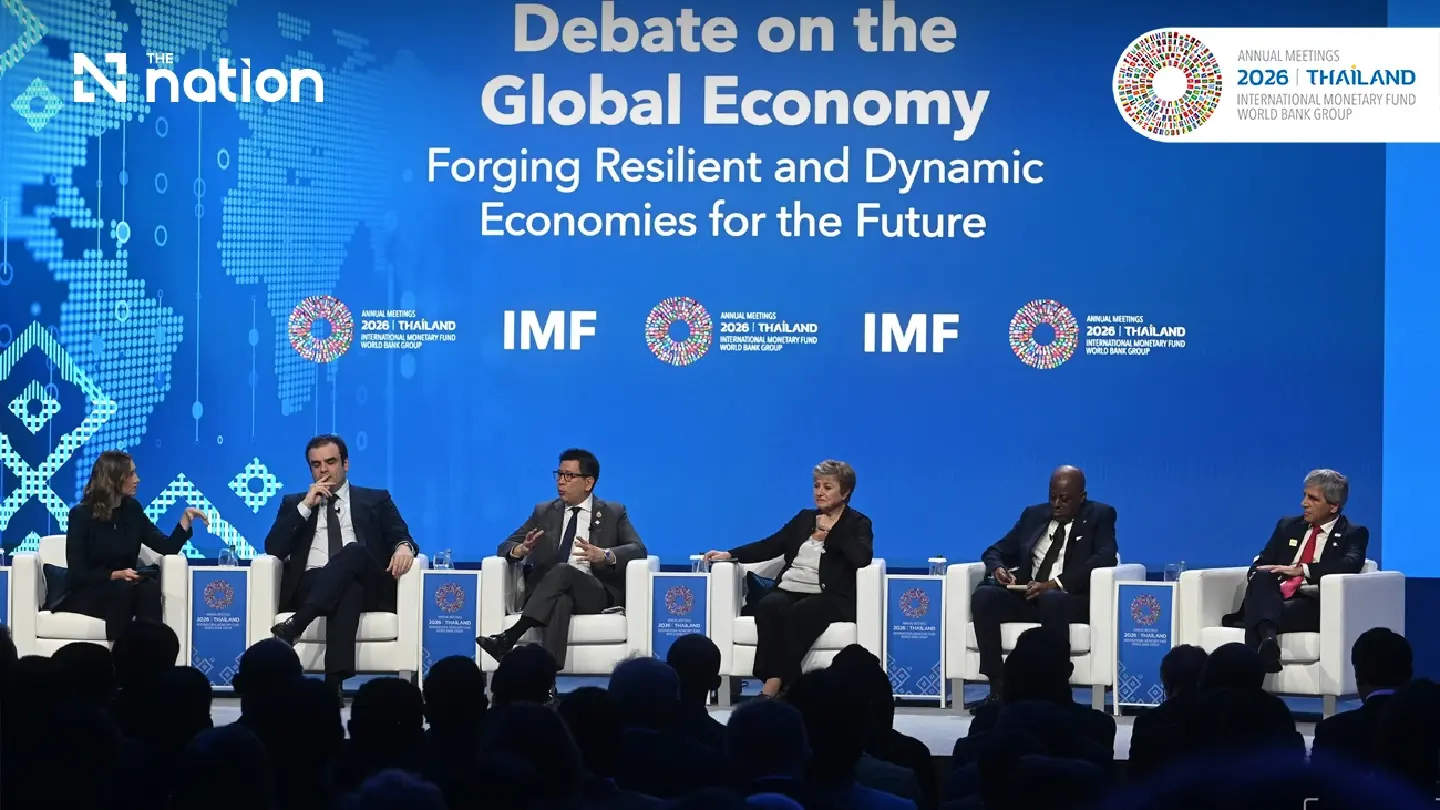
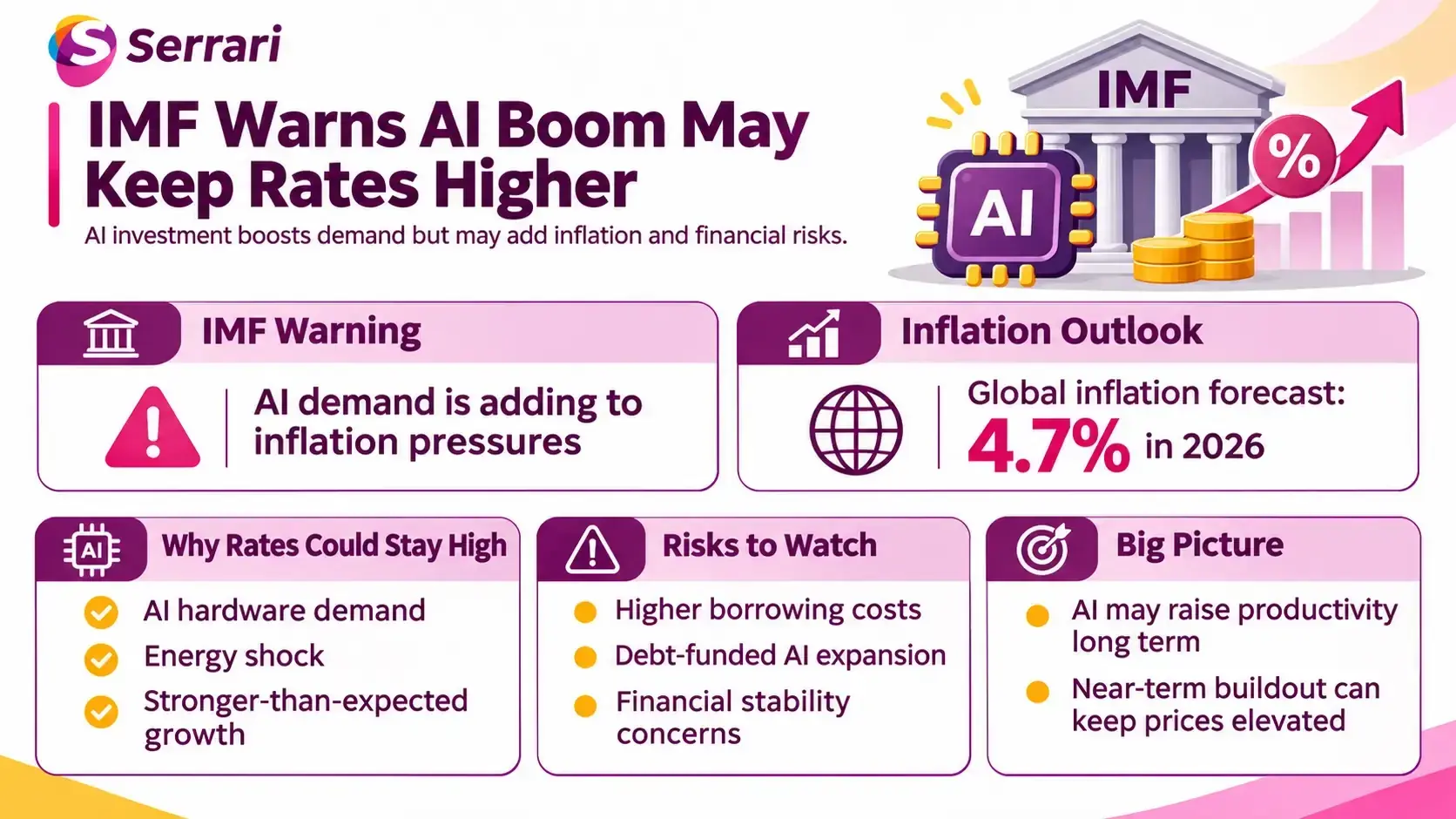
The global artificial intelligence investment boom is becoming a monetary-policy problem as well as a technological breakthrough. Speaking at the Asia-Pacific Economic Cooperation summit in Shenzhen on November 19, 2026, International Monetary Fund managing director Kristalina Georgieva warned that demand for AI hardware, together with the energy shock from the Middle East conflict, is adding to inflationary pressure and may require tighter monetary policy in many economies. The warning comes as the IMF forecasts global inflation of 4.7% in 2026, central banks confront renewed price pressures and financial regulators examine the growing debt used to fund AI infrastructure. The crucial distinction is that AI could simultaneously raise prices in the near term and improve productivity over time. Whether households see cheaper technology and stronger incomes—or more expensive credit—depends on how quickly the infrastructure buildout produces measurable economic benefits.
Key Overview
- IMF warning: Georgieva said the combination of AI-driven demand and the energy shock could require monetary tightening in many economies; she did not announce a universal central-bank rate decision.
- Inflation outlook: The IMF projects global headline inflation of 4.7% in 2026 and 4.1% in 2027, with higher commodity prices the principal driver of the near-term increase.
- Growth outlook: Global economic growth is forecast at 3.1% in 2026 and 3.4% in 2027, supported partly by investment in AI infrastructure.
- Physical bottlenecks: Data centres need electricity, grid capacity, chips, cooling equipment and construction inputs, which cannot all expand as rapidly as demand.
- Financial risks: European supervisors warn that more debt-financed AI spending could transmit a technology-sector reversal into bond markets and lenders.
- Household impact: Persistent inflation and higher borrowing rates could affect mortgages, business loans, government financing and employment even outside the technology sector.
Why AI Investment Has Become an Inflation Concern
The immediate trigger for Georgieva’s warning is the collision of two powerful forces: an energy supply shock and an extraordinary surge in demand for technology infrastructure. At the November 19 APEC meeting, she argued that pressure from AI equipment and related products is arriving while oil and other energy costs are already troubling the world economy. Strong technology spending can support economic output, but it can also compete for resources that are scarce in the short run.
AI services may seem intangible, yet creating them requires physical facilities. Technology companies purchase advanced semiconductors, servers, networking equipment, power systems and cooling machinery. They also commission enormous data centres and seek long-term electricity supplies. If manufacturers, electricians, grid operators and construction companies cannot scale at the same pace, prices can rise before new capacity becomes available.
The latest assessment of energy and AI illustrates the scale. Capital expenditure by five major technology companies exceeded $400 billion in 2025 and was expected to increase a further 75% in 2026. Data-centre electricity use rose 17% in 2025, substantially faster than overall global electricity consumption. Those trends do not prove that AI is responsible for a particular country’s inflation reading, but they explain why monetary authorities are watching its demand for power and industrial inputs.
This is also why the inflation story differs from earlier internet booms. AI investment is not confined to software valuations: it affects the supply of transformers, electricity connections, specialised components and construction capacity. When bottlenecks are concentrated in certain regions, costs may rise locally even if aggregate global supply is sufficient.
Why Central Banks Could Keep Rates Higher
Central banks raise policy interest rates when they judge that demand and inflation expectations threaten price stability. Higher borrowing costs discourage some spending, make credit-financed investment more expensive and can help moderate inflation. Georgieva’s warning that conditions call for tightening in many economies is therefore about the macroeconomic balance—not a prediction that every country will raise rates by the same amount.
The IMF’s October global outlook projects inflation of 4.7% this year, easing to 4.1% in 2027. Importantly, that forecast attributes the immediate upward inflation pressure primarily to commodities, including the effects of the Middle East conflict. AI investment is another force supporting demand and activity; it should not be misrepresented as the sole explanation for 4.7% inflation.
Several major central banks have already responded to their respective inflation conditions. The Federal Reserve’s September rate increase marked its first rise since 2023, amid renewed concern about price pressures. But policy paths may diverge depending on domestic inflation, employment, currencies and the scale of exposure to energy and AI investment. Rate hikes are decisions made from evolving data, not automatic consequences of a single industry boom.
For families, a prolonged period of elevated rates could delay relief on variable-rate mortgages and other loans. For firms, it raises the hurdle for investments whose expected earnings are years away. Governments rolling over debt may also face more expensive financing. Higher deposit yields could benefit some savers, but those gains must be weighed against inflation and the broader economic effects of tight credit.
The Paradox: AI Could Raise Prices Now and Lower Costs Later
There is an apparent contradiction at the heart of the warning: AI can be inflationary while also promising productivity gains. The explanation is timing. Building infrastructure creates immediate spending on labour, energy and equipment, whereas the benefits from automation, scientific discovery and improved business processes may take longer to arrive.
Georgieva’s October assessment of the AI boom described it as a positive demand shock that is lifting growth in countries supplying AI hardware. That helps explain the divergence between economies benefiting from semiconductor production and those primarily paying higher costs for imported energy and technology. The investment is real, but its benefits are unevenly distributed.
Over time, AI tools may allow companies to produce more services with the same resources, reducing unit costs and making some goods cheaper. Those productivity gains could ease inflation and raise living standards. Yet whether they outweigh the near-term demand shock depends on adoption, worker training, competition and whether businesses convert technical efficiency into lower prices rather than simply wider margins.
There is also a risk that expectations outrun reality. If expensive facilities are built on assumptions of rapid revenue growth that fails to materialise, some investments could become uneconomic. That would turn today’s growth engine into tomorrow’s source of corporate losses and postponed projects.
Context is everything. Stay ahead of shifting trends with today’s market updates, and uncover emerging opportunities using the Serrari Group Market Index and Marketplace. Then, take control of your own financial future by exploring our Money & Life Reset Transformation Blueprint ™ to build stronger habits, create better systems, and design a path toward lasting wealth.
Debt-Financed AI Expansion Creates Another Vulnerability
The concern extends beyond inflation. In its November financial stability assessment, the European Central Bank highlighted increasingly debt-funded AI infrastructure and the possibility that a change in market sentiment could spread losses beyond technology shares to bonds. As companies borrow more to fund data centres and computing capacity, the boom becomes more closely connected to creditors and financial intermediaries.
A detailed analysis of AI financing draws parallels with past periods when investment enthusiasm encouraged rapid infrastructure expansion and financial leverage. The comparison does not establish that AI is a bubble or that a crash is inevitable. It identifies a possible transmission mechanism: disappointing returns could weaken company balance sheets, reduce the value of debt holdings and tighten lending conditions for businesses unrelated to AI.
The timing is uncomfortable for policymakers. Higher interest rates can restrain inflation but also increase the financing costs of the same AI projects that investors expect to power future productivity growth. If debt burdens rise while anticipated revenue remains uncertain, the sector becomes more sensitive to shifts in bond yields and investor confidence.
This creates a double risk for the wider economy. Excessive AI investment can bid up scarce resources during expansion; a sudden withdrawal of funding can then reduce capital spending and jobs. Regulators are therefore monitoring both the pace of borrowing and how risk moves into the banking and non-bank financial system.
Why the Benefits Will Be Uneven Across Countries
Countries supplying semiconductors, computing hardware and related manufacturing services are more directly positioned to benefit from the current investment wave. Economies that import most of that equipment and energy may instead face higher bills before they capture meaningful productivity improvements. Access to affordable electricity, reliable networks and skilled workers will determine how widely the gains spread.
The IMF’s growth projections show global activity expanding by 3.1% this year before improving to 3.4% in 2027. Those global averages mask very different national circumstances. Energy importers already struggling with higher fuel costs could experience sharper inflation pressures, while exporters linked to AI infrastructure benefit from stronger orders.
For developing economies, the policy challenge is particularly difficult. Building digital infrastructure and training workers requires investment, but public finances and borrowing conditions may already be strained. Countries that delay preparation risk losing competitive opportunities, while those that borrow aggressively without a clear economic return could deepen debt vulnerabilities. This is why digital readiness should be assessed alongside reliable power, education, cybersecurity and sound public investment choices.
What Matters After Georgieva’s Warning
The warning is not that AI development should stop. It is that technological progress carries macroeconomic costs during the buildout and financial risks if investments are poorly priced. The distinction matters now because policymakers are already contending with an energy-driven inflation shock, and AI expenditure may keep demand resilient enough to complicate attempts to lower rates.
Investors should watch whether spending on computing capacity translates into sustainable revenue, how much investment is financed with debt and whether credit spreads widen. Businesses should assess both the productive applications of AI and the prospect that financing and electricity remain expensive. Households should expect different outcomes depending on local inflation, employment and interest-rate decisions rather than assuming a worldwide rate increase is guaranteed.
The bigger picture is a race between capacity and productivity. If supply chains, power grids and workers adjust quickly, AI could eventually expand output faster than demand and help reduce costs. If investment runs ahead of those adjustments, the technology promising greater efficiency may first prolong inflation and expensive credit. That is the economic dilemma underlying the IMF’s warning—and why the costs of the AI boom matter to far more people than the companies building it.
Sources: International Monetary Fund / International Energy Agency / European Central Bank / The Guardian / Reuters
Your financial future isn’t something you wait for—it’s something you build.
The real question is: when do you begin?
Move beyond simply staying informed.
Navigate the markets with clarity—track trends through the Serrari Group Market Index, uncover opportunities in the Serrari Marketplace, and build practical knowledge with our Curated Wealth Builder Platform.
Stay connected to what truly matters.
Get daily insights on macro trends and financial movements across Kenya, Africa, and global markets—delivered through the Serrari Newsletter.
Growth opens doors.
Advance your career through professional programs including ACCA, HESI A2, ATI TEAS 7 , HESI EXIT , NCLEX – RN and NCLEX – PN, Financial Literacy!🌟—designed to move you forward with confidence.
See where money is flowing—clearly and in real time.
Track Money Market Funds, Treasury Bills, Treasury Bonds, Green Bonds, and Fixed Deposits, alongside global and African indexes, key economic indicators, and the evolving Crypto and stablecoin landscape—all within Serrari’s Market Index.