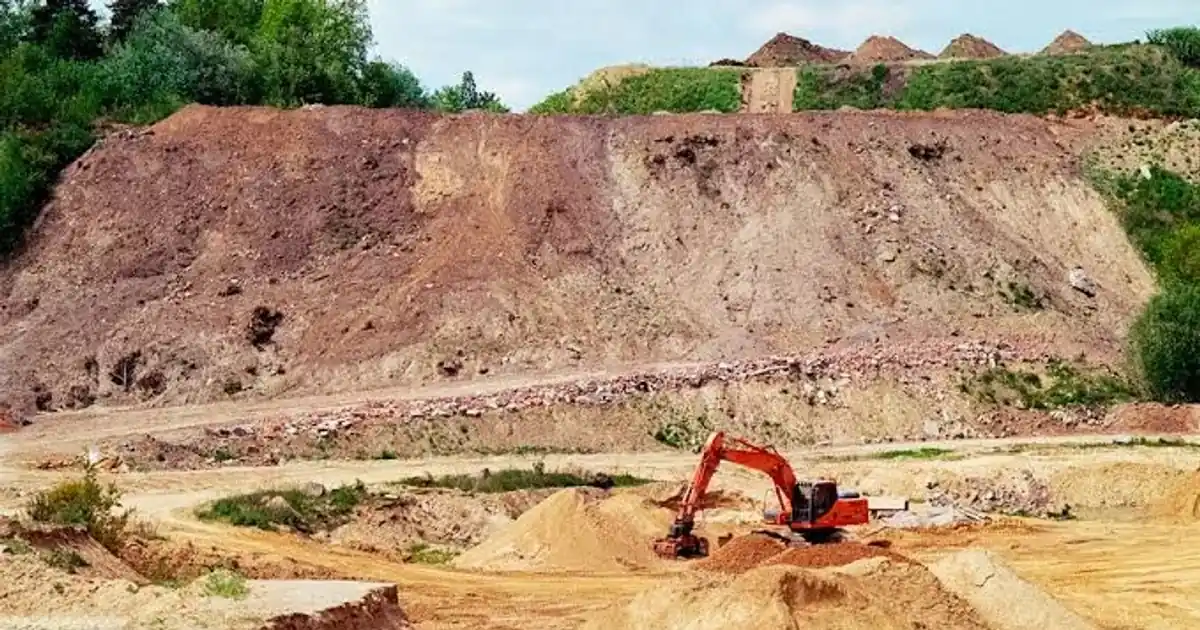
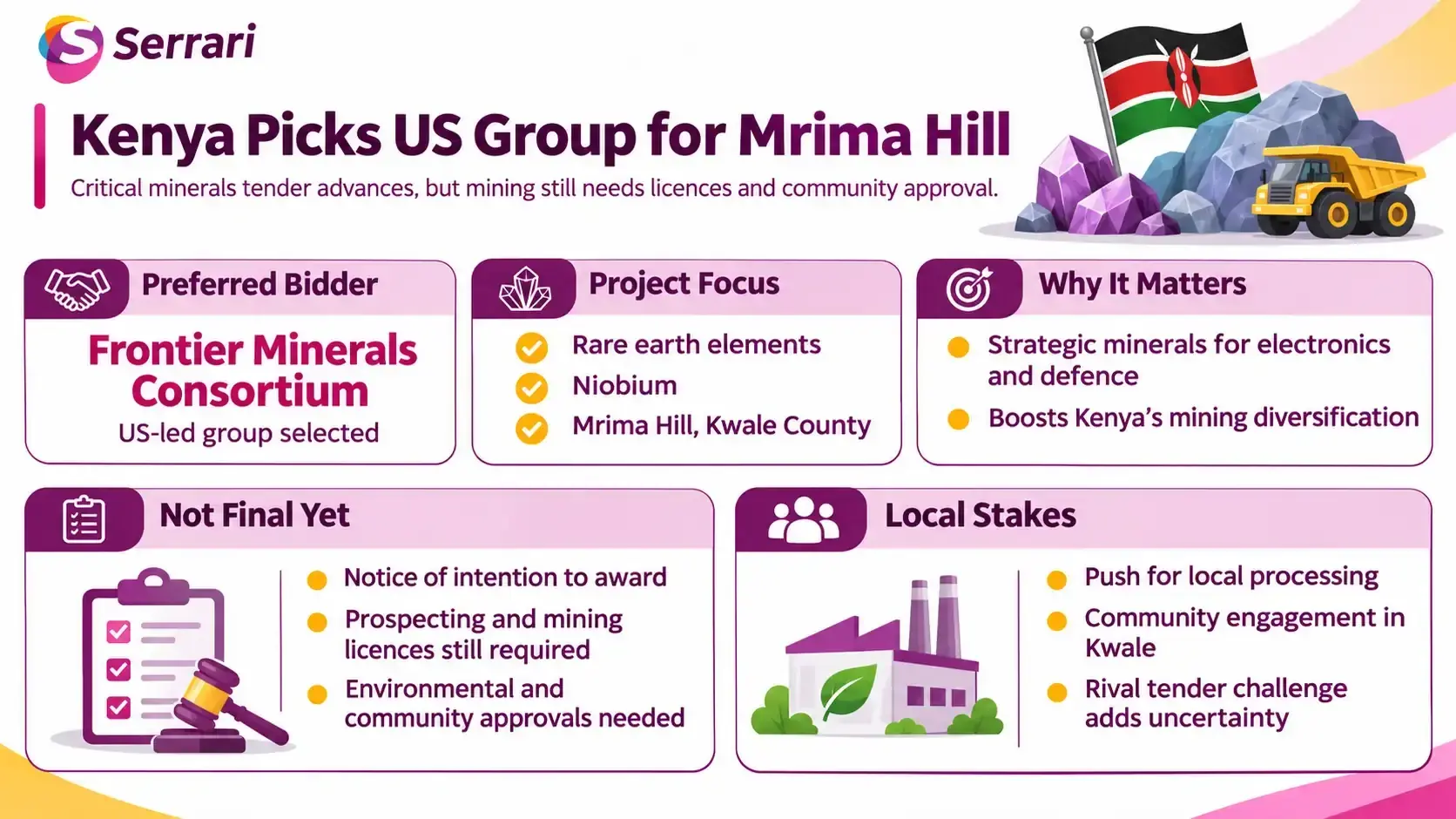
Kenya has named the US-led Frontier Minerals Consortium as its preferred bidder for the Mrima Hill niobium and rare-earth project in Kwale County, marking a significant step in the global contest to secure critical mineral supplies outside China. Mining Cabinet Secretary Hassan Joho announced a notice of intention to award on November 19, 2026, but the decision is not permission to start commercial mining. The project remains subject to prospecting rights, environmental approvals and community engagement, while an Australian rival says it will challenge the tender outcome. For Kenya, the stakes extend beyond who controls a valuable deposit: the country must determine how much processing, employment and tax revenue it can retain, without sacrificing a forest of profound cultural and ecological importance.
Key Overview
- Preferred bidder: Frontier Minerals Consortium, comprising Frontier Minerals LLC, Bunker Hill Mining, ReElement Technologies and American Resources Corporation.
- Decision status: Kenya issued a notice of intention to award on November 19, not a final authorisation for excavation or production.
- Strategic minerals: Mrima Hill contains rare earth elements and niobium sought for applications spanning magnets, advanced manufacturing and specialist steels.
- Global competition: Chinese firms had withdrawn from the Mrima Hill tender before the award; the US victory should not be presented as a direct final-round defeat of Chinese bids.
- Procurement dispute: The competing RareX–Iluka group says it intends to challenge Frontier’s eligibility, an allegation still to be adjudicated.
- Local stakes: Refining commitments, credible geological estimates, public participation and environmental protections will determine the project’s practical value to Kenya.
Why Washington Is Pursuing Kenya’s Critical Minerals
The November 19 selection puts Kenya into a supply-chain contest that goes well beyond East African mining. Modern defence systems, electric vehicles, wind turbines and advanced electronics depend on minerals that are difficult to replace quickly. Rare earths are especially important for high-performance permanent magnets, while niobium has important uses in specialised steels and alloys. Countries seeking secure supplies must acquire not only mineral deposits but also the ability to separate, refine and manufacture useful materials from them.
China’s dominance is most pronounced after extraction. An international assessment of rare-earth supply chains found that China accounted for approximately 91% of refining output for the magnet rare earths examined. This concentration leaves manufacturers elsewhere vulnerable to export restrictions, bottlenecks and changes in diplomatic relations. A mine outside China therefore has strategic value, but it cannot independently break that dependence if the ore still needs to be shipped to established foreign refineries.
The United States has consequently been searching for sources of critical minerals and processing expertise beyond China. Mrima Hill offers a potentially important African link. The winning group combines the proposed project vehicle Frontier Minerals with Bunker Hill Mining and businesses associated with critical-material processing, including ReElement Technologies and American Resources Corporation. Its proposed advantage is not simply access to ore, but an ambition to establish processing and refining capacity within Kenya.
That ambition helps explain the political attention. However, US strategic interest does not by itself prove that Kenya secured the best economic terms. Kenya’s own test is whether the agreement delivers defensible fiscal returns, technology transfer and domestic industrial capacity after the project costs and environmental obligations are accounted for.
What the Tender Actually Awarded—and Why It Is Contested
The government’s announcement followed a competitive process launched in March, with bidders shortlisted in July and detailed proposals considered in October. Frontier emerged as the preferred consortium, but the legal distinction is crucial: a notice of intention to award begins a process that can include challenges and further licensing steps. It does not automatically confer a right to mine commercially.
The title of the initial story suggests American firms beat Chinese companies in a final contest. In fact, accounts of the bidding process indicate that two Chinese candidates withdrew before final selection. Other competitors remained, including an Australian consortium. That difference matters because it separates an indisputable US strategic gain from an inaccurate impression of a head-to-head final decision against Chinese bids.
The outcome also faces a fresh procedural question. Australian miner RareX says its partnership with Iluka Resources placed second and plans to lodge a procurement complaint. RareX alleges that Frontier’s initial expression of interest missed the stipulated deadline, making it ineligible. These are the losing bidder’s claims, not proven procurement violations. The company has identified December 10 as the deadline for its challenge; Kenyan authorities and the applicable review process will determine the consequences.
The dispute raises the cost of uncertainty for investors and residents alike. If the award is upheld, permitting and project preparation can proceed. If there is a successful complaint, the timetable or selected developer could change. Either outcome demonstrates why transparent procurement is essential when a mineral project is politically and commercially sensitive.
Why a Multitrillion-Shilling Deposit Is Not Yet Revenue
Reports have valued the minerals beneath Mrima Hill at more than KSh 6 trillion, while other estimates have been higher. These headline figures must be treated cautiously. An estimated gross value of minerals underground is not a verified profit, an immediately recoverable reserve or a sum Kenya can expect to collect in taxes. The economically extractable quantity depends on drilling results, mineral grades, recovery rates, commodity prices, energy costs, environmental constraints and the cost of processing.
Before any extraction forecast can be credible, a developer must establish how much of each valuable mineral is present and how reliably it can be recovered. Rare earths frequently require complicated separation processes. Commercial success may be influenced as much by processing technology and plant economics as by the apparent size of the deposit.
Kenya’s insistence on domestic value addition is therefore economically significant. Selling unprocessed concentrates could generate export earnings, but refining within the country could support more skilled jobs, utilities investment, technical services and potentially higher-value output. Whether those benefits are achievable depends on the detailed feasibility study, financing, energy availability and a firm commitment to build and operate local plants.
This is especially important as Kenya seeks to diversify a mining industry that has struggled with uneven investment and the closure of major operations. The project’s economic contribution should ultimately be assessed using realised production, taxes, royalties, local procurement and jobs—not the headline underground valuation.
Context is everything. Stay ahead of shifting trends with today’s market updates, and uncover emerging opportunities using the Serrari Group Market Index and Marketplace. Then, take control of your own financial future by exploring our Money & Life Reset Transformation Blueprint ™ to build stronger habits, create better systems, and design a path toward lasting wealth.
The Environmental and Community Questions Cannot Be Deferred
Mrima Hill is not an empty industrial site. It includes protected forest and culturally important places associated with local communities. A court challenge brought by a civil-society group earlier in 2026 raised concerns about inadequate public participation and risks to ancestral and sacred sites. Those arguments remain part of the project’s public debate and cannot be resolved merely by naming a preferred bidder.
Prospecting and commercial mining have different legal thresholds. A prospecting licence primarily supports geological investigations, while production would require additional permissions. The competing bidder’s disclosure of the tender conditions describes requirements for a separate mining licence, environmental and social impact assessment, community development agreement and further government approvals. Each stage creates an opportunity to clarify what activities may occur and who bears the costs of damage or displacement.
Environmental questions can include forest disturbance, water use, dust, tailings and the handling of potentially radioactive material associated with certain mineral deposits. The presence and severity of these hazards must be established through site-specific scientific assessment rather than assumed. Residents also need intelligible information on land rights, access restrictions, compensation and benefit sharing before decisions become irreversible.
For the government, treating community participation as a box to tick would create litigation risk and could delay a project whose economic case already depends on substantial investment. For local families, the stakes are immediate: the value of a distant minerals supply chain must be weighed against livelihoods, cultural heritage and the condition of the land they use.
Will Kenya Gain a Refining Industry or Just a New Export Route?
The central policy question is what part of the mineral value chain stays in Kenya. Frontier’s reported plan for local refining aligns with the government’s preference for processing instead of merely exporting raw concentrates. Yet the level of actual processing, investment milestones, ownership arrangements and penalties for non-delivery will matter much more than a general promise.
An effective agreement would also define Kenyan participation in procurement and the workforce, and specify how mining income would reach national and county institutions under the law. Officials must guard against the appearance of industrialisation where only basic crushing takes place locally while almost all high-value separation occurs elsewhere. At the same time, requiring every stage to happen domestically without adequate skills, power and capital could make an otherwise viable project uncompetitive.
The broader geopolitical picture gives Kenya bargaining power but also presents risks. Competition between Western and Chinese supply chains may attract financing and technology, yet it can tempt governments to prioritise diplomatic symbolism over commercial and environmental scrutiny. Kenya’s most valuable position is not as a passive supplier to one geopolitical bloc, but as a host able to negotiate enforceable industrial benefits while maintaining relationships with different trading partners.
Why the Decision Matters Now
The November announcement is a meaningful advance after years of uncertainty around Mrima Hill, but it is the beginning of a long development process rather than the arrival of a multitrillion-shilling windfall. Global interest in rare earths makes the project more attractive, while the pending procurement challenge and local opposition make its immediate path less certain.
For investors, the next signals are the resolution of the tender dispute, a legally sound prospecting award and credible technical results. For Kwale residents, they are transparent consultation, independently reviewed environmental safeguards and evidence of enforceable local benefits. For the Kenyan public, they are the financing and value-addition terms that will show whether mineral wealth can be converted into durable national income.
Ultimately, the significance of the US-led consortium’s selection is not simply that Washington has secured an advantage in its contest with Beijing. It is that Kenya has another opportunity to decide whether strategic minerals will anchor a genuine domestic industry—or repeat the older model in which valuable resources leave the ground while much of the economic value is captured elsewhere.
Sources: Kenya News Agency / Reuters / RareX / International Energy Agency / Citizen Digital / Daily Nation / Associated Press
Your financial future isn’t something you wait for—it’s something you build.
The real question is: when do you begin?
Move beyond simply staying informed.
Navigate the markets with clarity—track trends through the Serrari Group Market Index, uncover opportunities in the Serrari Marketplace, and build practical knowledge with our Curated Wealth Builder Platform.
Stay connected to what truly matters.
Get daily insights on macro trends and financial movements across Kenya, Africa, and global markets—delivered through the Serrari Newsletter.
Growth opens doors.
Advance your career through professional programs including ACCA, HESI A2, ATI TEAS 7 , HESI EXIT , NCLEX – RN and NCLEX – PN, Financial Literacy!🌟—designed to move you forward with confidence.
See where money is flowing—clearly and in real time.
Track Money Market Funds, Treasury Bills, Treasury Bonds, Green Bonds, and Fixed Deposits, alongside global and African indexes, key economic indicators, and the evolving Crypto and stablecoin landscape—all within Serrari’s Market Index.