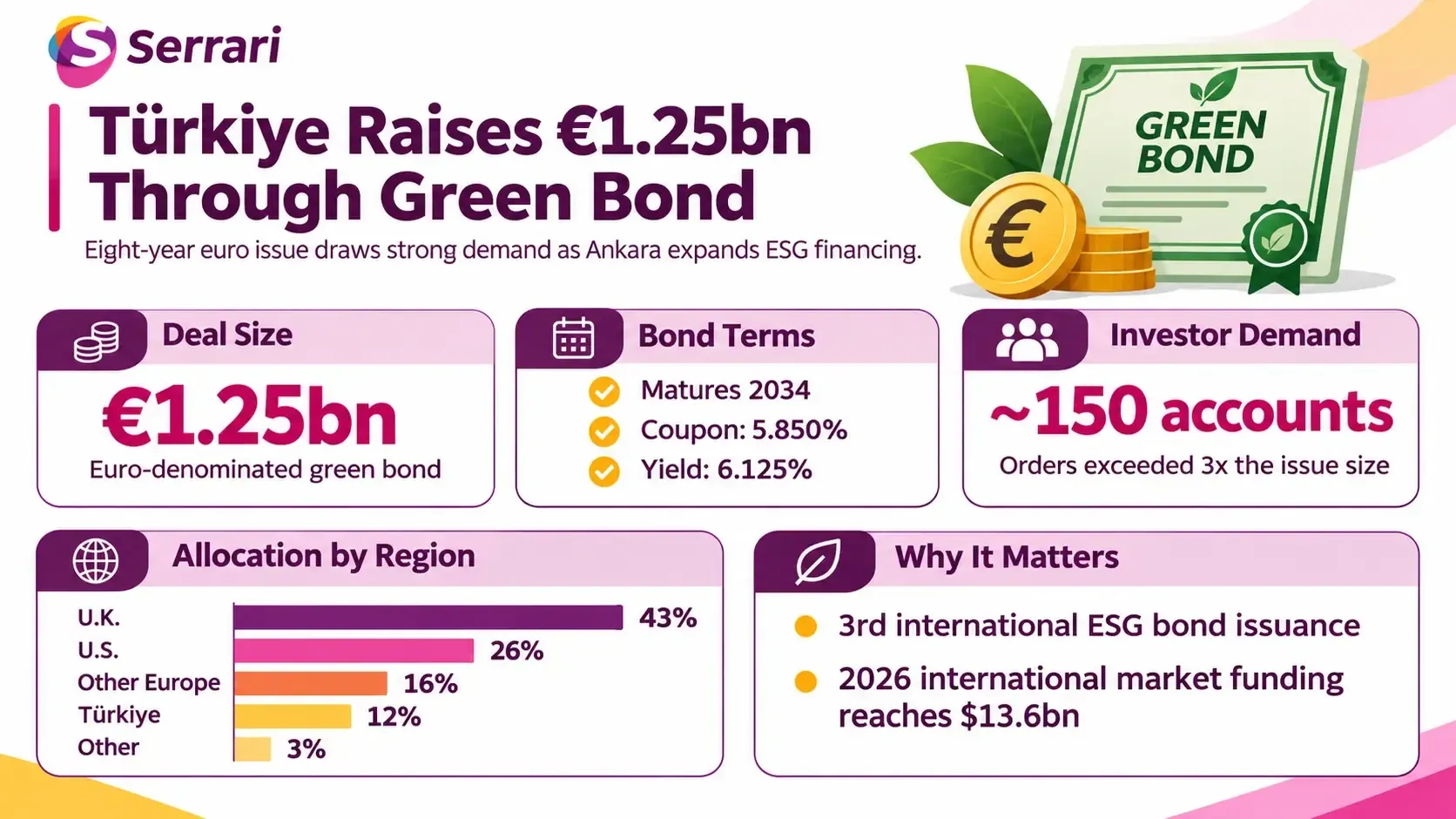
Türkiye has raised €1.25 billion through an eight-year, euro-denominated green bond, tapping international investors to help fund eligible environmental expenditure while expanding its foreign-currency borrowing programme. The bond attracted demand of roughly three times the amount offered, suggesting that global investors remain willing to lend to Ankara. Yet the 6.125% yield also underscores the premium Türkiye pays to access long-term funding. The transaction is therefore more than an environmental finance milestone: it tests the country’s ability to combine credible climate spending, debt management and macroeconomic stabilisation.
Key Overview
- Amount raised: €1.25 billion in notes due November 25, 2034, priced on November 18, 2026.
- Pricing: A 5.850% annual coupon and 6.125% yield to maturity, with the bonds sold at 98.301% of face value.
- Investor demand: Orders of roughly three times the issue size from about 150 investor accounts.
- Geographic reach: The United Kingdom received 43% of allocations, the United States 26%, other European countries 16%, Türkiye 12% and other markets 3%.
- Strategic significance: This was Türkiye’s third international ESG bond transaction and second in 2026, lifting international-market fundraising for the year to a reported $13.6 billion.
Why Türkiye Returned to International Green Bond Markets
Türkiye’s Treasury and Finance Ministry completed the sale after appointing Bank of America, BBVA, Deutsche Bank and JPMorgan to manage the eight-year issue. The transaction forms part of the government’s 2026 external borrowing programme, rather than an isolated fundraising exercise. The ministry’s green bond mandate was announced on November 18, with the market results disclosed the following day.
The timing matters because sovereign debt managers must balance several priorities: obtaining sufficient cash, spreading repayments across future years and avoiding excessive reliance on any single investor base or currency. A euro issue adds another funding channel to Türkiye’s international borrowing mix. Its 2034 maturity also allows the government to raise longer-term capital instead of repeatedly refinancing the same obligation over short intervals.
Green bonds add a second dimension. Their proceeds are intended to support qualifying environmental projects or expenditure under an established financing framework. For Türkiye, issuing such securities offers access to institutional investors with sustainability mandates, potentially broadening the pool of potential buyers beyond conventional sovereign bond portfolios. However, a green label does not itself demonstrate cheaper financing; the price must be assessed against comparable conventional borrowing and relevant market benchmarks.
The sale also builds on a programme that began with Türkiye’s first international green bond in April 2023. The Treasury’s sustainable finance framework provides the policy structure for eligible spending and subsequent reporting. Its continued use indicates an effort to make sustainability-labelled issuance a recurring part of sovereign funding rather than a one-off transaction.
Strong Demand Does Not Mean Cheap Borrowing
The strongest headline from the transaction was demand. Approximately 150 investor accounts placed orders amounting to around three times the €1.25 billion offered. That level of interest indicates that the issue was marketable at its agreed price and that investors were prepared to take exposure to Türkiye over an eight-year horizon.
The distribution was predominantly international. Buyers in the United Kingdom received 43% of the bonds, those in the United States 26%, and investors elsewhere in Europe 16%. Combined, those markets accounted for 85% of allocations. Turkish buyers received 12%, with the remaining 3% going to other countries. The geographical spread matters because a broader base of holders can help keep future issuance channels open, although it does not guarantee strong secondary-market liquidity.
Demand, however, should not be confused with a verdict that the borrowing was inexpensive. The final pricing terms show a 5.850% coupon, a 6.125% yield to maturity and an issue price of 98.301% of principal. The coupon is the annual interest rate applied to the bond’s face value. The higher yield reflects the fact that investors bought the notes below par and, assuming the bonds are held to maturity and obligations are met, are due repayment at face value.
At a face amount of €1.25 billion, the annual coupon obligation is approximately €73.1 million. The pricing document places net proceeds to the issuer at about €1.228 billion after the issue discount and stated fees, rather than the full €1.25 billion face amount. That distinction is important when comparing cash raised with future debt-servicing obligations.
The notes were priced at a spread of 272.5 basis points above the relevant euro mid-swap rate and 283.4 basis points above a specified German government bond benchmark. Those spreads reflect the extra compensation required by investors relative to lower-risk reference rates. They are a more informative measure of borrowing conditions than the coupon alone, though they also fluctuate with market interest rates and sentiment.
Context is everything. Stay ahead of shifting trends with today’s market updates, and uncover emerging opportunities using the Serrari Group Market Index and Marketplace. Then, take control of your own financial future by exploring our Money & Life Reset Transformation Blueprint ™ to build stronger habits, create better systems, and design a path toward lasting wealth.
Why Inflation and Economic Credibility Still Matter
Türkiye’s international borrowing costs cannot be separated from its broader economic policy. The country has spent recent years trying to restore price stability and strengthen confidence in monetary management after an extended period of elevated inflation and currency volatility. Investors assessing its sovereign bonds therefore consider not just repayment capacity but also policy consistency, foreign-exchange conditions and access to external financing.
In October, the central bank reduced its policy rate from 37% to 36%, while emphasising that monetary policy would remain restrictive until price stability was achieved. Its November inflation briefing raised the year-end 2026 inflation forecast to 29.5%. The persistence of inflation illustrates why international investors may still require meaningful compensation for Turkish sovereign risk despite signs of policy normalisation.
Foreign-currency borrowing can help diversify funding and avoid issuing all debt at high domestic-currency interest rates, but it comes with its own exposure. Euro-denominated interest and principal must ultimately be serviced in euros. If the lira depreciates against the euro, the domestic-currency cost of those obligations rises, even when the contractual euro coupon stays unchanged.
For this reason, the successful placement is best understood as evidence of market access, not proof that underlying economic risks have disappeared. Continued investor confidence will depend on inflation performance, fiscal discipline and whether policymakers maintain a predictable economic framework.
What Makes the Bond Green—and Why Verification Counts
A conventional sovereign bond typically finances general government needs. A green bond, by contrast, links an amount equivalent to the proceeds to expenditure categories defined in its sustainable finance framework. Eligible categories can encompass areas such as clean transportation, climate adaptation and sustainable water management, subject to the precise rules of the issuer’s framework.
Türkiye has previously published a green bond allocation report for its inaugural 2023 transaction. Such reporting matters because investors want to understand where funds were directed and what environmental outcomes the expenditure is expected to support. Without transparent allocation and impact information, the green label risks becoming a financing description rather than a measurable climate commitment.
The distinction is especially significant for a sovereign issuer. Governments frequently finance large, multi-year infrastructure and environmental programmes through their general budgets. The analytical question is whether eligible expenditure is clearly identified and accounted for, not whether every euro from an individual bond can be tracked into a physically separate bank account or newly announced project.
There is also a difference between allocation and impact. Allocation reporting explains which eligible expenditure has been matched to green-bond proceeds. Impact reporting attempts to demonstrate environmental effects, often using indicators tied to transport, emissions, water or resilience projects. Investors will need to examine future disclosures to assess how the November 2026 issue fits into those commitments.
For taxpayers, successful green investment could mean stronger infrastructure, more resilient public services and reduced exposure to climate-related damage over time. Such outcomes are potential benefits, however, not established results of this particular bond sale. The evidence will emerge from project delivery and reporting after issuance.
What the €13.6 Billion Fundraising Total Signals
The ministry reported that the transaction raised Türkiye’s cumulative international capital-market financing during 2026 to $13.6 billion. That figure represents a broader external funding programme, not solely green bonds, and should not be confused with net cash proceeds from this particular euro issue.
The larger total underscores the government’s continued use of global debt markets to meet financing requirements. International issuance can help manage maturities and maintain market visibility. Yet every new borrowing transaction also creates future obligations. The long-term value depends on how efficiently funds are used, what debt is refinanced and whether the economy generates the resources needed for repayment.
For international investors, the green bond offers exposure to Turkish sovereign credit risk alongside a use-of-proceeds sustainability framework. Its return is not guaranteed simply because it carries a sovereign or green designation. Credit deterioration, changing euro interest rates and trading conditions can affect the bond’s market value before maturity.
For emerging-market borrowers more broadly, Türkiye’s issuance illustrates a trade-off at the heart of sustainable finance. Green bonds can widen access to capital and help fund environmentally important expenditure, but the sustainability label cannot erase macroeconomic vulnerabilities or substitute for credible fiscal and monetary policy.
The Real Test Comes After the Bond Sale
The immediate achievement is clear: Türkiye placed €1.25 billion of long-dated euro debt with a geographically diversified group of investors, despite having to offer a yield above 6%. This demonstrates demand for the country’s sovereign credit and continued appetite for labelled debt instruments.
The more important questions lie ahead. Will borrowing conditions improve as inflation moderates? Will the Treasury maintain transparent, comparable green-bond reporting? And will the expenditure supported under its framework produce environmental results that justify the financing strategy?
Those questions matter now because sovereign green finance is moving beyond symbolic first-time issuance. Türkiye is returning to the market repeatedly, meaning investors can assess a developing track record rather than a single transaction. Its credibility will be shaped not only by successful bond placements, but also by the cost of debt, the consistency of economic policy and the measurable results delivered with the money.
Sources: Republic of Türkiye Ministry of Treasury and Finance / U.S. Securities and Exchange Commission / Central Bank of the Republic of Türkiye / Anadolu Agency / Hürriyet Daily News
Your financial future isn’t something you wait for—it’s something you build.
The real question is: when do you begin?
Move beyond simply staying informed.
Navigate the markets with clarity—track trends through the Serrari Group Market Index, uncover opportunities in the Serrari Marketplace, and build practical knowledge with our Curated Wealth Builder Platform.
Stay connected to what truly matters.
Get daily insights on macro trends and financial movements across Kenya, Africa, and global markets—delivered through the Serrari Newsletter.
Growth opens doors.
Advance your career through professional programs including ACCA, HESI A2, ATI TEAS 7 , HESI EXIT , NCLEX – RN and NCLEX – PN, Financial Literacy!🌟—designed to move you forward with confidence.
See where money is flowing—clearly and in real time.
Track Money Market Funds, Treasury Bills, Treasury Bonds, Green Bonds, and Fixed Deposits, alongside global and African indexes, key economic indicators, and the evolving Crypto and stablecoin landscape—all within Serrari’s Market Index.