Kenya is preparing to begin commercial crude oil production from the South Lokichar fields in Turkana County on December 1, 2026. Energy and Petroleum Cabinet Secretary Opiyo Wandayi confirmed that drilling rigs would be activated on November 20, marking a transition from exploration and pilot production to commercial operations. The first phase, operated by Gulf Energy, targets 20,000 barrels per day, with output expected to rise to 50,000 barrels per day from the end of 2032. Initially, crude will be transported by road to Mombasa for export and refining abroad. The government is also reviewing four possible trade names for the country’s crude.
Key Takeaways
- Kenya is scheduled to begin commercial crude oil production in South Lokichar, Turkana County, on December 1, 2026.
- Drilling rigs are expected to be activated on November 20, ahead of the first production.
- Gulf Energy is targeting initial output of 20,000 barrels per day, increasing to 50,000 barrels per day from the end of 2032.
- The first phase will rely on insulated trucks to transport the waxy crude to Mombasa for export.
- Kenya has shortlisted four possible trade names for its crude oil.
- The project could diversify Kenya’s export earnings and foreign exchange sources, while creating new infrastructure and logistics requirements.
Kenya Moves Closer to Joining the International Oil Market
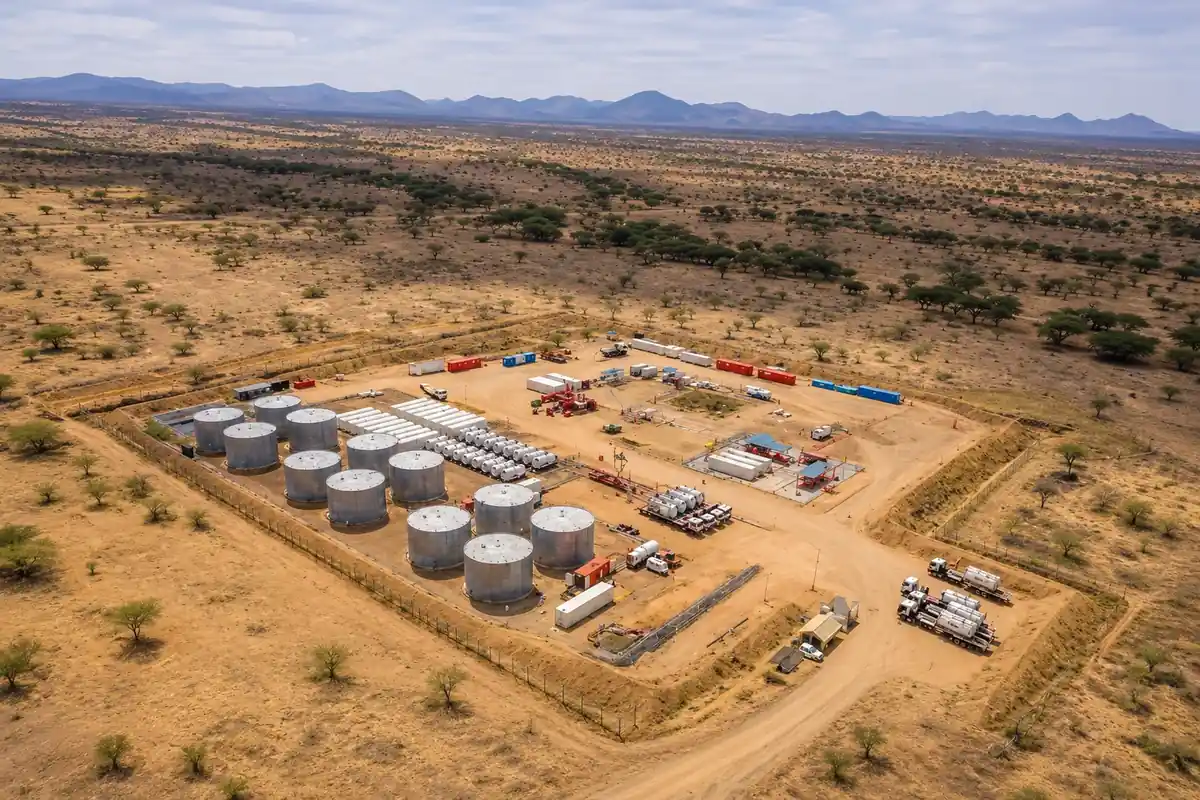
Kenya is preparing to enter the international crude oil market as commercial production from the South Lokichar oil fields in Turkana County is scheduled to begin on December 1, 2026.
The development marks a major step in the country’s oil exploration journey, moving the project from years of exploration and pilot production towards commercial operations and international exports.
Energy and Petroleum Cabinet Secretary Opiyo Wandayi confirmed the production timeline on November 18, saying the drilling rigs would be switched on on Friday, November 20.
“We are switching on the drilling rigs on Friday and the first production date of December 1 still remains as scheduled. Everything is set,” Wandayi said, as reported by Business Daily.
The Ministry of Energy and Petroleum has also described December 1 as the date when Kenya moves from exploration and pilot production into full commercial production. It said Kenyan crude would subsequently be offered to international refiners and traders.
President William Ruto is expected to flag off the first oil convoy on December 1 and announce the crude’s official trading name.
The development would position Kenya alongside established and emerging oil-exporting countries in the East African region, including Uganda and South Sudan. It could also introduce a new source of export earnings for an economy that relies on several existing foreign exchange-generating sectors.
However, the start of production is only one part of the process. Kenya will also need to establish reliable transportation, storage, export arrangements and commercial relationships with buyers.
Gulf Energy Targets 20,000 Barrels Per Day in the First Phase
Gulf Energy, the Kenyan company that took over the South Lokichar project from Tullow Oil, is targeting an initial production rate of 20,000 barrels per day (bpd) from Blocks T6 and T7.
The first phase is expected to run from 2026 to 2032. Gulf Energy plans to increase production to 50,000 barrels per day from the end of 2032, subject to the project’s development plans.
The company told a joint sitting of Parliament’s energy committees in February that it planned to invest approximately US$6 billion in the South Lokichar project.
The investment highlights the scale of the infrastructure and operational requirements involved in moving from initial production to higher output. Developing an oil field requires more than drilling wells: it also involves facilities for handling crude, transportation arrangements, storage capacity and access to export markets.
The planned production increase would therefore require the supporting infrastructure to expand alongside output.
For Kenya, the first phase will provide an opportunity to establish the commercial and logistical systems needed to handle domestic crude before production is expected to rise further.
How Kenya Plans to Transport and Export Turkana Crude
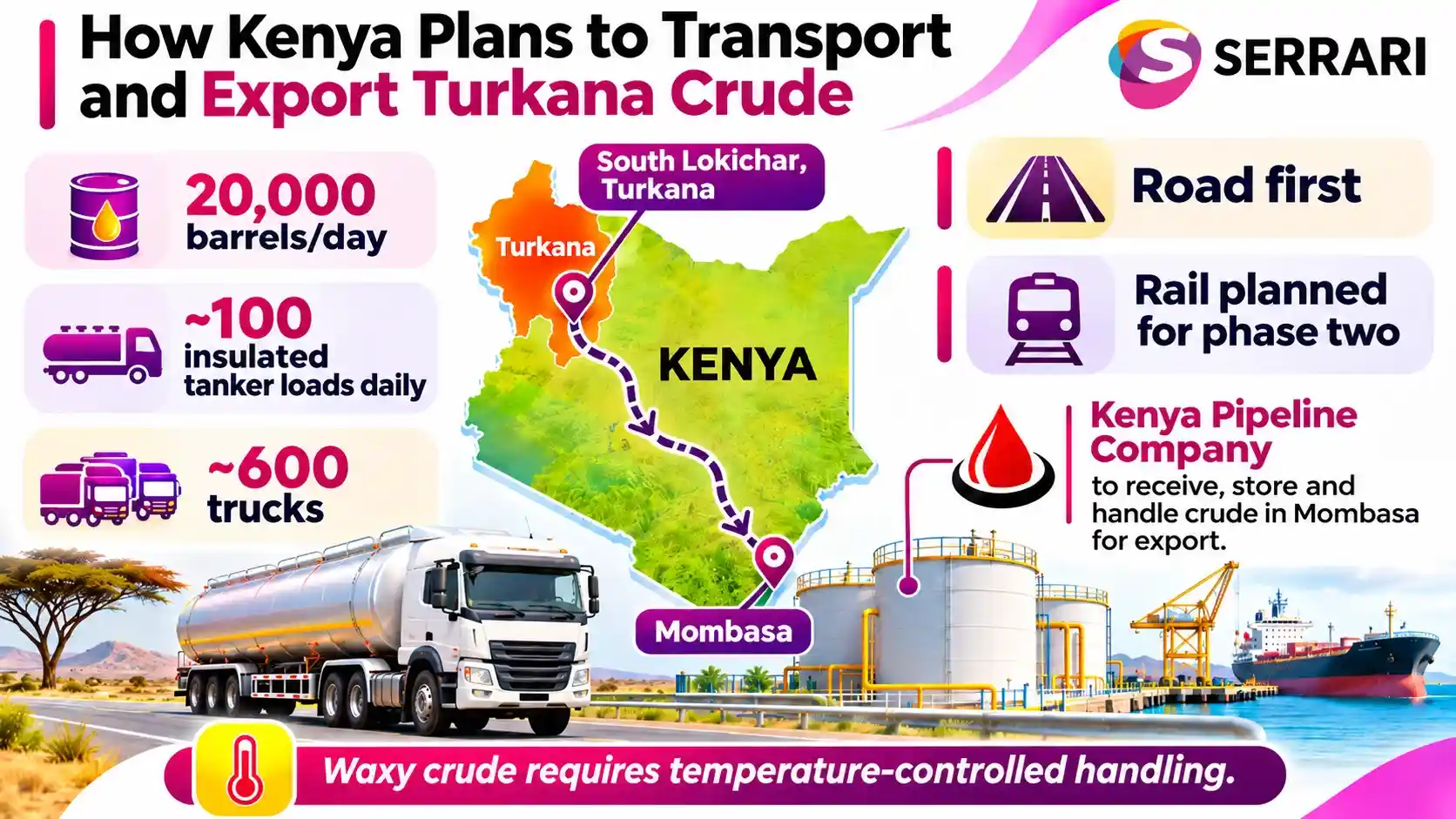
One of the main challenges facing the project is transporting crude oil from the inland South Lokichar fields to the coast.
During the first phase, the oil will be transported by road to the Port of Mombasa before being exported for refining abroad. Rail transportation is expected to be introduced in the second phase, according to Business Daily.
The crude has a waxy characteristic, meaning it can solidify at normal ambient temperatures. This creates additional handling and transportation requirements because the oil needs to be kept at suitable temperatures while moving through the supply chain.
Official estimates indicate that transporting 20,000 barrels per day could require approximately 100 insulated tanker loads a day and a fleet of around 600 trucks.
This illustrates the scale of the initial transportation operation. A continuous flow of vehicles will be needed to move the crude from Turkana to Mombasa, while storage and handling facilities must be ready to receive and manage the shipments.
Kenya Pipeline Company (KPC) is expected to play a role in the export process. In August, the company signed a 25-year agreement to receive, store and handle Gulf Energy’s crude in Mombasa for export.
KPC estimated that the agreement could generate approximately KES93.68 billion (US$725 million) in gross revenue over the contract period.
The arrangement gives the project access to established petroleum-handling infrastructure at the coast, while providing KPC with a potential long-term source of business.
In the longer term, the planned shift towards rail transportation could change how crude is moved from the oil fields to the coast. The government had previously proposed a KES220 billion (US$1.7 billion) extension of the metre-gauge railway to South Lokichar, expected to be completed by the end of 2031.
Kenya Shortlists Four Names for Its Crude Oil
Alongside preparations for production, the government is finalising the commercial identity of Kenya’s crude oil.
Following a public participation exercise held in October, the Ministry of Energy and Petroleum shortlisted four proposed trade names from citizen submissions.
The options are:
- Great Rift Light
- Great Rift Intermediate
- Great Rift Blend
- Great Rift Sweet
The shortlisted names are undergoing final review, with a recommendation expected to be submitted to President William Ruto for approval.
The trading name will provide a commercial identity for Kenyan crude as it is introduced to international refiners and traders.
The names also reflect terminology commonly associated with crude oil grades. Terms such as light and sweet describe certain characteristics of crude, including its density and sulphur content. Kenya’s crude has been described as light and sweet, meaning it has relatively low sulphur content.
The final name is expected to be unveiled alongside the launch of the first oil convoy on December 1.
Context is everything. Stay ahead of shifting trends with today’s market updates, and uncover emerging opportunities using the Serrari Group Market Index and Marketplace. Then, take control of your own financial future by exploring our Money & Life Reset Transformation Blueprint ™ to build stronger habits, create better systems, and design a path toward lasting wealth.
Kenya Has Yet to Name Its First Crude Oil Buyers
While production and export preparations are progressing, Kenya has not yet announced the buyers for its initial crude oil shipments.
The government has indicated that the oil will be sold through commercial negotiations, with buyers selected based on the prices they offer.
Energy and Petroleum Regulatory Authority (EPRA) Director General Edward Kinyua explained the approach in October, saying: “It will be a willing buyer, willing seller and whoever gives us a good price, we will take it there.”
This means that the initial exports will depend on negotiations between the seller and prospective international buyers.
The price Kenya receives will be influenced by factors such as the characteristics of its crude, prevailing international oil prices, transportation costs and demand from refiners.
Although the government describes the crude as light and sweet, it has not yet disclosed the final buyers or the commercial terms of the initial export arrangements.
Securing buyers will be an important next step in turning the start of production into actual export revenue.
Dangote Pipeline Could Shape the Project’s Longer-Term Future
Beyond the initial road transportation arrangements, Kenya is also exploring longer-term infrastructure options that could connect the Turkana oil fields to a refinery in Lamu.
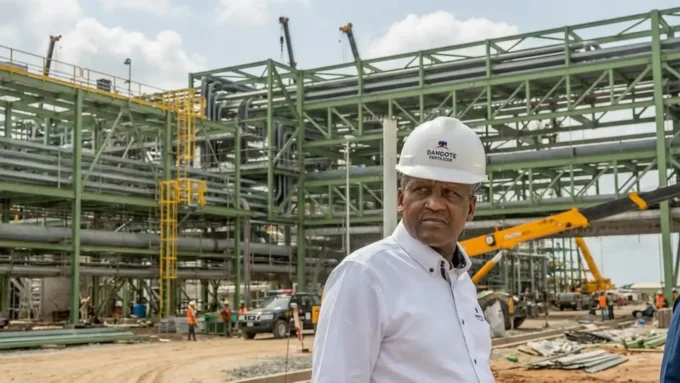
President William Ruto has said that Nigerian industrialist Aliko Dangote agreed to invest in a pipeline linking the South Lokichar fields to his planned refinery in Lamu, where construction was officially launched on September 30.
David Ndii, chairman of Ruto’s Council of Economic Advisors, said the planned Dangote refinery had made a long-discussed Turkana pipeline commercially viable, according to IntelliNews in a November 6 report.
A pipeline could provide an alternative to transporting crude by road over long distances, particularly as production increases. It could also connect the oil fields to a domestic refining facility, depending on the project’s eventual development and commercial arrangements.
Dangote’s involvement in Kenya’s petroleum infrastructure also extends to Kenya Pipeline Company. In October, he acquired a 24.76% stake in KPC for US$327 million.
However, the proposed Turkana-to-Lamu pipeline remains a longer-term development. The immediate export plan is still based on transporting crude by road to Mombasa, with rail also identified as a future option.
The Bigger Picture: What Oil Production Could Mean for Kenya’s Economy
Kenya’s entry into commercial oil production could create another source of export earnings and foreign exchange.
Crude oil exports would add a new commodity to the country’s international trade activity, potentially helping diversify its export base. The project could also support activity in transportation, storage, energy infrastructure and related services.
The involvement of KPC illustrates how the project could extend beyond the oil fields themselves. Its 25-year handling agreement creates a potential revenue stream for the pipeline operator, while the transportation requirements could generate business for logistics and supporting service providers.
The planned increase in production from 20,000 barrels per day to 50,000 barrels per day would make the availability of reliable infrastructure even more important.
However, the economic benefits will depend on the volume of crude actually produced, the prices achieved in international markets, the cost of transporting the oil and the investment required to sustain operations.
Oil production also exposes countries to fluctuations in global commodity prices. International crude prices can change in response to supply and demand, geopolitical developments and broader economic conditions. This means export earnings may vary over time.
For Kenya, the commercial success of the project will therefore depend not only on beginning production but also on managing costs, securing buyers and developing infrastructure that can support the oil sector over the long term.
Why Does This Matter Now?
The December 1 production date represents a transition from oil exploration and pilot activity to a commercial export operation.
For the government, it is an opportunity to introduce a new export commodity and potentially broaden the country’s foreign exchange earnings. For the energy sector, it creates demand for transportation, storage, handling and other supporting infrastructure.
The immediate challenge is ensuring that the first shipments can move reliably from Turkana to Mombasa and reach international buyers. The longer-term challenge will be expanding capacity as production increases.
The project also raises questions about how Kenya will manage the economic opportunities and risks associated with becoming an oil producer, including exposure to global oil prices and the investment required to maintain production.
Outlook
Kenya is approaching a significant milestone in its energy sector, with drilling scheduled to begin on November 20 and commercial production targeted for December 1, 2026.
The first phase is expected to produce 20,000 barrels per day, with Gulf Energy targeting a rise to 50,000 barrels per day from the end of 2032. Initial exports will rely on insulated trucks transporting the crude to Mombasa, while rail and a possible pipeline offer longer-term transportation options.
The immediate priorities will be starting production as scheduled, completing the crude’s commercial branding, securing buyers and establishing reliable export operations.
If the project progresses according to plan, South Lokichar could become an important part of Kenya’s energy and export economy. Its longer-term contribution, however, will depend on production performance, infrastructure development, investment and the country’s ability to compete in international oil markets.
Frequently Asked Questions
1. When will Kenya begin commercial oil production?
Kenya is scheduled to begin commercial crude oil production from the South Lokichar fields in Turkana County on December 1, 2026. Drilling rigs are expected to be activated on November 20.
2. How much oil will Kenya initially produce?
Gulf Energy is targeting an initial production rate of 20,000 barrels per day from Blocks T6 and T7, with a planned increase to 50,000 barrels per day from the end of 2032.
3. How will Kenya transport its crude oil for export?
During the first phase, crude will be transported by insulated trucks from Turkana to Mombasa for export and refining abroad. Rail transportation is planned for the second phase.
4. What are the proposed names for Kenya’s crude oil?
The four shortlisted names are Great Rift Light, Great Rift Intermediate, Great Rift Blend and Great Rift Sweet. The final recommendation is expected to be submitted to President William Ruto for approval.
Your financial future isn’t something you wait for—it’s something you build.
The real question is: when do you begin?
Move beyond simply staying informed.
Navigate the markets with clarity—track trends through the Serrari Group Market Index, uncover opportunities in the Serrari Marketplace, and build practical knowledge with our Curated Wealth Builder Platform.
Stay connected to what truly matters.
Get daily insights on macro trends and financial movements across Kenya, Africa, and global markets—delivered through the Serrari Newsletter.
Growth opens doors.
Advance your career through professional programs including ACCA, HESI A2, ATI TEAS 7 , HESI EXIT , NCLEX – RN and NCLEX – PN, Financial Literacy!🌟—designed to move you forward with confidence.
See where money is flowing—clearly and in real time.
Track Money Market Funds, Treasury Bills, Treasury Bonds, Green Bonds, and Fixed Deposits, alongside global and African indexes, key economic indicators, and the evolving Crypto and stablecoin landscape—all within Serrari’s Market Index.