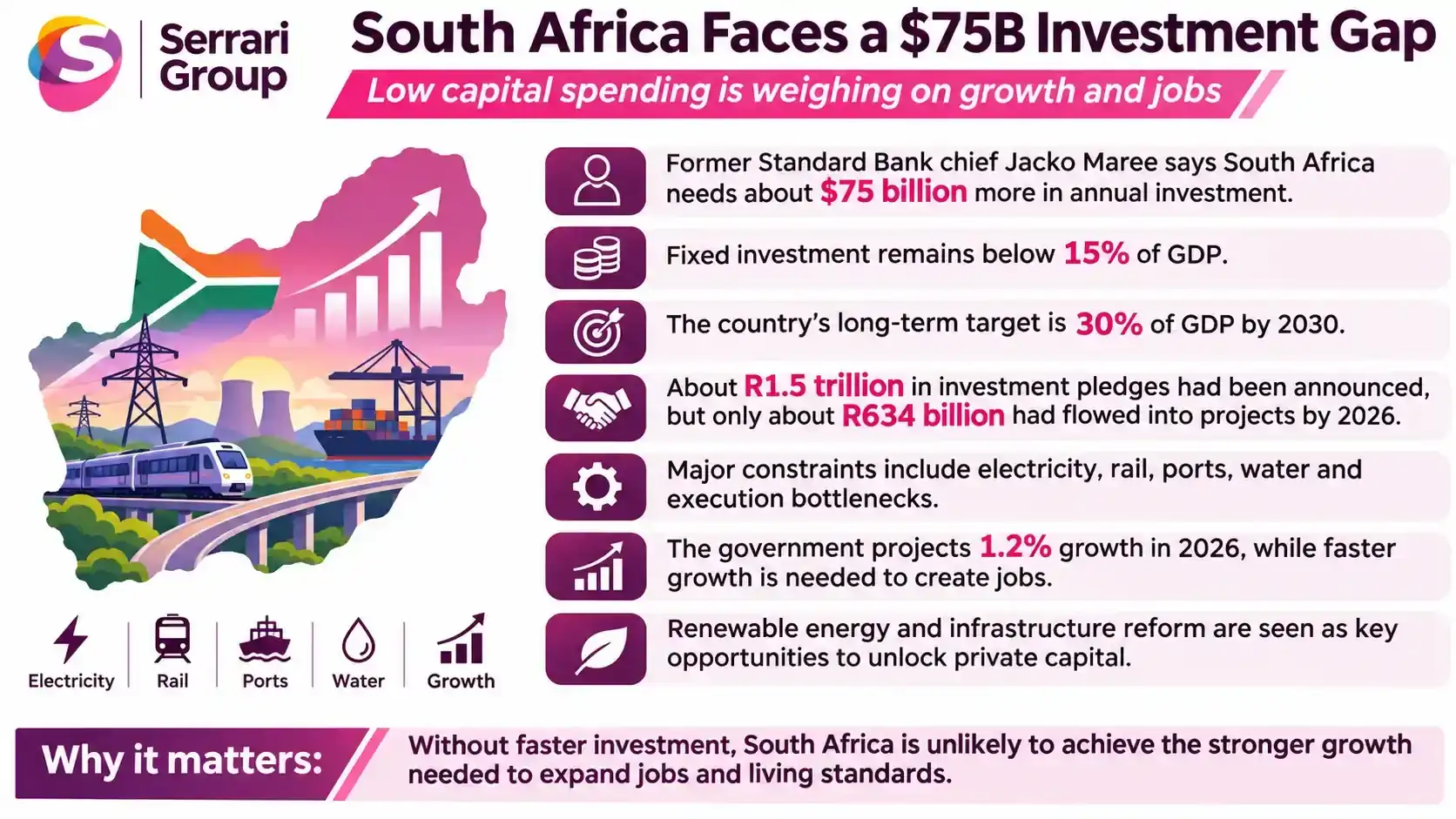
South Africa needs roughly $75 billion (R1.27 trillion) in additional fixed investment every year to achieve its longer-term economic ambitions, according to former Standard Bank chief executive Jacko Maree. His warning comes as the country’s investment rate remains below 15% of gross domestic product (GDP), less than half the 30% target set under its National Development Plan. Although authorities have attracted substantial investment pledges and advanced reforms in electricity, logistics and public finance, turning announcements into completed projects remains difficult. The stakes extend beyond investors: without new productive capacity, unreliable infrastructure and sluggish economic growth will continue to constrain hiring, household incomes and the government’s ability to fund public services.
Key Overview
- Annual shortfall: Maree estimates that South Africa needs an additional $75 billion, or around R1.27 trillion, in investment each year to meet its growth objectives.
- Target gap: Fixed investment is below 15% of GDP, versus a long-standing national target of 30% by 2030.
- Pledges versus delivery: Of approximately R1.5 trillion in investment commitments secured through the initial investment drive, about R634 billion had flowed into projects by 2026.
- Growth outlook: The government projects GDP growth of 1.2% in 2026 and 2% by 2029, while former finance minister Nhlanhla Nene argues at least 3% growth is needed for meaningful employment gains.
- Priority sectors: Electricity, transmission lines, railways, ports, water systems and manufacturing offer opportunities to expand productive capacity.
- Core challenge: Transparent rules and commercially credible projects must turn available savings and institutional capital into construction, equipment and jobs.
Why South Africa Needs Another $75 Billion Every Year
Jacko Maree’s warning is ultimately about the economy’s ability to produce more, rather than the amount of money announced at investment conferences. The former Standard Bank chief, who led the lender between 1999 and 2013, says sustained growth is unlikely without a substantial rise in fixed investment. In his assessment of the investment shortfall, he placed the additional annual requirement at $75 billion, equivalent to approximately R1.27 trillion at the exchange rate used in the reporting.
Fixed investment means spending on assets that can support production over time, such as factories, machinery, electricity infrastructure, transport networks and buildings. It is distinct from purchases of existing financial assets or the announcement of future spending. That difference matters because buying a share in an existing business does not necessarily create a new production line, whereas constructing a power station or expanding a port can increase the economy’s capacity.
South Africa’s National Development Plan established a goal of lifting investment to 30% of GDP by 2030. With investment currently below 15%, Maree argues that the country is severely underinvesting relative to its development ambitions. His $75 billion figure is an estimate of an annual additional requirement, not a government appropriation, an investment pledge or a sum already raised. It also should not be confused with the total amount the economy currently invests.
The underlying problem is cumulative. When firms defer capital spending, factories age, transport bottlenecks persist and productivity improvements are delayed. Weak growth then lowers expected business returns, discouraging the next round of investment. Breaking that cycle requires addressing the reasons that businesses hesitate to commit capital in the first place.
How Power, Rail and Ports Have Held Back Growth
South Africa has lived with the economic consequences of years of electricity shortages, aging infrastructure and governance failures. Even when power availability improves, businesses still consider the reliability and price of future supply before building facilities with decades-long operating lives. Manufacturers need predictable production schedules, while exporters depend on ports and freight rail to deliver goods on time.
Unreliable logistics can impose costs that spread through the economy. A mining company facing rail constraints may export less than its production capacity allows. A factory may hold additional inventory to prepare for shipping delays. Retailers and consumers can ultimately bear higher transport and distribution costs. These pressures weaken the expected return on new plants and equipment, making financing harder to justify.
The government’s October 2026 economic statement acknowledges that weak infrastructure, particularly water provision and other essential services, continues to constrain activity. It identifies macroeconomic stability, structural reform, stronger state capability and growth-enhancing infrastructure as the main pillars of recovery.
This explains why infrastructure projects are not merely another spending category. They can unlock private investment elsewhere. Improving the capacity of an electricity network or a rail corridor may allow multiple businesses to expand without each having to overcome the same constraint independently. The economic payoff therefore depends partly on choosing projects with demonstrable demand, sound operating arrangements and measurable benefits.
Context is everything. Stay ahead of shifting trends with today’s market updates, and uncover emerging opportunities using the Serrari Group Market Index and Marketplace. Then, take control of your own financial future by exploring our Money & Life Reset Transformation Blueprint ™ to build stronger habits, create better systems, and design a path toward lasting wealth.
Why Investment Pledges Have Not Become Enough Real Spending
The country has not been unsuccessful at persuading companies to announce plans. Its first presidential investment drive attracted roughly R1.5 trillion in commitments. Yet official updates on implementation indicated that about R634 billion had been invested in factories, mines, power plants, data centres and other projects by May 2026. That is substantial activity, but well below the full amount pledged.
The distinction should not be interpreted as proof that every remaining commitment has failed. Some projects are scheduled over several years, require permits or must pass feasibility and financing milestones. Others can be revised when market conditions change. Nonetheless, the difference shows why investment headlines are an incomplete measure of economic progress.
At the March 2026 investment conference, President Cyril Ramaphosa launched another five-year drive, describing a R2 trillion target for new commitments and more than R1 trillion in public infrastructure investment planned over three years. Those targets represent ambitions and budgeted programmes, not immediate additions to GDP. Their effects will depend on the speed and quality of actual delivery.
Potential investors must also assess regulatory uncertainty, municipal performance, procurement processes, corruption risks and whether a project has users willing to pay for its output. A proposal can be economically attractive in principle but remain unfinanceable if contracts are unclear or essential approvals take too long. This is why accelerating implementation may matter as much as announcing larger targets.
What Renewable Energy Teaches Other Infrastructure Sectors
Maree has pointed to South Africa’s renewable-energy procurement experience as an example of how the country can attract capital when projects have clear commercial structures. Its independent power producer programme uses competitive procurement and contractual frameworks to mobilise private developers for electricity generation.
The lesson is not that railways or ports can copy every detail of power procurement. Rather, investors need clear rules about who builds an asset, who pays for the service, how revenues are collected and how risks are divided. Where these questions are settled credibly, pension funds, insurers, banks and specialist infrastructure investors have a stronger basis for committing long-term financing.
South Africa’s renewable-energy investment experience also demonstrates that successful capital mobilisation depends on complementary regulation and project preparation, not simply on the availability of money. Similar discipline could help unlock investment in freight corridors, port terminals, water treatment and industrial facilities.
However, private capital cannot replace effective public institutions. Investors may fund and operate assets, but government still has to provide credible regulation, safeguard competition, manage public obligations and coordinate infrastructure that serves communities as well as commercial customers.
Why Faster Investment Matters for Jobs and Households
South Africa’s investment gap is particularly urgent because growth remains too weak to substantially improve employment and living standards. National Treasury lowered its 2026 growth forecast to 1.2%, with growth projected to reach 2% in 2029. Former finance minister Nhlanhla Nene has argued that growth of at least 3% is needed to generate meaningful employment gains.
New capital spending can create construction work immediately and potentially support lasting jobs once projects operate. More reliable power and logistics can also make existing businesses more competitive. But investment does not automatically translate into broad job creation: the outcome depends on whether projects use local suppliers, build skills, encourage downstream business activity and support sectors capable of employing large numbers of people.
For households, stronger productive investment can eventually mean more employment opportunities, steadier incomes and better infrastructure. For government, higher growth can expand the tax base without relying solely on higher tax rates. Conversely, prolonged underinvestment can leave the public sector facing growing social demands while economic revenues remain constrained.
There is an important fiscal trade-off. Government cannot sustainably borrow unlimited amounts to close the gap. Following the rebasing of South Africa’s GDP, debt ratios have been revised lower, but that accounting change does not itself finance new roads, railways or power infrastructure. Improving fiscal credibility can lower financing risks, yet it must be paired with stronger project execution to produce real economic gains.
The Bigger Picture: South Africa Needs Projects, Not Just Promises
Maree’s $75 billion estimate puts a number on a long-running structural problem: South Africa has not been investing enough to generate the productive capacity needed for faster, more inclusive growth. Its relatively sophisticated financial institutions and large pool of domestic savings offer an opportunity, but capital flows toward projects that can demonstrate returns, workable regulations and dependable execution.
The next measure of success should therefore be how many committed projects reach financial close, begin construction and enter service, not simply the value of pledges announced. Continued electricity and logistics reform, credible public-private partnerships and stronger municipal performance could improve those outcomes.
Why does this matter now? The government’s own growth forecast remains modest even as it seeks to accelerate infrastructure spending, and the 2030 investment target is approaching. If South Africa can convert institutional capital and investment commitments into operating assets, it can create conditions for stronger employment and productivity. If implementation remains slow, the gap between its economic ambitions and actual living standards will persist regardless of how impressive the next investment announcement sounds.
Sources: Bloomberg / Engineering News / South African Government / The Presidency of South Africa / Department of Electricity and Energy / OECD / SAnews / Reuters
Your financial future isn’t something you wait for—it’s something you build.
The real question is: when do you begin?
Move beyond simply staying informed.
Navigate the markets with clarity—track trends through the Serrari Group Market Index, uncover opportunities in the Serrari Marketplace, and build practical knowledge with our Curated Wealth Builder Platform.
Stay connected to what truly matters.
Get daily insights on macro trends and financial movements across Kenya, Africa, and global markets—delivered through the Serrari Newsletter.
Growth opens doors.
Advance your career through professional programs including ACCA, HESI A2, ATI TEAS 7 , HESI EXIT , NCLEX – RN and NCLEX – PN, Financial Literacy!🌟—designed to move you forward with confidence.
See where money is flowing—clearly and in real time.
Track Money Market Funds, Treasury Bills, Treasury Bonds, Green Bonds, and Fixed Deposits, alongside global and African indexes, key economic indicators, and the evolving Crypto and stablecoin landscape—all within Serrari’s Market Index.