
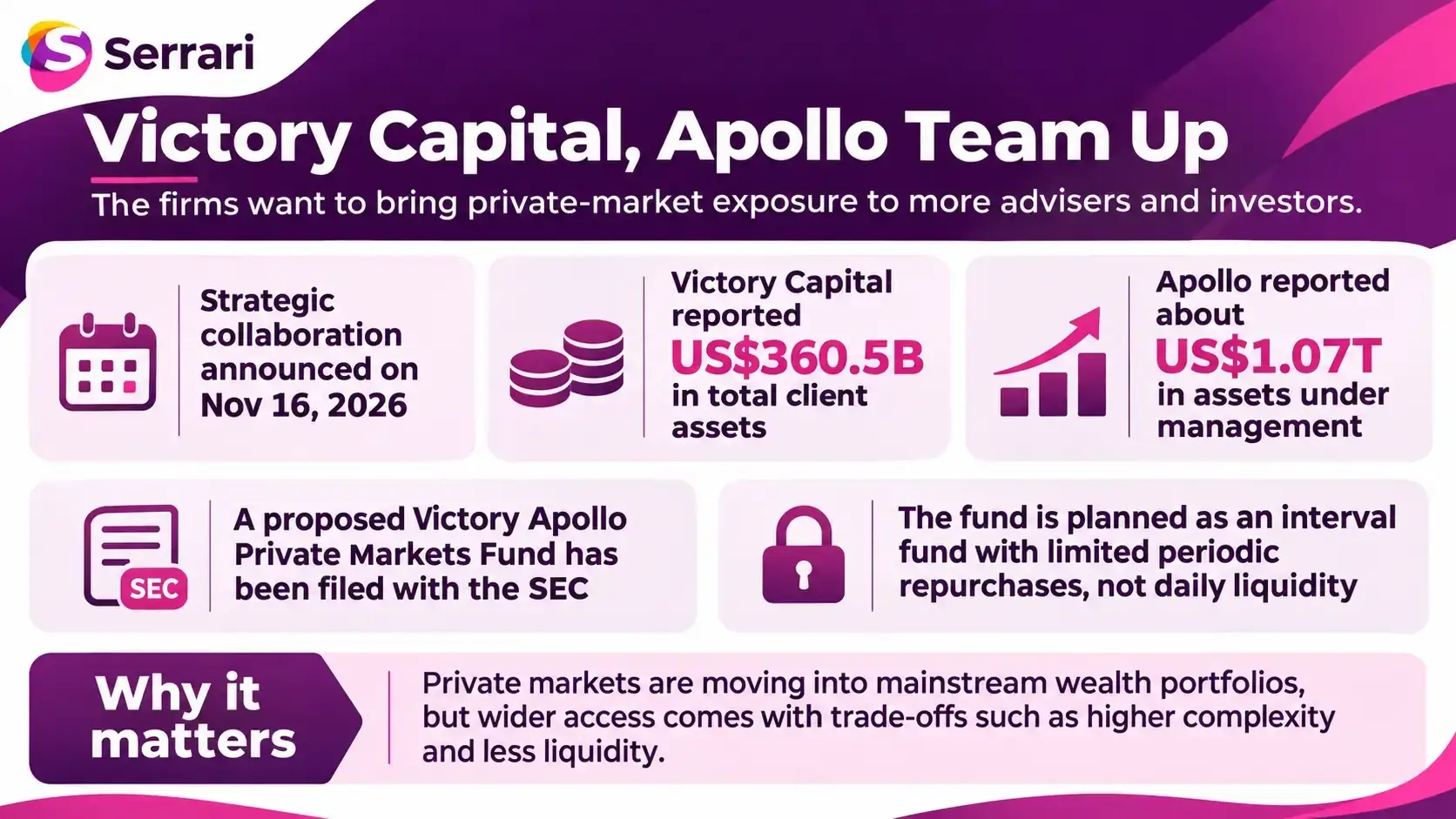
Victory Capital and Apollo announced a strategic partnership on November 16, 2026, designed to bring private-market investments into portfolios used by financial advisers and individual investors. The firms will combine Apollo’s expertise in private credit, real assets and other alternative investments with Victory Capital’s model-portfolio and distribution network. Their first announced product, the Victory Apollo Private Markets Fund, has been filed with US regulators but has not yet launched. The collaboration reflects growing demand for investment opportunities beyond listed stocks and bonds, yet it also exposes an important trade-off: access to investments traditionally held by institutions does not mean investors will receive the daily liquidity, transparent market pricing or lower costs they may expect from conventional funds.
Key Overview
- New partnership: Victory Capital and Apollo announced plans to build investment solutions combining public and private markets.
- Proposed fund: Victory Capital has filed a registration statement for the Victory Apollo Private Markets Fund; launch remains subject to regulatory effectiveness and board approval.
- Investment focus: The proposed fund could hold private credit, private equity, real estate and infrastructure exposure, primarily through underlying investment vehicles.
- Limited withdrawals: The preliminary prospectus describes quarterly repurchase offers involving only a portion of outstanding shares, rather than unrestricted daily redemptions.
- Scale: Victory Capital reported $360.5 billion in total client assets as of October 31, while Apollo reported approximately $1.07 trillion in assets under management at September 30.
- Wider implications: The collaboration illustrates how private asset managers are seeking to distribute institutional-style strategies through adviser-led wealth and retirement channels.
Why Victory Capital and Apollo Are Joining Forces
The partnership addresses a gap between where wealth managers traditionally invest clients’ money and where large institutions have increasingly been able to deploy capital. Public stocks and bonds are readily available through familiar funds and brokerage accounts. By contrast, private lending, infrastructure projects, unlisted businesses and specialized asset transactions frequently require large commitments, specialist managers and long investment horizons.
In their November 16 announcement, the companies said they would combine Apollo’s investment capabilities with Victory Capital’s distribution and portfolio-construction infrastructure. The arrangement is commercially complementary. Apollo can reach more advisers and end investors without having to build every distribution relationship itself, while Victory Capital can offer exposure to assets it would be difficult and expensive to originate independently.
WestEnd Advisors, a Victory Capital investment franchise specializing in macro-driven model portfolios, will lead the extension into private assets. This is important because advisers often allocate client money through models that package several asset classes in prescribed proportions. Adding private investments to that process could make alternatives easier to incorporate into existing portfolio-management workflows.
The immediate business opportunity is therefore not simply a new fund. It is the possibility of making private-market allocation a recurring part of adviser-led investment plans. Whether that happens will depend on product approvals, adviser demand, platform availability, fees and measurable investment results.
What the Proposed Victory Apollo Fund Would Actually Offer
Victory Capital Management filed a preliminary Form N-2 registration statement on November 16 for the Victory Apollo Private Markets Fund. Its stated objectives are income and long-term capital appreciation. The strategy contemplates broad exposure to private-market assets, mainly through other investment vehicles and, to a lesser extent, direct or indirect investments in individual securities.
The filing names private credit, private equity, private real estate and private infrastructure as potential areas of investment. These categories serve different purposes. Private credit may generate contractual interest income from loans to borrowers outside traditional public bond markets. Private equity seeks gains from owning and improving businesses. Real estate and infrastructure can offer income or long-duration exposure to physical assets, although both may face financing, operating and valuation pressures.
The breadth of the proposed mandate means the fund would not be a simple substitute for a bond fund or an index-tracking equity product. The mix of underlying exposures, associated costs and risk concentrations will determine how it behaves, particularly during economic stress.
Importantly, the filing is preliminary. Shares cannot be sold under the incomplete prospectus before the registration statement becomes effective, and the companies have said launch is also subject to board approval. A collaboration announcement should not be mistaken for confirmation that investors can already subscribe.
Context is everything. Stay ahead of shifting trends with today’s market updates, and uncover emerging opportunities using the Serrari Group Market Index and Marketplace. Then, take control of your own financial future by exploring our Money & Life Reset Transformation Blueprint ™ to build stronger habits, create better systems, and design a path toward lasting wealth.
Why Liquidity Is the Central Risk for Individual Investors
The fund is structured as an interval fund, a closed-end investment vehicle that offers to buy back a limited amount of its own shares at specified intervals. Unlike a conventional open-end mutual fund, it does not give shareholders an unrestricted right to redeem daily. Its shares are not expected to trade on a stock exchange, and the filing does not anticipate a secondary market.
The preliminary prospectus describes quarterly repurchase offers for a limited percentage of outstanding shares. Such offers can range from 5% to 25% of shares, with the precise amount governed by the fund’s policies and decisions. If requests exceed the amount offered for repurchase, investors may have only part of their holdings bought back.
That design is not an incidental restriction. Private assets often take months or years to sell and may not have buyers willing to transact immediately at a stated valuation. A fund offering instant withdrawals against a largely illiquid portfolio could be forced to sell assets at unfavorable prices during market stress. Periodic repurchases help align the investment vehicle’s liquidity promises with the underlying assets.
The trade-off falls on the investor. Someone who needs cash unexpectedly may be unable to liquidate the desired amount when needed. The regulatory guidance on interval funds specifically warns that limited repurchases can restrict access to invested money, including during downturns.
Consequently, broader access should not be confused with easier exits. Investors considering such products need a separate pool of readily available funds for emergencies and near-term obligations.
Can Private Assets Really Improve Diversification?
The attraction of private markets is that returns need not arise from exactly the same securities driving daily listed-market indices. A portfolio combining publicly traded investments with private loans, infrastructure or unlisted business interests may gain exposure to different borrowers, projects and sources of income.
But diversification is not guaranteed by an asset being labeled private. A private loan can still suffer when the borrower faces high interest expenses or declining cash flow. Private equity valuations may weaken during a recession. Real estate and infrastructure can be sensitive to financing costs, economic demand and policy changes. Different assets may become highly correlated when funding markets tighten.
Private valuations also present a transparency challenge. Unlike listed shares with continuously observable trades, some private holdings rely on models, appraisals or periodic transaction evidence. Reported values may therefore adjust more slowly than public-market prices. An apparently smoother return series does not necessarily mean the underlying economic risk is lower.
Apollo has emphasized innovations in pricing and transparency, but an investor must still evaluate the specific fund’s valuation policies, underlying exposures and independent oversight. Comparisons with public funds should account for differences in pricing frequency as well as investment performance.
Why the Partnership Matters to Both Asset Managers
The firms enter the arrangement with substantial scale. Victory Capital reported total client assets of $360.5 billion at October 31, 2026. Apollo’s third-quarter regulatory disclosures placed assets under management at roughly $1.07 trillion as of September 30.
Those figures are not directly comparable measures of revenue, investable cash or committed capital, but they demonstrate the businesses’ distribution and investment reach. For Victory Capital, private markets may help broaden its product lineup and deepen adviser relationships. For Apollo, additional distribution can expand the pool of potential capital available to strategies across its platform.
There are also commercial incentives that investors should examine carefully. Private-market funds may charge multiple layers of expenses, including fees in the top-level fund and in underlying vehicles. If a portfolio provider allocates clients to products connected with a strategic partner, the selection process should be independently justified by suitability, cost and expected investment benefits. The companies themselves identify potential conflicts of interest and higher expenses among the arrangement’s risks.
The new fund is to be advised by Victory Capital, not Apollo. The announcement explicitly states that Apollo is not its sponsor, investment adviser, sub-adviser, underwriter or affiliate. This distinction matters when assessing responsibility for fund governance and investment decisions.
The Bigger Picture: Private Markets Move Toward Mainstream Wealth Portfolios
The partnership is part of a broader shift in how private-market managers seek capital. Instead of relying only on pensions, endowments and other large institutions, firms are developing structures aimed at advisers and individuals willing to commit money for longer periods. At the same time, wealth managers are looking for products that distinguish their offerings from conventional portfolios of listed stocks and bonds.
This convergence may widen the investment universe available to suitable clients. It could also change competition among asset managers as distribution relationships, liquidity design and pricing become as important as the ability to originate private investments.
Still, the success of the model will be measured by more than launches and assets raised. Investors need to know whether returns after all fees justify lower liquidity and more complex valuation. Advisers need to establish which clients can tolerate those constraints, how exposures fit existing portfolios and what happens when markets deteriorate.
For now, the November 16 announcement is a strategic commitment rather than evidence of fund performance. The next milestones are completion of registration, board approval, final investment terms, distribution arrangements and the fund’s eventual track record. Victory Capital and Apollo may help make private markets more accessible, but they cannot remove the economic risks that have historically made these investments demanding.
Sources: Apollo Global Management / Victory Capital / U.S. Securities and Exchange Commission / Investor.gov
Your financial future isn’t something you wait for—it’s something you build.
The real question is: when do you begin?
Move beyond simply staying informed.
Navigate the markets with clarity—track trends through the Serrari Group Market Index, uncover opportunities in the Serrari Marketplace, and build practical knowledge with our Curated Wealth Builder Platform.
Stay connected to what truly matters.
Get daily insights on macro trends and financial movements across Kenya, Africa, and global markets—delivered through the Serrari Newsletter.
Growth opens doors.
Advance your career through professional programs including ACCA, HESI A2, ATI TEAS 7 , HESI EXIT , NCLEX – RN and NCLEX – PN, Financial Literacy!🌟—designed to move you forward with confidence.
See where money is flowing—clearly and in real time.
Track Money Market Funds, Treasury Bills, Treasury Bonds, Green Bonds, and Fixed Deposits, alongside global and African indexes, key economic indicators, and the evolving Crypto and stablecoin landscape—all within Serrari’s Market Index.