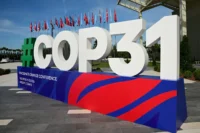
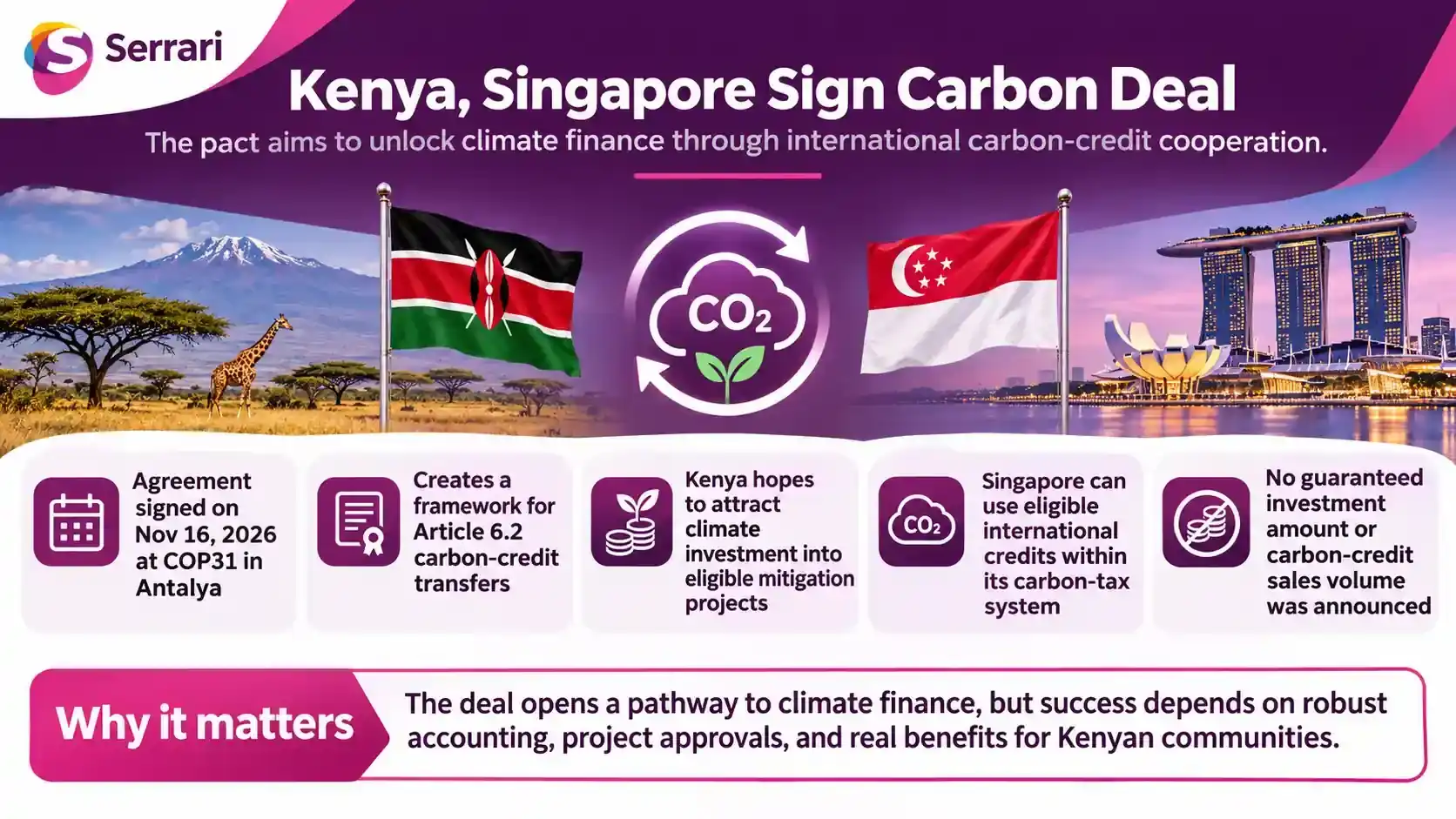
Kenya and Singapore signed a carbon trading Implementation Agreement on November 16, 2026, at COP31 in Antalya, Türkiye, creating a government-backed framework for transferring verified emissions reductions under Article 6.2 of the Paris Agreement. The arrangement could help Kenyan climate projects secure international financing while giving eligible Singaporean buyers access to carbon credits. However, no investment amount, credit price or guaranteed transaction volume was announced. The agreement builds on cooperation dating to 2023, and its commercial impact will depend on project authorisation, reliable emissions accounting and meaningful returns for communities hosting climate projects. Singapore expects applications for projects to open in 2027.
Key Overview
- Agreement signed: Environment Cabinet Secretary Deborah Barasa and Singapore’s Minister Grace Fu signed the pact on November 16 during COP31.
- Purpose: The framework enables eligible, government-authorised carbon credits from Kenyan projects to be transferred internationally with safeguards against double counting.
- Market access: Singapore allows carbon tax-liable facilities to use eligible international credits against up to 5% of taxable emissions, subject to its rules.
- Kenyan opportunity: Potential financing could support emissions-reduction and removal projects, but the governments have not announced a guaranteed purchase value or volume.
- Community safeguards: Kenyan rules provide minimum benefit-sharing contributions for qualifying projects on public and community land.
- Next steps: Joint oversight, approval processes, eligible methodologies, registries and reporting arrangements must be operationalised before projects can trade under the pact.
Why Kenya and Singapore Are Cooperating on Carbon Credits
The agreement responds to a financing problem confronting climate action: projects that can reduce or remove emissions often need capital before they produce any measurable benefit. Forest restoration, improved land management, cleaner technology and other mitigation activities may carry upfront costs, while potential carbon-credit revenue arrives only after results are monitored and independently verified. A credible route to international buyers can make some projects more bankable, although credit purchases alone cannot guarantee commercial viability.
The two governments signed the Implementation Agreement on November 16 at the United Nations climate conference in Antalya. It follows their May 2023 memorandum of understanding and moves cooperation from a declaration of intent toward procedures for approving and transferring climate mitigation outcomes.
For Kenya, the incentive is to attract private investment into activities that might otherwise lack sufficient financing, while creating employment and protecting natural assets. For Singapore, the incentive is different but complementary: as a densely developed economy facing constraints on some domestic emissions-reduction options, it seeks access to high-quality international mitigation outcomes that satisfy its climate-accounting and carbon-tax requirements.
Singapore also sees an opportunity to connect its financial and carbon-services sector with Kenyan project developers. In her remarks at the signing ceremony, Grace Fu said Kenya generated more than 90% of its electricity from renewable sources in 2024 and accounted for around one-fifth of Africa’s voluntary carbon-market revenues that year. Those figures illustrate existing activity, not the expected financial proceeds of this new agreement.
How the Carbon Trading Mechanism Will Work
Article 6.2 of the Paris Agreement permits countries to cooperate through internationally transferred mitigation outcomes, commonly called ITMOs. In simplified terms, a qualifying project first demonstrates that it reduced or removed greenhouse gases against an accepted baseline. The reduction must be quantified, verified under an approved programme and authorised by the relevant governments before it can be transferred for an eligible international use.
The distinction between producing a carbon credit and receiving authorisation to export it matters. Not every voluntary-market credit automatically qualifies for use under a bilateral agreement. Singapore sets eligibility criteria for international carbon credits that address issues including additionality, verification, permanence and double counting. Kenya must also determine whether a project is consistent with its own legal requirements and national climate commitments.
A central safeguard is the corresponding adjustment. If Kenya authorises a mitigation outcome for use toward Singapore’s climate target, both countries must reflect the transfer appropriately in their national emissions accounting so that the same reduction is not claimed twice. The Article 6 framework is designed to enable cooperation without artificially inflating global emissions reductions.
This accounting rule also creates a policy trade-off for Kenya. Credits sold abroad cannot simply be counted again toward Kenya’s own target. Officials therefore need to decide which mitigation outcomes are appropriate to transfer and whether the financing received sufficiently supports domestic climate ambitions. High credit volumes are not necessarily successful if the country gives up inexpensive reductions it needs to meet its own commitments.
Context is everything. Stay ahead of shifting trends with today’s market updates, and uncover emerging opportunities using the Serrari Group Market Index and Marketplace. Then, take control of your own financial future by exploring our Money & Life Reset Transformation Blueprint ™ to build stronger habits, create better systems, and design a path toward lasting wealth.
Why Singapore Could Become an Important Buyer
Singapore’s carbon-pricing regime creates a concrete reason for some companies to seek eligible international credits. Its carbon-tax framework sets the tax at S$45 per tonne of carbon dioxide equivalent for 2026 and 2027. Eligible tax-liable facilities can use qualifying international carbon credits to offset up to 5% of their taxable emissions, subject to applicable provisions.
That arrangement creates potential compliance-related demand rather than relying exclusively on voluntary corporate purchases. However, the 5% ceiling limits the share of emissions that can be covered with credits, and Singaporean companies are not required to buy from Kenya. Projects must compete on quality, price, timing and regulatory eligibility against credits originating elsewhere.
The Kenyan agreement is Singapore’s 13th such implementation pact and its third with an African country, following Ghana and Rwanda. This wider network suggests that Singapore is deliberately developing multiple potential sources of credits rather than depending on a single partner. Kenya’s advantage will depend on how quickly credible projects can satisfy the relevant standards and offer attractive terms.
The financial opportunity should therefore not be reported as an immediate inflow of climate funds. The agreement specifies a route for future projects and transactions, not a committed investment package, a government purchase order or a fixed carbon price.
What Kenyan Communities Stand to Gain — and Risk
For communities living near forests, grasslands and other project areas, the decisive issue is who controls the project, who receives the revenue and whether promised benefits materialise. Carbon trading can help pay for conservation, better resource management and local employment. It can also generate disputes if developers make commitments over land or carbon rights without meaningful consent or transparent contracts.
Kenya’s 2024 carbon-market regulations establish approval processes and community-development requirements. For qualifying projects on public and community land, the framework provides for minimum annual social contributions of 40% for land-based projects and 25% for non-land-based projects, with the regulatory calculation taking account of the cost of doing business. These requirements should not be presented as an automatic 40% or 25% share of every project’s gross sale price; coverage, deductions and contractual terms matter.
That distinction affects whether communities receive the sums they expect. Transparent project accounts, community development agreements, participatory oversight and accessible dispute mechanisms will be essential. Carbon income can fluctuate with market prices and verified credit issuance, so it should not be treated as an assured substitute for public services or other livelihoods.
Deborah Barasa stressed that climate investment must respect Kenyan law and deliver measurable environmental and social outcomes. The practical benchmark will be whether local people can identify funded improvements — such as jobs, restoration activity or community infrastructure — rather than merely seeing credits sold in an overseas market.
The Unfinished Work Behind the Agreement
The signing ceremony did not by itself complete the operational systems needed for trading. Kenya identified the establishment of a Joint Committee, common project-approval procedures, eligible crediting programmes and methodologies, and stronger registry and reporting systems as immediate priorities. These processes determine which projects qualify, who can authorise transfers and how the resulting credits are tracked.
Singapore expects the project application process to open in 2027. Even after applications begin, projects may require lengthy development, validation, monitoring and verification before credits are issued. Investors should distinguish a project’s estimated future credit generation from credits actually verified, authorised and delivered.
Credibility will matter as much as speed. Weak baselines can overstate avoided emissions; poor monitoring can miss reversals in forest or land-based projects; and insufficient disclosure can obscure whether communities received their agreed shares. Strong supervision may increase compliance costs, but it can also protect the market from reputational damage and improve buyers’ confidence.
The Bigger Picture: Climate Finance Must Deliver Real Value
The Kenya–Singapore pact forms part of a broader effort to make international carbon markets a source of financing for climate action in developing economies. Singapore is building a network of bilateral agreements, while Kenya is trying to position its natural resources, climate expertise and regulatory framework as foundations for investable mitigation projects.
Yet carbon finance remains a supplement to, not a replacement for, domestic decarbonisation, adaptation spending or broader development funding. A payment for verified emissions reductions cannot by itself resolve the impacts of droughts and floods, and a carbon-credit export should never be confused with a direct reduction in the buyer’s domestic emissions.
The agreement matters now because it turns three years of bilateral discussions into a framework under which project developers can prepare actual proposals. The next measure of success will not be the number of agreements signed, but the quantity and quality of credits ultimately authorised, the investment mobilised, the emissions genuinely reduced and the share of value reaching Kenyan communities. Until those outcomes can be measured, the deal is an important opening for climate investment rather than proof that the promised economic benefits have arrived.
Sources: Singapore Ministry of Energy, Trade and Industry / Singapore Ministry of Sustainability and the Environment / National Environment Agency Singapore / Singapore Carbon Markets Cooperation / UN Climate Change / FAOLEX / The Star Kenya / Daily Nation
Your financial future isn’t something you wait for—it’s something you build.
The real question is: when do you begin?
Move beyond simply staying informed.
Navigate the markets with clarity—track trends through the Serrari Group Market Index, uncover opportunities in the Serrari Marketplace, and build practical knowledge with our Curated Wealth Builder Platform.
Stay connected to what truly matters.
Get daily insights on macro trends and financial movements across Kenya, Africa, and global markets—delivered through the Serrari Newsletter.
Growth opens doors.
Advance your career through professional programs including ACCA, HESI A2, ATI TEAS 7 , HESI EXIT , NCLEX – RN and NCLEX – PN, Financial Literacy!🌟—designed to move you forward with confidence.
See where money is flowing—clearly and in real time.
Track Money Market Funds, Treasury Bills, Treasury Bonds, Green Bonds, and Fixed Deposits, alongside global and African indexes, key economic indicators, and the evolving Crypto and stablecoin landscape—all within Serrari’s Market Index.