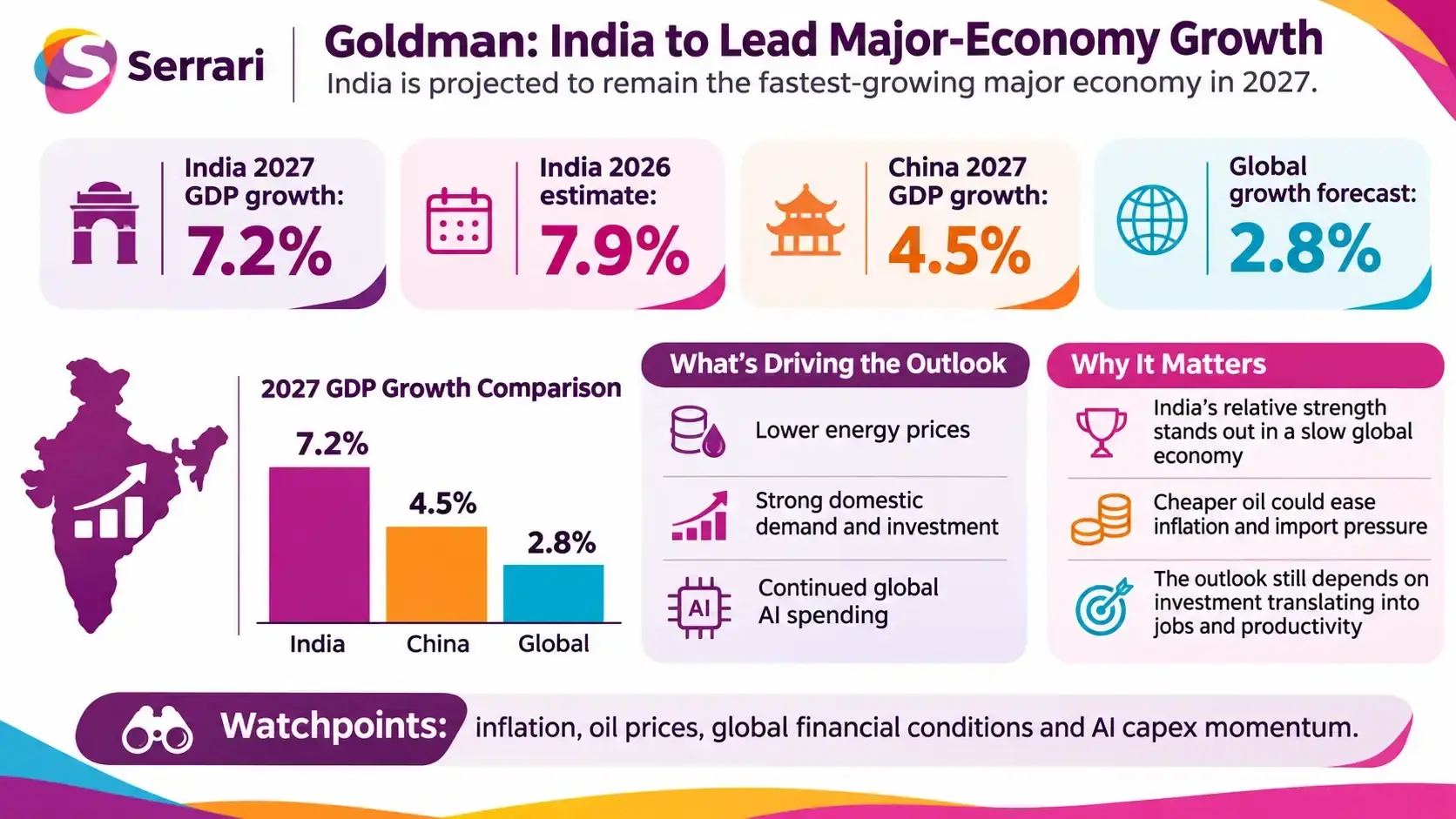
India is projected to grow 7.2% in 2027, ahead of China’s expected 4.5% expansion and the 2.8% global growth forecast in Goldman Sachs’ latest economic outlook. Although India’s growth would moderate from an estimated 7.9% in 2026, its continued lead highlights the importance of domestic demand and investment in an otherwise subdued world economy. The broader forecast depends on lower energy costs and a further surge in artificial intelligence infrastructure spending offsetting tight financial conditions. For India, cheaper imported energy could relieve pressure on businesses and consumers, but the outlook remains exposed to inflation, monetary policy, geopolitical shocks and the possibility that investment fails to translate into durable job creation.
Key Overview
- India’s lead: Goldman Sachs forecasts 7.2% GDP growth in 2027, above a reported 6.8% market consensus, though below its 7.9% estimate for 2026.
- China’s outlook: The Chinese economy is expected to expand 4.5%, supported by exports but constrained by property-sector weakness and subdued consumption.
- Global economy: Growth is projected at 2.8% in 2027, only slightly above the 2.7% estimated for 2026.
- Energy relief: Brent crude is forecast to decline to $78 per barrel by end-2027, potentially easing costs for energy-importing economies.
- AI investment: Global nominal spending on AI is expected to climb from $1.1 trillion in 2026 to $1.8 trillion in 2027, adding an estimated 0.4 percentage points to world growth.
- Main risks: Renewed Middle East disruption, high borrowing costs and weaker-than-expected AI spending could overturn the optimistic assumptions.
Why India Is Expected to Outgrow Other Major Economies
India’s projected lead is significant precisely because the headline growth rate is expected to slow. The November 2027 economic outlook anticipates a world economy expanding at only a modestly faster pace, while India’s country forecast places growth at 7.2%, compared with an estimated 7.9% in 2026. India would be expanding more than twice as fast as the global aggregate forecast, even though it is not immune to international pressures.
The important distinction is between relative outperformance and acceleration. A country can remain the fastest-growing large economy while losing momentum from an exceptionally strong prior year. Goldman Sachs’ forecast implies a deceleration of 0.7 percentage points, not another increase. Investors and policymakers should therefore examine what supports growth as the economy moves away from the exceptional expansion assumed for 2026.
India benefits from a large domestic market, business services and an expanding base of private investment. Consumption and infrastructure spending can generate activity even when demand abroad is weak. Its growth advantage also reflects differing conditions in competing economies: China faces a prolonged property adjustment, while several advanced economies must contend with tighter financing costs and fading fiscal support.
Independent assessments provide context without making the forecast certain. A November credit assessment raised India’s fiscal-year growth projection to 7%, citing resilient consumption, investment and greater ability to manage energy shocks. The figures are not perfectly interchangeable because calendar-year and Indian fiscal-year forecasts cover different periods, but both point toward comparatively strong momentum.
Why Cheaper Oil Could Deliver an Important Boost
Lower energy prices are among the most consequential assumptions in the outlook. Goldman Sachs expects Brent crude to fall to $78 a barrel by the end of 2027 as supply conditions adjust following the energy disruption associated with conflict in the Middle East. The forecast also anticipates some easing in global liquefied natural gas prices.
For an economy that imports substantial quantities of crude, the transmission is direct. Lower international prices can reduce the foreign currency needed to pay for fuel, ease input costs for manufacturers and transport operators, and relieve pressure on household spending. If businesses face smaller energy bills, some may have room to protect margins or delay price increases; if consumers spend less on energy-intensive essentials, they may have more income available for other purchases.
Those gains are neither immediate nor guaranteed. Exchange-rate movements, taxes, domestic pricing arrangements and the timing of imported supplies influence whether a global price decline reaches consumers. Falling crude prices can also coincide with weak world demand, which might hurt India’s exports. The forecast is most favorable when lower prices stem from improving supply rather than a severe downturn.
The contrast with Europe is revealing. Goldman Sachs expects earlier energy-price increases to continue passing through to some European consumers even if wholesale prices ease. India’s possible advantage is thus relative: the same change in oil markets can improve the outlook for one economy while providing delayed or smaller relief elsewhere.
What the AI Spending Surge Means for Global Growth
Artificial intelligence is the second major support for the forecast, but its economic effects are unevenly distributed. Goldman Sachs projects global AI investment of $1.8 trillion in 2027, up from $1.1 trillion in 2026, with more than $500 billion of the increase coming from US hardware spending. The bank expects the surge to add approximately 0.4 percentage points to global GDP growth, including an estimated 0.6-point boost to underlying US growth after statistical adjustments.
This matters because building data centres, purchasing chips and installing computing equipment count as economic activity before AI applications deliver widespread productivity gains. The first phase of the boom supports equipment suppliers, construction and investment. A second phase would need to demonstrate that companies using AI can produce more valuable goods and services with their existing resources.
The growth impulse may begin to fade even as actual spending continues rising. Goldman Sachs expects the strongest year-on-year investment contribution in the first half of 2027. A slower increase in new spending later in the year would provide less additional stimulus to GDP, although the level of investment could remain historically high.
For India, the immediate benefit is less straightforward than for countries directly supplying advanced semiconductors. South Korea and Taiwan are expected to benefit from AI-related exports. Indian technology-service providers may find opportunities in cloud integration, software and business-process transformation, but they must also manage the risk that automation changes demand for some existing services. The forecast does not establish that AI will automatically produce higher employment or productivity in India during 2027.
Context is everything. Stay ahead of shifting trends with today’s market updates, and uncover emerging opportunities using the Serrari Group Market Index and Marketplace. Then, take control of your own financial future by exploring our Money & Life Reset Transformation Blueprint ™ to build stronger habits, create better systems, and design a path toward lasting wealth.
Why China Is Growing More Slowly Despite Strong Exports
Goldman Sachs puts China’s 2027 growth at 4.5%, slightly above a reported 4.4% consensus forecast. Its optimism is concentrated in exports, while the domestic economy continues to face a weak property sector and restrained consumer spending.
China’s manufacturing and export capacity can sustain output even when households are cautious. But a growth model more reliant on foreign sales also transmits competitive pressure to other economies. Increased exports can lower prices for global buyers while challenging manufacturers elsewhere, including businesses trying to expand their own industrial capacity.
Goldman Sachs estimates that weakness in China’s domestic demand, coupled with a larger trade surplus, could subtract about 0.1 percentage point from growth in the rest of the world. This helps explain why India can lead among large economies without triggering a broad-based emerging-market boom. Strong performance in one market does not erase the spillovers from weaker consumption in another.
The comparison is also about scale. China remains a much larger economy in absolute output terms, so a slower percentage growth rate does not by itself mean it contributes less to global production in every measure. The meaningful conclusion is that India’s rate of expansion is forecast to remain higher, not that it has overtaken China economically.
What Could Derail India’s Growth Outlook?
A 7.2% forecast depends partly on conditions outside India’s control. Renewed disruption in the Middle East could push oil and gas prices higher again, reversing the relief assumed for importers. Large fiscal deficits in major economies could keep long-term bond yields elevated, raising global financing costs. Tighter credit conditions could discourage investment even where demand appears healthy.
Domestic risks also matter. Higher inflation can reduce purchasing power and force a less accommodative monetary stance. A weaker monsoon could hurt farm income and food supplies, while disappointing private investment would make headline growth more dependent on public spending. The recent assessment of domestic risks specifically highlights inflation, weather and tighter monetary policy as threats to household spending and business expansion.
There is an important social question beneath the GDP projections. Strong aggregate growth does not guarantee equivalent improvements in wages, formal employment or living standards. Whether infrastructure projects and investment translate into productive jobs will determine how broadly households experience the benefits. Sustained gains in productivity and incomes are a stronger indication of development than one year’s position in an international growth ranking.
Why the 2027 Forecast Matters Now
The forecast arrives as policymakers and investors prepare decisions on spending, capacity expansion and asset allocation for the next year. Businesses considering new factories must assess energy and borrowing costs. Exporters must judge demand in China and advanced economies. Financial markets must determine how much of the anticipated AI and disinflation benefit is already reflected in asset prices.
The most useful indicators to monitor through 2027 will be India’s consumption and private-investment trends, domestic inflation, crude oil prices, the trajectory of AI capital expenditure and China’s import demand. These will help distinguish a resilient growth path from a favorable forecast that relies too heavily on external tailwinds.
India’s expected 7.2% expansion is therefore an important signal, but not an unconditional victory. It suggests the country’s domestic economic engines can continue to outperform as the global economy grows only moderately. Whether that lead becomes a lasting advantage will depend on investment quality, job creation and the ability to withstand the next energy or financial shock.
Sources: Goldman Sachs / Telangana Today / Reuters / Moneycontrol / The Economic Times
Your financial future isn’t something you wait for—it’s something you build.
The real question is: when do you begin?
Move beyond simply staying informed.
Navigate the markets with clarity—track trends through the Serrari Group Market Index, uncover opportunities in the Serrari Marketplace, and build practical knowledge with our Curated Wealth Builder Platform.
Stay connected to what truly matters.
Get daily insights on macro trends and financial movements across Kenya, Africa, and global markets—delivered through the Serrari Newsletter.
Growth opens doors.
Advance your career through professional programs including ACCA, HESI A2, ATI TEAS 7 , HESI EXIT , NCLEX – RN and NCLEX – PN, Financial Literacy!🌟—designed to move you forward with confidence.
See where money is flowing—clearly and in real time.
Track Money Market Funds, Treasury Bills, Treasury Bonds, Green Bonds, and Fixed Deposits, alongside global and African indexes, key economic indicators, and the evolving Crypto and stablecoin landscape—all within Serrari’s Market Index.