Nigerian technology venture WAWU has introduced WHO MADE THIS? (WMT), a platform intended to help African creators and professionals establish verified profiles, sell digital work and receive international payments. Announced on November 15, 2026, the initiative addresses a familiar weakness in Africa’s expanding creative economy: a global audience does not necessarily translate into dependable income for the people producing the content. WAWU is combining identity verification, a creator marketplace, payments, professional networking and creative tools, but its effectiveness will depend on practical questions including transaction fees, payment access, intellectual property enforcement and user adoption. Its published terms already make clear that verification and monetisation come with costs, while its mobile applications are still advertised as forthcoming.
Key Overview
- New platform: WHO MADE THIS? aims to connect African creators and skilled professionals with customers and commercial opportunities beyond their home markets.
- Verified profiles: WAWU promotes identity checks and content attribution, although verification alone does not confer legal copyright or prevent infringement.
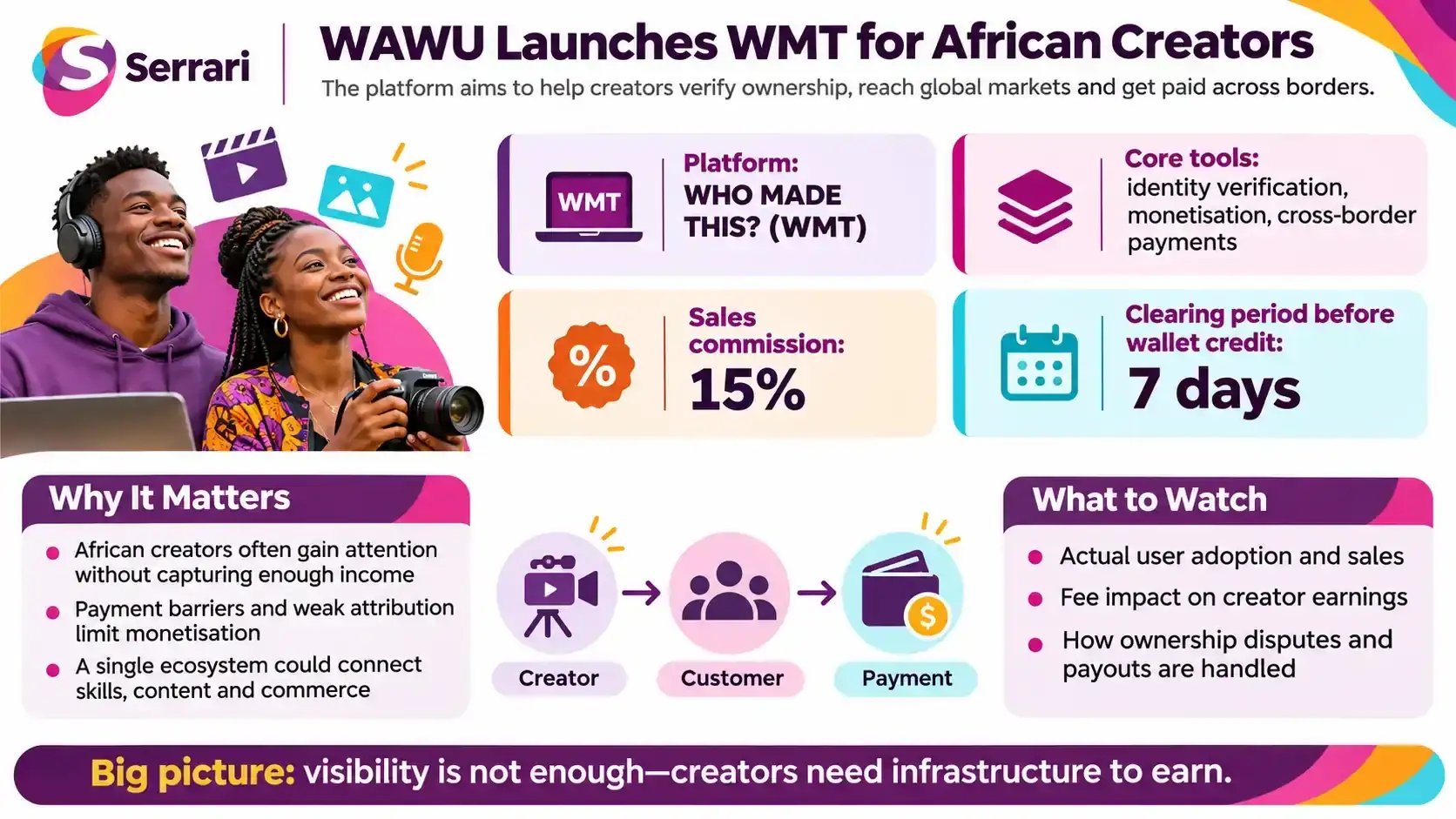
- Monetisation terms: Registration is advertised as free, but verification is paid and WAWU’s creator agreement specifies a 15% commission on sales, with possible processing fees.
- Payment timing: The stated clearing period is seven days before sale proceeds are credited to a creator’s wallet, after which bank payout processing may take additional time.
- Broader model: The company describes AI-assisted production, networking, learning and cross-border payment capabilities, with mobile app releases still described as forthcoming.
- Economic test: The initiative must demonstrate that creators can reliably reach buyers, retain meaningful earnings and resolve payment or ownership disputes.
Why African Creators Need More Than Global Attention
African music, film, visual art and digital services increasingly circulate across borders, yet the commercial systems behind them are uneven. Some creators can attract audiences abroad without having a straightforward way to license their work, verify who produced it, invoice an overseas customer or receive payment in their own country. In the November 15 launch announcement, WAWU presented WHO MADE THIS? as an attempt to close that gap.
The problem is not merely visibility. A creator who gains followers but cannot collect royalties or sell services has generated attention without reliably capturing its economic value. Even a successful sale can be undermined by transfer restrictions, high conversion charges, delayed settlement or uncertainty about ownership. Those frictions matter particularly for freelancers and smaller creative businesses without legal teams or established distribution partners.
Recent research provides a measure of the obstacle. A study of young African creatives found that nearly half of respondents encountered a payment challenge in the previous year. Some reported that their location prevented them from using digital payment services, while others relied on workarounds to collect money they had already earned. The finding helps explain why another content-sharing platform would not be enough: commerce and settlement need to work alongside discovery.
How WHO MADE THIS? Proposes to Convert Skills Into Income
WAWU describes a combined system for portfolios, verification, paid content, services and a digital wallet. Its product description shows creators adding work, setting prices and inviting customers to purchase or unlock content. The company also describes tools for professional networking, education and AI-assisted production of writing, images, audio and video.
For a designer, this could mean presenting a verifiable profile and selling a digital product to someone abroad. For a video editor or consultant, it could mean offering services without depending solely on social-media messaging to establish credibility. The potential benefit is a shorter journey from displaying work to receiving income, particularly if users can manage their portfolio and transactions in one place.
But a platform’s announced features should not be confused with demonstrated transaction volumes or universal market coverage. Its public page says the mobile applications are coming soon, while WAWU also promotes web-based access. There is not yet enough independently published evidence to establish how many creators have earned money through WMT, which countries have operational payout routes or whether all advertised multicurrency services are available to every user.
The Real Cost of Getting Paid Matters
The commercial details are more revealing than a claim that the platform is free to join. WAWU’s creator monetisation agreement requires sellers to be verified and specifies a 15% commission on each sale, with additional payment-processing charges possible. Its service terms also provide for a seven-day clearing period before proceeds are credited to the wallet, after which a bank payout may require further processing.
These conditions are not inherently unreasonable: platforms need revenue to operate verification, payment, hosting and customer-support systems. However, they affect a creator’s take-home earnings. On a hypothetical ₦100,000 sale, a 15% commission leaves ₦85,000 before any processing charges or applicable taxes. For businesses working with slim margins, the difference can shape pricing and the decision to use the service.
Payment reliability matters just as much as commission. Buyers need clarity on refunds and disputes, while sellers need transparent exchange rates, timelines and withdrawal eligibility. If a platform reduces the difficulty of finding overseas clients but leaves expensive or unpredictable payout processes, much of the economic benefit may disappear before the income reaches the creator.
Context is everything. Stay ahead of shifting trends with today’s market updates, and uncover emerging opportunities using the Serrari Group Market Index and Marketplace. Then, take control of your own financial future by exploring our Money & Life Reset Transformation Blueprint ™ to build stronger habits, create better systems, and design a path toward lasting wealth.
Does Digital Verification Really Protect Intellectual Property?
Ownership is at the centre of WAWU’s pitch, but identity verification and intellectual property protection are not interchangeable. A verified profile can help buyers establish that an account belongs to a real person and can provide a useful record linking a creator to particular content. It does not, by itself, conclusively prove legal authorship, register copyright across jurisdictions or stop another person from copying work.
Effective protection also depends on licensing contracts, reliable records of creation, complaint procedures and enforceable rights under relevant national laws. Creators working with music, images or collaborative projects must understand which rights they retain and which permissions they grant customers or the platform. WAWU’s privacy and ownership disclosures state that users retain ownership of uploaded content, but that principle still needs to operate alongside practical dispute resolution.
This distinction is economically significant. A review of Africa’s creative industries identifies piracy, weak royalty collection and limited access to finance among the obstacles preventing creative activity from becoming sustainable enterprise. Better attribution can help with recognition and commercial trust; collecting royalties and enforcing rights require additional mechanisms.
Why Training Partnerships Could Strengthen the Model
WAWU says the launch draws on relationships developed through Nigeria’s 10 Million Youths and Women Upskilling and Empowerment Initiative, which connected training in digital skills, business and entrepreneurship with public and private institutions. The company named learning provider Alison and professional bodies including ICAN, CIBN, CRMI, CIS, NICA and NIIE in connection with previous skills-development work.
It also identified Afreximbank, Development Bank of Nigeria, Enterprise Development Centre and innovation-support organisations among the institutions associated with its wider network. These are company-reported relationships and should not be interpreted as independent guarantees of WMT payment services, funding commitments or product performance.
The strategic logic is nonetheless clear. Skills programmes can train thousands of people without giving them customers. A functioning marketplace could help bridge the gap between a completed course and a first paid assignment, allowing educational investments to produce measurable income. Universities and innovation hubs could also help attract credible users, provided the platform offers useful services and fair terms.
What WAWU Must Prove as Africa’s Creative Market Expands
The initiative enters an increasingly competitive landscape of social networks, freelancer platforms, digital storefronts and regional payment providers. Its potential advantage is integration: verification, audience discovery, products, services and payments offered together. Its challenge is the same one that confronts many marketplaces—attracting sufficient buyers and sellers at the same time.
A large registered user base is not necessarily a successful creative economy. More meaningful measures include completed sales, repeat customers, successful cross-border payouts, the share of transaction value retained by creators and the speed of resolving complaints. Disclosures about supported countries, actual verification costs, currency conversion and user protection would make it easier to assess whether the platform improves on existing alternatives.
The AI tools also create a dual opportunity and risk. They may lower production costs for independent creators, but can intensify competition and complicate questions of originality, licensing and misuse of voice or likeness. Human creators will need clear rules on what they can sell and how content generated with third-party models is treated.
The wider significance of WMT is therefore not its promise that African work can reach the world—much of it already does. It is the attempt to connect authorship, distribution and payment into a repeatable business process. If WAWU can make that process trustworthy and affordable, it could help move creators from sporadic online visibility to predictable earnings. If fees, access restrictions or unresolved ownership disputes persist, the platform risks reproducing the very barriers it was designed to remove.
Sources: The Guardian Nigeria / WAWU / Caribou / Brookings Institution / The Sun Nigeria
Your financial future isn’t something you wait for—it’s something you build.
The real question is: when do you begin?
Move beyond simply staying informed.
Navigate the markets with clarity—track trends through the Serrari Group Market Index, uncover opportunities in the Serrari Marketplace, and build practical knowledge with our Curated Wealth Builder Platform.
Stay connected to what truly matters.
Get daily insights on macro trends and financial movements across Kenya, Africa, and global markets—delivered through the Serrari Newsletter.
Growth opens doors.
Advance your career through professional programs including ACCA, HESI A2, ATI TEAS 7 , HESI EXIT , NCLEX – RN and NCLEX – PN, Financial Literacy!🌟—designed to move you forward with confidence.
See where money is flowing—clearly and in real time.
Track Money Market Funds, Treasury Bills, Treasury Bonds, Green Bonds, and Fixed Deposits, alongside global and African indexes, key economic indicators, and the evolving Crypto and stablecoin landscape—all within Serrari’s Market Index.