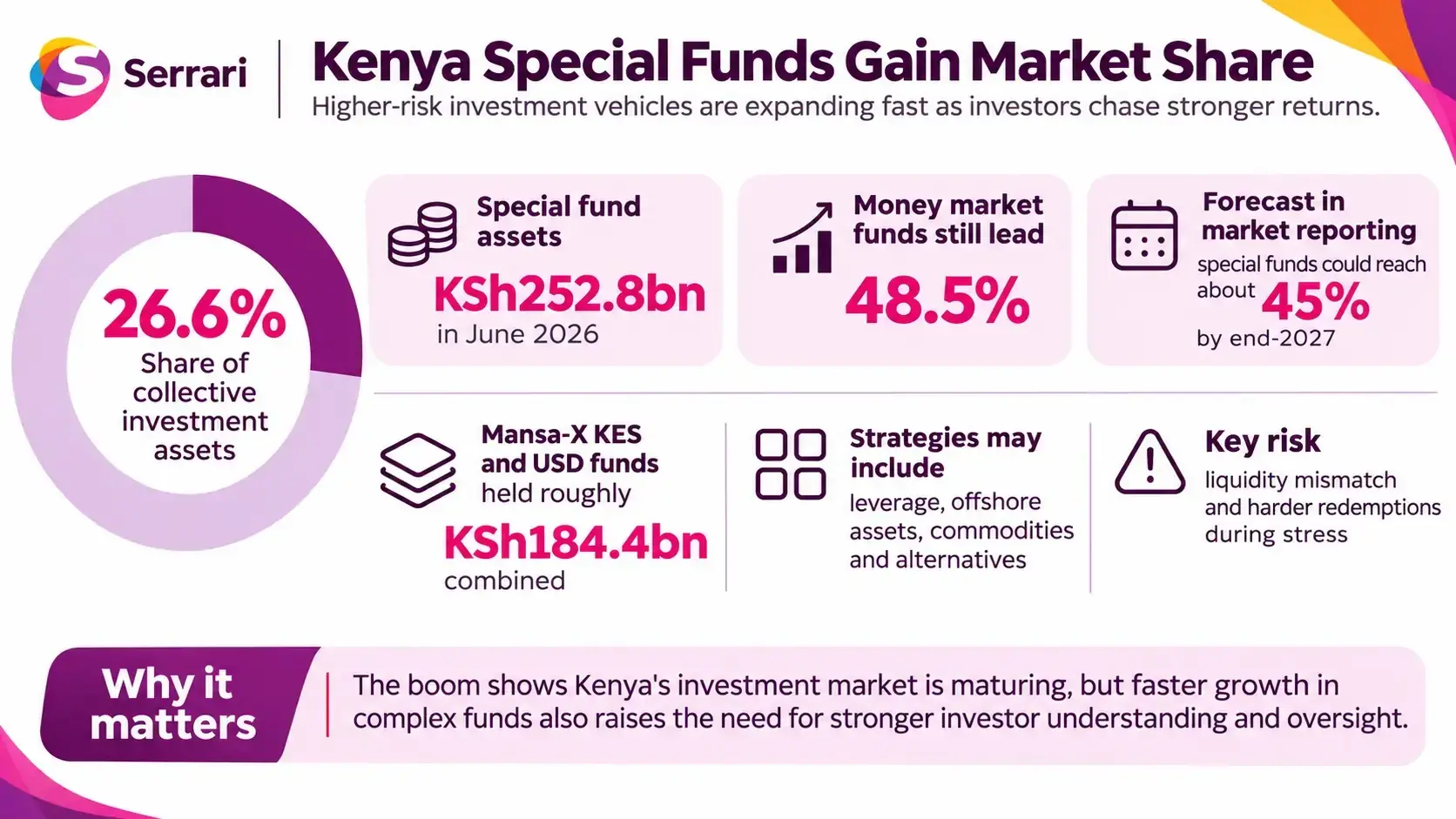
Kenya’s special collective investment funds are emerging as one of the fastest-growing parts of the country’s managed-investment industry, attracting investors seeking strategies beyond traditional money market funds. A November 2026 report suggests they could control approximately 45% of the market by the end of 2027, although that figure is a forecast rather than an official regulatory target. At the end of June 2026, special funds held KSh252.8 billion, equivalent to 26.6% of KSh948.7 billion in total collective investment scheme assets. Their expansion offers investors more choice, including offshore and multi-asset exposure, but also raises pressing questions about liquidity, concentration and whether buyers understand the risks attached to potentially higher returns.
Key Overview
- Growth: Special fund assets increased from KSh203.5 billion in March to KSh252.8 billion in June 2026, a 24.2% quarterly rise.
- Market share: The segment accounted for 26.6% of collective investment assets in June, against 48.5% held by money market funds.
- Forecast: A reported 45% share by late 2027 remains an unverified projection, not a confirmed Capital Markets Authority forecast.
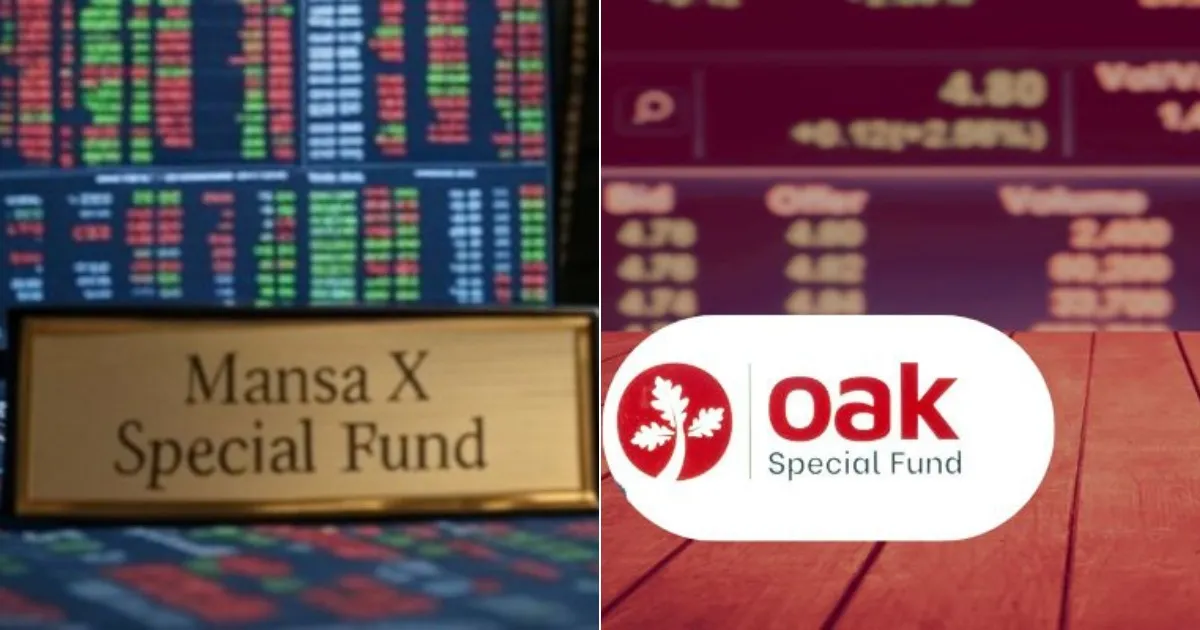
- Market leader: Mansa-X Special Fund KES held roughly KSh163.8 billion, while its USD counterpart held KSh20.6 billion at June’s end.
- Investor risks: Leverage, difficult-to-sell assets, offshore exposures and redemption restrictions may make some products riskier than conventional cash-management funds.
- Global warning: Turkey’s September 2026 intervention involving 131 funds and 455,758 investors illustrates how liquidity problems can escalate, without implying Kenyan funds have engaged in similar conduct.
Why Kenyan Investors Are Moving Beyond Money Market Funds
For years, money market funds have been the default entry point for many Kenyan retail investors. Their appeal rests on relatively accessible minimum investments, exposure to short-term interest-bearing instruments and the possibility of withdrawing money without the complexity of managing a portfolio directly. But as the collective investment industry grows, savers increasingly encounter products designed for different objectives: foreign-currency diversification, multi-asset investing, absolute-return strategies and potentially higher yields.
The shift is visible in the June 2026 industry breakdown. Special funds increased assets by KSh49.3 billion during the second quarter, compared with approximately KSh17.7 billion added by money market funds. That is not proof that every shilling entering special funds was withdrawn from an MMF. Changes in assets under management also reflect investment performance, new subscriptions and fund launches. Nevertheless, the differing growth rates show where the market’s momentum is strongest.
This development is occurring as Kenya’s investment industry becomes more varied. The regulator approved additional multi-currency and multi-asset products in July 2026, explicitly linking product innovation with broader investor choice. The opportunity is genuine: investors who previously relied on bank deposits, Treasury securities and conventional unit trusts can access a wider range of professional strategies. The danger is assuming that any product with a higher published return is simply a better version of a money market fund.
What the 45% Projection Actually Means
The report that special funds could account for about 45% of Kenya’s mutual-fund market by the end of 2027 is striking, but it should not be confused with the present market composition or a commitment by regulators. The independently traceable June 2026 regulatory figures put the category at KSh252.8 billion out of KSh948.7 billion, or 26.6%.
If the overall market remained unchanged, a 45% share would imply approximately KSh427 billion in special fund assets, some KSh174 billion above the June level. But the market is unlikely to stand still: the denominator could expand considerably by 2027. A forecast of market share therefore depends on growth in both special funds and competing categories, not merely on the special-funds segment maintaining its recent quarterly pace.
The raw account’s reference to a US$7.3 billion market also needs a time-specific qualification. The June 2026 market was reported in Kenyan shillings at KSh948.7 billion; any US-dollar figure changes with the exchange rate and measurement date. Presenting a currency-converted estimate without stating its reference period could make otherwise comparable market sizes appear inconsistent.
Why Mansa-X’s Dominance Deserves Attention
A key feature of the special-funds story is how much of the category is concentrated in one investment group. The manager’s September disclosure of June holdings showed Mansa-X Special Fund KES at approximately KSh163.8 billion and its USD version at KSh20.6 billion. Together, those two products accounted for around 73% of the special-funds category.
That is evidence of significant scale and investor interest, but it also means category-wide trends can be heavily influenced by a small number of portfolios. An inflow into one large fund can raise the category’s overall market share without demonstrating equally strong demand across every competing product. Likewise, a change in the valuation or liquidity of a dominant portfolio could have a disproportionate influence on perceptions of the entire segment.
Concentration is not evidence of wrongdoing or a forecast of failure. It is a reason to examine portfolio construction carefully. Investors should ask whether funds with apparently different names are exposed to the same assets, currencies, counterparties or trading strategies. Holding several products does not provide much diversification if their underlying risks overlap.
Context is everything. Stay ahead of shifting trends with today’s market updates, and uncover emerging opportunities using the Serrari Group Market Index and Marketplace. Then, take control of your own financial future by exploring our Money & Life Reset Transformation Blueprint ™ to build stronger habits, create better systems, and design a path toward lasting wealth.
What Makes a Special Fund Different From a Money Market Fund?
The term “special fund” describes a regulated product category, not a uniform investment strategy. Some funds focus on fixed income, while others can combine listed securities, offshore investments, commodities, derivatives or other approved exposures. The applicable mandate and permissions matter more than the marketing label.
Kenya’s collective investment regulations provide a framework for authorised schemes, including reporting, portfolio valuation and disclosure. Regulatory approval, however, does not convert investments into guaranteed deposits or eliminate market losses. The precise investment limits, borrowing powers and redemption arrangements must be assessed for each fund rather than assumed to apply identically across the category.
Leverage is an important example. Borrowing or derivative exposure may amplify gains when a strategy works, but it can also magnify losses and create demands for additional cash when markets move adversely. Offshore assets introduce currency effects: an investment may gain in dollars but deliver a different result after conversion into shillings. Illiquid assets can be difficult to sell at the valuation shown on periodic fund statements, especially during market stress.
Investors also need to distinguish a quoted annualised return from a guaranteed payout. Historical performance depends on the measurement period, the treatment of costs and the valuation of holdings. A comparison with a money market fund is meaningful only when return figures are calculated on comparable terms and the investor recognises the different risks involved.
What Turkey’s Fund Crisis Can—and Cannot—Tell Kenya
Turkey provides a timely warning about the consequences of strained fund liquidity. In September 2026, its regulator ordered the liquidation of 131 investment funds linked to seven portfolio managers. A regulatory account of the intervention identified 455,758 unique investors affected. Trading and redemptions were restricted during the intervention, with appointed banks overseeing liquidation arrangements.
The crisis highlighted concerns about concentrated positions, difficult redemptions and allegedly distorted valuations. But liquidation is not synonymous with the disappearance of every investor’s money: assets may be sold and proceeds distributed, and final recoveries depend on the value realised and the regulatory process. Nor should allegations made against particular Turkish market participants be transferred to Kenyan funds without evidence.
The useful lesson is structural. If a fund promises access to cash faster than it can realistically sell its underlying investments, heavy withdrawal requests may create a mismatch. A manager may then need to sell at depressed prices, defer withdrawals or use restrictions permitted by its governing documents. As the Turkish experience shows, such problems can move rapidly from individual portfolios into broader market confidence.
Kenya’s rules and supervision differ, and the country has no verified equivalent crisis in the material reviewed. The comparison is therefore a risk-management warning, not an assertion that a similar collapse is underway.
What Investors and Regulators Should Watch Next
The first priority is transparency. Investors should be able to identify a fund’s main asset classes, valuation methodology, use of leverage, foreign-currency exposure, fees and redemption conditions before committing money. A headline return is insufficient without information on how it was generated and what could cause it to reverse.
Liquidity terms deserve particular scrutiny. A fund may specify a notice period, settlement window, minimum holding period or circumstances under which withdrawals can be suspended or delayed. Those terms determine whether the product is appropriate for emergency savings, school fees or longer-term wealth accumulation. Money needed at short notice should not depend on assets that could take weeks or months to liquidate.
The regulator’s challenge is to encourage product innovation without allowing complex strategies to be sold as uncomplicated substitutes for cash. Comparable performance reporting, clear risk disclosures and appropriate liquidity management can help investors distinguish promising products from strategies that are poorly matched to their needs. Fund managers, meanwhile, will have to demonstrate that growth in assets can be accompanied by sound controls rather than simply higher marketing budgets.
Kenya’s special-funds boom is a sign of a maturing investment market, but its success should not be measured by whether the segment reaches 45% by 2027. A healthier measure is whether investors receive transparent, risk-adjusted returns and can access their money under the terms they were promised. The most consequential question is not how quickly these funds grow, but whether the protections around them grow just as quickly.
Sources
Capital Markets Authority / Standard Investment Bank / Kenya News Agency / Cytonn Research / Turkish Capital Markets Board / Hürriyet Daily News / Anadolu Agency / Parliament of Kenya
Your financial future isn’t something you wait for—it’s something you build.
The real question is: when do you begin?
Move beyond simply staying informed.
Navigate the markets with clarity—track trends through the Serrari Group Market Index, uncover opportunities in the Serrari Marketplace, and build practical knowledge with our Curated Wealth Builder Platform.
Stay connected to what truly matters.
Get daily insights on macro trends and financial movements across Kenya, Africa, and global markets—delivered through the Serrari Newsletter.
Growth opens doors.
Advance your career through professional programs including ACCA, HESI A2, ATI TEAS 7 , HESI EXIT , NCLEX – RN and NCLEX – PN, Financial Literacy!🌟—designed to move you forward with confidence.
See where money is flowing—clearly and in real time.
Track Money Market Funds, Treasury Bills, Treasury Bonds, Green Bonds, and Fixed Deposits, alongside global and African indexes, key economic indicators, and the evolving Crypto and stablecoin landscape—all within Serrari’s Market Index.