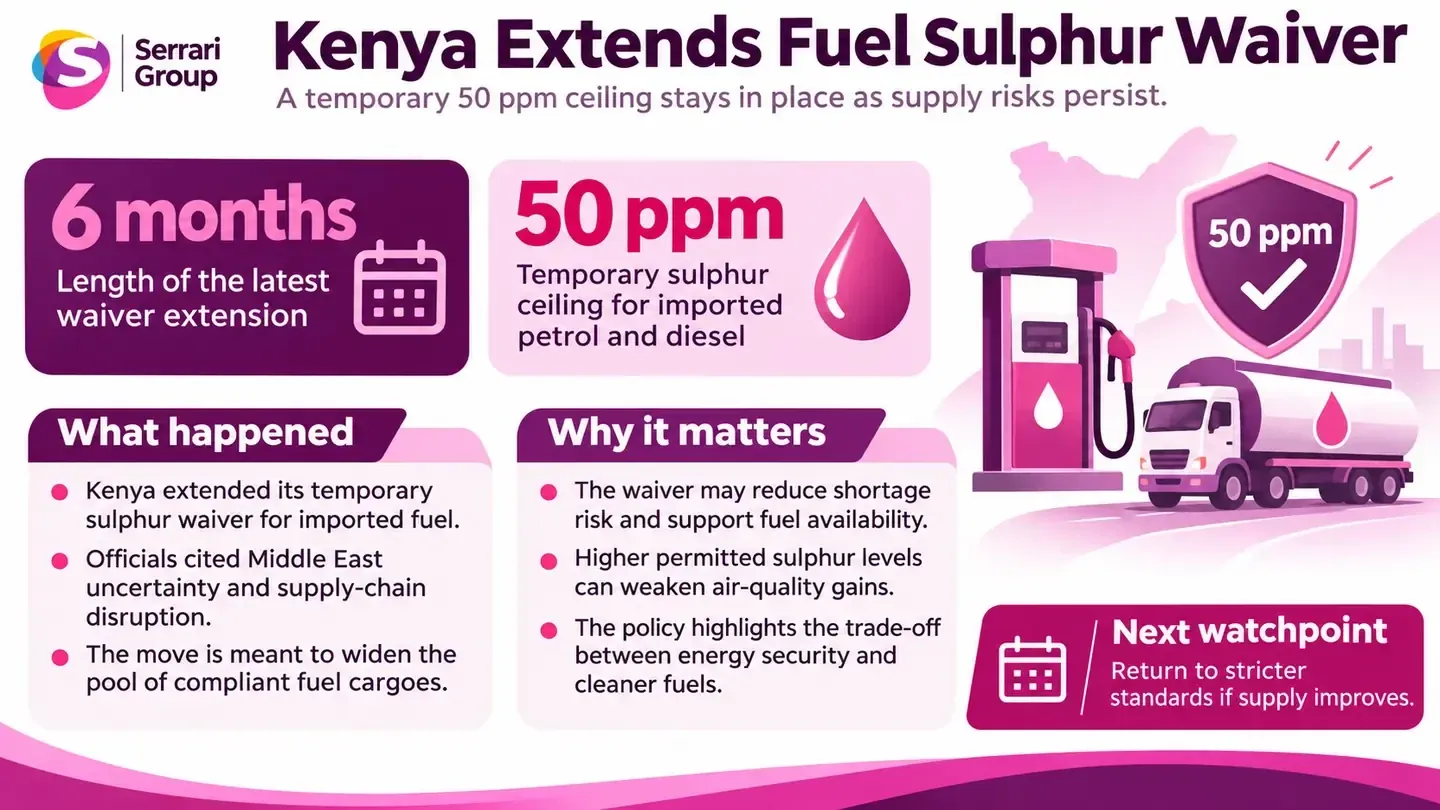
Kenya has extended a temporary relaxation of sulphur limits for imported petrol and diesel by another six months, allowing fuel containing up to 50 milligrams of sulphur per kilogram as uncertainty over Middle East petroleum supplies persists. Trade Cabinet Secretary Lee Kinyanjui announced the extension on November 11, 2026, following a request from the Energy Ministry and a recommendation from the National Standards Council. The government argues that the measure will widen the range of fuel suppliers able to serve Kenya and reduce the danger of shortages. But keeping a higher sulphur ceiling in place also raises a policy trade-off: protecting fuel availability today while preserving the progress made towards cleaner fuels, lower vehicle emissions and better air quality.
Key Overview
- Six-month extension: Kenya has prolonged the temporary fuel-quality adjustment introduced on April 30, 2026, amid continuing Middle East supply uncertainty.
- 50 ppm ceiling: Petrol and diesel may contain up to 50 mg/kg of sulphur, compared with the stricter 10 mg/kg requirement applied before the original waiver.
- Two standards: The decision concerns KS EAS 177:2025 for automotive diesel and KS EAS 158:2025 for premium motor spirit.
- Supply protection: The government wants importers to have a broader choice of available cargoes when shipping routes and refining supply are disrupted.
- Environmental concern: Higher-sulphur fuel can increase pollution and interfere with advanced vehicle emission-control systems.
- No automatic pump-price cut: Fuel quality and Kenya’s regulated retail-price formula are separate decisions; cheaper supplies are not guaranteed.
Why Kenya Has Extended Its Fuel Waiver
The government’s decision is an acknowledgment that the global petroleum market remains vulnerable months after Kenya first relaxed its standards. In its November 11 announcement, the Ministry of Investments, Trade and Industry cited continuing uncertainty in the Middle East, particularly disruption affecting the Strait of Hormuz, as grounds for keeping the emergency provision in place.
The problem is not simply how much crude oil exists worldwide. Kenya imports finished petroleum products and therefore needs access to refineries, shipping services and cargoes that match its prescribed fuel specifications. A product may be available on the international market but fail a particular quality threshold. When supplies tighten, a narrower specification can leave importers competing for fewer suitable cargoes, potentially raising procurement costs or creating delays.
That was the reasoning behind the original April 30 waiver. At the time, the government said stakeholders were having difficulty sourcing petrol and diesel that complied with the stricter standards after disruptions involving the Middle East. The Ministry of Energy and Petroleum requested an adjustment, which was evaluated with standards authorities before approval.
Extending the measure for another six months suggests those risks have not disappeared sufficiently for officials to restore the former limit. However, the announcement does not provide figures showing how many cargoes were rejected, how much fuel was saved from shortage, or the financial benefit achieved by the initial waiver. The rationale is clear, but its measurable success remains an important question for public scrutiny.
What the Change From 10 ppm to 50 ppm Actually Means
Sulphur concentration is usually stated in parts per million by mass. A limit of 50 milligrams per kilogram is equivalent to 50 ppm; a 10 mg/kg limit is equivalent to 10 ppm. The temporary threshold therefore permits up to five times the previously applicable sulphur concentration, but it does not require importers to supply fuel at that maximum.
The extension covers the sulphur parameter in two designated specifications: KS EAS 177:2025 for automotive gas oil, commonly known as diesel, and KS EAS 158:2025 for premium motor spirit, or petrol. It should not be interpreted as a general suspension of every fuel-quality rule. Other specification requirements and ordinary verification processes remain relevant, unless separately changed through lawful procedures.
This distinction matters for consumers. A legal ceiling is not the same as an observed nationwide fuel-quality average. Some imported cargoes may still satisfy the lower 10 ppm benchmark, while others could fall between 10 and 50 ppm. Without published batch-level testing or import data, it is impossible to say that all fuel sold in Kenya has become five times more sulphurous.
Kenya is also not returning to the much dirtier fuels historically used in some markets. The international clean-fuels programme documents East Africa’s earlier transition to lower-sulphur fuels, including a 50 ppm diesel limit in 2015 and later petrol improvements. Nevertheless, movement from 10 ppm back to a 50 ppm ceiling reverses part of the tightening intended to support cleaner vehicle technology.
Why the Strait of Hormuz Matters to Kenyan Fuel Imports
The Strait of Hormuz connects the Persian Gulf with international shipping routes and is one of the world’s most important energy chokepoints. An assessment of the shipping corridor estimates that roughly 20 million barrels of crude oil and petroleum products moved through it daily in 2025, representing about one-quarter of global seaborne oil trade.
A disruption can affect far more than the countries buying oil directly from the Gulf. Cargoes may need to be redirected, insurance premiums can rise and refiners elsewhere may face changing feedstock costs. Competition for available finished fuels can intensify across importing markets, even where a country does not obtain every shipment through Hormuz.
Kenya is particularly sensitive because it depends on international supply for its petroleum needs. Shipping delays or higher landed costs can influence the availability of diesel for trucks and industrial equipment, petrol for motorists and fuel for a wide range of commercial activities. The impact can pass through transport charges, production costs and ultimately consumer prices.
By allowing more fuel that meets a temporarily revised sulphur threshold, the government hopes to improve import flexibility. Yet broader eligibility does not eliminate geopolitical risks. It cannot reopen a shipping route, replace lost refinery output or prevent global prices from rising if another supply disruption occurs. The waiver is therefore a contingency tool rather than a complete energy-security solution.
Context is everything. Stay ahead of shifting trends with today’s market updates, and uncover emerging opportunities using the Serrari Group Market Index and Marketplace. Then, take control of your own financial future by exploring our Money & Life Reset Transformation Blueprint ™ to build stronger habits, create better systems, and design a path toward lasting wealth.
Will the Relaxed Standard Reduce Pump Prices?
The possible benefit to motorists is indirect. If importers can choose from a larger pool of cargoes, they may avoid some supply premiums and delivery delays. Maintaining adequate stock also reduces the likelihood of queues, rationing or abrupt disruption to transport operations. These benefits can be economically important even when retail prices do not immediately fall.
But the government has not announced a price reduction through this decision. Kenya’s regulated pump-price methodology considers the landed cost of imported products alongside handling, storage, transport, financing, wholesale and retail margins, and taxes. Exchange-rate movements and the timing of shipments can influence the result.
A cargo with a higher permitted sulphur level is not automatically cheaper once all these costs are included. Nor does expanding the pool of eligible suppliers guarantee that a saving will be passed to consumers. A meaningful assessment would compare actual procurement costs, product availability and final regulated prices before and after the waiver.
For businesses, reliability may matter as much as headline prices. Manufacturers, agricultural suppliers and freight companies can suffer substantial costs when diesel is unavailable, while households feel the effects through higher delivery charges and interruptions to essential services. That is why the government has framed the measure primarily as protection against shortages rather than as a guaranteed affordability programme.
The Environmental and Public-Health Trade-Off
The main downside is that fuel sulphur contributes to harmful emissions. Sulphur in fuel can produce sulphur dioxide during combustion and can limit the effectiveness of some exhaust-treatment systems. In modern diesel vehicles, very low sulphur levels are especially important for advanced particulate filters and other emission-control technologies.
The clean-fuel guidance for vehicle emissions stresses that fuel quality and vehicle technology must be considered together. Lower-sulphur fuels help reduce direct particulate pollution and make cleaner engines more effective. Weakening a fuel specification, even temporarily, can therefore have consequences beyond a laboratory measurement.
Those consequences should not be exaggerated without evidence. A higher maximum does not mean every vehicle suddenly emits five times as much pollution, and the relationship between fuel sulphur and actual emissions depends on engines, exhaust controls, driving conditions and the fuel ultimately used. Still, the direction of the trade-off is clear: the supply-security flexibility comes at the cost of permitting fuel that may produce more pollution than the stricter standard allowed.
The policy question is how to make that compromise proportionate. Authorities could publish results of fuel-quality inspections, identify how much imported fuel falls above 10 ppm and explain the conditions that would trigger an early return to the tighter limit. Such transparency would allow the public to distinguish a narrowly used emergency option from a prolonged weakening of air-quality protections.
What Happens When the Six Months End?
The extension announced on November 11 is intended to operate for a further six months, broadly taking the arrangement into 2027, with provision for an earlier review if supply conditions improve. The crucial next step is not merely reaching an expiry date; it is defining the evidence that would justify restoring the 10 ppm limit.
The government can assess whether compliant low-sulphur cargoes are again widely available, whether delivery delays have eased and whether returning to the stricter threshold would materially endanger supply. It can also examine whether the waiver has achieved measurable savings or simply become a convenient procurement option.
The bigger issue is Kenya’s exposure to external energy shocks. A temporary fuel-quality exception may help manage a disruption, but durable resilience requires dependable procurement, adequate storage, efficient logistics and policies that encourage cleaner transport technologies. Environmental progress and energy security need not be permanent rivals if the country invests in both.
For now, the extension matters because it shows how international conflict can force a domestic regulatory compromise with consequences for motorists, industry and public health. The government’s challenge over the next six months is to keep fuel available without allowing an emergency waiver to quietly become the country’s new normal.
Sources: Kenya Broadcasting Corporation / Ministry of Investments, Trade and Industry / Africa Updates / International Energy Agency / United Nations Environment Programme / Energy and Petroleum Regulatory Authority / Citizen Digital
Your financial future isn’t something you wait for—it’s something you build.
The real question is: when do you begin?
Move beyond simply staying informed.
Navigate the markets with clarity—track trends through the Serrari Group Market Index, uncover opportunities in the Serrari Marketplace, and build practical knowledge with our Curated Wealth Builder Platform.
Stay connected to what truly matters.
Get daily insights on macro trends and financial movements across Kenya, Africa, and global markets—delivered through the Serrari Newsletter.
Growth opens doors.
Advance your career through professional programs including ACCA, HESI A2, ATI TEAS 7 , HESI EXIT , NCLEX – RN and NCLEX – PN, Financial Literacy!🌟—designed to move you forward with confidence.
See where money is flowing—clearly and in real time.
Track Money Market Funds, Treasury Bills, Treasury Bonds, Green Bonds, and Fixed Deposits, alongside global and African indexes, key economic indicators, and the evolving Crypto and stablecoin landscape—all within Serrari’s Market Index.