Deutsche Bank has launched its digital asset custody service for institutional and corporate clients, allowing eligible customers in Europe to hold and transfer Bitcoin, Ethereum and three stablecoins through the bank’s infrastructure. The service initially supports BTC, ETH, USDC, EURC and EURAU, with Deutsche Bank managing clients’ digital wallets and private keys. The launch follows the bank’s September announcement and its October registration under the European Union’s Markets in Crypto-Assets Regulation (MiCA). Deutsche Bank also plans to expand its digital asset services into Asian financial centres in 2027 and has signed a memorandum of understanding with Deutsche Asset Management to explore tokenized financial products.
Key Takeaways
- Deutsche Bank’s digital asset custody service went live on November 11, 2026, for eligible institutional and corporate clients.
- The platform initially supports Bitcoin, Ethereum, USDC, EURC and EURAU.
- The bank manages clients’ digital wallets and private keys, allowing institutions to hold and transfer digital assets without building their own custody infrastructure.
- The service is initially available in Germany, with wider European servicing subject to applicable regulatory requirements.
- Deutsche Bank has signed an MoU with Deutsche Asset Management to explore tokenized money market funds, crypto-linked exchange-traded commodities and stablecoins.
- The bank plans to extend its digital asset custody business into major Asian financial centres in 2027.
What Has Deutsche Bank Launched?
Deutsche Bank has officially launched its digital asset custody service for institutional and corporate clients, marking a major expansion of the German banking group’s involvement in cryptocurrencies and blockchain-based financial services.
The service went live on November 11, after the German bank announced its plans in September.
The platform, known as Digital Asset Custody (DAC), allows eligible clients to securely hold and transfer selected digital assets through the bank’s custody infrastructure.
The launch gives eligible institutions another way to hold cryptocurrencies through a traditional banking provider, with Deutsche Bank managing wallets and private keys on their behalf.
This means institutional clients can access cryptocurrency custody through an established banking relationship instead of having to develop and operate their own digital asset storage systems.
The service targets institutional investors, asset managers, hedge funds, corporations, brokers, custodians and sovereign institutions. It is not designed for retail cryptocurrency customers.
The launch is also an important step in the bank’s broader digital asset strategy. Deutsche Bank has previously indicated that it wants to move beyond simply holding cryptocurrencies towards providing a wider range of blockchain-based financial services.
Which Cryptocurrencies Does Deutsche Bank Support?
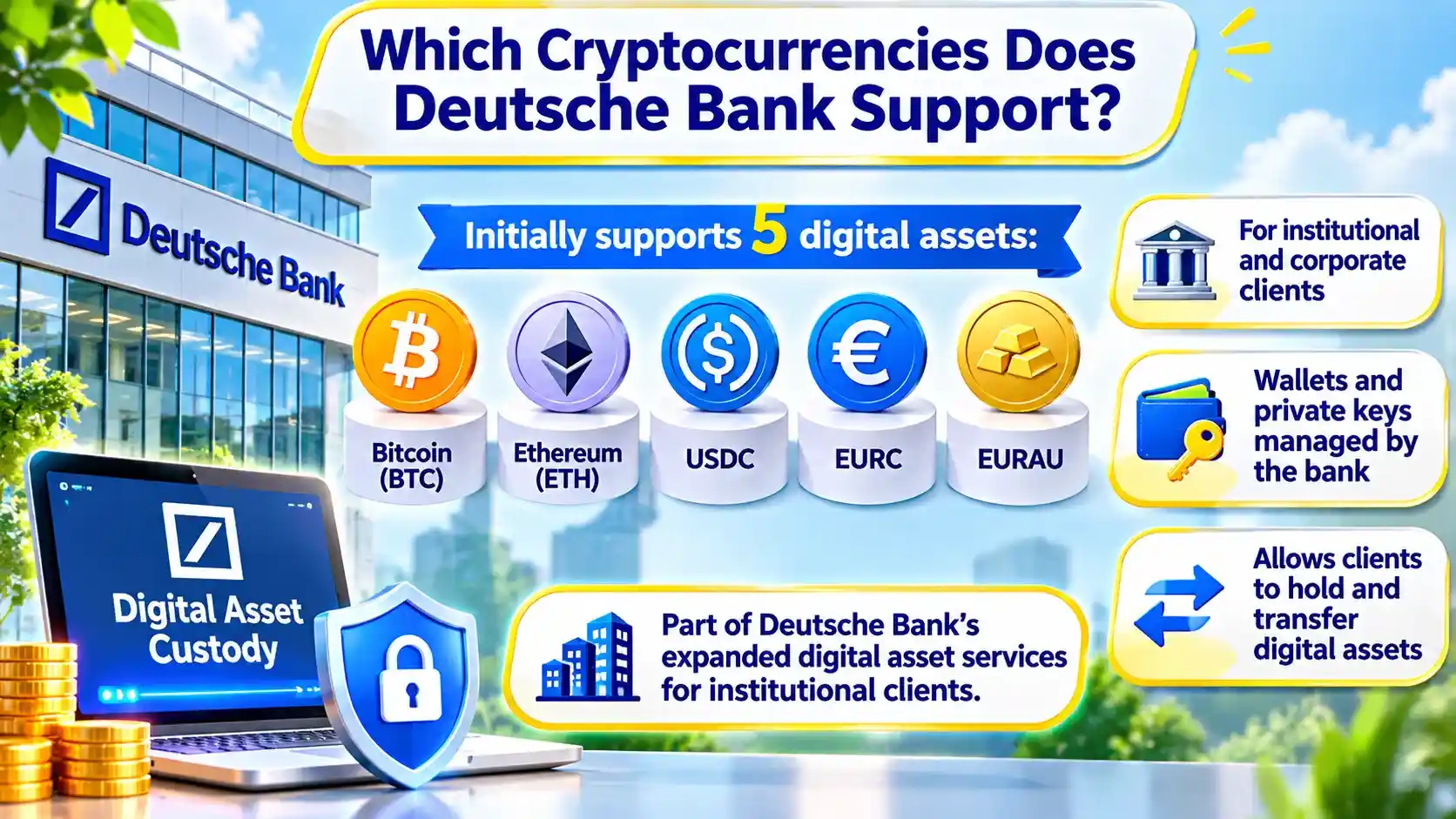
At launch, the custody service supports five digital assets: Bitcoin (BTC), Ethereum (ETH), USDC, EURC and EURAU.
The supported assets include two major cryptocurrencies and three stablecoins. Stablecoins are digital assets designed to maintain a relatively stable value against a reference currency or asset. USDC, EURC and EURAU are included in the bank’s initial supported asset list.
Through the service, clients can hold these assets and transfer them to third parties.
One of the platform’s key features is that cryptocurrency wallets and private keys are managed by the bank.
Private keys are essential because they provide control over digital assets held on a blockchain. Managing them requires specialised security arrangements and operational controls. By taking responsibility for clients’ wallets and private keys, Deutsche Bank allows institutions to use its custody infrastructure rather than managing the underlying technical arrangements themselves.
The service can also be accessed through the bank’s Autobahn corporate banking platform, giving eligible business customers access to digital asset custody through an existing banking system.
However, the initial offering is limited to custody and transfers. Cryptocurrency trading and exchange services are not part of the service at launch.
How Does Deutsche Bank Protect Clients’ Digital Assets?
Digital asset custody requires controls to protect private keys, authorise transactions and manage the risks associated with storing cryptocurrencies.
Deutsche Bank’s custody solution incorporates several security arrangements designed to reduce the possibility of unauthorised access, key loss and operational failure.
The system incorporates several security measures, including hardware-based private key protection, separate warm and cold storage environments, multi-person transaction approvals, and backup and recovery arrangements.
Hardware-based protection helps secure private keys, while warm and cold storage arrangements provide different environments for holding digital assets. Multi-person approvals introduce additional checks before transactions can be authorised.
The system also includes backup and recovery arrangements to address situations involving key loss or operational disruption.
The bank’s project builds on its earlier work with digital asset infrastructure provider Taurus, with which it partnered in 2023. Reporting in 2025 also identified Bitpanda Technology Solutions as another technology provider involved in developing the offering.
The bank’s September 2026 announcement did not name the providers responsible for individual components of the live service, saying only that selected external technology and infrastructure providers would support defined technical functions.
The security arrangements are intended to reduce risks, but they do not eliminate all risks associated with digital assets. Cryptocurrency values can fluctuate, and custody does not protect clients against every possible fraud, cyber incident or failure involving other market participants.
The bank has also cautioned that crypto-assets do not carry deposit protection comparable to eligible bank deposits.
What Does MiCA Registration Mean for Deutsche Bank’s Crypto Service?
The launch follows Deutsche Bank’s registration under the European Union’s Markets in Crypto-Assets Regulation, commonly known as MiCA.
The bank registered under the European Union’s Markets in Crypto-Assets Regulation, known as MiCA, on October 12.
Germany’s financial regulator, BaFin, is Deutsche Bank’s competent national regulator, while the European Securities and Markets Authority (ESMA) maintains the official MiCA register.
MiCA establishes common authorisation and supervision rules for crypto-asset service providers operating within the European Union. These rules cover services such as custody and the transfer of crypto-assets.
The registration allows Deutsche Bank to provide eligible custody and transfer services in Germany and, subject to applicable cross-border requirements, other European markets.
The distinction between authorisation for custody and permission to offer other crypto services is important. Registration for custody and transfers does not automatically permit a bank to offer every activity involving digital assets.
The approval does not cover every product the bank hopes to introduce. Its custody website does not list cryptocurrency trading, exchange services or tokenized securities among the products available at launch.
Additional services will therefore require the relevant approvals and compliance arrangements before they can be introduced.
Why Is Deutsche Bank Partnering With Its Asset Management Business?
Alongside the launch of its custody service, Deutsche Bank announced a memorandum of understanding with Deutsche Asset Management, its asset management business formerly known as DWS.
The agreement is intended to explore commercial and technical cooperation involving digital assets.
The parties plan to work on tokenized money market funds, cryptocurrency-linked exchange-traded commodities (ETCs), and stablecoins.
The collaboration could connect Deutsche Bank’s custody infrastructure with its asset management operations, creating opportunities to develop and support digital financial products.
Tokenized money market funds are investment funds whose ownership interests are represented using blockchain-based digital tokens. Tokenization can potentially support the recording, transfer and settlement of ownership through digital infrastructure.
The proposed cooperation also covers areas such as digital asset custody, settlement, liquidity management and distribution processes.
Manfred Bauer, a product manager at Deutsche Asset Management, confirmed plans to develop a tokenized money market fund. As of September 30, 2026, the company had €1.22 trillion in assets under management.
This provides context for the potential scale of the asset management business involved in the discussions. However, the memorandum does not mean that a tokenized fund or other new product has already been launched.
The announced memorandum of understanding does not mean that the new products have already been launched. Their scope and potential launch dates have yet to be finalised.
The agreement remains exploratory, with future products dependent on the partners’ decisions and applicable regulatory requirements.
How Does Deutsche Bank Plan to Expand Beyond Cryptocurrency Custody?
Deutsche Bank’s ambitions extend beyond holding and transferring cryptocurrencies. The bank wants to develop a broader infrastructure for blockchain-based financial services, including tokenization and digital asset settlement.
Paul Maley, the bank’s global head of trust and securities services, described the longer-term ambition:
“In the medium term we aim to deliver a fully integrated, regulated ecosystem that supports the custody, tokenisation, and settlement of digital assets.”
The statement highlights the distinction between the service currently available and the bank’s longer-term plans. Custody is now operational, while tokenization and settlement form part of its wider roadmap.
The bank is also considering services that would allow institutional clients to exchange traditional currencies into stablecoins, use tokenized deposits and receive support for issuing digital bonds.
Gerald Podobnik, co-head of the bank’s corporate banking division, outlined these expansion plans in October, linking the initiative to growing institutional demand for digital assets and blockchain-based financial services.
The planned rollout includes services for exchanging traditional currencies into stablecoins, tokenized deposits and support for issuing digital bonds.
These services would extend the bank’s involvement from safeguarding existing digital assets to supporting the creation, management and movement of blockchain-based financial instruments.
The expansion forms part of Deutsche Bank’s corporate banking growth strategy, which targets approximately 8% compound annual revenue growth between 2025 and 2028.
Context is everything. Stay ahead of shifting trends with today’s market updates, and uncover emerging opportunities using the Serrari Group Market Index and Marketplace. Then, take control of your own financial future by exploring our Money & Life Reset Transformation Blueprint ™ to build stronger habits, create better systems, and design a path toward lasting wealth.
Why Is Deutsche Bank Looking Towards Asia in 2027?
Deutsche Bank is also considering expanding its digital asset custody operations into major Asian financial centres in 2027.
The bank plans to extend its crypto custody business into Asia in 2027.
Gerald Podobnik discussed the expansion plans in an October interview, although the bank has not specified which Asian markets will be prioritised or provided a detailed launch timetable.
The potential expansion reflects the bank’s intention to serve institutional clients beyond its initial European market.
Asia is also part of the longer-term development of its digital asset business, which could include stablecoin services, tokenized deposits and digital bonds.
However, the introduction of these services would depend on customer demand, the bank’s internal approvals and regulatory requirements in the relevant markets.
The expansion plans therefore remain part of the bank’s roadmap rather than services that are already available to customers across Asia.
How Are Other Banks Expanding Into Digital Asset Custody?
Deutsche Bank’s launch comes as established financial institutions expand their involvement in cryptocurrency custody and other blockchain-based services.
BNY has expanded its digital asset custody activities through a partnership with Ripple, supporting institutional custody of XRP and Ripple’s RLUSD stablecoin.
Other financial institutions, including State Street, have developed digital asset custody infrastructure, while specialist providers such as BitGo and Anchorage Digital offer cryptocurrency custody services to institutional customers.
The broader shift reflects banks’ efforts to give institutional clients access to digital assets through established financial infrastructure rather than specialist crypto custodians alone.
The development suggests that traditional financial institutions are increasingly exploring ways to provide digital asset services within their existing banking and investment operations.
Deutsche Bank’s entry into institutional custody also comes amid wider cooperation between major banks on stablecoin development.
One day before the custody launch, reports emerged that Goldman Sachs, Citigroup, Banco Santander and Deutsche Bank were among financial institutions backing a new stablecoin venture with approximately $270 million in committed funding.
The proposed venture involves 21 financial institutions and is targeting the launch of a US dollar stablecoin in the first half of 2027.
The consortium plans to begin with dollar-denominated tokens before considering a euro stablecoin, with the funding intended to cover its first five years of operations.
The proposed stablecoin venture is separate from Deutsche Bank’s custody service and its memorandum of understanding with Deutsche Asset Management. However, both developments reflect the growing interest of established financial institutions in blockchain-based payment and financial infrastructure.
The Bigger Picture: Why Are Traditional Banks Moving Into Digital Assets?
Deutsche Bank’s launch illustrates how traditional banking institutions are moving beyond simply observing the cryptocurrency market and beginning to provide services that support institutional participation.
For many large investors and corporations, holding digital assets requires more than purchasing cryptocurrencies. They also need secure custody, transaction controls, regulatory compliance and reliable infrastructure.
By managing wallets and private keys, Deutsche Bank is offering a service that allows eligible institutions to access selected digital assets through a traditional banking provider.
The bank’s plans for tokenized money market funds, stablecoins, tokenized deposits and digital bonds also point towards a broader change in how financial assets could be issued, held and transferred.
Tokenization could allow certain traditional financial instruments to be represented digitally on blockchain networks. However, the development of these products requires appropriate technology, operational controls and regulatory approval.
The bank’s current service should therefore be viewed as an initial step rather than a complete digital asset ecosystem. It currently supports custody and transfers of five assets, while trading, tokenized securities and other products remain outside the initial offering.
Why Does This Matter Now?
The launch marks a transition from Deutsche Bank’s September announcement of its digital asset custody plans to an operational service for paying institutional clients.
It also comes as the bank prepares to expand its digital asset activities through partnerships, potential tokenized products and plans for Asian markets in 2027.
For institutional investors, the development provides another route to hold and transfer cryptocurrencies through established financial infrastructure. For the banking industry, it highlights the growing convergence between traditional financial services and blockchain-based systems.
However, the commercial impact of the launch is not yet clear. Deutsche Bank has not disclosed how many clients it has onboarded, the value of assets held in custody or the revenue generated by the service.
The next milestones will be client growth, the volume of assets held, and whether the bank expands into tokenization, settlement and Asian markets.
The MoU with its asset management business also provides a potential route towards new digital financial products, although no joint investment product or tokenized fund has been launched.
Ultimately, the success of Deutsche Bank’s digital asset strategy will depend on institutional demand, the development of additional services and the bank’s ability to operate within the regulatory requirements of the markets it intends to serve.
Frequently Asked Questions
1. Which cryptocurrencies does Deutsche Bank support through its custody service?
The service initially supports Bitcoin (BTC), Ethereum (ETH), USDC, EURC and EURAU.
2. Can retail customers use Deutsche Bank’s digital asset custody service?
No. The initial service targets institutional and corporate clients, including asset managers, hedge funds, brokers, corporations, custodians and sovereign institutions.
3. What is Deutsche Bank planning with Deutsche Asset Management?
The two businesses have signed a memorandum of understanding to explore cooperation involving tokenized money market funds, cryptocurrency-linked exchange-traded commodities, stablecoins, custody, settlement, liquidity management and distribution.
4. Does Deutsche Bank plan to expand its digital asset services beyond Europe?
Yes. The bank plans to extend its digital asset custody business into major Asian financial centres in 2027, although it has not specified the markets or exact launch dates.
Your financial future isn’t something you wait for—it’s something you build.
The real question is: when do you begin?
Move beyond simply staying informed.
Navigate the markets with clarity—track trends through the Serrari Group Market Index, uncover opportunities in the Serrari Marketplace, and build practical knowledge with our Curated Wealth Builder Platform.
Stay connected to what truly matters.
Get daily insights on macro trends and financial movements across Kenya, Africa, and global markets—delivered through the Serrari Newsletter.
Growth opens doors.
Advance your career through professional programs including ACCA, HESI A2, ATI TEAS 7 , HESI EXIT , NCLEX – RN and NCLEX – PN, Financial Literacy!🌟—designed to move you forward with confidence.
See where money is flowing—clearly and in real time.
Track Money Market Funds, Treasury Bills, Treasury Bonds, Green Bonds, and Fixed Deposits, alongside global and African indexes, key economic indicators, and the evolving Crypto and stablecoin landscape—all within Serrari’s Market Index.