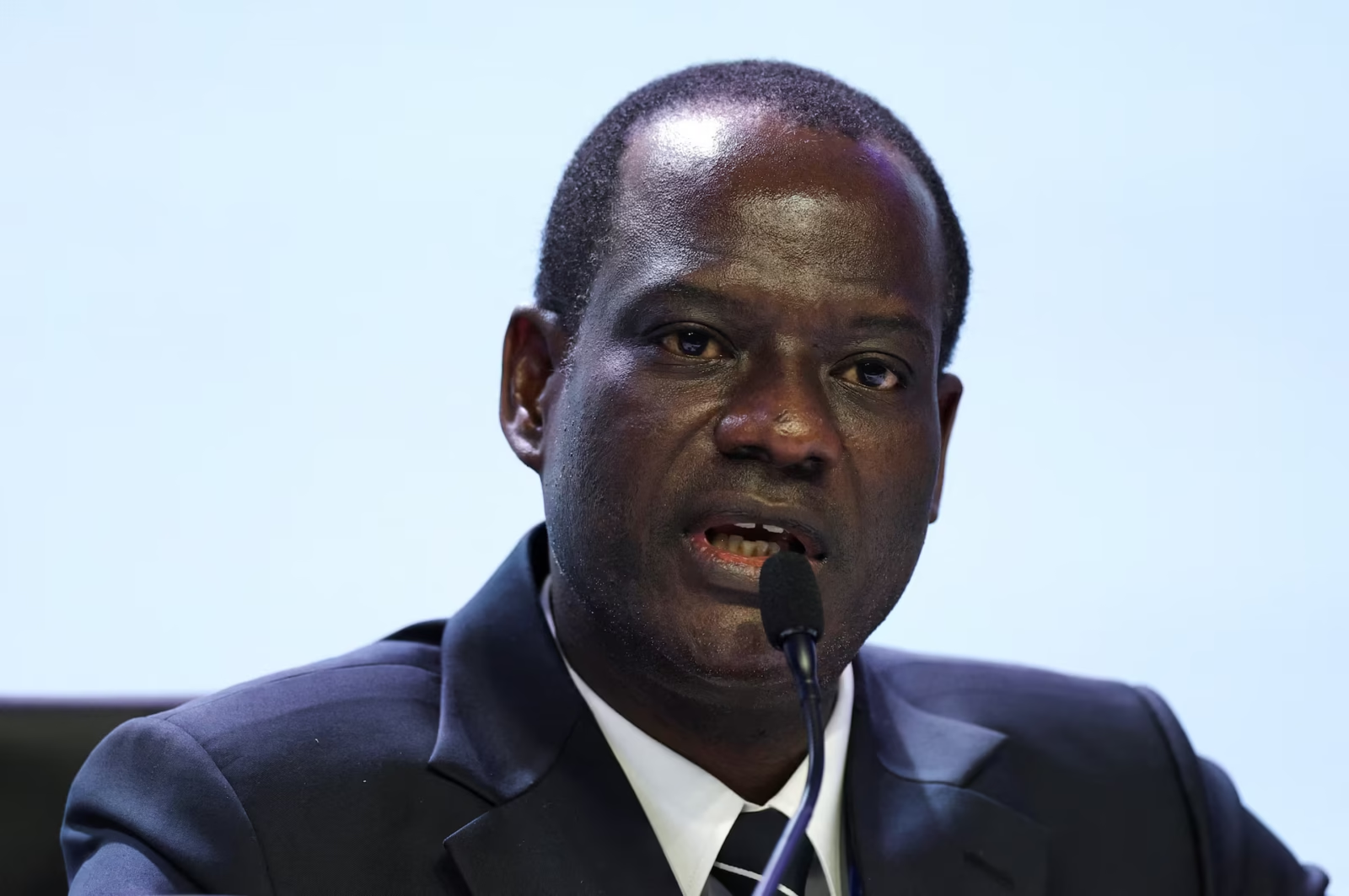
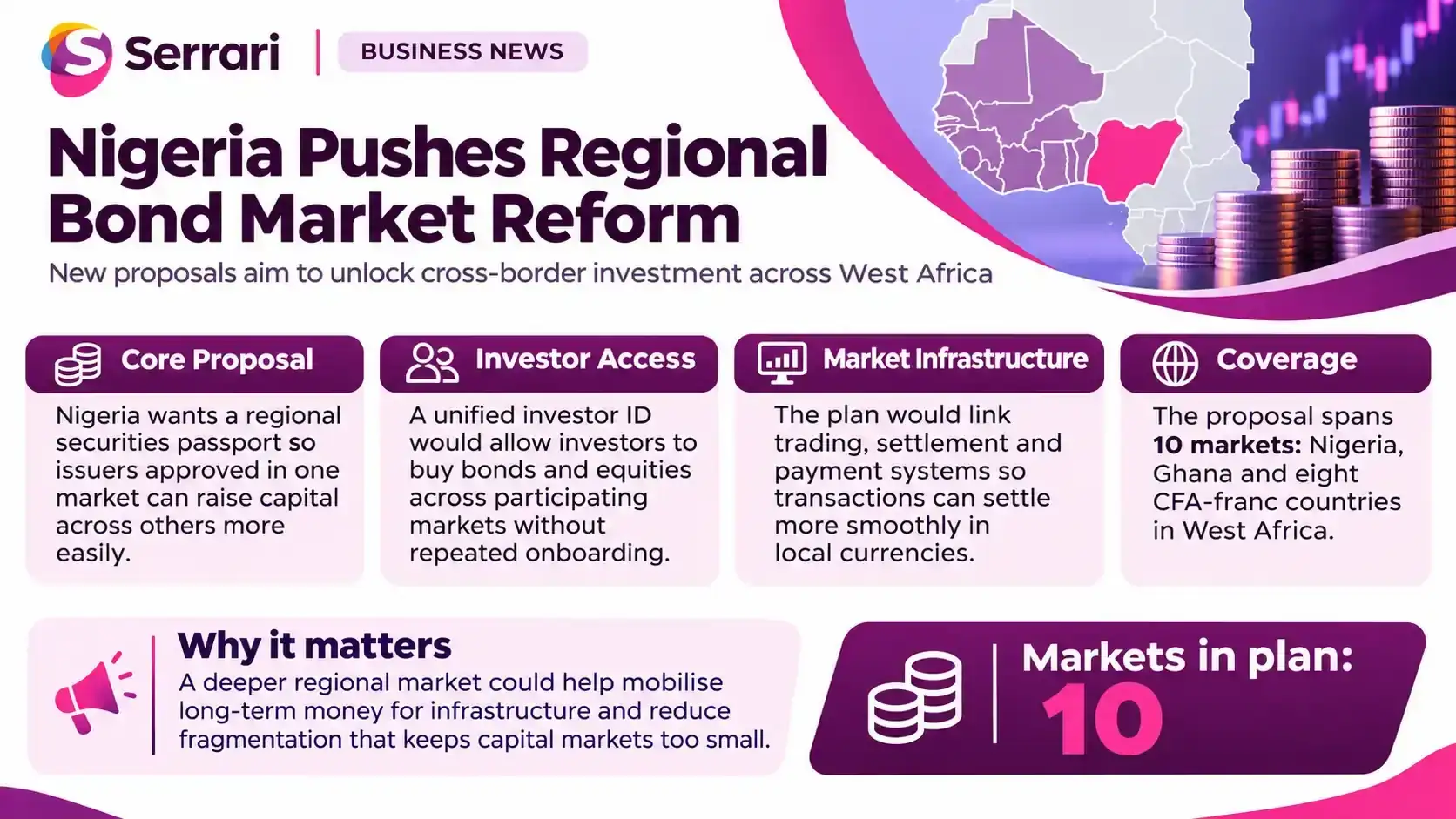
Nigeria has proposed an overhaul of West Africa’s fragmented capital markets to make it easier for governments, companies and investors to raise and move money across borders. Speaking at a ratings summit in Lagos on November 10, 2026, Finance Minister Taiwo Oyedele called for a regional securities passport, common investor identification, connected trading and settlement systems, and financing tools for infrastructure. The proposals cover Nigeria, Ghana and eight countries using the West African CFA franc. Their importance lies not simply in making bond purchases more convenient, but in addressing a longstanding financing problem: markets operating separately struggle to mobilise the large, patient pools of capital needed for power, transport and industrial projects. Turning the proposals into functioning rules, however, will require regulators to reconcile different legal systems, currencies and investor protections.
Key Overview
- Ten-market proposal: Nigeria and Ghana would join Benin, Burkina Faso, Côte d’Ivoire, Guinea-Bissau, Mali, Niger, Senegal and Togo in the proposed framework.
- Issuer passport: A bond or share issuer authorised in one participating jurisdiction could seek investors in others without repeating the full approval process.
- Common investor identity: Investors could register once rather than undergo separate onboarding in every participating market.
- Local-currency settlement: Connected trading and payment systems would aim to reduce reliance on US-dollar intermediaries, although they cannot eliminate exchange-rate risk.
- Infrastructure financing: A regional local-currency bond index and credit enhancement facility could support longer-term fundraising.
- Unfinished reform: The measures are proposals, not an implemented common market; harmonised supervision, settlement arrangements and safeguards are still necessary.
Why West Africa Needs a Deeper Bond Market
At the Lagos ratings summit, Oyedele argued that fragmented markets prevent the region from assembling the scale of long-term financing required for economic development. A country may have substantial savings in pension funds, insurers and banks, yet the pool available to a particular bond issuer can remain small when investment rules, market infrastructure and transaction costs effectively confine that capital within national borders.
That matters particularly for infrastructure. A power plant, port, rail link or transmission network can require large upfront spending and may take years to generate dependable revenue. Short-term bank loans can create refinancing risk if the debt comes due before the project produces sufficient cash. Longer-maturity bonds can align repayments more closely with a project’s economic life, but only where investors are willing and permitted to buy them.
The proposed reforms attempt to widen the buyer base rather than rely exclusively on governments borrowing more or attracting additional foreign-currency loans. Access to investors across several countries could help an eligible infrastructure issuer raise larger amounts, diversify its funding sources and potentially negotiate better terms. None of those benefits is automatic: investors will still demand compensation for credit risk, currency volatility, inflation and political uncertainty.
The proposed ten-country grouping is economically diverse. Nigeria and Ghana have separate currencies and monetary frameworks, while the eight named francophone countries participate in the West African Economic and Monetary Union and use the CFA franc. This creates an opportunity to connect different pools of savings, but also complicates the design of a market in which securities are sold and settled under different national and regional rules.
How a Regional Securities Passport Would Work
The centrepiece of the November 10 proposals is a passport for securities issuers. Under the proposed model, an issuer approved in one participating market could offer bonds or shares to investors in others without repeating an entire set of regulatory approvals. That could lower legal fees, shorten time to market and make a larger cross-border offering commercially feasible.
Consider a hypothetical electricity company seeking the equivalent of $200 million to construct a regional transmission project. Instead of preparing separate offerings and lengthy registration packages for each country, it could potentially use a recognised approval and common disclosure standards to approach investors across participating markets. This is an illustration of the mechanism, not an announced transaction or a guarantee of funding.
For the passport to be credible, regulators would have to agree on what adequate disclosure means and which authority is responsible when an issuer breaches its obligations. Investors need comparable financial reporting, clear treatment of defaults and reliable enforcement mechanisms. Mutual recognition without these protections could move risk across borders faster than regulators can respond.
Nigeria is also advocating a single investor-identification framework. This addresses the other side of the transaction: an investor who has already met identification and due-diligence requirements in one market may currently face repeated checks elsewhere. A shared identity arrangement could reduce paperwork for brokers, asset managers and individuals while preserving anti-money-laundering and customer-protection standards. It would need secure data governance and clear procedures for handling errors or suspicious activity.
Why Payments and Settlement Are Just as Important as Regulation
Permission to invest does little good if a cross-border trade remains expensive or difficult to settle. When a bond changes hands, the securities must be delivered and the seller paid, ideally with both legs completed reliably. Differences in custodians, clearing arrangements, currency availability and operating hours can make an apparently straightforward transaction slow or costly.
Existing infrastructure provides a starting point. The African Exchanges Linkage Project connects brokers through an order-routing system, but its current design still uses the host exchange’s rules and settlement arrangements. A trade on another exchange does not automatically create a single regional depository or remove the need to fund the transaction in the host-market currency.
The Pan-African Payment and Settlement System is another building block, enabling participating institutions to process local-currency cross-border payments. Its published operating model includes multilateral settlement arrangements involving central banks and Afreximbank. This is valuable infrastructure, but a payments network alone cannot deliver an integrated securities market: it must connect with brokers, depositories, trading platforms and the legal finality of securities settlement.
The local-currency ambition also requires careful interpretation. Allowing a Nigerian investor to buy a Ghanaian security without routing every payment through a US-dollar account may reduce some conversion costs and operational frictions. It does not make the naira and cedi interchangeable, remove foreign-exchange restrictions or protect an investor from losing money when an exchange rate moves. Currency hedging and predictable repatriation remain important for institutions investing across borders.
Context is everything. Stay ahead of shifting trends with today’s market updates, and uncover emerging opportunities using the Serrari Group Market Index and Marketplace. Then, take control of your own financial future by exploring our Money & Life Reset Transformation Blueprint ™ to build stronger habits, create better systems, and design a path toward lasting wealth.
Can a Regional Bond Index and Guarantees Attract Investors?
Oyedele’s proposals extend beyond transaction plumbing. A regional local-currency bond index could give fund managers a clearer benchmark for comparing issues across markets. Pension funds, insurers and investment funds often use indices to assess performance, manage exposures and decide which markets are sufficiently accessible for investment mandates. A credible index could improve visibility and encourage research into under-followed securities.
Yet an index requires consistent information. Issuers and market operators would need to publish comparable details on maturity, yields, outstanding amounts, trading volumes and settlement eligibility. If bonds rarely trade, quoted prices may not represent executable transactions. A benchmark can make a market easier to observe without necessarily making it liquid.
The proposed credit enhancement facility could address a different barrier: project risk. Guarantees or other credit support may improve the credit profile of eligible infrastructure debt by protecting investors against specified losses or payment interruptions. This can help attract long-term capital to projects that would otherwise be judged too risky, especially where the underlying project is economically useful but revenue takes time to stabilise.
Credit enhancement does not eliminate risk; it reallocates it. Investors must examine who provides the guarantee, what triggers payment and whether the guarantor has sufficient financial capacity. Publicly backed guarantees can also create contingent liabilities for taxpayers if projects fail. Any regional facility would therefore need transparent eligibility rules, pricing and reporting rather than an assumption that guaranteed debt is risk-free.
Nigeria’s Larger Ambition: A Trillion-Dollar Capital Market
The regional initiative fits a broader domestic agenda. On October 19, Nigeria launched a 2026–2036 capital-market roadmap intended to mobilise savings, diversify investment products and deepen market participation. The plan seeks to expand the role of capital markets in financing businesses and public priorities rather than leaving growth dependent on banking credit or external financing.
Oyedele has separately articulated an ambition for Nigeria’s capital market to reach at least $1 trillion within ten years and for the country to achieve investment-grade sovereign ratings within three years. Both are aspirations, not outcomes or official rating commitments. The domestic roadmap’s targets include a N750 trillion market-capitalisation objective by 2036, which is distinct from the minister’s more ambitious dollar-denominated goal.
These targets are linked. Deeper capital markets can widen the range of financing options, but investors will judge the country’s underlying macroeconomic conditions as well as its market architecture. Stable inflation, credible fiscal policy, predictable foreign-exchange access and dependable contract enforcement are relevant to a country’s borrowing costs. Creating a passport cannot substitute for those fundamentals.
What Could Prevent the Reforms From Succeeding?
The largest obstacle may be coordination rather than technology. Multiple securities regulators, central banks, exchanges and depositories would need to agree on standards while retaining legal accountability. Participation by the eight CFA-franc countries also involves institutions and rules shared within their monetary union, making a regional arrangement more complex than simply signing ten bilateral agreements.
Investor protection and market integrity are equally consequential. Common onboarding must not weaken checks on beneficial ownership; recognition of an issuer’s prospectus must not dilute disclosure standards; and cross-border settlement needs clear remedies when a trade fails. Without confidence that securities can be held, sold and paid for reliably, investors may continue to prefer domestic instruments even if a regional portal exists.
The proposals do not yet establish a common timetable, binding treaty or operational rulebook. Their immediate significance is therefore the political push to connect initiatives that have developed separately. The test will be whether participating authorities move from a statement of intent to enforceable arrangements, pilot trades and measurable reductions in transaction costs.
For ordinary savers and businesses, the potential payoff is tangible: more investment choices, broader funding markets and, over time, better access to finance for infrastructure that supports jobs and production. But market integration is useful only if it channels money into viable investments on terms that issuers can repay and investors can trust. Nigeria’s proposal identifies a real financing bottleneck; solving it will require the less visible work of regulatory alignment, currency management and institutional credibility.
Sources: Reuters / S&P Global Ratings / FSD Africa / African Exchanges Linkage Project / Pan-African Payment and Settlement System / Nairametrics
Your financial future isn’t something you wait for—it’s something you build.
The real question is: when do you begin?
Move beyond simply staying informed.
Navigate the markets with clarity—track trends through the Serrari Group Market Index, uncover opportunities in the Serrari Marketplace, and build practical knowledge with our Curated Wealth Builder Platform.
Stay connected to what truly matters.
Get daily insights on macro trends and financial movements across Kenya, Africa, and global markets—delivered through the Serrari Newsletter.
Growth opens doors.
Advance your career through professional programs including ACCA, HESI A2, ATI TEAS 7 , HESI EXIT , NCLEX – RN and NCLEX – PN, Financial Literacy!🌟—designed to move you forward with confidence.
See where money is flowing—clearly and in real time.
Track Money Market Funds, Treasury Bills, Treasury Bonds, Green Bonds, and Fixed Deposits, alongside global and African indexes, key economic indicators, and the evolving Crypto and stablecoin landscape—all within Serrari’s Market Index.