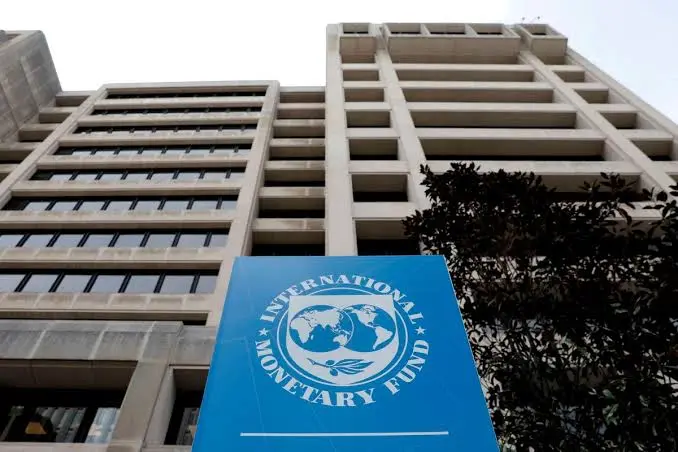
The Democratic Republic of Congo (DRC) is asking the International Monetary Fund to increase financing and ease fiscal deficit limits for 2026 and 2027 as fighting in the east and a major Ebola emergency place growing pressure on its public finances. Following talks concluded on November 4, 2026, IMF staff reached a preliminary agreement on reviews of two existing financing programmes, but expanded access has not yet been approved. The request exposes a central contradiction in Congo’s economy: national output is still expected to grow by more than 5%, yet conflict, health costs and rising food and fuel prices are stretching government resources and household budgets. The question is whether additional financing can help Kinshasa manage immediate emergencies without weakening the reforms intended to make public spending more transparent and sustainable.
Key Overview
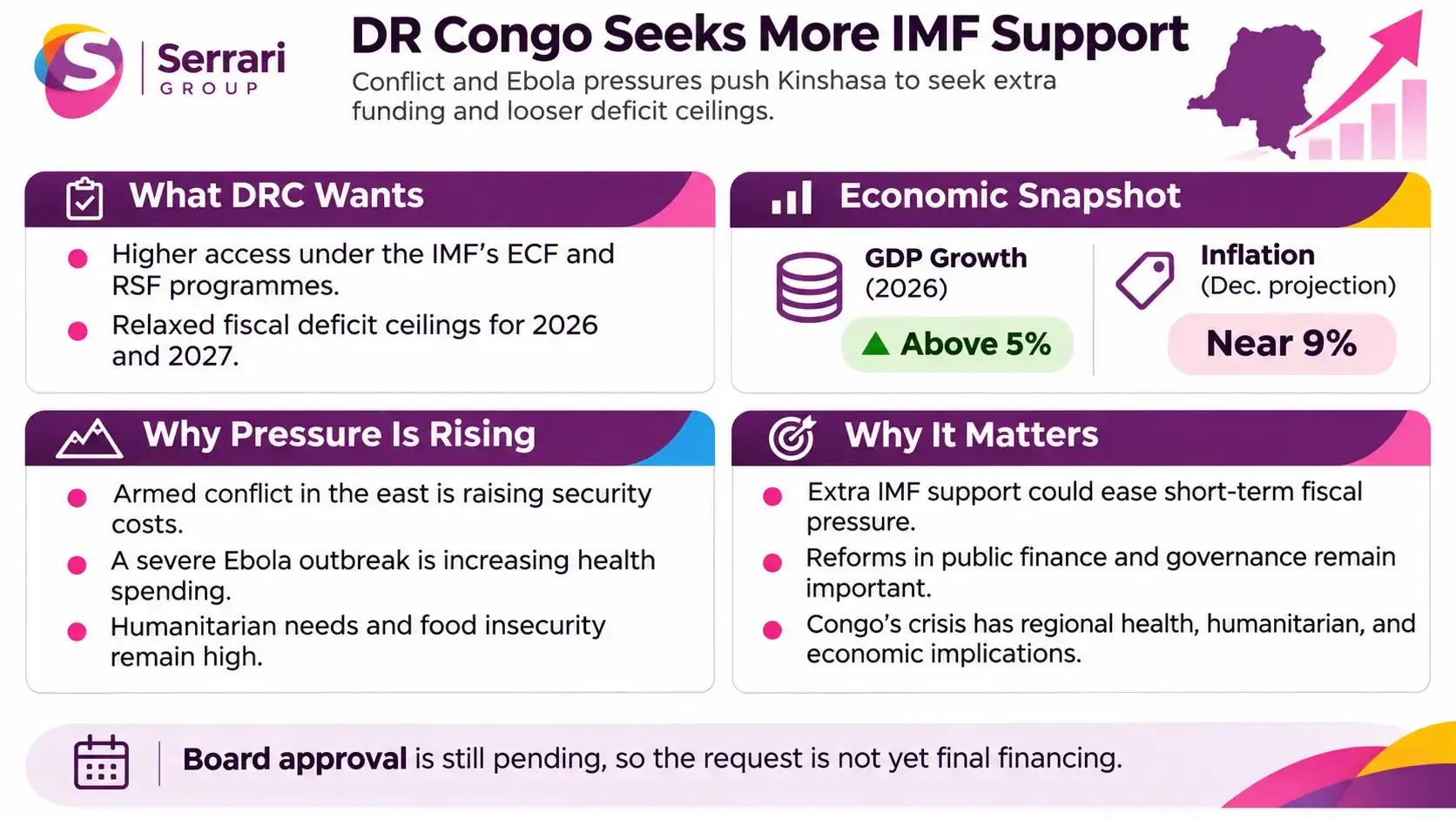
- More assistance requested: Kinshasa wants higher access to funding under the Extended Credit Facility (ECF) and Resilience and Sustainability Facility (RSF), alongside looser deficit ceilings for 2026 and 2027.
- Approval remains pending: Staff-level agreements on the fourth ECF review and third RSF review are subject to IMF management and Executive Board approval, tentatively expected in December.
- Growth does not eliminate the squeeze: Real GDP is projected to expand by more than 5% in 2026, but inflation may approach 9% by December as food and petroleum costs rise.
- Health emergency is severe: The separate 2026 Bundibugyo-virus outbreak had reached 9,704 confirmed cases and 4,687 deaths by October 20, according to the latest dated outbreak bulletin reviewed.
- Humanitarian pressure is mounting: A food-security assessment projects 28.8 million people facing acute food insecurity between September and December 2026.
- Reforms remain essential: The IMF wants tighter expenditure controls, improved revenue collection and continued financial-integrity reforms despite the emergency.
Why Congo Is Asking the IMF to Relax Its Budget Limits
The immediate trigger is that expenditures required to respond to violence and disease are increasing faster than the government can comfortably accommodate under its existing fiscal plan. In the November 4 mission statement, IMF mission chief Calixte Ahokpossi said the authorities had requested more ECF resources and relaxation of domestic fiscal deficit ceilings for 2026 and 2027. They also sought expanded RSF access to strengthen epidemic preparedness and reduce future health-related fiscal risks.
A fiscal deficit ceiling limits how far government spending can exceed the relevant measure of revenue. Such restrictions help prevent unsustainable borrowing, but they can become difficult to maintain when circumstances change sharply. Higher military and emergency health expenditure must be financed somehow: through additional revenue, reduced spending elsewhere, external support or increased borrowing. Congo is asking for room to respond without automatically breaching the programme limits negotiated before the full pressure of the latest shocks became clear.
The request is not the same as a fresh unconditional emergency grant. It concerns modifications and additional access under existing IMF arrangements, requiring further scrutiny and Board approval. That matters for the public because additional loans can relieve short-term financing pressure but also create future obligations and demands for stronger fiscal management.
Why More Than 5% Growth Is Not Enough to Protect the Budget
Economic growth and government financial strength are related, but they are not interchangeable. The IMF expects DRC’s real GDP to expand by more than 5% during 2026 and over the medium term, even after activity slowed because of Ebola and problems at two large mines. Yet growth concentrated in capital-intensive extractive industries does not automatically produce comparable increases in wages, household purchasing power or government tax receipts.
Mining remains vital to exports and foreign-exchange earnings, but production setbacks at major operations can reduce revenues precisely when spending needs are escalating. Meanwhile, the economy’s substantial informal activity makes taxation harder. To convert growth into better public services, the government must collect revenue efficiently, ensure it reaches the Treasury and allocate it toward priorities that improve welfare.
Inflation complicates that task. The IMF projects annual price growth near 9% by the end of December 2026, driven by food and petroleum products. Higher fuel costs affect freight and electricity generation, while food inflation bears especially heavily on low-income households. The central bank kept its policy rate at 12.5% in October, balancing inflation risks against already difficult economic conditions.
If prices continue rising, households can be worse off even while headline national output expands. The government also faces higher costs for transport, medical supplies and basic procurement. This explains why Congo can report respectable growth alongside an urgent appeal for extra concessional financing: GDP measures production, not the state’s immediately available cash or the distribution of economic gains.
Context is everything. Stay ahead of shifting trends with today’s market updates, and uncover emerging opportunities using the Serrari Group Market Index and Marketplace. Then, take control of your own financial future by exploring our Money & Life Reset Transformation Blueprint ™ to build stronger habits, create better systems, and design a path toward lasting wealth.
How Conflict and Ebola Are Compounding the Humanitarian Crisis
Persistent fighting in eastern Congo drives displacement, disrupts farming and commerce, damages infrastructure and increases security spending. It also makes health surveillance and humanitarian access more difficult. These effects reinforce one another: displaced families lose livelihoods, disease-response teams struggle to reach communities, and government resources are diverted from schools, hospitals and long-term development.
The epidemic timeline needs to be distinguished carefully. The Kasai outbreak of September 2025 was declared over on December 1, 2025. The ongoing crisis is a separate outbreak of Ebola disease caused by Bundibugyo virus, first detected in May 2026 and concentrated mainly in eastern provinces. Conflating these outbreaks would misrepresent both the current health threat and the response required.
In an October 23 health update, authorities reported 9,704 confirmed cases and 4,687 deaths in DRC as of October 20, with transmission documented across eight provinces. The outbreak had also produced imported cases in neighbouring or connected countries, including Kenya. Unlike the 2025 Zaire-virus outbreak, the 2026 Bundibugyo outbreak had no approved vaccine or specific treatment at the time of that assessment, making surveillance, infection prevention, clinical care and vaccine research particularly important.
The humanitarian consequences extend well beyond infection numbers. A food-security assessment for late 2026 estimates that 28.8 million people are experiencing crisis-level or worse food insecurity, with conditions projected to deteriorate further in the first half of 2027. Disease, conflict, disrupted markets and expensive food reinforce vulnerability. Where international aid is constrained, the state faces even more pressure to fund essential services.
What the Two IMF Programmes Are Meant to Achieve
The IMF approved DRC’s 38-month ECF and RSF arrangements in January 2025, initially worth approximately $1.73 billion and $1.04 billion respectively, using the exchange values reported at approval. The facilities have distinct purposes, so requests to increase access under both should not be treated as duplicate financing.
The ECF financing framework supports macroeconomic stability and reforms involving revenue mobilisation, governance, public expenditure and the business environment. Its reviews assess whether the authorities meet agreed targets and implement reforms. In June 2026, the third ECF and second RSF reviews unlocked approximately $348.5 million in combined disbursements, illustrating how programme reviews translate into staged financial support rather than a single upfront payout.
The RSF has a longer-term resilience purpose, including climate-related risks and reforms. Congo now wants higher access to help reduce the fiscal damage caused by epidemics and improve preparedness. That may involve better surveillance capacity, stronger institutions and funding arrangements able to respond before a local health shock becomes a nationwide financial emergency.
The latest staff-level agreement covers the fourth ECF and third RSF reviews. But a technical agreement is only one step: IMF management and the Executive Board still have to assess the proposed reviews and access increases. The additional amount requested has not been specified in the statement, so it should not be presented as an approved new loan.
Why Financial Oversight Matters Even During an Emergency
The IMF’s willingness to consider flexibility is accompanied by a warning that emergency pressure cannot become a reason to weaken accountability indefinitely. The mission urged Congo to limit exceptional expenditure procedures, advance its Treasury Single Account, improve ministerial spending controls, rationalise special funds and public entities, and strengthen revenue measures already included in the budget.
These technical reforms matter directly to citizens. A consolidated Treasury system helps officials see where public money is held and spent. More transparent procurement and clearer expenditure authorisation can reduce leakage and make it easier to direct scarce resources toward clinics, schools and relief operations. When defence and epidemic spending rise suddenly, oversight becomes more—not less—important.
Congo also secured a significant financial-integrity milestone. The October 2026 decision removed the country from the international anti-money-laundering grey list after authorities completed an agreed reform plan. This can help improve confidence in financial transactions and compliance systems, but it does not eliminate corruption risk or guarantee new investment. Continued enforcement and institutional credibility will determine whether the gains last.
The Bigger Picture: Financing Relief Must Reach Households
For Congo, the immediate benefit of increased IMF access would be fiscal breathing room while the government manages conflict and disease simultaneously. It could reduce pressure to slash essential programmes abruptly or rely on less predictable sources of finance. Yet fresh funding cannot itself stop fighting, contain Ebola or resolve weak tax collection. The effectiveness of support depends on whether it reaches priority services and whether authorities implement the reforms associated with the programmes.
The implications are regional as well as domestic. Conflict and epidemics can spill across borders through displacement, trade disruption and travel, making the strength of Congo’s public-health response important to neighbouring countries. At the same time, Congo’s mineral production links its economic stability to global supply chains, including industries dependent on copper and cobalt.
The next decision point is the anticipated December 2026 IMF Executive Board consideration. Approval would signal support for adapting the programme to extraordinary pressures, but it would not mean that Congo’s crisis had been solved. What matters now is whether emergency financing, credible budget management and international humanitarian assistance can prevent the country’s security and health shocks from eroding the benefits of its economic growth.
Sources: International Monetary Fund / World Health Organization / Financial Action Task Force / Integrated Food Security Phase Classification / World Food Programme / The East African / Mirage News
Your financial future isn’t something you wait for—it’s something you build.
The real question is: when do you begin?
Move beyond simply staying informed.
Navigate the markets with clarity—track trends through the Serrari Group Market Index, uncover opportunities in the Serrari Marketplace, and build practical knowledge with our Curated Wealth Builder Platform.
Stay connected to what truly matters.
Get daily insights on macro trends and financial movements across Kenya, Africa, and global markets—delivered through the Serrari Newsletter.
Growth opens doors.
Advance your career through professional programs including ACCA, HESI A2, ATI TEAS 7 , HESI EXIT , NCLEX – RN and NCLEX – PN, Financial Literacy!🌟—designed to move you forward with confidence.
See where money is flowing—clearly and in real time.
Track Money Market Funds, Treasury Bills, Treasury Bonds, Green Bonds, and Fixed Deposits, alongside global and African indexes, key economic indicators, and the evolving Crypto and stablecoin landscape—all within Serrari’s Market Index.