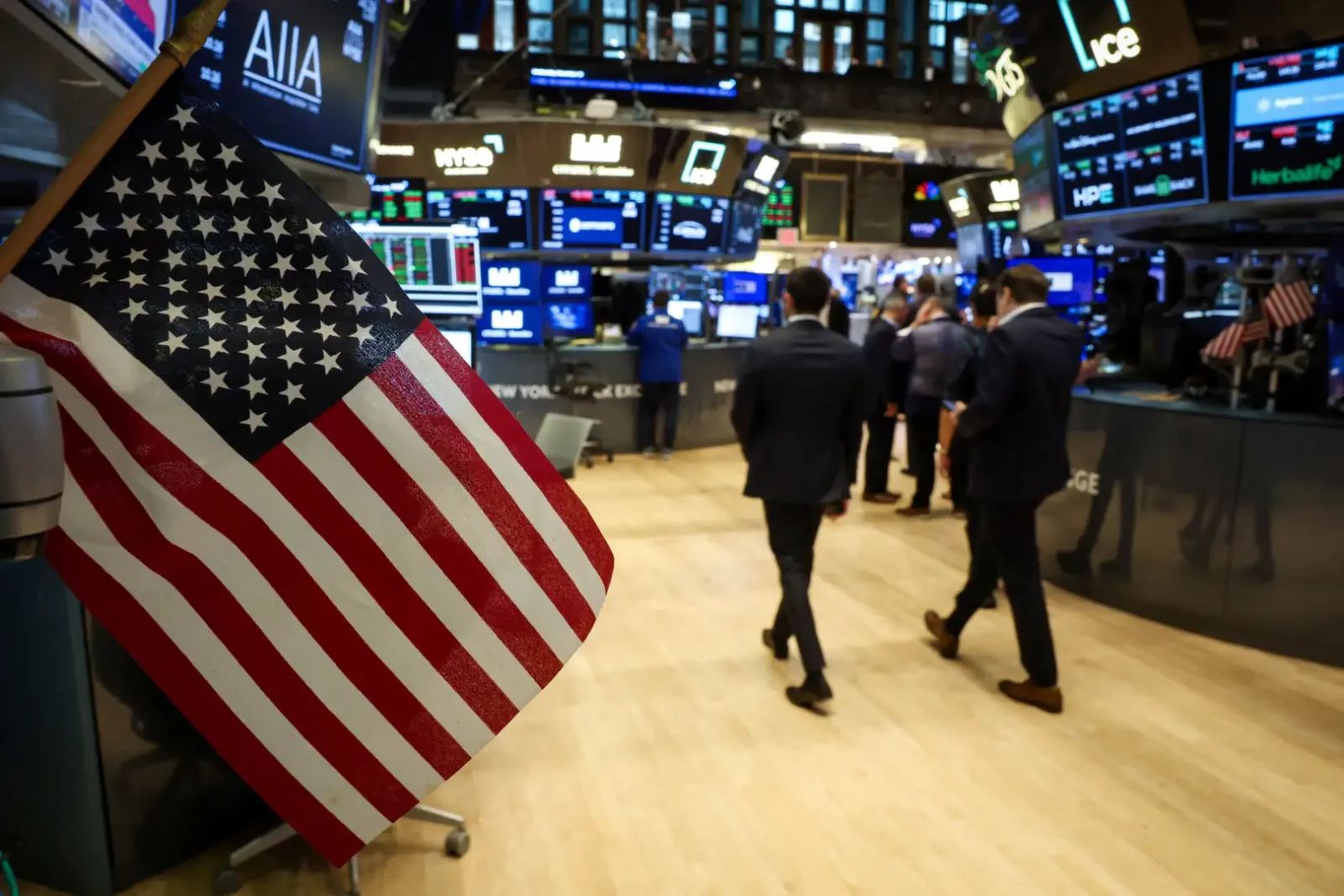
US stocks staged a powerful rebound on Monday, November 9, 2026, as plunging oil prices reduced fears of another inflation shock and encouraged investors to return to riskier assets. The Dow Jones Industrial Average gained more than 1,100 points, while the S&P 500 and Nasdaq Composite climbed more than 2%. Yet the rally came against an unsettled backdrop: uncertainty about US policy after the midterm elections, renewed scrutiny of Nvidia’s chief executive, and inflation figures that could reshape interest-rate expectations. The central question is whether cheaper energy can provide lasting relief to households and businesses, or merely a temporary pause in a volatile market.
Key Overview
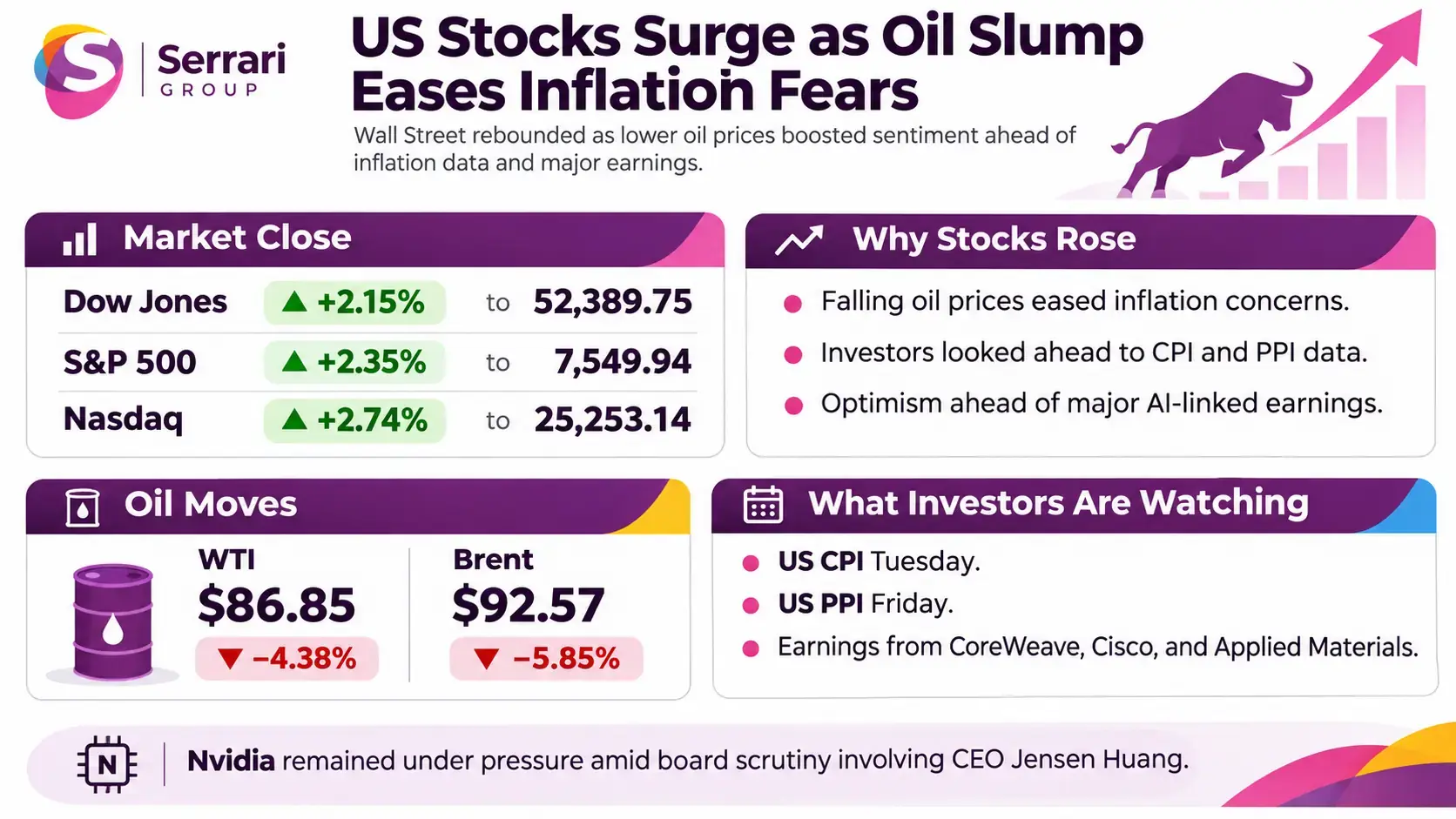
- Wall Street rebounded: The Dow rose 2.15% to 52,389.75, the S&P 500 advanced 2.35% to 7,549.94, and the Nasdaq gained 2.74% to 25,253.14.
- Crude prices tumbled: Brent settled 5.85% lower at $92.57 a barrel, while US West Texas Intermediate fell roughly 4.4% to $86.85.
- Geopolitics drove the oil move: Signals that renewed US military action against Iran was less likely reduced the immediate premium investors had placed on supply disruption.
- Nvidia remained a notable exception: Its shares dropped despite the wider rally as directors investigated reports of a foreign intelligence effort targeting CEO Jensen Huang.
- Economic data pointed to strong demand: September wholesale sales grew 2.8% month on month, outpacing a 0.7% increase in inventories.
- The next test is inflation: October consumer prices are due November 10 and producer prices November 13, with implications for the Federal Reserve’s interest-rate outlook.
Why Falling Oil Prices Triggered a Broad Market Rally
The November 9 market rebound was unusually broad. The Dow gained 1,104.02 points, the S&P 500 added 173.08 points, and the Nasdaq rose 673.71 points. Smaller companies also participated, with the Russell 2000 rising approximately 3.1%. This was not simply a rally confined to a handful of large technology stocks; investors were reassessing prospects across the economy.
The clearest catalyst was crude oil. Brent futures declined to $92.57 per barrel and West Texas Intermediate fell to $86.85, following signals of reduced US-Iran escalation. President Donald Trump’s comments suggesting further strikes on Iran were unlikely for the time being changed the balance of risks perceived by traders, although the conflict and the threat of supply disruption had not disappeared.
Oil matters well beyond energy-company profits. Higher crude prices filter into petrol, diesel, aviation fuel, freight costs and the price of moving goods through supply chains. They can squeeze household spending power while raising costs for manufacturers, airlines and retailers. A sharp fall, by contrast, can ease some of those pressures, potentially improving margins and reducing the risk that energy-driven inflation becomes more persistent.
That explains why an oil sell-off can be welcomed by equity investors even as it hurts energy producers. Companies that consume large amounts of fuel may gain from lower operating costs, while consumers may eventually have more discretionary income if cheaper crude translates into lower pump prices. The benefit is not instantaneous: retail fuel prices, transport contracts and inventories respond at different speeds, and the exchange rate or taxes may offset some savings outside the United States.
It also matters why crude fell. A decline caused by collapsing demand would be a troubling economic signal. Monday’s drop was instead closely connected to changing geopolitical expectations, giving investors more reason to interpret it as potential cost relief rather than evidence of an approaching recession. Still, the prospect of renewed fighting means that any energy-price benefit remains vulnerable to reversal.
Why Inflation Data Now Matters More Than the Rally
Cheaper oil does not automatically mean that the Federal Reserve has won its inflation battle. Energy is only one part of consumer prices, and policymakers also examine housing, services, wages and broader underlying price pressures. Investors therefore face an immediate test of whether Monday’s optimism is consistent with incoming economic data.
The official release schedule places the October consumer price index on Tuesday, November 10, followed by the producer price index on Friday, November 13. The first measures changes in prices paid by consumers; the second offers insight into price pressures faced by producers, some of which may eventually be passed along to customers.
The Federal Reserve’s policy-rate target stood at 3.75%–4.00% following its latest decision. Because inflation remained a concern, a softer-than-expected reading could help investors argue that additional monetary tightening is less necessary. A stronger reading could have the opposite effect, pushing bond yields higher and putting pressure on equity valuations.
This sensitivity is especially important for technology companies. When investors value businesses on profits expected many years into the future, higher interest rates reduce the present value of those earnings. A sudden change in rate expectations can therefore cause a disproportionate swing in growth stocks, even without any immediate change in their operating performance.
The week’s releases also matter to households and businesses. Persistently high inflation can keep borrowing expensive, limiting mortgage affordability, consumer credit demand and corporate investment. Lower inflation, if sustained without a major slowdown in employment, could create a more supportive environment for spending and investment. Monday’s rally was therefore partly a bet on an improved path for financing costs, not merely an immediate response to falling crude prices.
Wholesale Sales Show Economic Resilience, but Raise Questions
Fresh September wholesale trade figures provided another piece of evidence about the economy’s condition. Sales by merchant wholesalers increased 2.8% from August to $840.1 billion and were 19.8% above their level a year earlier. Inventories rose by a more moderate 0.7% to approximately $1.013 trillion and stood 7.6% above September 2025.
The difference between sales growth and inventory growth is important. When goods are moving through the supply chain faster than businesses are replenishing warehouses, it can indicate resilient customer demand and fewer risks from unsold stock. The inventories-to-sales ratio fell to 1.21 from 1.34 a year earlier, reinforcing the picture of relatively brisk turnover.
However, the data are reported in nominal dollars, without adjusting sales for inflation. Rising sales values do not necessarily mean that the same volume of goods increased by an equivalent percentage. Strong demand can also complicate the Federal Reserve’s job if it allows businesses to keep raising prices. As a result, the wholesale figures were encouraging for economic activity but not an unqualified argument for easier monetary policy.
For investors, the combination of solid sales and falling energy prices offers an appealing possibility: companies might maintain revenue growth while enjoying some relief on transport and other input costs. Whether that translates into stronger profits will depend on wage bills, pricing power, competition and how long the oil decline lasts.
Context is everything. Stay ahead of shifting trends with today’s market updates, and uncover emerging opportunities using the Serrari Group Market Index and Marketplace. Then, take control of your own financial future by exploring our Money & Life Reset Transformation Blueprint ™ to build stronger habits, create better systems, and design a path toward lasting wealth.
Nvidia’s Investigation Exposes a Separate AI Risk
The market’s strong technology performance masked an important divergence. Nvidia shares fell more than 4% on Monday even as the Nasdaq climbed. The chipmaker is central to the artificial-intelligence investment boom, so uncertainty around its leadership carries implications beyond one company’s share price.
In a November 8 board statement, Nvidia said independent directors and external counsel would investigate reports that CEO Jensen Huang had been targeted by a foreign intelligence effort. Crucially, the board said it had no reason to believe national security or company secrets had been compromised, expressed confidence in Huang and said he was cooperating. The reported allegations should not be confused with established findings of wrongdoing or espionage.
Why did investors react so sharply? Nvidia operates at the intersection of advanced computing, export restrictions and US-China strategic competition. Concerns about leadership, access to sensitive information or future regulatory scrutiny could affect confidence in a company whose valuation depends on sustained AI infrastructure spending. At the same time, no evidence presented in the board’s statement established that customer orders, chip deliveries or intellectual property had been compromised.
The broader market’s ability to rise without Nvidia also matters. It suggests that investors were willing to buy other semiconductor, industrial and consumer-facing companies instead of treating all technology shares as a single trade. Nevertheless, the episode highlights how heavily the AI investment story still depends on corporate governance, national-security policy and expectations for future capital expenditure.
Corporate Earnings Offer a Reality Check on Investor Optimism
Company results published alongside the rally showed how differently the same economic environment can affect sectors. Skydance reported third-quarter financial results showing $7 billion in revenue, $73 million in net earnings and approximately $1 billion in adjusted earnings before interest, taxes, depreciation and amortisation. These figures covered a period ending September 30, before its October 6 completion of the Warner Bros. Discovery acquisition, meaning they should not be interpreted as a full quarter of combined-company performance.
Take-Two Interactive, meanwhile, reported fiscal second-quarter net bookings of $1.60 billion, down 18% from a year earlier, with revenue declining to $1.50 billion. Yet the publisher reaffirmed its 8.2 billion annual bookings outlook as Grand Theft Auto VI approached its scheduled November 19 launch. For shareholders, the tension is clear: near-term results were weaker, but expectations for the upcoming release remained exceptionally high.
In energy, Occidental Petroleum’s third-quarter earnings illustrated why crude-price moves can have mixed effects. The company reported $1.6 billion in net income attributable to common shareholders and $1.91 in adjusted earnings per share from continuing operations. It also highlighted debt reduction and operating cash generation. Lower oil prices may eventually reduce producer revenues, but stronger balance sheets can help companies withstand volatility.
Investors are also awaiting earnings from AI-linked businesses including CoreWeave, Cisco and Applied Materials. Their outlooks can indicate whether spending on data centres, networking and semiconductor-manufacturing equipment remains robust after last week’s sell-off. That evidence will be important in distinguishing a sustainable improvement in market confidence from a short-lived relief rally.
The Bigger Picture: A Rebound, Not Yet an All-Clear
Monday’s advance followed a turbulent period in which investors weighed the implications of Democratic gains in the midterm elections, possible changes to AI-related policy and the cost of an extended geopolitical confrontation. The rebound demonstrated how quickly sentiment can improve when one major source of inflation anxiety eases. But it did not eliminate those political or economic risks.
Three questions will shape the next phase: whether lower oil prices persist, whether inflation readings support a less restrictive interest-rate outlook, and whether corporate earnings justify the high expectations built into parts of the equity market. A favourable answer to all three would give the recovery stronger foundations. Disappointing inflation or renewed geopolitical escalation could quickly reverse the move.
For households, the potential reward is a moderation in energy and borrowing costs. For businesses, it is relief on expenses without a sharp deterioration in demand. For investors, it is an opportunity to see whether market leadership can broaden beyond a concentrated set of AI winners. The significance of November 9 is therefore not simply that stocks surged: it is that the market briefly priced in a more manageable balance between growth, inflation and geopolitical risk, a balance that the coming data must still confirm.
Sources: Associated Press / Reuters / Financial Times / US Census Bureau / US Bureau of Labor Statistics / Federal Reserve / Nvidia / Skydance / Take-Two Interactive / Occidental Petroleum / Axios
Your financial future isn’t something you wait for—it’s something you build.
The real question is: when do you begin?
Move beyond simply staying informed.
Navigate the markets with clarity—track trends through the Serrari Group Market Index, uncover opportunities in the Serrari Marketplace, and build practical knowledge with our Curated Wealth Builder Platform.
Stay connected to what truly matters.
Get daily insights on macro trends and financial movements across Kenya, Africa, and global markets—delivered through the Serrari Newsletter.
Growth opens doors.
Advance your career through professional programs including ACCA, HESI A2, ATI TEAS 7 , HESI EXIT , NCLEX – RN and NCLEX – PN, Financial Literacy!🌟—designed to move you forward with confidence.
See where money is flowing—clearly and in real time.
Track Money Market Funds, Treasury Bills, Treasury Bonds, Green Bonds, and Fixed Deposits, alongside global and African indexes, key economic indicators, and the evolving Crypto and stablecoin landscape—all within Serrari’s Market Index.