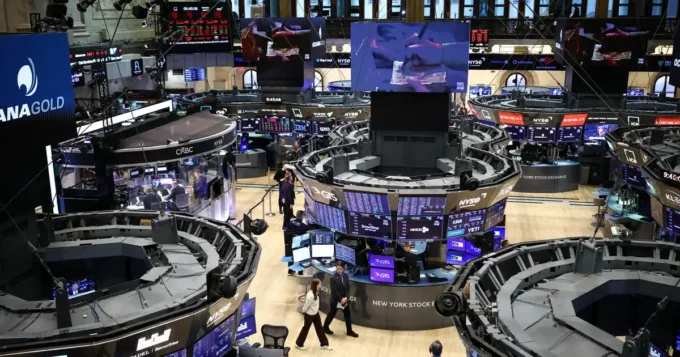






US stocks suffered a sharp reversal on November 5, 2026, as investors reassessed whether the artificial intelligence boom can sustain its extraordinary infrastructure expansion after Democrats won control of Congress and local voters endorsed restrictions on data centres. The selloff extended well beyond a political reaction: it exposed growing doubts over the electricity, financing, permitting and profitability assumptions embedded in AI-related valuations. Technology companies that depend on rapidly building computing capacity faced especially heavy losses, while the broader market absorbed the consequences of its dependence on a narrow group of high-growth stocks.
Key Overview
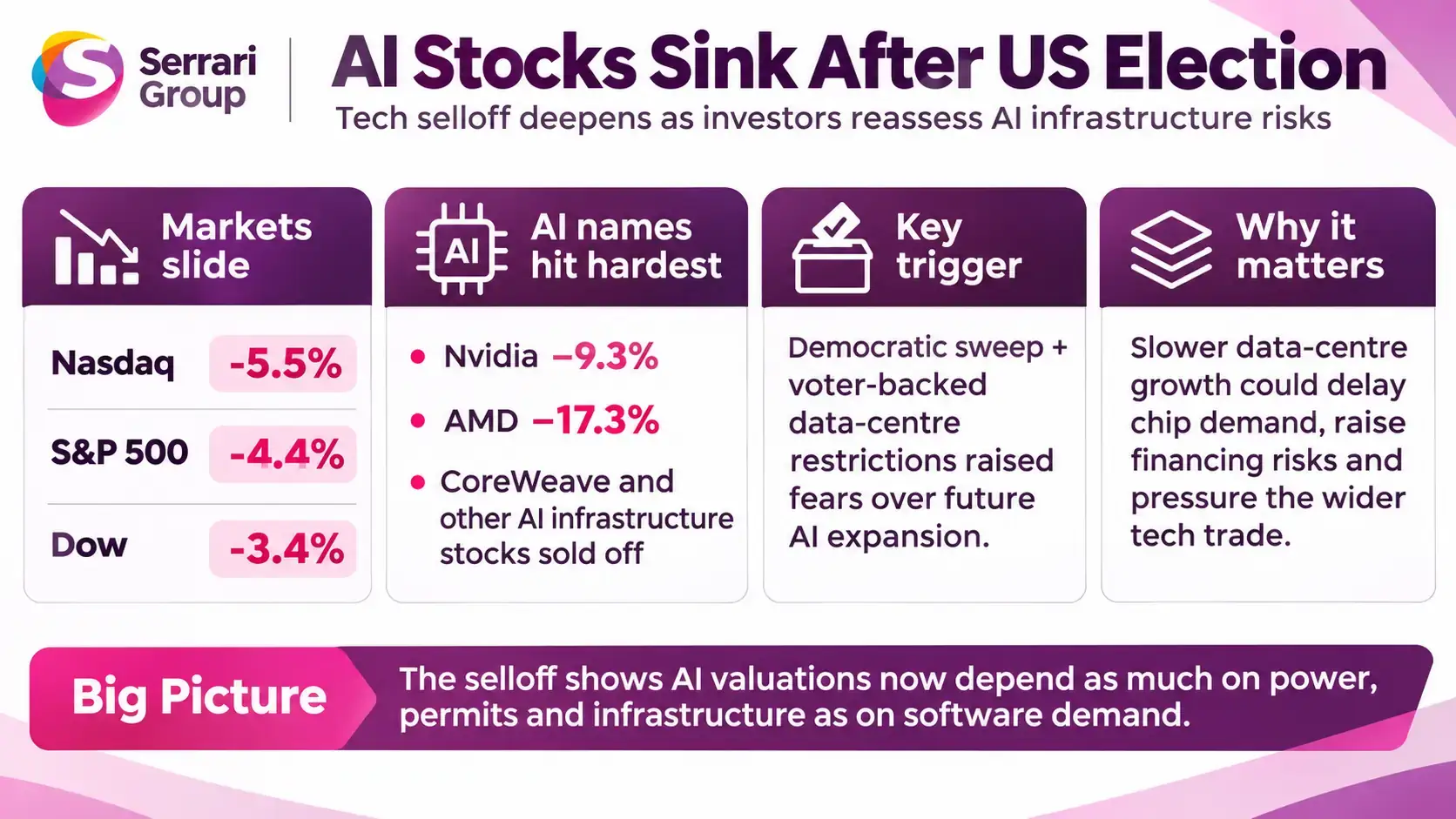
- Major indexes tumbled: The Nasdaq Composite declined approximately 5.5%, the S&P 500 4.4%, and the Dow Jones Industrial Average 3.4% at Thursday’s close, sharper than the midday declines initially reported.
- AI-linked shares led the retreat: Nvidia lost approximately 9.3%, while newer cloud-computing providers and semiconductor suppliers experienced particularly severe pressure.
- Local opposition became a market-moving risk: A 2026 ballot-measure tally showed voters favouring limits on data-centre development in 46 of 47 decided measures as of November 4.
- Future capacity is under scrutiny: Analysts estimated potential construction pauses could threaten roughly 30% of expected US data-centre capacity additions in 2028; this is a scenario, not a confirmed cancellation figure.
- The implications extend beyond technology: Electricity supply, local utility costs, construction investment, credit markets and the outlook for global technology stocks are all exposed to a slower infrastructure rollout.
Why the Election Triggered a Sharp AI Selloff
US equities entered November with enormous expectations attached to artificial intelligence. Investors had rewarded companies supplying chips, servers, computing capacity and electricity infrastructure on the assumption that spending on AI would continue accelerating for years. Those valuations reflected not only strong current demand but also the expectation that new data centres could be approved, powered, built and filled with expensive equipment on schedule.
The November 3 midterm elections challenged that assumption. Democrats won control of both chambers of Congress, adding the prospect of more oversight of AI development and of companies with political ties to the outgoing Republican congressional majority. More immediately, a series of local election results revealed how strongly communities had begun pushing back against energy-intensive data centres.
The immediate market response was not straightforward. US stocks initially rallied on November 4 as election results clarified the political landscape and reduced uncertainty over the transfer of congressional power. By Thursday, however, investors had moved from celebrating political clarity to calculating what the results could mean for particular industries. Shares linked to AI infrastructure bore the brunt of that reassessment.
The reversal is evident in the November 5 closing market figures. The Nasdaq lost about 5.5%, the S&P 500 fell 4.4%, and the Dow retreated 3.4%. The broad selloff suggests the concern was bigger than a temporary reaction to one election result: it challenged a growth narrative that had supported a substantial part of the market’s gains.
The election did not itself impose a nationwide ban on AI infrastructure. Congressional control, local ballot decisions and future regulatory action are separate matters. What changed was the market’s assessment of the probability, duration and cost of restrictions. A project that still gets built but starts a year later can generate significantly different financial returns for its investors and lenders.
Voters Are Challenging the Physical Cost of AI Expansion
Public resistance to data centres matters because AI is not only a software business. Large AI systems require server buildings, cooling systems, high-capacity electrical connections, land and often substantial water resources. Their construction can require local zoning approval, grid connections and infrastructure investment that competes with other community priorities.
The local ballot results provide a striking indication of public sentiment. As of November 4, 46 of 47 decided data-centre-related measures had outcomes favouring limits on development, while Harwood, North Dakota, rejected additional review requirements. These results cannot all be described as votes to prohibit AI: the measures differed, and some restricted development by rejecting proposals that would have facilitated it. Nevertheless, the overall pattern showed that resistance had become geographically widespread and politically consequential.
Why are voters concerned? Electricity is a central issue. A large facility can add substantial demand to an already constrained power network. Local residents may worry about who pays for grid upgrades, whether rising demand will affect household electricity bills, and whether capacity reserved for data centres could delay connections for homes and businesses. Noise, water use, land conversion and the relatively limited number of permanent jobs at highly automated facilities can intensify opposition.
This pressure did not arise in isolation. The latest analysis of US electricity demand describes how data centres have helped accelerate electricity consumption after a lengthy period of relatively modest growth. More demand can be commercially attractive for utilities, but only if generation, transmission and distribution systems can expand quickly enough and the costs are allocated fairly.
For technology companies, political opposition therefore introduces an operational problem. The key question is no longer just whether a developer can afford thousands of powerful chips. It is whether the developer can secure an acceptable site, a timely grid connection and durable local approval at a predictable cost.
Why Chipmakers and New Cloud Providers Were Hit Hardest
The selloff was particularly painful for businesses whose future revenues depend on an uninterrupted chain of new AI construction. Nvidia’s shares fell approximately 9.3%, while Advanced Micro Devices lost about 17.3%, as investors questioned the pace at which customers would take delivery of advanced processors and supporting systems. The closing-day account of the market rout also recorded a sharp drop in shares of electricity-equipment supplier GE Vernova.
For chipmakers, the economic relationship is relatively direct. If a new data centre is delayed, orders for processors, memory chips, networking equipment and servers may be postponed. Demand is not necessarily eliminated, but revenue recognition and cash flow can shift further into the future. Because share valuations often anticipate rapid sales growth, even a delay can prompt a disproportionate fall in market prices.
The damage can be more serious for specialised AI cloud providers, sometimes called neoclouds. These companies finance expensive computing infrastructure and rent capacity to AI developers and large technology customers. Many depend on substantial borrowing or long-term contracts to make the economics work. A construction delay can leave financing costs accruing before the facilities generate revenue.
CoreWeave and Nebius were among the names that weakened sharply. Their earlier exposure to election-related concerns illustrated a broader investor distinction: established technology giants may have diversified cash flows and operating campuses, whereas smaller infrastructure specialists often have a greater share of their future value tied to projects still under development.
The risk is magnified when financing is expensive. A company may be able to absorb a temporary delay operationally but still face pressure on debt-servicing costs, investor confidence and its ability to raise fresh capital. Investors are consequently asking not just how much AI capacity businesses plan to build, but how much of that capacity will be profitable after power, equipment, debt and construction expenses.
Context is everything. Stay ahead of shifting trends with today’s market updates, and uncover emerging opportunities using the Serrari Group Market Index and Marketplace. Then, take control of your own financial future by exploring our Money & Life Reset Transformation Blueprint ™ to build stronger habits, create better systems, and design a path toward lasting wealth.
The AI Investment Boom Faces a Financing Reality Check
Industry demand has not disappeared. AI model development, enterprise automation and cloud services continue to create incentives for more computing infrastructure. Yet rapid demand growth does not guarantee that every proposed campus or financing structure will deliver attractive returns.
The updated global energy outlook projects that data-centre electricity consumption could roughly double from 485 terawatt-hours in 2025 to 950 terawatt-hours by 2030. The projection demonstrates the potential scale of expansion, but also the pressures that expansion will place on power networks, supply chains and investment budgets.
An important distinction is that the outlook describes a possible energy trajectory, not a guarantee that all announced US projects will come online on their original schedules. Demand for computing can remain strong while construction bottlenecks delay delivery and alter which companies benefit financially.
Analysts at UBS estimated that possible construction pauses could put around 30% of anticipated US data-centre capacity additions in 2028 at risk. The estimate reported during the selloff should be understood as an assessment of exposure to delays, not proof that nearly one-third of the projects have been cancelled.
This distinction matters for investors. A delay could temporarily reduce orders and raise financing costs even when a facility eventually opens. A cancellation would have more permanent consequences. The difference determines whether the market is pricing a short-term earnings interruption or a structural reduction in the industry’s growth potential.
It also affects banks, bondholders and private credit funds that finance construction. Expensive infrastructure is increasingly dependent on outside capital, making interest rates, lending terms and investor risk appetite major determinants of how quickly the AI economy can expand. The election results have therefore intersected with an existing debate over whether heavy AI capital expenditure will translate into sufficient profits.
Tesla and SpaceX Highlight the Political Dimension
The repricing also reached Elon Musk’s publicly traded companies. Tesla and SpaceX declined sharply as investors examined whether Democratic victories, particularly in Texas, could increase oversight or complicate projects involving AI, energy and transportation. SpaceX has traded publicly since its June 2026 initial public offering.
Musk’s considerable spending in the midterms added to scrutiny of his political exposure. The review of his election expenditures put his support for Republicans at no less than $445 million, while Democrats won several contests in which he had backed opposing candidates.
These share-price losses should not be interpreted as evidence that election results immediately reduced each company’s operating income. Rather, investors were attaching a higher probability to regulatory scrutiny, uncertainty over future business arrangements and delays affecting ambitious infrastructure plans. Discussion of a potential Tesla–SpaceX merger creates another possible area of political and antitrust uncertainty, although a proposed transaction is not the same as an approved or completed deal.
Why Ordinary Consumers and Global Investors Should Care
For US households, the central issue is how the costs and benefits of AI expansion are distributed. Rapid construction can create jobs, investment and demand for electrical equipment, but communities may resist if they expect to shoulder higher utility costs or infrastructure burdens without corresponding local benefits. Regulatory scrutiny can potentially improve cost allocation and accountability, even if it delays investment.
For pension funds and individual investors, the selloff exposes concentration risk. When a relatively small collection of technology companies drives a large share of equity-market gains, disappointing news for that group can pull down diversified benchmark indexes. People who do not directly own Nvidia or a specialist cloud provider may still have indirect exposure through retirement plans, exchange-traded funds and global equity portfolios.
International markets are exposed through interconnected supply chains. Asian semiconductor manufacturers, European electrical-equipment businesses, energy producers and construction suppliers all depend to varying degrees on the pace of US technology investment. A sustained slowdown could change export orders, commodity demand and capital flows across borders.
The flight toward defensive assets underscores the broader adjustment in risk appetite. Gold reached a more than two-week high on Thursday as investors weighed weaker US yields and the dollar alongside political and market uncertainty. Such moves do not establish a permanent shift away from equities, but they show how quickly confidence can move when a popular investment theme encounters new risks.
What Happens Next for AI Stocks?
The November 5 selloff does not prove that AI investment is ending. What it reveals is a more demanding market. Investors will increasingly distinguish between companies with functioning, profitable AI infrastructure and those whose projected returns rely on facilities that still need permits, grid connections, financing and customers.
Three developments are particularly important: whether newly elected officials turn campaign promises into enforceable data-centre restrictions; whether utilities and developers can reach agreements that protect households from disproportionate costs; and whether technology companies can demonstrate that AI services generate enough revenue to justify the infrastructure being built.
There may also be an adjustment within the industry. Developers able to secure grid access and local support could gain an advantage over competitors forced to redesign or postpone projects. Existing data centres may become more valuable where approvals for new capacity grow harder to obtain. More efficient chips, cooling systems and software could also help companies generate more computing output from constrained electricity supplies.
The bigger story is that AI has entered a stage in which physical infrastructure and political consent matter as much as algorithms. The election changed expectations because it made those constraints more visible and potentially more expensive. For markets, the question is no longer simply how fast artificial intelligence can grow, but how reliably and profitably that growth can be delivered.
Sources: Associated Press / Reuters / Ballotpedia / International Energy Agency / US Energy Information Administration / SpaceX Investor Relations / Channel News Asia / Euronext / Fidelity
Your financial future isn’t something you wait for—it’s something you build.
The real question is: when do you begin?
Move beyond simply staying informed.
Navigate the markets with clarity—track trends through the Serrari Group Market Index, uncover opportunities in the Serrari Marketplace, and build practical knowledge with our Curated Wealth Builder Platform.
Stay connected to what truly matters.
Get daily insights on macro trends and financial movements across Kenya, Africa, and global markets—delivered through the Serrari Newsletter.
Growth opens doors.
Advance your career through professional programs including ACCA, HESI A2, ATI TEAS 7 , HESI EXIT , NCLEX – RN and NCLEX – PN, Financial Literacy!🌟—designed to move you forward with confidence.
See where money is flowing—clearly and in real time.
Track Money Market Funds, Treasury Bills, Treasury Bonds, Green Bonds, and Fixed Deposits, alongside global and African indexes, key economic indicators, and the evolving Crypto and stablecoin landscape—all within Serrari’s Market Index.