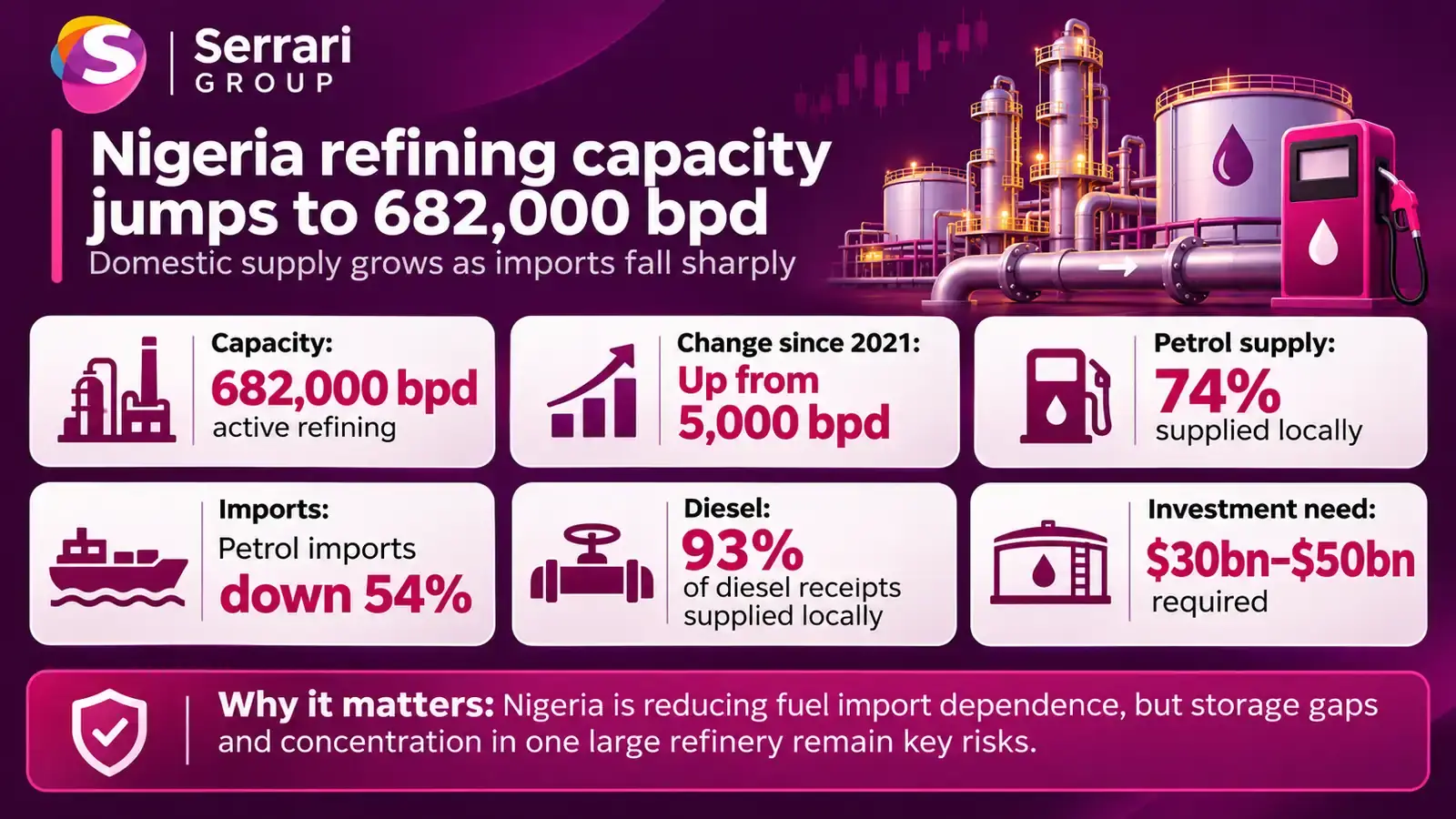
Nigeria’s active crude oil refining capacity has increased from 5,000 barrels per day in 2021 to 682,000 barrels per day in 2026, according to the Nigerian Midstream and Downstream Petroleum Regulatory Authority (NMDPRA). The expansion, equivalent to a 13,540% increase, is shifting the country’s fuel supply towards domestic production. However, weak storage buffers, dependence on a major refinery and substantial investment requirements remain risks to long-term energy security.
Key Overview
- Refining capacity: Active capacity rose to 682,000 barrels per day, from 5,000 in 2021.
- Petrol supply: Domestic refineries supplied approximately 74% of the market in September 2026, compared with 44% a year earlier.
- Petrol imports: Daily imports dropped 54%, from 22.1 million litres to 10.2 million litres.
- Diesel and gas: Local refineries supplied 93% of September diesel receipts, while LPG supply rose 50% from 2021 levels.
- Investment gap: The regulator estimates 30billion–50 billion is needed for further oil and gas infrastructure development.
Refining Expansion Reshapes Nigeria’s Fuel Market
NMDPRA chief executive Rabiu A. Umar outlined the refining gains at the 20th OTL Africa Downstream Energy Week in Lagos, linking the shift to changes since the Petroleum Industry Act took effect in 2021.
The increase from 5,000 to 682,000 barrels daily is a measure of active refining capacity, rather than the total design capacity of all Nigerian refineries. The distinction matters because several older government-owned refineries have undergone prolonged rehabilitation or remained offline. The country’s refinery profile identifies the 650,000-barrel-per-day Dangote refinery as a central contributor to domestic processing capacity.
The regulator said locally refined petrol accounted for around 74% of supply in September 2026, up from approximately 44% in September 2025. Petrol imports declined from 22.1 million to 10.2 million litres per day, reducing dependence on overseas refined fuel and exposure to international shipping disruptions.
Dangote Concentration Raises Supply Risks
Despite the gains, the regulator warned that a large proportion of domestic petrol supply comes from a single major refinery. Umar said that facility operated above its nameplate capacity during September, while domestic petrol availability fell from an August peak as exports increased.
Heavy reliance on one producer creates vulnerability to maintenance shutdowns, operational problems and changes in commercial supply decisions. The regulator plans to support smaller modular refineries and cooperate with the Nigerian National Petroleum Company to restore facilities in Port Harcourt, Warri and Kaduna.
Nigeria also intends to maintain a competitive import market, with licences issued to qualifying operators under published criteria. Imports therefore remain a potential supply buffer rather than being eliminated entirely.
Context is everything. Stay ahead of shifting trends with today’s market updates, and uncover emerging opportunities using the Serrari Group Market Index and Marketplace. Then, take control of your own financial future by exploring our Money & Life Reset Transformation Blueprint ™ to build stronger habits, create better systems, and design a path toward lasting wealth.
Diesel, Cooking Gas and CNG Infrastructure Grow
Domestic refineries supplied approximately 93% of diesel receipts in September, while local aviation-fuel receipts also increased, according to the reported regulatory presentation.
Liquefied petroleum gas (LPG) supply expanded from 1.2 million metric tonnes in 2021 to 1.8 million tonnes, a 50% increase. Compressed natural gas (CNG) compression facilities increased from 17 to 43, while CNG and liquefied natural gas autogas stations grew from 16 to 101.
These developments support efforts to broaden Nigeria’s energy supply beyond petrol and diesel, although infrastructure growth alone does not establish affordability or universal access for households and businesses.
Stock Shortfalls Expose Infrastructure Gaps
Fuel storage remains a major weakness. Petrol inventories provided approximately 24 days of cover in September, below the 30-day threshold cited by the regulator, while LPG reserves covered only 15.9 days. NMDPRA is targeting 30–45 days of product sufficiency through stronger logistics, storage and supply planning.
A proposed strategic stock programme with the national oil company would begin at depots in Ibadan, Enugu and Suleja. The regulator is also pursuing stronger domestic crude supply arrangements through the Domestic Crude Supply Obligation and Naira-for-Crude initiative.
Up to $50 Billion Needed for Further Expansion
Umar estimates that Nigeria requires 30billion–50 billion in additional oil and gas investment to expand refining and processing, fertiliser output, LPG infrastructure and flare-gas commercialisation. Storage depots, jetties, coastal shipping and pipeline rehabilitation are among the potential areas for private investment and public-private partnerships.
The investment requirement is an estimate, not funding already secured. Nigeria’s ambition to become a regional refining hub will depend on reliable crude supply, operating capacity, distribution networks and sufficient fuel reserves. The near-term test is whether higher domestic output translates into stable availability and competitive prices.
Sources: Nigerian Tribune / Nigerian Midstream and Downstream Petroleum Regulatory Authority / Africa Business Insight / US Energy Information Administration / OTL Africa / Mulagist
Your financial future isn’t something you wait for—it’s something you build.
The real question is: when do you begin?
Move beyond simply staying informed.
Navigate the markets with clarity—track trends through the Serrari Group Market Index, uncover opportunities in the Serrari Marketplace, and build practical knowledge with our Curated Wealth Builder Platform.
Stay connected to what truly matters.
Get daily insights on macro trends and financial movements across Kenya, Africa, and global markets—delivered through the Serrari Newsletter.
Growth opens doors.
Advance your career through professional programs including ACCA, HESI A2, ATI TEAS 7 , HESI EXIT , NCLEX – RN and NCLEX – PN, Financial Literacy!🌟—designed to move you forward with confidence.
See where money is flowing—clearly and in real time.
Track Money Market Funds, Treasury Bills, Treasury Bonds, Green Bonds, and Fixed Deposits, alongside global and African indexes, key economic indicators, and the evolving Crypto and stablecoin landscape—all within Serrari’s Market Index.