
Micron Technology reported record fiscal fourth-quarter 2026 revenue and earnings as demand for memory chips used in artificial intelligence pushed its core data center business to more than 11 times its year-earlier sales. The US semiconductor manufacturer also issued stronger-than-expected guidance for the next quarter, signalling that investment in AI computing infrastructure continues to support chip pricing and demand.
Key Overview
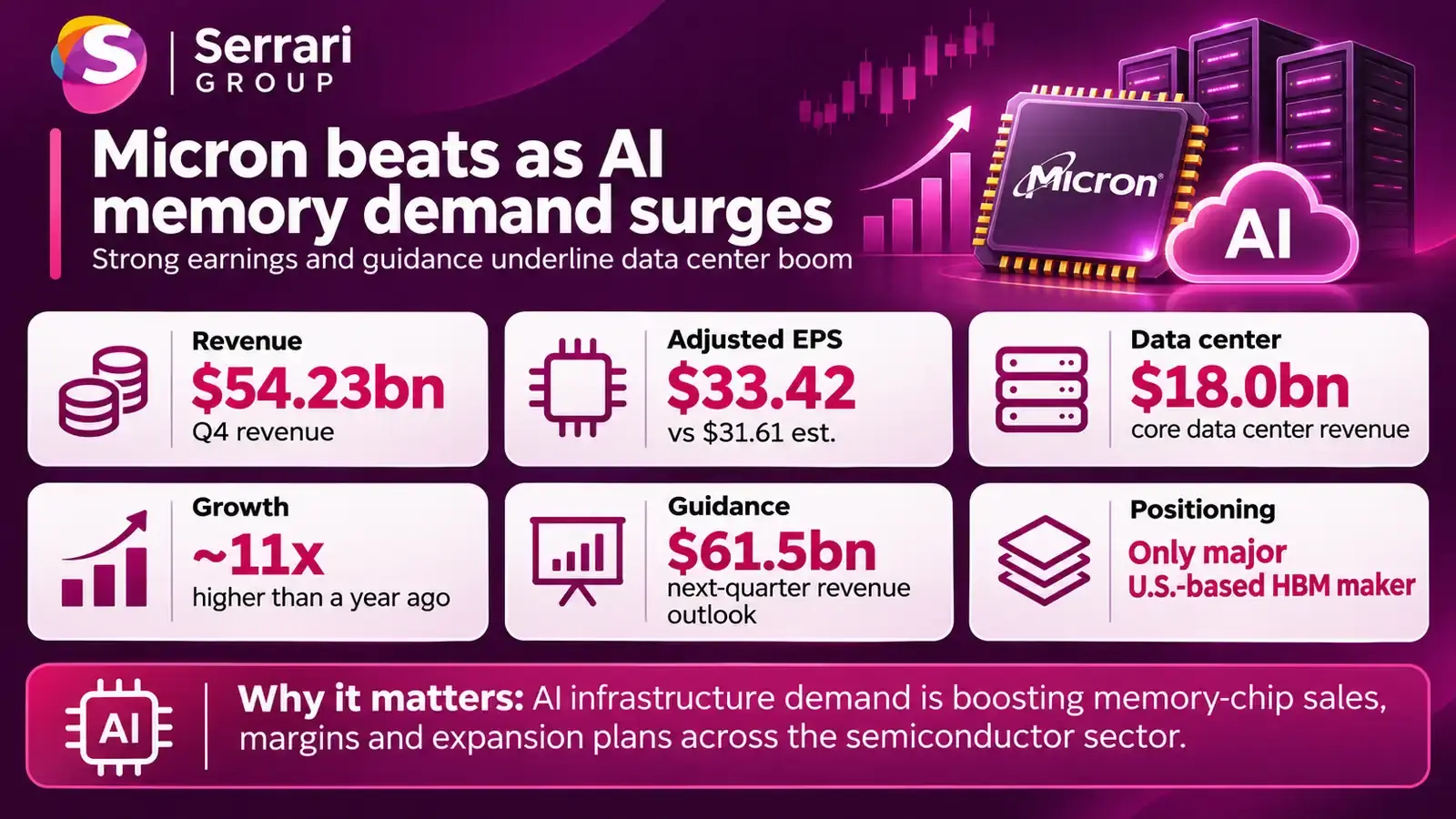
- Quarterly revenue reached $54.23 billion, up from $11.32 billion a year earlier and above analysts’ $51.07 billion estimate.
- Adjusted earnings per share were $33.42, ahead of the $31.61 consensus estimate.
- Core Data Center revenue climbed to $18.00 billion from $1.58 billion a year earlier, an increase of approximately 11.4 times.
- Fiscal first-quarter 2027 guidance called for approximately $61.5 billion in revenue and adjusted EPS of $38.15.
- US manufacturing and technology investments are planned to exceed $250 billion through 2035.
Record Earnings Reflect AI Memory Demand
Micron’s fiscal fourth-quarter results, released September 30, showed revenue rising nearly fivefold year on year to $54.23 billion. Adjusted net income reached $38.40 billion, while net income under generally accepted accounting principles stood at $37.70 billion, or $32.87 per diluted share.
The company reported $39.8 billion in DRAM revenue, reflecting the growing importance of memory chips alongside processors in AI servers. DRAM, or dynamic random-access memory, is used in computing systems, while high-bandwidth memory (HBM) stacks specialised DRAM chips to move data rapidly between processors and memory.
Micron’s Core Data Center Business Unit posted $18.00 billion in revenue, compared with $1.58 billion a year earlier. Its 90% gross margin showed how tight supply and demand for advanced memory are reshaping profitability. The broader Cloud Memory Business Unit generated $16.28 billion in quarterly revenue.
Context is everything. Stay ahead of shifting trends with today’s market updates, and uncover emerging opportunities using the Serrari Group Market Index and Marketplace. Then, take control of your own financial future by exploring our Money & Life Reset Transformation Blueprint ™ to build stronger habits, create better systems, and design a path toward lasting wealth.
Stronger Guidance Points to Continued Expansion
For the first quarter of fiscal 2027, Micron projected revenue of $61.5 billion, plus or minus $1.5 billion, and non-GAAP diluted EPS of $38.15, plus or minus $1. Analysts cited in the original report had expected about $57 billion in revenue and $35.40 in adjusted EPS.
Management expects demand for AI infrastructure to remain an important growth driver, with advanced memory increasingly required by graphics processors and AI accelerators. The forecast nevertheless remains subject to customer spending, supply constraints and the semiconductor industry’s historically cyclical pricing.
For the full fiscal year, Micron generated record revenue of $133.19 billion, compared with $37.38 billion in fiscal 2025. Its net cash provided by operating activities reached $89.68 billion, giving the company financial capacity to fund its manufacturing expansion.
Micron Expands US Manufacturing Footprint
Micron has announced more than $250 billion in planned US investments in manufacturing and technology through 2035. The programme includes major semiconductor projects in New York and Idaho, rather than only two manufacturing campuses.
Construction at its Clay, New York, site advanced after a January 2026 groundbreaking and a first concrete pour in July. In Boise, Idaho, the first new manufacturing facility is scheduled to begin producing DRAM wafers around mid-2027, followed by a second facility targeted for late 2028, according to the company’s annual regulatory filing.
The expansion seeks to increase domestic memory-production capacity as Micron competes with South Korean manufacturers SK Hynix and Samsung in high-performance memory. Greater production capacity may eventually ease supply constraints, although construction timelines, engineering complexity and equipment availability remain significant risks.
What the Results Mean for Investors and the AI Industry
Micron’s earnings underscore how AI investment is benefiting suppliers beyond the makers of graphics processors. Memory capacity and bandwidth have become critical to training and running increasingly large AI models, supporting revenue growth and margins across the sector.
However, an exceptional earnings cycle can also raise investor expectations. Micron’s ability to sustain profitability will depend on whether AI infrastructure spending continues to absorb new supply, whether competitors expand faster than demand and how effectively the company executes its capital-intensive projects.
Sources: Micron Technology / US Securities and Exchange Commission / CNBC / Reuters
Your financial future isn’t something you wait for—it’s something you build.
The real question is: when do you begin?
Move beyond simply staying informed.
Navigate the markets with clarity—track trends through the Serrari Group Market Index, uncover opportunities in the Serrari Marketplace, and build practical knowledge with our Curated Wealth Builder Platform.
Stay connected to what truly matters.
Get daily insights on macro trends and financial movements across Kenya, Africa, and global markets—delivered through the Serrari Newsletter.
Growth opens doors.
Advance your career through professional programs including ACCA, HESI A2, ATI TEAS 7 , HESI EXIT , NCLEX – RN and NCLEX – PN, Financial Literacy!🌟—designed to move you forward with confidence.
See where money is flowing—clearly and in real time.
Track Money Market Funds, Treasury Bills, Treasury Bonds, Green Bonds, and Fixed Deposits, alongside global and African indexes, key economic indicators, and the evolving Crypto and stablecoin landscape—all within Serrari’s Market Index.